


The difference between preferred shares and common stock is not a legal technicality. It determines who gets paid first in an exit, how much dilution common holders actually absorb, and whether your headline valuation means anything to the people holding options.
If you are negotiating a term sheet or building your next fundraise model, the decision that matters is which liquidation preference structure, participation rights, and conversion terms you accept, because those terms - not the valuation number in the press release - decide the actual payout math for founders and employees. J.P. Morgan's founder guide to preferred vs. common stock makes the same point: the structure of that capital, not just the amount, has lasting consequences.
Key takeaways
- Preferred stock carries contractual rights (liquidation preference, anti-dilution, board seats, protective provisions) that common stock does not have.
- Common stock is what founders and employees typically hold; preferred stock is what investors typically receive in exchange for capital.
- A 1x non-participating liquidation preference is the market standard for venture rounds; participating preferred and multiple preferences are red flags worth pushing back on.
- Below the "conversion point" in an exit, preferred stock takes its liquidation preference off the top. Above it, preferred converts to common and shares pro rata.
- Founders should model exit proceeds at three or four valuation scenarios before signing a term sheet, not just at the scenario the investor pitches.
- 1% equity is not a fixed answer. It only means something once you attach it to a share class, a fully diluted share count, and a realistic exit range.
What we'll cover
This piece walks through the mechanics you need before your next round or your next hire negotiates for equity: what separates preferred from common, how to calculate payouts under different preference structures, how to read a term sheet's liquidation stack, what to negotiate, the mistakes that quietly cost founders millions at exit, and a practical way to model it yourself.
The core concept: two share classes with very different claims on the same company
A startup's cap table usually has two broad categories of stock, and they are not interchangeable.
Common stock is the base equity class. Founders typically hold common stock at formation. Employees receive common stock (or options that convert to common stock) through equity compensation plans. Common stock has voting rights but no special financial protections. If the company is sold or liquidated, common stockholders get paid last, after every other claim is satisfied.
Preferred stock is what institutional investors receive in exchange for capital in a priced round. Preferred stock is "preferred" because it sits ahead of common stock in the payout order and usually carries a package of negotiated rights:
- A liquidation preference (a guaranteed minimum return before common stock gets anything)
- Anti-dilution protection (adjusts the investor's price per share if you raise a future round at a lower valuation)
- Board representation or board observer rights
- Protective provisions (veto rights over major decisions like selling the company, raising debt, or issuing new stock)
- Pro rata rights to maintain ownership percentage in future rounds
- Sometimes a conversion right, letting the holder choose to convert preferred shares into common shares if that produces a better outcome
As Carta's comparison of common and preferred stock lays out, preferred shares are designed to give investors security, predictability, and flexibility that common stock does not offer — which is exactly why VCs insist on them.
The single most consequential term for founders is the liquidation preference, because it directly determines how exit proceeds get split.
The three liquidation preference structures you will actually see
| Structure | How it pays out | Founder impact |
|---|---|---|
| 1x non-participating | Preferred holder gets the greater of (a) 1x their investment back, or (b) their pro rata share as if converted to common. Not both. | Market standard. Fair to both sides at most exit values. |
| 1x participating | Preferred holder gets 1x their investment back, then ALSO participates pro rata in the remaining proceeds alongside common. | Double-dips. Meaningfully worse for founders and employees, especially at lower exit values. |
| Multiple preference (2x, 3x) | Preferred holder gets 2x or 3x their investment back before anyone else sees a dollar. | Rare in healthy markets, common in down rounds or distressed financings. A serious red flag. |
If you take one number away from this section, take this: 1x non-participating is the term you should be defending. Everything above that shifts economics away from founders and employees without a corresponding increase in the capital you're raising. Fenwick & West's Silicon Valley venture capital survey consistently shows that non-participating preferred dominates Bay Area deal terms, with full participating preferred appearing in only a small fraction of recent financings.
How to calculate the payout: the liquidation waterfall
The math is not complicated once you separate it into steps. Here is the sequence a liquidation waterfall actually follows in an exit or dissolution:
- Debt and liabilities get paid first - any outstanding loans, venture debt, or accrued obligations.
- Preferred stock liquidation preferences get paid next, in order of seniority (later rounds are usually senior to earlier rounds unless the term sheet says otherwise).
- Preferred stock decides whether to convert. Each preferred holder compares their guaranteed preference payout to what they would get if they converted to common stock and took their pro rata share of everything. They take whichever number is larger.
- Remaining proceeds get split among common stockholders (founders, employees, and any preferred holders who converted).
Carta's guide to liquidation preferences classifies these terms as standard or non-standard and breaks down how seniority stacking works across multiple preferred series — worth reviewing before you model your own waterfall.
Worked example
Assume a company raised $10 million in a Series A for 20% fully diluted ownership, with a standard 1x non-participating liquidation preference and no participation rights. Common stock (founders and employee option pool) holds the remaining 80%.
- Exit at $20 million: Preferred's as-converted share would be 20% x $20M = $4M. That's less than their $10M preference, so they take the $10M preference instead. Common stockholders split the remaining $10M.
- Exit at $60 million: Preferred's as-converted share would be 20% x $60M = $12M. That's more than the $10M preference, so preferred converts. Common stockholders take the remaining $48M.
- Exit at $150 million: Preferred's as-converted share is 20% x $150M = $30M. Preferred converts, and common takes $120M.
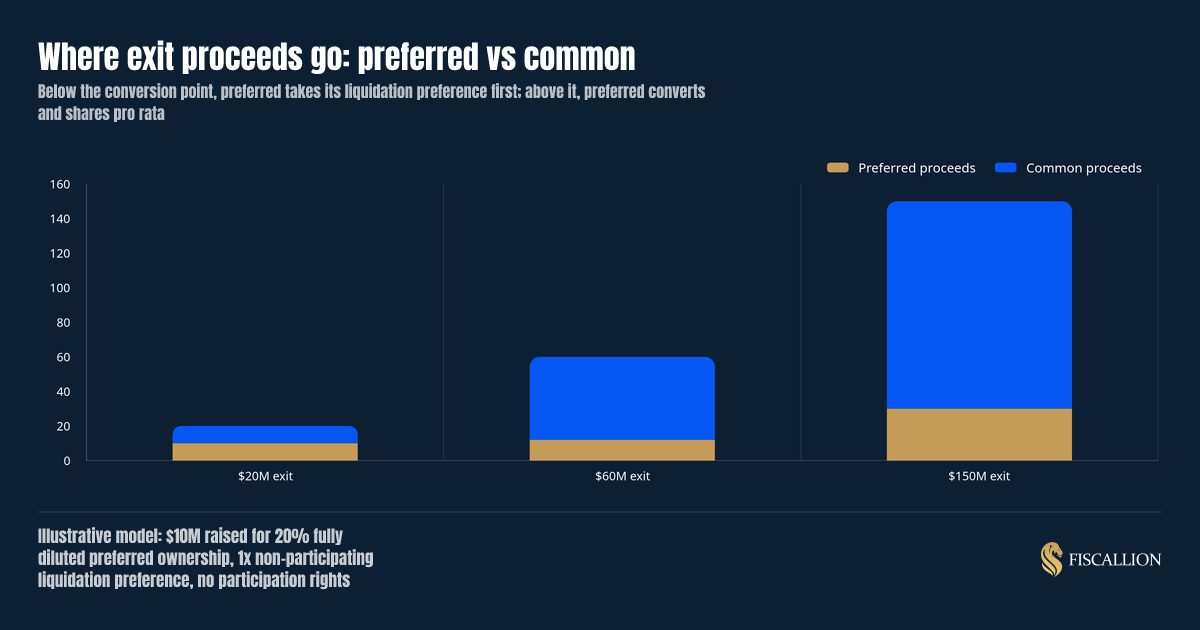
Notice the crossover point in this example sits right around a $50 million exit, which is exactly where the preference stops mattering and pro rata ownership takes over. That crossover point is the number you should calculate for your own cap table before every fundraise, not after a term sheet lands in your inbox. It tells you the exit value below which your liquidation preference stack determines outcomes, and above which ownership percentage does.
This is the same discipline we push in FP&A for startups: the decision-grade framework for $5-50M ARR - model the range of outcomes, not the one number that looks best in the deck.
How to interpret the waterfall: what changes at each exit value
A single liquidation preference number tells you almost nothing on its own. What matters is where your projected exit range sits relative to your total liquidation preference stack.
| Exit scenario relative to preference stack | What it means for common stockholders |
|---|---|
| Exit well below the total preference stack | Common stock (founders, employees) may get little or nothing. This is the scenario that makes acquihires and "soft landings" painful for employees. |
| Exit near the total preference stack | Preferred takes most or all proceeds off the top. Founders and employees get a small residual, if anything. |
| Exit above the total preference stack but below the conversion point | Preferred still takes the fixed preference rather than converting, because it's still the larger number. |
| Exit above the conversion point | Preferred converts to common. Everyone shares pro rata based on ownership percentage, not preference terms. |
The practical takeaway: as you stack multiple rounds of preferred stock (seed, Series A, Series B, Series C), your total liquidation preference stack grows, and the exit value required before common stockholders see meaningful proceeds rises with it. A company that raised $40 million in preferred capital across four rounds needs a materially larger exit before founders and employees clear the preference stack than a company that raised $15 million.
This is why "what's my equity worth" is the wrong question for an employee or founder to ask in isolation. The right question is: at what exit value does my share class start getting paid, and how likely is that exit value given the current growth trajectory?
What to do next: three moves before your next round or hire
1. Model your own liquidation waterfall before every fundraise.
Do not rely on the investor's summary of the term sheet. Build (or have your finance partner build) a waterfall model across three or four exit scenarios: a disappointing exit, a base case, a strong case, and a break-out case. See where the conversion point falls in each.
2. Negotiate liquidation preference terms as hard as you negotiate valuation.
A higher valuation paired with 1x participating preferred can be worse for founders than a lower valuation with clean 1x non-participating terms. Founders who only optimize for the headline valuation number are optimizing for the wrong variable. SVB's primer on preferred stock makes the same observation: founders fixated on maximizing valuation can trade away favorable liquidation preference terms without realizing the downstream cost.
3. Communicate real numbers to employees receiving equity, not just percentages.
An employee equity grant means very little without knowing the strike price, the total liquidation preference stack ahead of it, and the fully diluted share count. If you cannot answer those three questions cleanly for a candidate, your cap table reporting has a gap that will surface at the worst possible moment: during a competing offer negotiation or, worse, during an actual exit.
Fiscallion works with SaaS leadership teams on exactly this kind of decision-grade modeling, translating cap table structure and fundraise terms into the same cash, runway, and trade-off language used for headcount and pricing decisions, so a term sheet gets evaluated on real payout math instead of the valuation headline.
Common mistakes and the better move
Mistake: Treating valuation as the only negotiating lever.
Founders often accept aggressive liquidation preference terms in exchange for a higher headline valuation, because the valuation number is what gets repeated in the press release and to the team.
Better move: Negotiate the liquidation preference structure and participation rights with the same intensity as the price per share. A "clean" term sheet at a lower valuation frequently outperforms a "rich" term sheet with participating preferred once you run the waterfall.
Mistake: Not modeling the conversion point before granting employee equity.
Teams promise equity percentages without checking where that share class sits in the liquidation stack, which produces awkward conversations later when an acquisition offer arrives below the preference stack total.
Better move: Run the waterfall at the time of the grant and revisit it at every subsequent round, since each new preferred round can push the conversion point higher.
Mistake: Letting anti-dilution and protective provisions go unread.
Founders focus on liquidation preference and skip the anti-dilution and protective provision language, which can matter just as much in a down round or a contentious board vote.
Better move: Have counsel or a finance partner walk through every protective provision line by line and flag anything that requires investor consent for actions you'll need to take quickly (hiring, spending, follow-on financing). The NVCA model term sheet is the reference document most VC lawyers start from — reviewing it alongside your own term sheet gives you a baseline for what standard looks like.
Mistake: Assuming later rounds automatically stack "on top of" earlier ones cleanly.
Not all term sheets specify pari passu (equal) treatment among preferred rounds. Some later investors negotiate seniority over earlier preferred holders, which changes the payout order in a way that surprises seed investors and founders alike.
Better move: Confirm seniority and stacking order explicitly in every new round's term sheet, and communicate any changes to prior investors before signing.
Mistake: Reporting cap table structure to the board only in percentage terms.
A slide that shows "you own 42% fully diluted" tells the board nothing about what that ownership is worth across a realistic exit range.
Better move: Pair ownership percentage with a waterfall view at multiple exit values in every board update tied to fundraising, M&A conversations, or refresh grants.
FAQ: preferred shares vs common stock
Who gets paid first, common stock or preferred stock?
Preferred stock gets paid first. In a liquidation, sale, or dissolution, debt and other liabilities are satisfied first, then preferred stockholders receive their liquidation preference (or convert to common if that produces a larger payout), and only then do common stockholders receive whatever proceeds remain. This is the entire reason preferred stock is called "preferred" - it sits ahead of common stock in the payout order, and that seniority is a contractual right negotiated into the term sheet, not a default assumption. AngelList's overview of preferred vs. common shares breaks down how liquidation preferences create this priority structure in venture deals.
Are preferred shares better than common shares?
It depends entirely on your role and your exit assumptions, not on a blanket ranking. For an institutional investor writing a check, preferred shares are structurally better because they include downside protection (the liquidation preference) that common stock does not have, plus governance rights like board seats and protective provisions. For a founder or early employee, common stock is usually the only realistic option and it carries more upside in a strong exit, since preferred holders below the conversion point are capped at their preference while common stockholders capture full pro rata value once preferred converts. Neither class is universally "better" - they serve different parties with different risk tolerances, which is exactly why the terms attached to each class matter more than the label.
Do founders get preferred shares?
Typically not, at least not through standard vesting grants. Founders almost always hold common stock, issued at formation before any preferred round exists. In some structures, founders may negotiate to convert a portion of their common stock into preferred stock (sometimes called "founder preferred") during a secondary sale or in specific recapitalization scenarios, but this is the exception, not the norm. The practical reality for most founders at the Series A through Series C stage: your equity is common stock, sitting behind every round of preferred stock on the cap table, which is exactly why understanding the liquidation waterfall is a founder-level responsibility, not something to delegate entirely to counsel.
Is 1% equity in a startup good?
1% equity is meaningless without three additional data points: the total liquidation preference stack ahead of it, the fully diluted share count it's calculated against, and a realistic exit value range for the company. 1% of a company with a clean cap table (modest preference stack, no participating preferred) and a credible path to a $200 million exit can be worth several million dollars. 1% of a company with $60 million in stacked liquidation preferences and a realistic exit range of $80-120 million may be worth very little, because most or all of the proceeds get absorbed by the preference stack before common stock sees a dollar. Before evaluating any equity offer, ask for the fully diluted share count, the total preferred liquidation preference outstanding, and management's honest view of the exit range, then run the waterfall math yourself rather than accepting the percentage at face value.
A practical asset to run this yourself
The waterfall math above is simple with three or four line items. It gets complicated fast once you have multiple rounds, mixed preference terms, option pool refreshes, and a convertible note or two still outstanding. That complexity is exactly where founders lose track of what their next fundraise, hire, or exit scenario actually means in cash terms.
If your cap table has grown past the point where you can model the waterfall on a single spreadsheet tab with confidence, audit your metrics definitions and forecasting model before your next term sheet lands, so the negotiation is grounded in your actual payout math rather than the valuation headline.
Conclusion
Preferred shares and common stock are not two flavors of the same asset. They are two different contracts with different claims on the same future cash flows, and the terms attached to each class determine who captures value in every exit scenario short of a break-out outcome.
The founders who negotiate well are the ones who run the waterfall before they sign, not after. Model your exit scenarios, defend clean 1x non-participating terms, track your conversion point every time a new round changes your preference stack, and give your employees a real answer when they ask what their equity is actually worth. That discipline is what turns a cap table from a legal document into a decision-grade financial model.