

Most founders treat equity compensation as a legal and HR problem. It is not. It is an FP&A problem — and every grant you make carries a cash, dilution, and accounting consequence that belongs in your financial model before it appears in a board deck.
The real cost of a bad equity program is not the uncomfortable conversation when an employee leaves before their cliff. It is the option pool you sized too small for your hiring plan, the ASC 718 expense that surprised your investors at Series B, and the strike prices that went stale because you ran your 409A too infrequently.
This article gives you the decision-grade framework: what the instruments are, how to price them correctly, what they cost your company in cash and equity, and how to build a grant structure that your FP&A model can actually track.
Key takeaways
- Instrument choice is a tax and retention decision, not just an HR one. ISOs, NSOs, and RSUs have materially different tax outcomes for employees and different accounting treatments for your company. The wrong choice at the wrong stage costs real money.
- Grant sizing without a hiring model is guessing. Your option pool is finite. Model your 18–24 month headcount plan before setting pool size, or you will either dilute mid-round or lose candidates because the pool runs dry.
- Every equity grant hits your P&L. Under ASC 718, stock-based compensation (SBC) is a non-cash expense that affects GAAP profitability, your burn rate narrative, and how investors read your income statement. You need to model it explicitly.
What we'll cover
- The core instruments: ISOs, NSOs, RSUs, and restricted stock
- How vesting schedules work and where they break down
- Equity grant benchmarks by role and stage
- The 409A valuation connection and why it is operationally critical
- ASC 718 and what SBC means for your FP&A model
- Tax treatment by instrument
- Cap table management and dilution math
- Common mistakes and the replacement move for each
- An equity decision checklist for founders at Series A to Series C
The four instruments and when each one fits
Equity compensation is not a single thing. It is a family of instruments with different legal structures, tax outcomes, and operational complexity. Using the wrong one at the wrong stage is expensive.
ISOs: the baseline instrument for employees
Incentive Stock Options give an employee the right to buy company shares at a fixed price (the strike price) at some point in the future. The key attributes:
- Available only to employees - not contractors or advisors
- No ordinary income tax at exercise if the employee holds the shares for at least two years from grant and one year from exercise
- Long-term capital gains tax applies at sale (currently 20% for high earners vs. 37% ordinary income)
- AMT exposure - the spread between fair market value and strike price at exercise is an AMT preference item; employees who exercise large ISO grants early can face significant Alternative Minimum Tax bills
- $100,000 annual vesting limit - options that vest above this threshold in a single calendar year automatically convert to NSO treatment
ISOs are the default for employee equity grants at seed through Series B. The favorable tax treatment is a real retention argument, but you need to help employees understand the AMT exposure before they exercise aggressively. The IRS covers the statutory requirements and qualifying disposition rules in Topic No. 427 – Stock Options — worth reviewing before advising employees on exercise timing.
NSOs: broader but less tax-efficient
Non-Qualified Stock Options carry none of the tax restrictions of ISOs but also none of the benefits.
- Available to employees, contractors, advisors, and board members
- Ordinary income tax on the spread at exercise - taxed at the employee's marginal rate on the difference between strike price and FMV
- Employer gets a tax deduction equal to the income the employee recognizes
- No AMT exposure, no ISO dollar limits
NSOs are useful when you are granting equity to non-employees or when a grant exceeds the $100,000 ISO cap. Many later-stage companies default to NSOs for simplicity, accepting the tax efficiency trade-off. That is usually a mistake for your best employees - the tax difference between an ISO and an NSO at a meaningful exit is substantial. Andreessen Horowitz has written directly about how this trade-off plays out for employees in their recommendations for startup option plans.
RSUs: the later-stage default
Restricted Stock Units are promises to deliver shares upon meeting a vesting condition, rather than options to buy them. Key attributes:
- No purchase required - vested shares are delivered to the employee
- Taxed as ordinary income at vest on the full FMV of the shares received
- Double-trigger structure common in private companies - shares only vest and deliver upon both time passage and a liquidity event (IPO, acquisition)
- No AMT exposure and no exercise price to manage
RSUs simplify the employee experience dramatically because there is no exercise decision, no exercise price to fund, and no complex AMT modeling. However, they carry a significant tax burden at vest - in a late-stage private company with a high per-share FMV, the ordinary income at vest can be substantial even before the employee has liquidity to pay it.
RSUs make the most sense at Series C and beyond, where valuations are high enough that employees are unlikely to exercise large option positions anyway, and where a near-term liquidity event is credible enough to make the double-trigger delivery reasonable.
Restricted stock: the founder instrument
Restricted stock is actual share issuance subject to vesting conditions (the company retains a repurchase right that lapses over time). Founders typically receive restricted stock at formation rather than options.
The critical mechanism here is the 83(b) election: if you file within 30 days of receiving restricted stock, you elect to be taxed on the FMV of the shares at grant (usually near zero at formation) rather than at vesting. This converts what would be ordinary income at vesting into a capital gain at exit.
Missing the 83(b) election deadline is one of the most expensive administrative mistakes an early-stage company makes. There is no remedy after 30 days. The IRS does not grant extensions, and there is no workaround once the window closes — which is why this needs to be treated as a day-one legal task, not a week-three one.
How vesting schedules work and where they actually break down
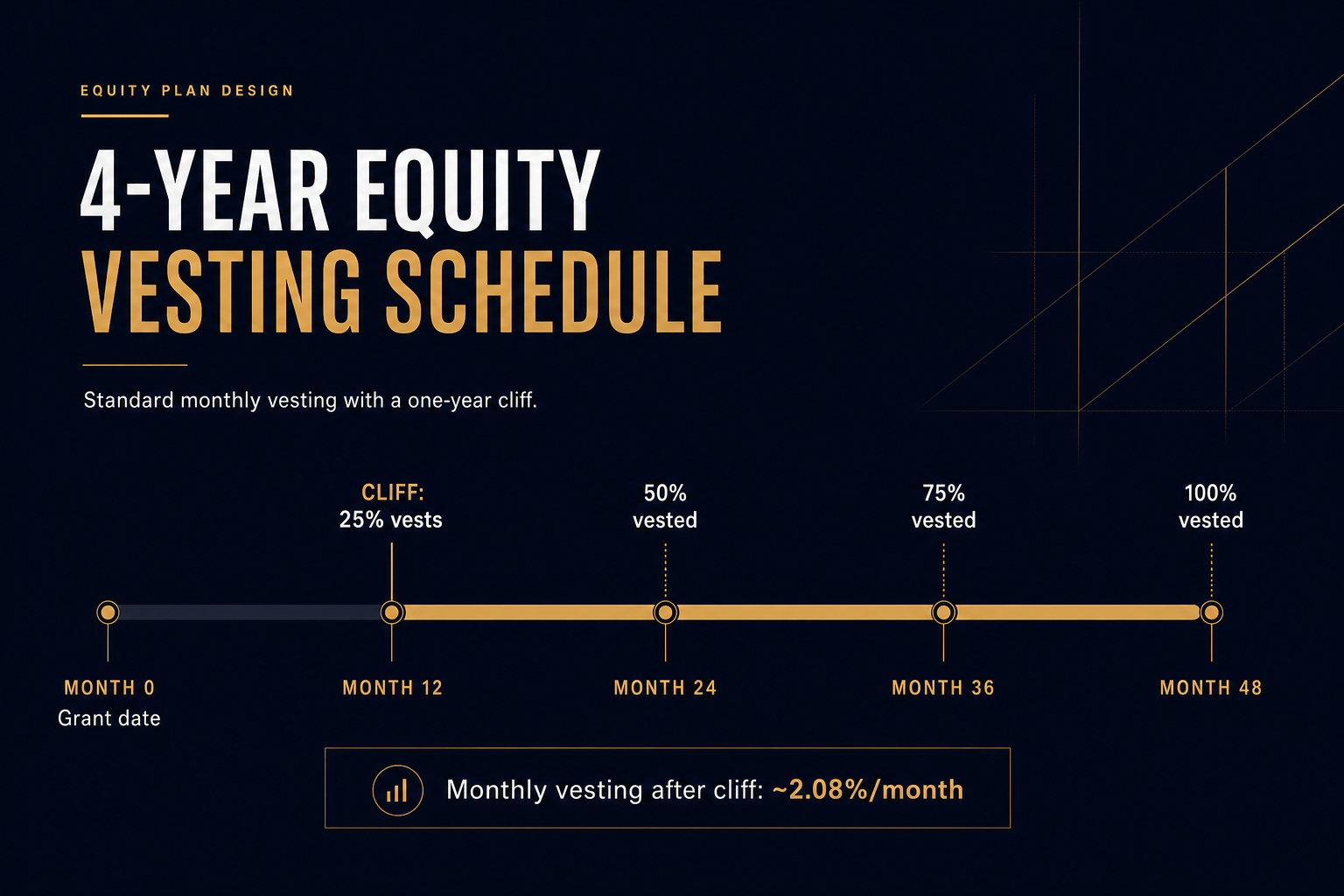
The industry standard is four-year vesting with a one-year cliff. It is standard because it broadly works, but it creates specific problems you should plan around.
The mechanics
- Month 0: Grant is made at the current 409A strike price. No shares are vested.
- Month 12 (cliff): 25% of the total grant vests in a single event. If the employee leaves at month 11, they receive nothing.
- Months 13-48: The remaining 75% vests monthly at approximately 2.08% of the original grant per month.
- Month 48: 100% vested.
The cliff creates a predictable attrition spike
Watch your voluntary departure data at months 10 and 11. Employees who are ambivalent about the role often make the decision to leave before the cliff rather than after, because they do not want to feel psychologically locked in by unvested equity that has become more valuable. If you are seeing unusual exits just before the 12-month mark, that is signal worth investigating.
Single-trigger vs. double-trigger acceleration
Acceleration provisions modify the vesting schedule at an exit event.
Double-trigger is the market standard for senior hires. Single-trigger acceleration is employee-favorable but creates friction for acquirers - it means they cannot retain employees using unvested equity as a retention tool. Most acquirers will reprice this as a deal cost.
For your VP-level and above hires, build double-trigger acceleration into the offer at the outset. It is a real retention signal and it does not meaningfully impair an acquisition.
Refresher grants prevent attrition in years 3 and 4
An employee who is 36 months into their four-year vest is three-quarters of the way through their retention incentive. Without a refresher grant, their forward-looking equity exposure to the company shrinks to near zero in the next 12 months - and their value in the external market is near its peak, because they have been shipping product for three years.
The practical rule: flag every employee within 18 months of full vesting for a refresher discussion. A typical refresher is 25–50% of the original grant on a new four-year schedule. That is not a raise - it is the re-establishment of a retention incentive that was always finite.
Grant benchmarks by role and stage
The percentage that makes a competitive offer depends on stage more than anything else. Grant percentages compress at each round because the company is worth more, so the dollar value of a smaller percentage can be equivalent or higher.

Benchmark ranges by role and stage
Source: Equity Matrix benchmarks (2026). Ranges represent competitive midpoints, not maximums.
Earlier employees earn a premium - build that in deliberately
Employee #1 is not the same risk profile as employee #20, and your grant structure should reflect that. The rough calibration:
- Employees 1–3: Top of the range. These are effectively late co-founders.
- Employees 4–10: Mid-to-upper range. The company exists, but the risk is still high.
- Employees 11–25: Mid range. Traction exists; the company has shape.
- Employees 25–50: Lower half. Salary should be closer to market at this point.
- Employees 50+: At or below range floor. Compensation moves toward full market cash.
Frame every offer in dollar terms, not percentage
"0.2% of the company" is not a useful data point for a candidate evaluating a competing offer. When presenting equity, translate the percentage:
"At our current 409A valuation of $15M, your 0.2% grant is worth $30,000. Based on our Series A target of $60M, it would be worth $120,000 at that valuation."
That framing gives the candidate a risk-adjusted basis for comparison, and it forces you to have a real number attached to your grant decision - which is exactly the discipline your equity program needs. Carta's equity compensation guide for employees and founders covers how to communicate equity value clearly across different grant types — useful reference material when you are building your offer documentation.
The 409A valuation: not just a compliance checkbox
You cannot grant stock options without a defensible 409A valuation. This is not a suggestion - granting options at a strike price below fair market value triggers IRC Section 409A penalties for employees: ordinary income tax plus a 20% excise tax on the entire option value, plus interest.
The 409A sets your strike price. If your 409A is stale when you issue grants, the IRS can challenge whether those grants were at FMV - and safe harbor protection requires a timely, qualified independent valuation.
When to refresh your 409A
The most common mistake at Series A-C companies is closing a preferred round, rushing to grant options to new hires funded by that capital, and failing to update the 409A first. That grant is outside safe harbor from the date the round closed. A defensible 409A is required before those grants are made.
Failing to properly sequence a new valuation immediately following a preferred funding round converts critical talent incentives into an administrative crisis. When post-close options are issued under stale strike prices, it breaks safe harbor compliance and exposes early hires to costly, retroactive tax penalties.
This is covered in depth in Fiscallion's guide to 409A valuation for startups, which walks through FMV methodology, the impact of preference stacks on common stock valuation, and what to do if your 409A result comes in higher than expected. The valuation also directly determines how your cap table is structured for dilution modeling — both topics belong in the same financial model.
ASC 718 and what stock-based compensation means for your FP&A model
Under US GAAP, stock-based compensation is a real expense. ASC 718 requires you to measure the fair value of an equity award at grant date and recognize that expense ratably over the vesting period.
This matters for your FP&A model in three direct ways.
SBC inflates your GAAP operating expenses
Every option grant you make adds a non-cash expense to your income statement. For a company at Series A to Series C, stock-based compensation can run 3–8% of revenue in engineering alone. If you are presenting GAAP financials to your board without calling out SBC explicitly, your profitability picture is being obscured by a number your team controls through grant policy.
This is not theoretical. Founders who do not separate SBC from cash burn walk into board meetings with a GAAP profitability number that investors immediately adjust — and that adjustment almost always catches the founder off guard.
Aggregating equity expenses into general overhead accounts masks the true operating performance of a scaling technology company from its oversight partners. Transitioning to an explicitly broken-out reporting layout ensures that non-cash adjustments are clearly communicated before institutional investors run their own recalculations.
The discipline required here overlaps directly with what we cover in the SaaS board reporting guide: present GAAP and non-GAAP metrics side by side, with the reconciliation visible, before anyone has to ask for it.
The expense depends on a Black-Scholes or binomial model input set
For options, fair value is calculated using the Black-Scholes model at grant date. The key inputs:
- Current FMV (from 409A)
- Strike price
- Expected term (typically 5–7 years for employee options)
- Volatility (based on comparable public companies for private firms)
- Risk-free rate (current Treasury rate at grant date)
Each of these is an assumption someone needs to own. Volatility is the most judgment-dependent input and has the largest effect on option fair value. If your accounting firm is setting these inputs without your FP&A team reviewing them, you are not managing your SBC expense - you are discovering it. PwC's stock-based compensation accounting guide remains the standard reference for the technical ASC 718 mechanics if you need to audit what your accountants are computing.
Build SBC into your financial model by role and expected grant cadence
The practical FP&A approach:
- Model your expected grants by month based on your hiring plan (hire date = grant date). If your headcount plan is not bottoms-up and role-specific, your SBC schedule will be wrong before you start.
- Estimate option FMV at grant using Black-Scholes with current assumptions
- Spread the expense over the 48-month vesting period for each grant
- Update the model each time you complete a new 409A (changing FMV changes future grant fair values)
- Separate SBC from cash burn in your runway model - SBC is non-cash and should not appear in your cash-based runway calculation
The board will ask you to present both GAAP and non-GAAP (SBC-adjusted) operating metrics. If you cannot produce that split cleanly, the conversation about your burn rate and profitability timeline becomes harder than it needs to be.
Tax treatment by instrument: what your employees actually face
This is one of the most under-communicated topics in startup equity programs. Founders rarely walk employees through the tax consequences of their grants - and when employees make uninformed exercise decisions, the company's equity program loses its retention value. The National Center for Employee Ownership publishes a factsheet on stock options and equity compensation that is worth distributing to employees as plain-language reference material before their first exercise event.

The core comparison
The AMT trap employees need to understand
An employee who exercises ISOs early (before a liquidity event) does not pay ordinary income tax - but the spread between strike price and FMV is an AMT preference item. In a year where an employee exercises a large block of ISOs at a significant spread, they can owe AMT even if the shares are illiquid and unsold.
This is a real risk at companies where the 409A has appreciated significantly from initial grants. Employees with options granted at $0.50/share at a company now worth $8/share on a 409A face an AMT exposure on the $7.50 spread the moment they exercise - before they have a single dollar of liquidity.
Your equity program should include clear written documentation of how each instrument works, when tax events are triggered, and a recommendation to consult a qualified tax advisor before exercising. The companies that do this consistently get credited for it in competitive offers.
Cap table management and the dilution math that matters
Every equity grant reduces the percentage ownership of every other shareholder. Managed well, that is an acceptable cost of hiring the team that makes the company worth more. Managed poorly, it creates a preference stack problem, a board perception problem, and a fundraising friction problem.
Option pool sizing is a model input, not a negotiation
Before your next round, you will need an option pool large enough to cover 18–24 months of grants. The standard investor ask is 10–15% of the fully diluted post-money share count, established before money goes in (meaning founders bear the dilution, not investors).
The way to negotiate this as a founder: bring a bottoms-up hiring model. If you can show the board that your modeled grants for the next 18 months require 8% of fully diluted shares, you have a basis for pushing back on a 15% pool request. Accepting a larger pool than you need transfers dilution from investors to you unnecessarily. This is the same discipline that applies to seed round financial projections — every round negotiation is stronger when it is anchored to a bottoms-up model, not a convention.
The calculation:
Required pool = sum of modeled grants (by hire month and role) + 20-30% buffer for unexpected grants and refreshers
Model this from your headcount plan, not from a percentage rule of thumb.
Track dilution across all instruments
Your cap table should reflect:
- Founder common shares (with vesting status)
- Investor preferred shares (by series, with liquidation preferences)
- Issued and outstanding options (granted, exercised, cancelled)
- Unissued option pool (available for future grants)
- SAFEs and convertible notes (modeled to conversion at the next round)
- Any warrants issued to lenders or advisors
When a SAFE converts at your next priced round, it creates new shares at a discount or below a valuation cap - diluting all existing shareholders. If you have raised multiple SAFEs with varying caps and discounts, model the conversion before your priced round closes so you understand the post-money cap table before you are in a room with investors. Carta's breakdown of share dilution mechanics is a useful reference for modeling the different conversion scenarios.
Understand the preference stack before any exit conversation
Investors hold preferred shares with liquidation preferences. In a modest acquisition, preferred shareholders recover their investment before common shareholders (employees with vested options) see any proceeds. This is standard - but many founders discover the implications of the preference stack only when they receive an acquisition offer.
The useful exercise: run a waterfall analysis at three exit prices (1x revenue, 3x revenue, 5x revenue) and calculate what employees with vested equity actually receive at each price point. If your common stock is "underwater" in the 1x and 3x scenarios, that is information your equity program needs to account for. This waterfall analysis is also a required piece of a complete due diligence package for startups — investors will run it independently, and you want to have seen the numbers first.
Common mistakes and the replacement move for each
These are the six equity mistakes that show up in diligence, compress valuations, and cost founders ownership they could have kept.
Granting options before updating the 409A after a new round
The mistake: Closing a Series A in March, then granting options to April hires at the pre-round 409A strike price.
The replacement move: No grants until the post-round 409A is complete. The grant queue waits. Build this as a standing rule with your legal counsel and operations team.
Sizing the option pool from a percentage convention, not a hiring model
The mistake: Agreeing to a 15% option pool because that is what the investor term sheet says, without checking whether 15% actually matches your plans.
The replacement move: Build a 24-month headcount model, map grants by role and hire date, sum the total dilution, and negotiate the pool size based on that number. Come to the term sheet negotiation with the model.
Treating SBC as a non-issue because it is non-cash
The mistake: Presenting GAAP financials to investors with SBC buried in operating expenses, then being surprised when they flag the number.
The replacement move: Model SBC by role class before grants are made. Present GAAP and SBC-adjusted metrics side by side in every board deck. Own the number before it appears. The three-statement financial model is where this discipline lives — SBC needs to be an explicit line in the income statement, not a reconciling item discovered mid-diligence.
Using RSUs at early stage because they are simpler to explain
The mistake: Issuing RSUs to seed-stage employees because options feel complicated. RSUs are simpler to explain, but they create immediate ordinary income tax at vest in a company where there is no liquidity to fund that tax bill.
The replacement move: Use ISOs for employees at seed and Series A where the strike price is low and the tax advantage is real. Move to RSUs for senior hires at Series C or later when the company is approaching a liquidity event where the double-trigger delivery makes sense. Stripe Atlas covers the instrument selection logic clearly in their equity for founders guide — useful framing to share with legal counsel before your next grant cycle.
Offering equity without a structured communication plan
The mistake: Issuing grants without explaining vesting, tax consequences, or how to read a cap table summary. Employees who do not understand their equity do not value it as a retention tool.
The replacement move: At hire, provide a written equity summary: grant size, vesting schedule, current strike price, current 409A FMV, and an illustrative value at 2x/5x/10x the current 409A. Update annually after each 409A refresh. Recommend external tax counsel before any exercise event.
An equity decision checklist for Series A to Series C founders
Equity compensation touches your cash model, your cap table, your income statement, and every key hire simultaneously. Use this checklist before each material grant or option program decision.
Before any grant batch:
- Is the current 409A dated within 12 months and post any material event (new round, significant revenue milestone)?
- Is the option pool large enough to cover this grant plus the next 6 months of planned grants?
- Has the grant been board-approved per your equity incentive plan requirements?
- Has each grantee received a written summary of their grant terms?
At each round:
- Have you run a bottoms-up grant model covering the next 18–24 months before negotiating pool size?
- Have you modeled the post-round cap table including SAFE and note conversion?
- Have you run a waterfall analysis at plausible exit prices to confirm common stock has meaningful value at reasonable outcomes?
- Is SBC expense modeled into your forward financial projections?
Annually:
- Have you completed a 409A refresh?
- Have you identified employees within 18 months of full vesting for refresher grant conversations?
- Have you reviewed whether your current instrument mix (ISO/NSO/RSU) still fits your stage and liquidity timeline?
At each board meeting:
- Are you presenting both GAAP and SBC-adjusted operating metrics separately?
- Is the outstanding option pool presented as a percentage of fully diluted shares?
- Does the board deck show the equity grants made in the period and the resulting dilution?
Equity compensation is only manageable when someone owns the inputs
Equity compensation is one of the few decisions that touches your cash model, your cap table, your income statement, and every key hire you make over the next three years - simultaneously.
The companies that get it right are not the ones with the most complex equity plans. They are the ones where a specific person owns the inputs: the 409A timeline, the grant model, the ASC 718 expense schedule, and the pool sizing calculation. They present those numbers to the board before the board asks for them.
At Fiscallion, we build FP&A models for $5–50M ARR companies that make equity compensation a trackable, forecastable line in the financial plan - not a compliance exercise that happens outside the model. If your equity program is running ahead of your financial model's ability to account for it, that is a problem worth fixing before your next round.
Book a working session with the Fiscallion team to audit your equity program structure, model your SBC expense, and make sure your cap table math is board-ready.