

Most seed-stage founders I work with make the same mistake. They build a financial model that looks impressive in a spreadsheet, attach it to a deck, and call it investor-ready. Then the first serious investor asks a single question - "How did you arrive at this revenue number?" - and the room goes quiet.
Seed round financial projections are not about predicting the future with precision. No one expects you to nail month-18 ARR to the dollar. What investors are actually evaluating is your thinking: whether you understand the drivers of your business, whether your assumptions are internally consistent, and whether you've pressure-tested the numbers well enough to defend them under fire.
This guide walks through exactly what those projections need to contain, how to structure your financial model, what benchmarks to target, and the common errors that kill deals before due diligence even starts.
Key takeaways
- Seed investors evaluate your assumptions and reasoning, not just the headline revenue number
- A credible seed financial model includes three core statements plus a dedicated assumptions tab
- Scenario modeling - conservative, base, and aggressive - is now standard; a single forecast signals inexperience
- Runway planning and burn rate transparency are non-negotiable in the current funding environment
- Unit economics (CAC, LTV, payback period) need to appear in your model even before you have rich data
- Median pre-money seed valuations reached $16M in 2025 - but only companies with tight financials are commanding that premium
What we'll cover
- Why seed projections are different from later-stage financial modeling
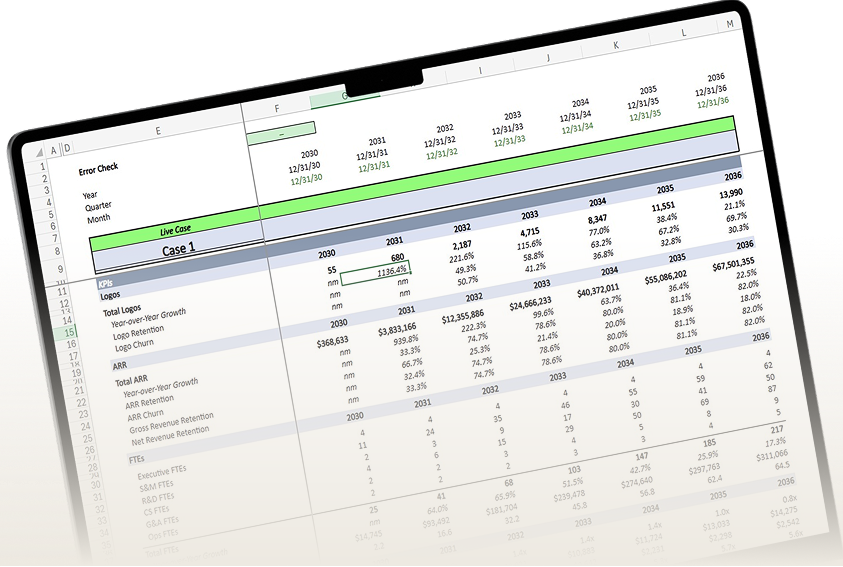
- The structure of a fundable seed financial model
- Revenue forecasting: bottom-up vs. top-down
- Scenario modeling done right
- Burn rate, runway, and cash flow planning
- Unit economics your model must reflect
- What benchmarks investors are using right now
- The most common projection mistakes and how to fix them
- How to present projections in a pitch context
Why seed projections are fundamentally different
At Series A and beyond, investors have data. They can scrutinize cohorts, churn curves, sales cycle lengths, and payback periods against 12+ months of actuals. At seed, that data is thin or non-existent. Which means your model has to do heavier narrative work than most founders expect.
Seed investors are not modeling your business from first principles - they're stress-testing your understanding of it. A model built on aggressive top-down assumptions ("If we capture just 1% of a $10B market...") tells an investor nothing useful. It actually signals the opposite of sophistication.
What works is a bottom-up approach anchored in honest input assumptions - how many salespeople you'll hire, at what ramp time, with what quota capacity - or, for product-led businesses, what your activation rate, conversion to paid, and expansion MRR look like. The numbers that come out the other end matter less than the inputs being defensible.
The broader market context in 2025 makes this even more important. Crunchbase data shows seed funding has bifurcated sharply - deal counts for rounds under $5M are down roughly 20% year-over-year, while outlier rounds of $10M and above grew significantly. Fewer standard deals are getting done, but the ones that do close are going to companies that can demonstrate financial command, not just a compelling story.
The structure of a fundable seed financial model
A fundable seed model has five components. Most I see in the wild are missing at least two.
1. Assumptions tab
This is the most important sheet in the model and the one most founders skip. Every input driver - average contract value (ACV), sales headcount ramp, customer churn rate, gross margin, cost per lead - should live here, exposed and labeled. When an investor asks "Why is your churn 2%?", you should be able to point directly to an assumption cell and explain the reasoning behind it.
In one seed round, the founder won the meeting on a single assumption: their payback period. The model showed a 9-month CAC payback. Most seed models at this stage either omit payback entirely or include it but clearly back-calculate to look good. What made this one credible was 8 months of actual cohort data from a paid pilot with 12 customers. The payback assumption was a trailing average with the underlying cohort table attached as a supporting tab — not a projection. The lead investor spent forty minutes on that one tab. The round closed two weeks later at a valuation 30% above the initial anchor.
2. Revenue model
This is your top-line build. For SaaS businesses, model revenue as a function of new logos per month, average ACV, expansion MRR rate, and gross revenue churn. Each of those is an assumption your investor will probe. For marketplace or platform businesses, model GMV, take rate, and transaction volume separately. Do not lump everything into a single "revenue growth %" line.
3. Headcount and operating expense model
Hiring plans are the single biggest driver of burn rate at the seed stage. Model headcount by role and month, with fully loaded costs (salary, payroll taxes, benefits). For engineering and product hires especially, include a ramp period before they're at full productivity. This is what we call a burdened labor rate approach, and it's the difference between a model that holds up and one that falls apart the moment an investor runs the numbers.
4. Three-statement model
Even at seed, you need a projected income statement, balance sheet, and cash flow statement. Many founders skip the balance sheet and the cash flow statement and show only a P&L. That's a red flag. Cash flow is what actually determines survival, and investors know it.
5. Scenario analysis
More on this below, but the baseline expectation is three scenarios: conservative, base case, and aggressive. Show how each changes your runway and key metrics.
Our FP&A and scenario planning service is purpose-built around this five-component structure - because every piece needs to be in place before you walk into a room with investors.
Revenue forecasting: bottom-up always beats top-down
The top-down approach - "our TAM is $5B and we'll get 0.5% of it" - is not a financial model. It is a marketing slide disguised as a number. I've seen it in hundreds of decks and it signals, every single time, that the founder has not done the hard thinking.
Bottom-up revenue forecasting means building your revenue number from operational inputs. For a SaaS startup, that typically looks like this:
- How many qualified leads does your current acquisition motion generate per month?
- What is your lead-to-trial conversion rate?
- What is your trial-to-paid conversion rate?
- What ACV or MRR does a new customer generate?
- What is your monthly logo churn rate?
- What is your net revenue retention (expansion minus contraction and churn)?
Build those assumptions month by month for 18 to 24 months, and your revenue projection falls out as the mathematical result. This approach has three advantages: it forces disciplined thinking about go-to-market, it surfaces operational bottlenecks before they happen, and it gives investors something real to evaluate.
The assumption seed founders most consistently get wrong in this build is time to first revenue from a new sales hire. Founders almost universally model new AEs as productive from month two or month three. The actual number, consistently, is closer to month five or six for a B2B SaaS product with any complexity in the sales motion. When you compare seed projections to actuals at 12 months, the revenue shortfall almost always traces back to this single input. The hire happened on schedule. The ramp did not.
For product-led growth models, the logic is slightly different but equally granular. Model signups, activation rates, conversion to paid tiers, and expansion revenue from existing users separately.
Scenario modeling done right
The single-scenario financial model is one of the biggest trust killers in a seed pitch. When you present one set of projections as "the forecast," you're either overconfident or you haven't tested your own assumptions. Investors know this.
A credible scenario analysis gives you three distinct MRR trajectories - conservative, base, and aggressive - each driven by a different set of input assumptions, not just a percentage adjustment applied to the same base number. The conservative case is not "base minus 20%." It reflects a genuinely different growth rate, a longer sales cycle, or a higher churn assumption. The aggressive case reflects what happens if your second sales hire ramps faster than expected and your retention beats the benchmark.
The chart below shows what this looks like in practice for an early-stage SaaS product with an initial ACV around $600.

The gap between the scenarios is the conversation. An investor will ask: "What would it take to hit the aggressive case? What does the conservative case tell you about your minimum viable go-to-market motion?" Those are exactly the questions you want to be having.
Burn rate, runway, and cash flow planning
If there is one number a seed investor cares about above all others, it is runway. Specifically: how long does this company survive on the capital raised, and is the plan to get to meaningful milestones before that clock expires?
As Y Combinator's Tim Brady explains, burn rate is a measurement of cash flow - not profit and loss - and every investor will ask for it. Runway is simply your cash on hand divided by monthly burn. But the complexity comes when burn is growing, which at a seed stage it almost always is.
The current environment has made runway planning even more critical. The seed-to-Series A timeline now averages more than two years. That means a seed round needs to fund the company long enough to hit Series A-grade metrics - typically $1-2M ARR for SaaS, strong net revenue retention, and demonstrated repeatability in sales. Raising a round that gives you 12 months of runway is not enough buffer, especially when you factor in the time it takes to actually run a fundraise.
Practical runway rules:
- Target 18 to 24 months of runway from the capital you raise
- Model burn rate on a monthly cash basis, not an accrual basis
- Show how burn evolves quarter by quarter - early months should reflect lower headcount, scaling up as you deploy capital
- Include a "bridge scenario" that shows what happens if Series A comes 6 months later than planned
The biggest error I see in burn rate modeling is using a flat monthly burn number for the entire 18-month period. Burn is not flat - it ramps as you hire. If you project a $150K/month burn in month 1 and model that flat for 18 months, you're misrepresenting both your hiring plan and your actual cash position in the out months.
For venture-backed startups, getting the burn model right isn't just about surviving - it's about having the financial credibility to lead board discussions with precision rather than approximation.
Unit economics your model must reflect
Even at seed, unit economics need to be in the model. Investors are not asking for perfect data - they're asking for a framework that proves you understand what drives profitability at scale.
The three metrics that matter most:
Customer acquisition cost (CAC)
This is total sales and marketing spend divided by the number of new customers acquired in the same period. At seed stage, you may not have multiple months of data, but you should have a cost-per-lead estimate from your acquisition channel and a conversion rate assumption. Model CAC explicitly - don't hide it.
LTV and LTV:CAC ratio
Lifetime value (LTV) is a function of average revenue per account, gross margin, and churn rate. The formula most investors use is: LTV = (ARPU × Gross Margin) / Churn Rate. The target LTV:CAC ratio for most SaaS businesses is 3:1 or higher. As Andreessen Horowitz explains, improving your LTV:CAC from 2x to 3x can nearly triple your valuation - because higher margins compound into higher reinvestment capacity and higher multiples. Show where you start and where you expect to land by month 18 as you learn your acquisition channels.
CAC payback period
This tells investors how many months of subscription revenue it takes to recover the cost of acquiring a customer. The current market benchmark for seed-stage SaaS is a payback period under 12 months for direct sales and under 6 months for product-led growth. If your payback period is 24 months, that is not automatically a deal-killer - but you need to explain the logic and the path to improving it.
Our KPI dashboards and reporting service tracks exactly these metrics in real time - CAC, LTV, MRR, and churn - so your model reflects actuals as they evolve, not frozen assumptions.
What benchmarks investors are using in 2025
The current seed market rewards specificity. Investors are no longer accepting top-of-funnel TAM arguments as a substitute for operational clarity. Here is what the data actually shows:

High Alpha's 2025 SaaS Benchmarks Report, drawing on data from 800+ SaaS companies, confirms that the strongest outcomes cluster at the intersection of high net revenue retention and short CAC payback periods - companies in that quadrant nearly double their growth and Rule of 40 scores versus peers with weaker retention or longer paybacks.
Key benchmarks worth anchoring your model against:
- MRR growth rate: Investors in 2025 are looking for 20%+ month-over-month growth at the seed stage for SaaS businesses with early traction
- Net revenue retention (NRR): 110%+ is the bar that signals a healthy expansion motion alongside solid retention
- Gross margin: SaaS businesses should model 70-80%+ gross margin. If yours is lower, explain the path to margin improvement as infrastructure costs spread
- Average seed deal size: $2-3M for traditional SaaS with $20-50K MRR, up to $4.6M for AI and healthcare where technical differentiation justifies a premium
- Dilution expectation: 20-25% is the standard. Model your post-money cap table to confirm you're not giving up more
- Seed-to-Series A runway: Plan for the timeline to exceed two years from close
These numbers are not targets to hit artificially. They are reference points that help you understand where your business sits relative to the cohort investors are evaluating simultaneously.
The most common projection mistakes that kill deals
Having built and reviewed hundreds of early-stage financial models across ABBYY, Usercentrics, and Coca-Cola HBC - and now dozens more at Fiscallion - I've seen the same errors repeat. Here are the ones that matter most.
Confusing revenue with cash received
Especially relevant for annual contracts or businesses with deferred revenue: SaaS companies that sign annual contracts often receive 12 months of cash upfront but recognize revenue monthly. If you model the full annual contract value as month-1 revenue, your cash flow looks very different from your P&L - and that difference can distort your runway calculation significantly.
Flat headcount models
Projecting the same number of employees from month 1 through month 18 means you're either over-hiring on day one or not showing a realistic growth plan. Headcount should ramp in alignment with revenue milestones and capital deployment.
Ignoring gross margin in the out months
Gross margin tends to improve as infrastructure costs scale against growing revenue. If you model a flat gross margin from month 1 to month 24, you're underestimating the economics of the business at scale. Show the margin trajectory.
Using a single revenue line
One "Revenue" line is not a revenue model. Break it out by product, segment, channel, or cohort. Investors want to understand which part of the business is driving growth.
Not showing what success looks like for Series A
Your seed round projections should show - explicitly - what metrics you'll hit by month 18 and why those metrics qualify you for a Series A conversation. If your model ends at $80K MRR and you haven't shown that's the threshold a Series A investor needs, you've left the narrative incomplete.
This is where working with a fractional CFO pays for itself: not just in building the model, but in stress-testing whether the story it tells actually qualifies you for the next round.
How to present projections in a pitch context
The model is not the pitch. Most seed pitch decks include one slide of financials, and that slide needs to communicate the core story, not the full model detail.
The financial slide in a seed pitch should show:
- 3-year revenue projection (monthly for year 1, quarterly for years 2-3)
- Burn rate and runway
- Key unit economics (CAC, LTV, payback period)
- The milestone your raise gets you to
The model itself belongs in the data room - not on slide 11. Investors who are serious will ask for it, and that is when the assumptions tab, the scenario analysis, and the three-statement structure become critical.
What Fiscallion does in practice is build the full model first, then reverse-engineer the pitch slide from it. The numbers on the slide are defensible because they trace directly back to modeled assumptions. When an investor asks "How did you arrive at this?" the answer is always the same: "Let me show you the model."

This is the difference between projections that open doors and projections that close them. The former feel like the work of a founder who is operating with financial clarity. The latter feel like a spreadsheet that was built for the pitch and will never be touched again.
Investor-ready financial projections for a seed round are not just a fundraising artifact. They are the operating system of your business for the next 18 months - a living tool you update as actuals come in, as assumptions prove right or wrong, and as you navigate toward the milestones that get you to Series A.
If you are building that model from scratch, or if the one you have does not hold up to the questions above, the fundraising and investor support services at Fiscallion are built specifically for this stage - translating your business drivers into a model that works in front of investors and in your own planning.
A defensible model is the highest-leverage asset in a seed raise
Seed round financial projections are one of the highest-leverage documents you will produce as a founder. Done right, they signal operational maturity, force honest thinking about your go-to-market assumptions, and give investors a clear basis for belief. Done wrong, they erode trust faster than almost anything else in the process.
The fundamentals are not complicated. Build bottom-up. Expose your assumptions. Model three scenarios. Show unit economics even when they are early. Plan for more than 18 months of runway. And make sure your model traces directly to the story you are telling in the pitch room.
The founders who close seed rounds in today's environment are not the ones with the most optimistic spreadsheets. They are the ones who can walk an investor through the logic of their business - calmly, specifically, and without flinching when the hard questions come.
That is what turning financial fog into structured paths actually looks like in practice. And it starts with getting the model right before you walk into the room.