

In a growth-stage startup, your hiring plan is your burn plan. Headcount typically devours 60% to 75% of your total operating expenses, yet most founders approve new roles based on a department head's current pain rather than hard financial data. Treating hiring and cash management as separate workflows is the fastest way to get blindsided by a shrinking runway.
This guide shows you how to build a headcount planning model that actually informs decisions - not just records them. By the end, you will know how to calculate required capacity, translate it into a staged hiring plan, and connect every hire to runway impact before anyone signs an offer letter.
What you'll learn
- How to build a capacity-based headcount model instead of reacting to departmental requests
- What the benchmark headcount-per-$1M-ARR ratios look like across your growth stage
- How to calculate the true burn impact of your hiring plan before committing to it
- The three most common headcount planning mistakes and the replacement moves for each
Why headcount planning is really a runway problem
For a company at $5M–$50M ARR, headcount planning isn't about org charts—it’s about cash.
At this stage, headcount planning is a cash decision. Every approved role adds a cost that begins 30-60 days before the person starts being productive and runs for 12-18 months before generating enough output to pay for itself. Model those timing gaps wrong and your runway shrinks in ways that only show up when it is too late to course-correct.
People costs don't behave like software costs
SaaS leaders are accustomed to adding a new tool - it shows up on a card, runs monthly, and can be cancelled. Headcount is the opposite. The cost begins before the person is productive, peaks before the role generates full output, and carries legal and cultural overhead if reversed.
That asymmetry means every hire decision deserves a forward-looking cash model, not just a budget line. As a16z notes in their cash management guide, for most startups the most significant expense will be employees - which means knowing your headcount plan is essential to understanding your cash needs.
What a headcount plan actually is (and isn't)
A headcount plan is not a list of roles you want to fill. It is a time-phased model that connects:
- Business targets (revenue, product milestones, retention goals)
- Capacity requirements (how much output you need to hit those targets)
- Current team productivity (what your existing team can actually produce)
- Hiring needs (the gap between required and current capacity)
- Financial impact (the burn effect of each hire, staged by start date)
A role wishlist from department heads is not a headcount plan. A budget that shows total salary by department is not a headcount plan. A headcount plan is a decision tool - it shows you the trade-off between what you want to build and what your runway allows.
The three types of hiring mistakes this model prevents
All three mistakes share a root cause: the hiring decision happened before anyone built the model.
Step 1: Start with business targets, not open reqs
Every headcount plan starts from the top. You need a clear answer to: what does the business need to achieve in the next 12 months?
Useful targets to anchor:
- Net new ARR (e.g., grow from $8M to $14M ARR)
- Logo retention rate (e.g., keep monthly logo churn below 1.5%)
- Product milestones (e.g., ship features X, Y, Z by Q3)
- Support quality (e.g., maintain 12-hour first response at 30% higher ticket volume)
Do not start modeling headcount until these targets are written down and agreed on by leadership. The headcount model is a function of the business targets - not the other way around.
As the CFO of Notion noted in First Round Review's annual planning guide: "I found people often plan as though that headcount they're asking for is already there... they're not at full productivity on day one." Constrain headcount allocations before teams build their plans, not after.
The question you need to answer before opening any req
For every role on the list, ask: what business target does this hire serve, and what happens to that target if we delay this hire by one quarter?
If you can't answer that question concisely, the req isn't ready to be opened.
Step 2: Calculate required capacity - not required headcount
Skip the headcount wishlists. Calculate required output first, then translate that data into functional capacity. The distinction matters because capacity accounts for ramp time, attrition, and productivity variation. Headcount alone doesn't.
Sales capacity example
Say you need to add $4M in net new ARR over the next 12 months.
Step through it:
- If annual logo churn is 12%, you'll lose ~$960K in ARR (12% of $8M). You need $4.96M in gross new bookings to land $4M net.
- If a fully-ramped rep carries $600K annual quota, you need 8.3 fully productive rep-years of capacity.
- You currently have 6 reps. Two are in their first year and averaging 40% productivity. Effective capacity is roughly 5.8 rep-years.
- Capacity gap: 8.3 - 5.8 = 2.5 additional fully productive rep-years needed.
- If you hire 3 reps in Q1 and they ramp over 6-9 months, by year-end they'll average about 80% productivity. That gives you 2.4 rep-years - close to the gap, with normal variance accounted for.
The output is: hire 3 reps in Q1. Not "hire 3 reps" as a vague target - Q1, with the ramp model attached.
Customer success capacity example
If you're scaling from 200 to 320 customers and each CS manager can effectively support 80 customers:
- You need 4 CSMs at year-end.
- You currently have 2.5 effective CSMs (two fully ramped, one in Q1 ramp at ~50%).
- You need to add 1.5 CSM capacity by Q3, before volume hits 280.
- Hire one CSM in Q2 so they're ramped by Q3.
This is capacity planning, not headcount planning. The difference is whether you run the math before you post the role. It also feeds directly into your customer churn rate model - understaffed CS is one of the fastest ways to accelerate logo churn.
Step 3: Model productivity curves - the number that almost everyone ignores
New hires are not productive at full capacity on day one. Ignoring this produces burn forecasts that are too optimistic and revenue forecasts that are too high.
A realistic sales rep productivity curve looks like this:
SaaStr's research on sales rep ramp consistently finds that new reps need 9-12 months to reach full productivity in B2B SaaS - with enterprise-focused reps often taking longer given longer sales cycles. Model this conservatively, not optimistically.
CS managers, engineers, and support reps each have their own curve - build it from your own retention and ramp data rather than assuming a generic shape.
The practical implication: a Q1 hire who starts February 1 costs you full salary in Q1 but delivers roughly 20% of full output. Budget accordingly.
Attrition belongs in the model too
If your annual attrition rate is 15%, and you need 20 FTEs at year-end, you need to plan to hire 23-24 people. The model should reflect this - or you'll hit Q4 short of capacity and scrambling.
Step 4: Build the financial model - monthly, by department
This is where most headcount plans fail. They stay at the annual level, which hides the timing of cash impact.
Build your headcount model monthly. For each new hire, capture:
- Start date (not January 1 by default - model realistic recruiting timelines, typically 60-90 days)
- Base salary + variable comp (fully loaded, including benefits and payroll taxes - typically 1.2-1.3x base salary)
- Ramp schedule (when does productivity begin and at what rate)
- Department (maps to the P&L category: R&D, S&M, or G&A)
- Revenue attribution (for sales and CS hires: when does the hire begin contributing to bookings or retention?)
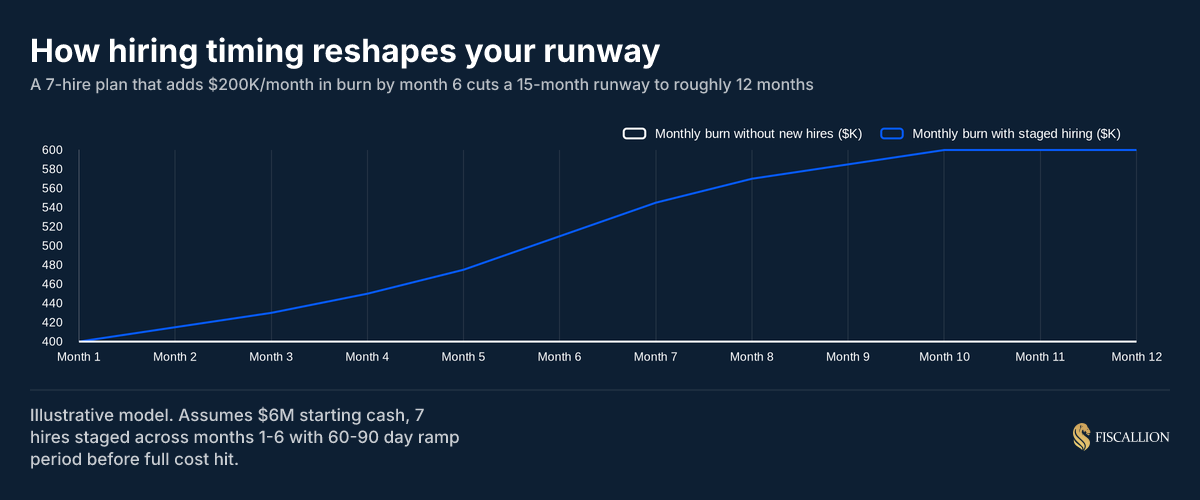
Once you have this by hire, roll it up monthly. You'll see the burn step-ups as each hire enters payroll and the lag before they become productive. That lag is where runway pressure hides.
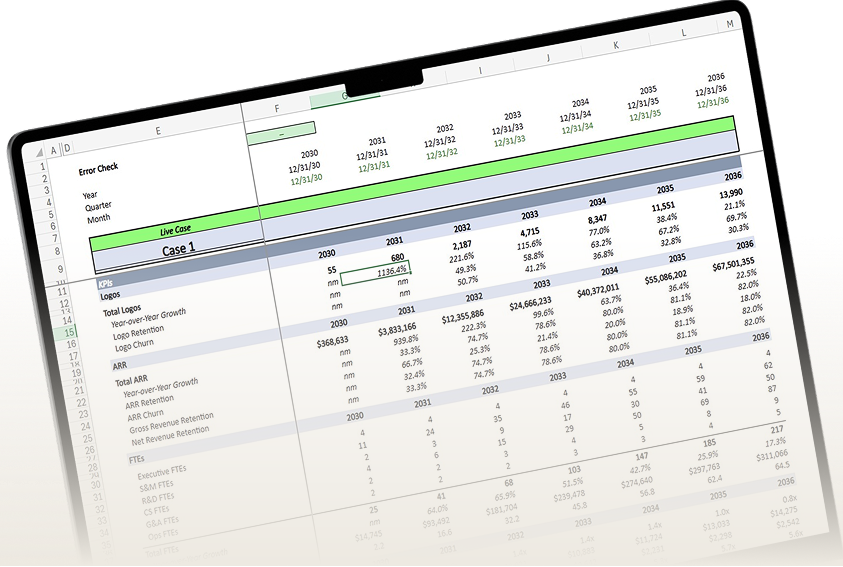
The headcount model should feed directly into your three-statement financial model - not live in a separate spreadsheet. Every approved hire should move operating expenses, update cash flow, and recalculate runway in one connected view.
Fully burdened cost - what the model should use
Do not model salary alone. A $130K base salary typically costs $165K-$175K all-in when you include:
- Payroll taxes: ~7.65% employer-side FICA
- Benefits: 20-30% of base (health, dental, vision, 401k match)
- Equipment: $2K-$5K one-time per hire
- Software seats: $1.5K-$3K annually per hire
- Office or remote overhead (if applicable)
Modeling salary-only understates headcount burn by 20-30%. At 20 hires, that gap is material. This is also why equity compensation belongs in the full picture - option grants and RSUs add non-cash dilution costs that belong in a complete talent expense model even if they don't hit the P&L the same way cash comp does.
Headcount benchmarks: what the numbers actually look like at your stage
Before finalizing a hiring plan, benchmark your current headcount efficiency against comparable companies. The key metric is headcount per $1M ARR, segmented by function.
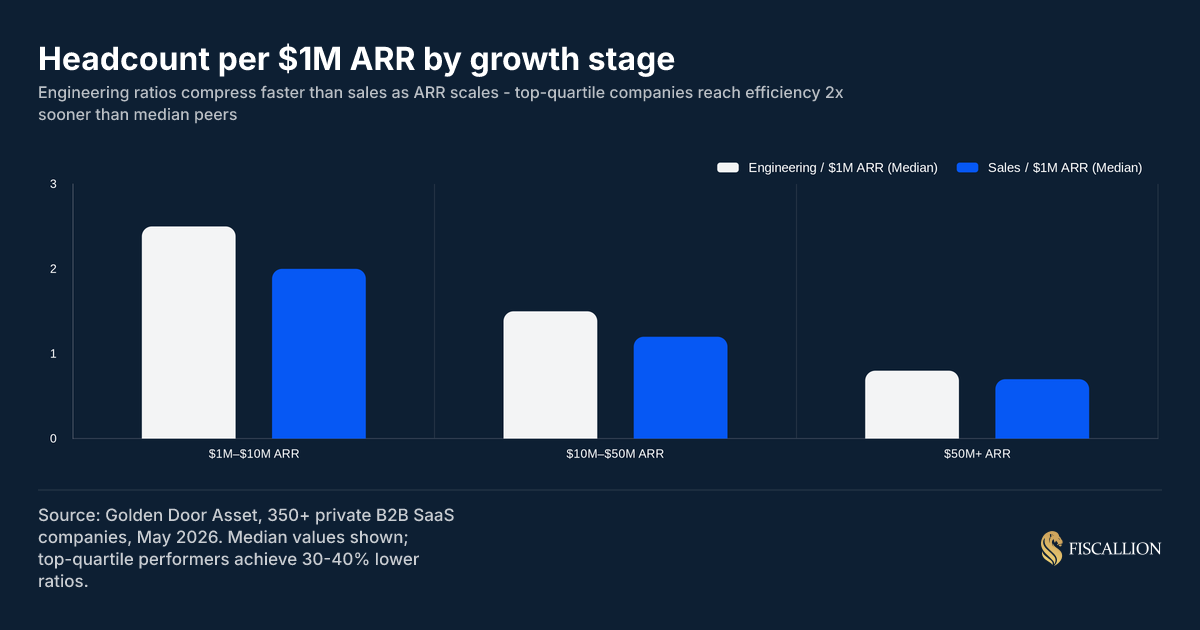
Data from 350+ private B2B SaaS companies shows clear patterns by ARR scale:
Top-quartile performers at the $10M-$50M stage already operate at ratios that median companies don't reach until $50M+. That gap represents $3M-$4M in annual operating leverage at scale - real capital that either extends runway or gets reinvested into growth. OpenView's SaaS benchmarks reports track this headcount efficiency gap across cohorts and confirm the same pattern: efficient operators hire fewer people per dollar of ARR at every stage.
Your GTM motion changes the benchmarks
These are median figures, not universal targets. The right benchmark depends on how you go to market:
A high engineering ratio is a problem for an enterprise-sales company but expected for a PLG business. Don't benchmark against the wrong archetype. This also connects to your SaaS magic number - if your magic number is below 0.75, adding sales headcount before fixing your GTM efficiency just accelerates burn without proportional ARR return.
Use the benchmark as a diagnostic, not a target
If your headcount ratios are significantly above median for your stage and GTM motion, that's a signal - not a mandate to lay people off. The question is whether the delta is intentional (you're investing ahead of a growth inflection) or unintentional (you approved reqs without a model).
Step 5: Connect every hire to runway impact before approving
Once you have the month-by-month burn model for your hiring plan, run it against your current cash balance and revenue forecast. This is the step that turns a headcount plan into an actual decision tool.
The output should show:
- Runway under your current plan (hiring as modeled)
- Runway if you delay non-critical hires by one quarter
- Runway under a downside revenue scenario (e.g., new bookings miss by 20%)
At Fiscallion, this is how we frame it for founders going into board meetings: the question isn't "can we afford these hires?" It's "which of these hires is justified by current capacity gaps, and which ones change the funding timeline?"
Shifting the conversation requires reframing requests from emotional pain narratives to objective, data-backed models that directly connect to operational output.
For a deeper look at how to build the scenarios that support this decision, see our guide on scenario planning for startups.
The runway threshold that changes the decision calculus
A useful rule of thumb:
- 18+ months of runway after hiring plan: hire ahead of growth. Capacity constraints will cost you more than the burn.
- 12-18 months of runway after hiring plan: hire against confirmed capacity gaps only. No speculative reqs.
- Under 12 months of runway: only backfills and roles with direct, near-term revenue attribution. Everything else waits.
This is not a rigid framework - it's a starting position for the conversation. The actual answer depends on your revenue visibility, fundraising timeline, and whether you're in diligence. For a fuller treatment of how to model and manage runway as a decision variable, see our cash flow forecasting guide.
The three most common headcount planning mistakes
Mistake 1: Hiring for current pain instead of future capacity
By the time a department is visibly underwater, you're already 60-90 days behind. The hire goes out, recruiting takes 8 weeks, onboarding takes 4 weeks, and ramp takes 3-6 months. The pain is still there for 6 months after you felt it.
The replacement move: build the capacity model 6 months ahead of when you think you'll need capacity. The signal to hire is "we will hit a capacity ceiling in Q3" - not "we are already over capacity in Q2."
Standard growth financial models often assume a new hire achieves instant productivity, completely ignoring the complex learning curves and the heavy operational drag placed on existing team members during onboarding.
Mistake 2: Treating the hiring plan as separate from the financial model
Many companies have a headcount list in a Google Sheet and a financial model in a separate spreadsheet. The numbers never talk to each other. The board sees a burn forecast that doesn't account for 8 hires approved in the past 6 weeks.
The replacement move: the headcount plan is an input to the three-statement model, not a separate document. Every approved hire should update your operating expense projections and runway estimate automatically. This is part of what we help founders build at Fiscallion - a single connected model where the hiring decision and the runway impact are visible on the same screen.
Mistake 3: Modeling all employees as equally productive
An assumption that 5 new hires will all hit 100% of productivity by month 6 is almost always wrong. 80% is optimistic. More realistic is a distribution: 20% of hires underperform significantly, 60% hit expectations, 20% overperform. That distribution affects both your cost model and your revenue forecast.
The replacement move: model productivity as a range. Build a base case (80% of hires hit expected output curves), a downside (60%), and run the sensitivity. If the plan only works in the base case, it's too fragile. This is exactly the kind of scenario sensitivity that belongs in a decision-ready ARR growth rate model - hiring assumptions and revenue assumptions have to be stress-tested together.
The headcount planning checklist
Use this before any hiring plan goes to the board or gets final approval:
Targets and capacity
- Business targets for the planning period are written down and agreed on
- Required capacity has been calculated from targets (not from headcount wishlist)
- Current team productivity is modeled by role, not assumed at 100%
Model inputs
- Every hire has a realistic start date (not January 1 by default)
- Ramp curves are built by role, not generic
- Fully burdened cost is used (not base salary alone)
- Attrition rate is modeled into year-end capacity
Financial connection
- Hiring plan is connected to the three-statement model
- Runway is calculated monthly, not annually
- At least two scenarios are modeled (base and downside)
- Runway threshold is evaluated against fundraising timeline
Decision readiness
- Each role can be tied to a specific capacity gap or business target
- Delayed-by-one-quarter sensitivity has been run
- The board presentation frames the trade-off, not just the plan
What to do next: three moves by owner
For the founder or CEO
Run the capacity math on your next planned hire before approving it. What business target does it serve? When does it become productive? What does your runway look like 12 months out if you hire it now versus in Q2? If you can't answer those questions in 10 minutes, the model isn't built yet.
For the head of finance or fractional CFO
Connect the headcount list to the operating model. If they live in separate documents, that is the first thing to fix. Every new req should trigger a runway recalculation - not a quarterly review. Build the connection to your cash flow forecast so any new hire immediately updates burn and runway in your board-facing model.
For the team as a whole
Own your ramp and productivity assumptions. The model is only as good as the inputs. If your CS team's actual ramp time is 5 months but the model assumes 3, the capacity plan will be wrong by a quarter. Run a retrospective on last year's hires - how long did they actually take to reach expected output? - and update the model with real numbers.
Stop collecting whichlists, start making capacity
A headcount plan that lives separately from your financial model isn't a plan - it's a list. The decision you're actually making when you approve a hire is a cash and runway decision, and it should be treated as one.
Build the capacity model first. Run the fully burdened cost. Connect the hire to the three-statement model. Show the board the trade-off, not just the org chart.
At Fiscallion, we build these models with founders who are managing hiring decisions without a full finance team. The work isn't complicated - it's just disciplined. And doing it before the hire is always easier than explaining the runway gap six months later.
If your hiring plan and your financial model are still two separate documents, that's where to start. Get the template, connect the inputs, and run the numbers before the next board meeting.