

Hiring a fundraising consultant will not fix a financial model that doesn't reconcile, and no consultant fee buys back six weeks lost when an investor finds a cap table nobody cleaned up. Before you evaluate consultants, decide whether your gap is access to investors or the credibility of your numbers. Most $5-50M ARR companies searching for "the best fundraising consultants" actually have a data readiness problem that a warm introduction cannot solve. Get that sequencing wrong and you pay success fees for a process that still stalls in diligence.
This piece gives you a working framework: what fundraising consultants actually do, what they cost, how to tell if you need one versus a fundable model, and the readiness checklist to run before you sign anyone.
Key takeaways
- Fundraising consultants range from success-fee advisors (3-8% of capital raised) to monthly retainer firms ($5K-$50K/month) to fractional CFO shops that focus on making your numbers investor-ready rather than making introductions.
- The consultant question and the "are our numbers fundable" question are different problems. Confusing them is the single most expensive mistake founders make in this process.
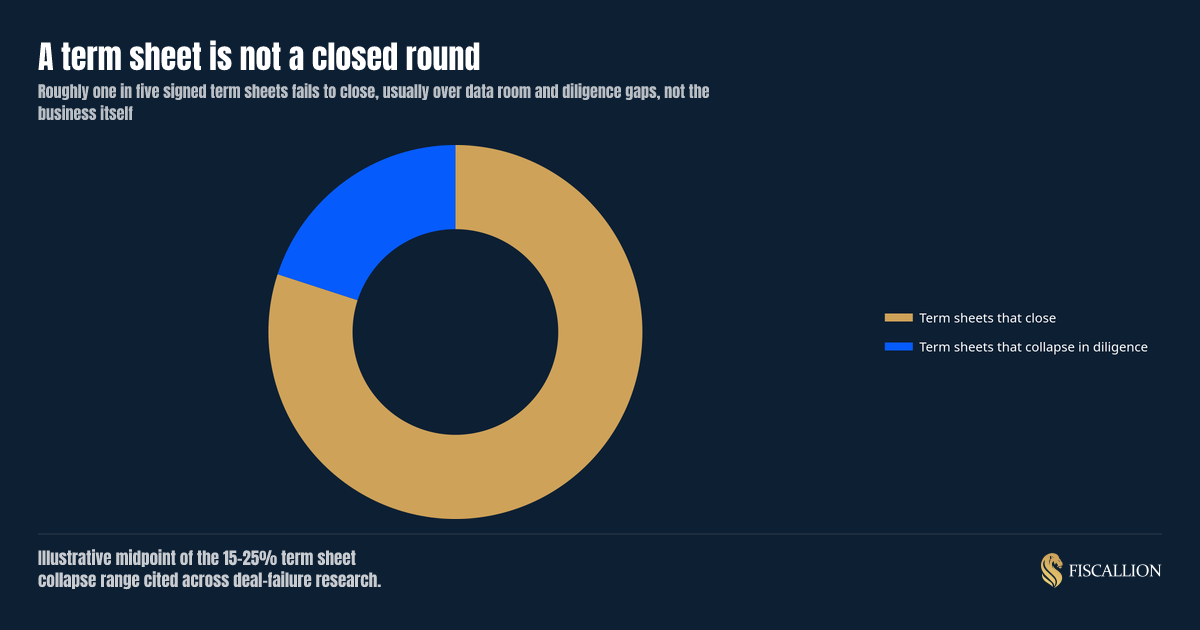
- Roughly one in five signed term sheets fails to close, and the collapse almost always traces back to financial inconsistency, cap table gaps, or a data room that was not built for how investors actually diligence, not to the underlying business.
- A consultant can compress your timeline and widen your investor funnel. A consultant cannot manufacture a defensible three-year model, a clean cohort view of unit economics, or a cap table that survives scrutiny.
- The right sequence is: fix your FP&A infrastructure first, then decide whether a consultant adds enough incremental value in access or negotiation to justify the fee.
What we'll cover
This article moves through the decision in order: what fundraising consultants are and how they get paid, how to evaluate whether one is worth the fee for your specific raise, how to interpret the fee structures and timelines, what to do before you sign an engagement letter, the mistakes founders repeat, and a practical readiness scorecard you can run this week.
What a fundraising consultant actually is
"Fundraising consultant" gets used loosely. In practice it covers at least four distinct roles, and conflating them is why founders overpay or underdeliver.
Success-fee advisors and finders. Paid a percentage of capital raised, typically 3-8% depending on stage, in exchange for introductions and process support. Legally, anyone taking transaction-based compensation for raising capital is supposed to be a registered broker-dealer in the US. Many informal advisors are not, which creates real risk for you as the issuer, not just for them.
Retainer-based boutique advisors. Charge $5,000 to $50,000 a month for strategy, deck coaching, and process management, regardless of outcome. Common for Series B and later, where the raise is large enough that a flat fee beats a percentage.
Placement agents.Registered broker-dealers running a formal process for larger institutional raises. Rare below Series B, standard for growth equity and debt-adjacent instruments.
Fractional CFO and FP&A firms doing fundraising prep. Not focused on introductions at all. Focused on building the three-statement model, the cohort-level unit economics, the data room structure, and the board narrative that make the raise credible once you are in the room. This is the category Fiscallion operates in, and it is worth naming explicitly because it gets bundled into "fundraising consultant" searches even though the job is different: we build the decision-grade infrastructure that determines whether your numbers survive diligence, not the Rolodex that gets you the first meeting.
Here is how the categories compare on cost, fit, and what they actually fix:
| Type | Typical cost | Best for | What it does not fix |
|---|---|---|---|
| Success-fee advisor / finder | 3-8% of capital raised | Founders with a weak investor network, first-time raise | An unfundable model or a messy data room |
| Retainer boutique advisor | $5K-$50K/month, 3-6 months | Series B+, complex or competitive rounds | Underlying financial credibility |
| Placement agent | 1-3% fee plus retainer, management fee tail | Institutional growth equity, larger debt raises | Weak unit economics or governance gaps |
| Fractional CFO / FP&A firm | $3K-$15K/month depending on scope | Fixing the model, cohorts, data room, and board narrative before or during a raise | Investor relationships you don't already have |
| In-house CFO or Head of Finance | $200K-$350K+ fully loaded annually | Post-raise scale, ongoing reporting cadence | Speed, if hired reactively right before a raise |
The instinct to search for "fundraising consultants" usually means you want the first or third row. The actual constraint, for most companies at this stage, is the fourth row.
How to evaluate whether a consultant is worth the fee
Run the math before you sign anything. A consultant's value is the product of three things: how much your network already covers, how much a faster close is worth to you, and how confident you are in your own numbers.
Use this scorecard. Score each item 1 (weak) to 5 (strong):
| Readiness factor | What you're really asking | Score 1-5 |
|---|---|---|
| Investor network | Can you get 15-20 qualified first meetings without help? | |
| Financial model | Does ARR in the deck match bookings in the model match recognized revenue in the ledger? | |
| Unit economics | Can you defend CAC and LTV as a cohort range, not a single blended number? | |
| Cap table | Is it clean, current, and free of undocumented SAFEs or option grants? | |
| Data room structure | Is it organized around how investors diligence, not how you built the company? | |
| Board narrative | Does your deck frame trade-offs and decisions, or just report history? |
If your network score is low and everything else is a 4 or 5, a success-fee advisor or placement agent is a reasonable use of capital. That is a real gap they close.
If your financial model, unit economics, cap table, or data room scores below 3, hiring a fundraising consultant first is the wrong sequence. You will pay someone to open doors into a room your own numbers cannot survive.
The fee math is worth doing in real dollars, too. A 5% success fee on a $10M raise is $500,000. That is real capital you are not deploying into the business. It only makes sense if the alternative, unmanaged, would cost you materially more in a lower valuation, a longer timeline, or a failed raise.

Notice that the percentage drops as rounds get larger, but the dollar cost still climbs. A 4% fee on a $15M Series A is $600,000. Model that number against the actual gap in your investor network before you sign, not after.
How to interpret the data: most fundraising failures are not investor-access failures
Deal collapse research keeps landing on the same finding: the business is usually fine, the documentation is not. Roughly 15-25% of signed term sheets never close, and the leading cited cause is poor diligence preparation, not a change of heart about the market or the team.
That distinction matters for how you spend your fundraising budget. If the failure mode were "we couldn't get in front of enough investors," the fix would be a consultant with a strong network. But if the failure mode is "we got the term sheet and then lost it in week three," the fix is a clean financial model, a reconciled data room, and a cap table with no surprises. That is an FP&A problem, not an introductions problem.
The pattern investors describe is consistent: they form a judgment on your data room in the first 72 hours, largely from cap table cleanliness and whether your ARR, bookings, and recognized revenue bridge to the same number. Everything after that is read in the shadow of that first impression. A consultant cannot retroactively fix a first impression that was already burned by a document gap in week one.
This is also why CAC and LTV need to survive scrutiny as a cohort view, not a single blended figure. Investors will rebuild your unit economics from raw data if you hand them a number that looks too clean. Handing them the channel-level breakdown yourself, including the worst-performing channel, is what a defensible model looks like. A consultant who is good at introductions is not the one who builds that.
What to do next: sequence the work correctly
Before you evaluate a single consultant, do this in order:
- Reconcile your core numbers. ARR in the deck, bookings in the model, and recognized revenue in the ledger need to bridge on one page. If they don't, fix that before any outreach.
- Build the cohort view of unit economics. Blended CAC and LTV get challenged in the first serious diligence call. A cohort-by-channel breakdown does not.
- Clean the cap table and document its history.Option grants, SAFE conversions, and prior rounds need paper trails, not just a current-state spreadsheet.
- Structure the data room around diligence tracks, not internal org charts. Financial and metrics, legal and corporate, product and operations, market and growth, people and governance. Investors move through those tracks in a predictable sequence, and your folder structure should anticipate it.
- Build the 12-18 month cash flow and runway model with named assumptions. Not a static projection. A model with hiring, pricing, and churn assumptions you can defend individually in a follow-up call.
- Only then decide on outside help. If your network gap is the binding constraint, evaluate success-fee advisors or a placement agent. If your model, cohorts, cap table, or data room are still weak, spend the budget on fixing that first.

A faster fundraise is real value. But the compression happens because the diligence questions get answered before they're asked, not because someone made more warm introductions. The consultant is a multiplier on readiness, not a substitute for it. This is the same logic behind decision-grade FP&A generally: a decision-grade FP&A framework exists to turn activity into cash, runway, and trade-offs before a board or investor ever asks the hard question, and a fundraise is simply the highest-stakes version of that same test.
Common mistakes and the better move
| Mistake | Why it fails | Replacement move |
|---|---|---|
| Hiring a success-fee advisor before fixing the model | You pay for access into a room your numbers can't survive | Fix the model and data room first, then evaluate access gaps honestly |
| Presenting blended CAC/LTV as a single clean number | Investors rebuild it and find the worst channel anyway | Bring the cohort-by-channel breakdown yourself, including the weak channel |
| Treating the data room as a document dump | Investors read structure as a proxy for how you'll run the company | Organize by diligence track: financial, legal, commercial, product, people |
| Signing a consultant on unclear success-fee triggers | Disputes over what counts as "sourced" delay closing, not accelerate it | Define attribution and payment triggers in writing before the engagement starts |
| Assuming a fundraising advisor replaces financial credibility | Advisors can open doors; they can't reconcile your ARR, bookings, and GAAP revenue for you | Build the reconciliation bridge internally or with FP&A support before outreach |
| Waiting until diligence starts to build the 18-month cash model | Reactive models look reactive, and investors notice | Maintain a live runway model as a standing operating habit, not a fundraising artifact |
A practical asset: the fundraising readiness checklist
Use this before you talk to any consultant, advisor, or investor:
- Deck ARR, model bookings, and ledger recognized revenue all bridge to the same number on one page
- CAC and LTV presented as a cohort range by channel, with the weakest channel disclosed upfront
- Cap table is current, fully diluted, and documented back through every SAFE, note, and option grant
- Data room folders mirror investor diligence tracks, not your internal org chart
- 12-18 month cash flow model with named, defensible assumptions for hiring, pricing, and churn
- Board deck frames the two or three real trade-offs ahead, not just a history of the last quarter
- Someone on the team can defend every assumption in a 15-minute follow-up call without checking with someone else
If more than two of these are weak, that is where your fundraising budget belongs before it goes toward a consultant's retainer or success fee.
Conclusion
The best fundraising consultant for your company depends entirely on which problem you actually have. If your investor network is thin and your numbers are already clean, a success-fee advisor or placement agent is a defensible cost. If your financial model doesn't reconcile, your unit economics only exist as a blended average, or your data room would take an investor three days to navigate, no consultant fee fixes that, and you risk paying for access into diligence you will lose anyway.
Get the sequence right: build the model, the cohorts, the cap table, and the data room first. Then decide what outside help, if any, is worth the fee.
If you're heading into a raise and you're not confident your numbers would survive the first 72 hours of diligence, audit your metrics definitions and forecasting model before you sign anyone. That is the work that actually determines whether a term sheet closes.