

SaaS unit economics measures whether the gross profit from a customer justifies the cost of acquiring and serving that customer. Start with fully loaded customer acquisition cost (CAC), gross-margin-adjusted lifetime value (LTV), and CAC payback. Then use retention and the Rule of 40 to understand the wider growth and cash-flow picture.
For a $5–50M ARR business, the useful question is which customer segments and acquisition channels deserve the next dollar of spend. This guide connects the formulas to that decision, using a single worked example and clear limits on what benchmarks can tell you.
SaaS unit economics formulas at a glance
| Metric | Formula | What to keep consistent |
|---|---|---|
| CAC | Acquisition sales and marketing cost ÷ new paying accounts | Use fully loaded acquisition costs and a documented sales-cycle lag. |
| Gross margin | (Revenue − cost of revenue) ÷ revenue | Use a decimal, such as 0.80, inside LTV and payback formulas. |
| Simple LTV | Monthly revenue per account × gross margin ÷ monthly account churn | A steady-state approximation; assumes no expansion and stable inputs. |
| LTV:CAC | Gross-profit LTV ÷ CAC | Match the same segment and acquisition cohort. |
| CAC payback | CAC ÷ monthly gross profit per account | Express the answer in months; this is not invoice cash collection. |
| NRR | (Opening cohort MRR + expansion − contraction − churn) ÷ opening cohort MRR | Exclude new customers; compare the same opening cohort. |
| Rule of 40 | Year-over-year revenue growth % + free cash flow margin % | Use a consistent reporting period and profitability definition. |
The Rule of 40 is a company-level diagnostic, rather than a customer-level return measure. A strong score cannot substitute for sustainable cohort economics.
What this guide covers
- Define the account and cohort you are measuring.
- Calculate CAC, LTV and payback with consistent inputs.
- Work through a complete example and stress test.
- Use benchmarks with their dates, definitions and samples attached.
- Turn the result into acquisition, pricing and runway decisions.
What SaaS economics is - and why it's structurally different
SaaS economics refers to the financial dynamics that determine whether a subscription software business creates or destroys value at the unit level. The central question is simple: does the lifetime revenue generated by a customer exceed the cost of acquiring and serving that customer?
But the structural difference from traditional businesses is what makes SaaS economics distinct. In a product business, you sell something once and collect cash upfront. In SaaS, you spend the acquisition cost on day one and collect revenue in small monthly or annual increments over months or years. That lag is the core tension in SaaS finance.
Three structural features make SaaS economics a separate discipline:
- Billing, revenue and cash follow different clocks. Annual upfront payment can bring cash in before revenue is recognized over the service period. Monthly billing creates a different funding need. Neither timing pattern proves that the customer is profitable.
- Churn is compounding. A 2% monthly churn sounds modest. Over 12 months, it means you lose roughly 22% of your customer base. Early churn is especially costly because there is less time to recover acquisition spend.
- Gross margin is a multiplier. For the same revenue, churn and CAC, a higher gross margin increases gross-profit LTV and shortens payback. If two companies already report the same gross-profit-adjusted LTV:CAC ratio, do not apply gross margin a second time; compare their cash timing, risk and overhead needs instead.
Understanding SaaS economics means understanding these three structural forces together - not tracking each metric in isolation on a dashboard.
SaaS economics vs. traditional business economics
| Dimension | Traditional product business | SaaS business |
|---|---|---|
| Revenue timing | Upfront at sale | Spread over contract/subscription life |
| Cost of acquisition | Paid at sale, recovered immediately | Paid at sale, recovered over months/years |
| Key risk | Inventory, COGS management | Churn, payback period, NRR |
| Growth driver | Volume of new sales | New sales + net retention |
| Finance complexity | Margin per transaction | CAC, LTV, payback, cohort analysis |
What a SaaS unit actually is
This is a question that sounds basic but causes real confusion when teams start calculating CAC and LTV.
A "unit" in SaaS unit economics is typically a customer - but it needs to be defined clearly before you run any numbers. Different definitions produce materially different results.
The three most common unit definitions:
- A customer account. The most common starting point. One contract = one unit. Works well if you have homogeneous customers.
- A customer cohort. A group of customers acquired in the same period (month, quarter, year). This is the correct level for measuring churn behavior and LTV over time.
- A seat or user. Used in per-seat pricing models. CAC per seat can be calculated, but LTV per seat requires assumptions about seat expansion and churn that get complicated quickly.
For a $10M–$30M ARR company, a practical starting point is the customer account + acquisition cohort level. This gives you both a point-in-time number for investor conversations and a trajectory view for internal decisions.
The unit definition matters because it determines:
- Whether you include expansion revenue in LTV (you should)
- Whether your CAC denominator is "new logos" only or includes expansion spend (it should be new logos only for acquisition CAC)
- Whether a "churned unit" is a full account cancellation or a seat reduction (different cash flow implications)
If your team argues about CAC during board prep, the disagreement is almost always upstream - it's about unit definition, not math.
Core metrics: how to calculate the numbers that actually matter
Customer acquisition cost (CAC)
Definition: The total cost required to acquire one new paying customer.
Formula:
CAC = Total sales and marketing spend ÷ Number of new customers acquired
Use a consistent acquisition-cost window and document the sales-cycle lag. Same-quarter spend divided by same-quarter wins is a starting proxy; for a long sales cycle, align the acquisition investment with the cohorts it helped close. If you spent $200K on S&M in Q3 and acquired 40 new customers in Q3, CAC = $5,000.
What to include in the numerator:
- All sales salaries, commissions, and variable comp
- Marketing salaries and contractor costs
- Paid media and demand generation spend
- Sales tools, CRM, and attribution software costs
- Allocated overhead for customer-facing roles (fractional)
Common input errors that inflate or deflate CAC:
| Error | Effect | Fix |
|---|---|---|
| Excluding salaries of SDRs or AEs | Understates CAC | Add fully-loaded comp, not just OTE |
| Including customer success costs | Overstates acquisition CAC | Separate CS spend into a retention cost bucket |
| Using contracted ARR as the denominator instead of new logos | Distorts if deal sizes vary | Use customer count, not ARR value |
| Mixing new logo and expansion spend | Blends two different economics | Track expansion CAC separately |
Compare CAC within the same sales motion and contract-value band. ARR alone does not establish a useful dollar target: a self-serve product and an enterprise sales team can have the same ARR and very different acquisition economics. Read the stage-by-stage unit economics guide alongside your own cohort history, rather than treating an unsourced CAC range as an industry standard.
Customer lifetime value (LTV)
Definition: The total gross profit contribution a customer generates from acquisition through churn.
Simple formula:
LTV = (Average MRR per customer × Gross margin %) ÷ Monthly churn rate
When expansion or retention changes over time, model the cohort explicitly. Forecast monthly revenue and cost of serving the original acquired accounts over a stated horizon, including churn, contraction and expansion. Sum the expected gross profit per original account; discount future contributions when appropriate and label the horizon and discount-rate assumption.
Do not divide by churn minus expansion when the denominator is zero or negative. That shortcut can imply infinite or negative customer value. Cohort analysis makes the retention curve and assumptions visible. David Skok’s SaaS Metrics 2.0 also distinguishes customer retention from revenue expansion and points readers to more complete LTV modelling.
Why gross margin, not revenue:
LTV calculated on revenue looks fine but tells you nothing about cash. Gross margin LTV tells you the actual contribution available to cover S&M spend, G&A, and R&D. At 60% gross margins, an LTV of $30,000 (revenue basis) becomes $18,000 in contribution - a materially different picture for capital allocation.
LTV is a range, not a number. Use a scenario range across your cohort history; it is not a statistical confidence interval unless you have estimated one:
- Best-case LTV: top retention cohort, high expansion
- Base-case LTV: median cohort behavior
- Stress-case LTV: cohorts with 20-30% higher churn than current median
A company that reports a single LTV number to its board is presenting false precision. A clearly labelled scenario presentation could be: "Our base-case LTV is $18,000, with a range of $12,000–$24,000 depending on cohort vintage."
The LTV:CAC ratio
Definition: How many dollars of gross margin contribution you generate for each dollar spent acquiring a customer.
Formula:
LTV:CAC ratio = LTV ÷ CAC
"A ratio above 1 means projected lifetime gross profit exceeds acquisition cost under the stated assumptions; it does not establish whole-company profitability."
— Aleksandar Stojanovic, CEO & Founder at FiscallionA higher ratio may reflect durable retention, conservative growth spend or an optimistic LTV model. Compare it with payback, cash runway and observed retention before increasing acquisition budgets.
Treat a 3:1 ratio as a heuristic, not a universal investor pass mark. Use the same cost basis, forecast horizon and segment for both sides of the calculation.
The cohort view matters. If you calculate a blended LTV:CAC of 3.2:1 but your most recent cohort shows 1.8:1, your headline number is hiding a deteriorating trend. Most companies that come to Fiscallion arguing about their CAC figure are actually looking at a blended number that masks cohort-level decay.
CAC payback period
Definition: How many months it takes to recover the cost of acquiring a customer through gross profit contribution.
Formula:
CAC payback period = CAC ÷ (ARPU × Gross margin %)
Why payback period matters more than LTV:CAC for runway decisions:
LTV:CAC is a long-horizon ratio. It tells you eventual return, not cash timing. If you're managing cash runway at $8M ARR and your payback period is 28 months, you are effectively pre-financing 28 months of customer value before seeing a dollar of gross profit back. That has a direct effect on cash burn and fundraising timing.
Historical comparison: McKinsey’s August 2021 SaaS analysis reported median payback of 16 months for top-quartile companies and 47 months for bottom-quartile companies. Its LTM measure uses sales and marketing investment, net new ARR and gross margin; it is not identical to new-logo CAC divided by monthly gross profit per account.
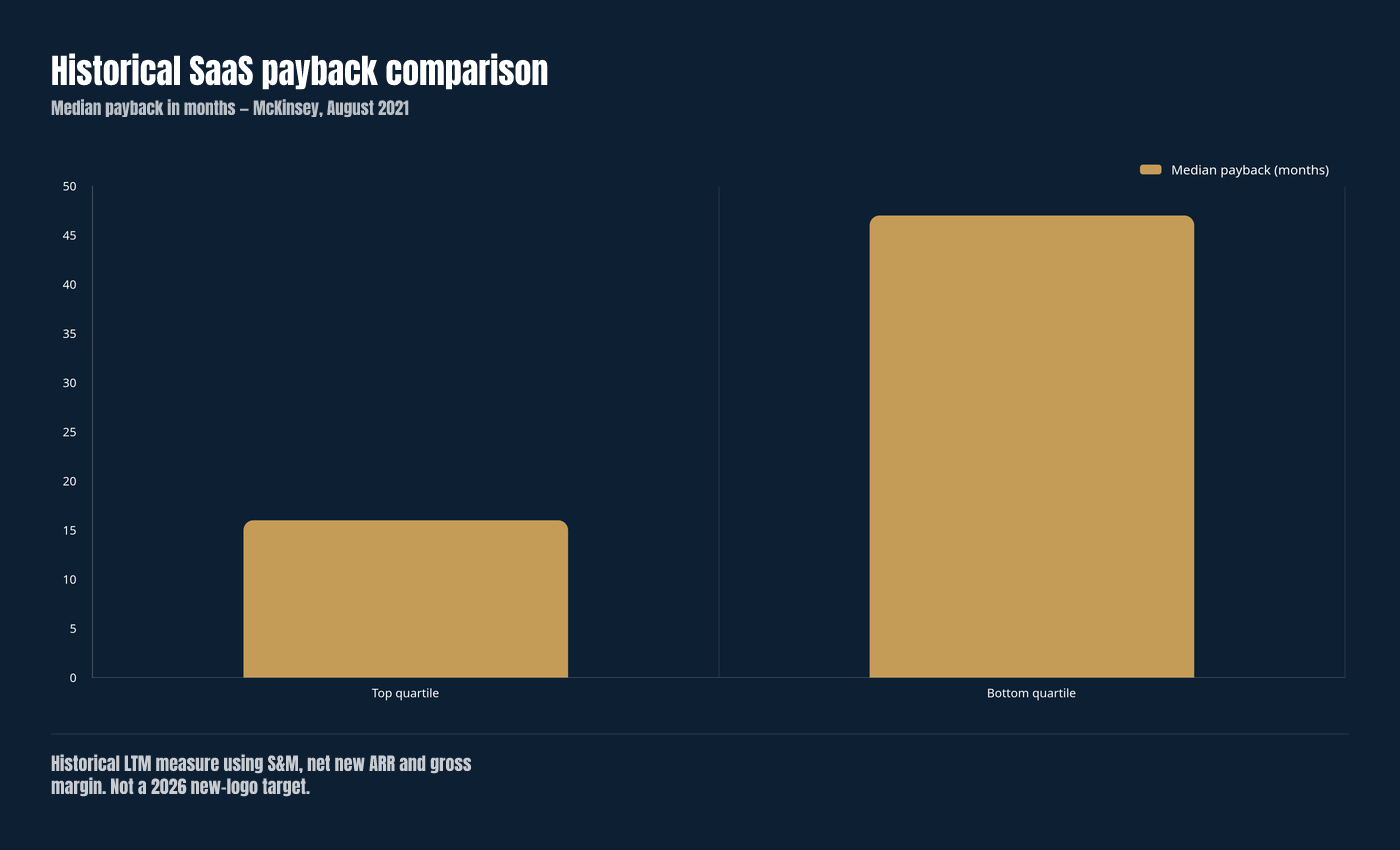
Use a consistent definition before comparing your result with a survey. Start with the CAC payback calculation and reconcile it with your cash flow forecast. Annual prepayment changes collection timing without changing the gross-profit payback formula.
In his LinkedIn post, Alex illustrates why channel-level payback can tell a different story from a blended number.
Gross margin: the metric that modifies everything else
SaaS gross margin is not a standalone metric - it's a multiplier that changes the meaning of every other unit economics figure.
Formula:
Gross margin % = (Revenue - COGS) ÷ Revenue × 100
Cost classification should reflect the work performed, not the department name. Hosting, production operations, embedded third-party services and delivery-related support normally affect cost of revenue. Selling, upselling and account-management activity belongs in operating expenses. Split mixed roles consistently, and assess implementation revenue and costs separately where appropriate.
SaaS Capital’s COGS framework, updated for 2025 makes this functional distinction. It reports 80–85% gross margins for pure SaaS licence revenue under its definition; that is a reference for that revenue mix, not a universal target for services-heavy or compute-intensive products.
Document your accounting policy and revenue mix before comparing margins. See the SaaS gross margin guide for the operating implications. Moving a cost below gross profit does not improve underlying cash generation.
Net revenue retention: the compounding engine behind good unit economics
Net revenue retention (NRR) - sometimes called net dollar retention (NDR) - measures how much revenue you retain and expand from your existing customer base over a 12-month period, expressed as a percentage.
Formula:
NRR = (Starting MRR + Expansion MRR - Contraction MRR - Churned MRR) ÷ Starting MRR × 100
Why NRR changes the unit economics picture:
NRR of 120% means the measured opening customer cohort produces 20% more recurring revenue by the end of the period after expansion, contraction and churn. It says nothing about new-logo revenue, does not guarantee future expansion, and does not change the new-customer denominator in acquisition CAC.
Compare retention within similar contract values, customer segments and measurement windows. Use the NRR benchmark guide to choose relevant peers. Track gross revenue retention too: expansion from a few accounts can hide losses elsewhere in the cohort.
The Rule of 40: a company-level cross-check
Add year-over-year revenue growth to free cash flow margin, using a consistent reporting period. At 25% revenue growth and an 18% FCF margin, the score is 43. State the profitability measure: substituting EBITDA or operating margin produces a different score, not an interchangeable answer.
McKinsey’s 2021 research found businesses exceeded the threshold 16% of the time across its 2011–2021 analysis. That is a frequency across observations, not the percentage of companies that ever qualified. Historical public-company findings are context, not a private-company approval gate.

"For a growth-stage company, inspect each component. A temporary margin gain from cuts can conceal weakening retention or product delivery."
— Aleksandar Stojanovic, CEO & Founder at FiscallionRecord which growth measure and cash-flow adjustments you use, then compare the same definition over time.
How AI usage changes unit economics
If model inference, retrieval or third-party processing costs rise with usage, model gross profit by customer and workload. A flat subscription can conceal a small group of customers with much higher delivery costs. Include retries, failed jobs and human review where they are part of delivering the service.
Start with measured costs rather than assuming an AI product must have a particular margin. Test usage tiers, overages and limits against customer value and expected behaviour. Recalculate LTV and payback with the resulting margin; do not copy a conventional SaaS margin into an AI-heavy model.
Common unit economics mistakes - and the replacement moves
Most teams at $5–50M ARR don't have bad intentions around unit economics. They have bad habits - most of which were inherited from investor decks rather than built from operational reality.
Mistake 1: Treating CAC and LTV as single numbers
What happens: You calculate one blended CAC and one LTV figure, put them on a slide, and present a 3.2:1 ratio. The board nods. Nothing changes.
The problem: A blended number hides segment-level decay. Your enterprise segment might show a 5:1 ratio while your SMB segment is destroying value at 0.8:1. You're cross-subsidizing bad economics with good, and reporting the average.
Replacement move: Break CAC and LTV by acquisition channel, customer segment (by ACV tier), and cohort vintage. Present as ranges, not points. Assign someone specific ownership of the inputs, not just the outputs.
Mistake 2: Using revenue-based LTV instead of gross margin LTV
What happens: LTV = ARPU ÷ churn. Looks great at $18,000. Then you close a fundraising conversation and the investor asks: "What's your gross margin?" The numbers don't connect.
Replacement move: Always calculate LTV on gross margin contribution. Run it on both bases in a model, note the difference, and present the gross margin version as your operating number.
Mistake 3: Ignoring payback period when making hiring decisions
What happens: You're at 18 months payback, burning $400K/month, with 14 months of runway. The head of sales asks for two more AEs. The model doesn't exist to evaluate the decision, so you hire on intuition.
Replacement move: Model payback period impact before approving headcount in S&M. If adding two AEs increases S&M spend by 30% but you don't have a pipeline model showing proportional new logo growth, the effective payback period extends - and runway shortens.
Mistake 4: Changing cost classification to improve the headline margin
What happens: A support team is moved out of COGS because the headline margin looks low, even though the work still delivers the service.
Replacement move: Allocate mixed delivery and selling roles by function, maintain a consistent policy and explain material changes. Use the COGS framework above; a reporting reclassification does not create savings.
Mistake 5: Treating the Rule of 40 as a target instead of a diagnostic
What happens: You're told to "hit Rule of 40." You cut R&D headcount by 20%, FCF margin improves by 8 points, and you technically cross 40. Investors seem satisfied. Then NRR drops six months later because you gutted the product roadmap.
Replacement move: Decompose Rule of 40 into its causal drivers. If you're below 40, determine whether the gap is a growth problem, a margin problem, or a capital efficiency problem. Each has a different fix. Cutting headcount to chase a composite number is the most expensive way to improve a ratio temporarily.
Worked example: one acquisition cohort, three different decisions
Illustrative assumptions, not a Fiscallion client case: A cohort contains 40 new paying accounts. Acquisition spend is $200,000, monthly revenue per account is $500, gross margin is 80%, and monthly account churn is 2%. Assume constant revenue and margin, no expansion and no contraction among surviving accounts.
| Calculation | Result |
|---|---|
| CAC: $200,000 ÷ 40 | $5,000 per account |
| Monthly gross profit: $500 × 0.80 | $400 per account |
| Simple LTV: $400 ÷ 0.02 | $20,000 per account |
| LTV:CAC: $20,000 ÷ $5,000 | 4.0:1 |
| Simple CAC payback: $5,000 ÷ $400 | 12.5 months |
The LTV result assumes the same churn rate continues indefinitely and ignores discounting. The 12.5-month payback is a steady-revenue proxy for an account that remains active, not the average realised recovery of the whole starting cohort. A retention-adjusted cohort model may recover acquisition cost later or never.

For an explicit 36-month horizon, assume the first $400 gross-profit contribution arrives in month one and each later month is weighted by 98% survival. Expected contribution per originally acquired account is $400 × (1 − 0.98^36) ÷ 0.02 = $10,336, rounded. This undiscounted finite-horizon value is different from the $20,000 perpetual estimate; label them separately.
| Stress test (other inputs unchanged) | LTV:CAC | Simple payback |
|---|---|---|
| CAC rises 20% to $6,000 | 3.33:1 | 15.0 months |
| Gross margin falls to 60% | 3.0:1 | 16.7 months |
| Monthly churn rises to 3% | 2.67:1 | 12.5 months for a surviving account; cohort recovery worsens |
The acquisition decision changes with the stress case. Higher delivery cost affects both LTV and payback; higher churn weakens lifetime recovery even when the simple payback formula does not move. Reconcile the cohort cash schedule, payment terms and hiring ramp with runway before approving spend.
Alex also shares a workbook that brings growth, retention, efficiency and runway metrics into one model.

What to do next: seven actions in order of impact
Use this sequence to move from consistent inputs to a decision-ready model. Each has a named owner because metrics without ownership are decoration.
- Define your unit and lock the definition in writing. (Owner: Head of Finance or Founder) Decide whether "unit" means a customer account, a cohort, or a seat. Document inclusion/exclusion rules for CAC and LTV inputs. Do this before recalculating anything.
- Rebuild CAC from fully-loaded costs. (Owner: Finance) Pull every S&M cost for the last four quarters - salaries, commissions, tools, paid media, contractor fees. Divide by new logos only. Compare to your previously reported figure.
- Calculate LTV on gross margin, by cohort. (Owner: Finance + RevOps) Run LTV for customers acquired in each of the last six quarters using actual retention and expansion data. Map the range. If the most recent cohort shows declining LTV, name the cause.
- Calculate payback period and map it to cash runway. (Owner: CFO or Founder) Payback period tells you how long you're pre-financing customer value. If that number is approaching or exceeding your available cash runway, it is the most urgent item in your next board deck.
- Track NRR monthly, not quarterly. (Owner: RevOps + Finance) Review monthly cohort movements alongside trailing-12-month NRR, so a changing mix is visible before the next quarterly board discussion.
- Calculate your Rule of 40 score for the last four quarters. (Owner: Finance) Track trend, not just the current number. Is it improving or deteriorating? If improving, what's driving it - growth or margin? If deteriorating, which component is moving faster?
- Present unit economics as a range with stated assumptions. (Owner: Founder + Board prep) In your next board deck, replace the single-number slide with a table showing base case, upside case, and stress case. Assign each input an owner. This is the difference between reporting history and framing decisions.
Decision-ready unit economics: a working checklist
Most unit economics failures are not calculation errors. They are definition and ownership problems. This checklist is designed to catch both before your next board meeting.
Definitions and inputs
- Unit defined in writing (account, cohort, or seat) with inclusion/exclusion rules
- CAC calculated on fully-loaded S&M costs, new logos only
- LTV calculated on gross margin contribution, not revenue
- Gross margin calculated with appropriate COGS classification (CS costs separated)
- Expansion revenue included in LTV calculation with explicit assumption
Calculations
- LTV:CAC ratio calculated by segment (not just blended)
- CAC payback period calculated and mapped to cash runway
- NRR calculated for last 12 months and tracked monthly
- Rule of 40 score calculated using FCF margin (not EBITDA)
- Cohort-level LTV calculated for last 4–6 acquisition cohorts
Interpretation and action
- LTV:CAC presented as a range (stress / base / upside)
- Trend identified: are unit economics improving or deteriorating quarter-over-quarter?
- Named owner for each key input (not just the output metric)
- Payback period stress-tested against a 20% increase in CAC
- Rule of 40 decomposed - growth component vs. margin component trend
Board and investor readiness
- Metrics definitions written down and consistent with prior period presentations
- Cohort data visualized - not just the blended number
- Trade-off framed: what would it cost to improve each metric by 10 points, and what does that do to runway?
Your unit economics model is only as useful as the decisions it changes
SaaS unit economics is not a reporting exercise. It is the analytical foundation for every major capital allocation decision you make - whether to hire in S&M, which customer segment to double down on, whether your payback period is compatible with your cash position, and how to position growth vs. profitability for your next raise.
The companies that get this right at $5–50M ARR don't have more metrics. They have better-defined inputs, ownership at the assumption level, and a consistent practice of presenting economics as ranges rather than single numbers.
The most common failure mode Fiscallion sees is not incorrect math - it's a mismatch between what the metrics say and what decisions they're actually informing. CAC and LTV get calculated for the deck. They don't get used to decide whether the next two AE hires extend or compress payback period. That's the gap worth closing.
If you want to audit your current metrics definitions and see where your unit economics model has implicit assumptions that nobody owns, start with the worked example and checklist above, then build the model using your own cost and retention data.
For help reconciling acquisition costs, retention and runway, talk to Fiscallion about a model built around your actual customer cohorts.
Frequently asked questions
What is SaaS economics?
SaaS economics describes the financial mechanics that determine whether a subscription software business creates value at the individual customer level. It encompasses how much it costs to acquire a customer (CAC), how much gross profit that customer generates over their lifetime (LTV), how quickly those costs are recovered (payback period), and how efficiently the business balances growth and profitability (Rule of 40, NRR). The defining structural feature of SaaS economics is the time lag between upfront acquisition spend and deferred revenue recovery - a dynamic that makes cash management, churn, and gross margin far more consequential than in traditional product or services businesses.
What is a SaaS unit?
A SaaS unit is the base entity used to measure unit economics. It is most commonly defined as a single customer account, though it can also be defined as a cohort (a group of customers acquired in the same period) or a seat/user in per-seat pricing models. The definition matters because it determines how CAC and LTV are calculated, whether expansion revenue is included in lifetime value, and how churn is measured. There is no single universal definition - the right unit depends on your pricing model and the decisions you need the economics to inform. What matters most is consistency: once defined, the unit definition should be locked and applied uniformly across all calculations and reporting periods.
Is the Rule of 40 a unit economics metric?
It is a company-level growth-and-margin diagnostic. Use it alongside customer-level CAC, gross-profit LTV and payback; it cannot establish whether an individual acquisition channel creates value.
What if expansion exceeds churn in the LTV formula?
Use a finite-horizon cohort model with explicit expansion, churn, margin and discount assumptions. A zero or negative churn-minus-expansion denominator does not produce a meaningful lifetime value.
Does a 4:1 LTV:CAC ratio mean we should spend more?
Not by itself. Check the age and retention of the cohort, payback, available cash and the incremental cost of the next acquisition channel. A historical blended ratio may not describe the next customers you win.