

Revenue-based financing is either the right tool for your stage or a cash flow trap. Most founders who get it wrong do so because they evaluated the repayment cap as if it were an interest rate, skipped the cash flow model, and deployed the capital into general operating expenses rather than specific initiatives with a measurable return.
This article gives you the CFO-level framing to evaluate RBF the right way - what it is, how to calculate its true cost, where it fits in your capital stack alongside venture debt and equity, and the four decision criteria that separate a good RBF match from a risky one.
Key takeaways
- The repayment cap is not your cost of capital. The effective APR on RBF depends on how fast you repay, which depends on how fast your revenue grows. At 12-month repayment, a 1.25x cap can carry an effective APR above 40%.
- RBF is non-dilutive but not free. The finite cost is a feature, but it comes out of top-line revenue - not profit. Thin gross margins make RBF repayments structurally dangerous.
- The right use is specific and ROI-mapped. RBF capital deployed against a proven acquisition channel or a quota-carrying hire is a different financial decision from RBF capital used to cover payroll when bookings slow.
- Model three scenarios before signing. A base case is not a stress test. You need a slow-growth scenario and a churn scenario to know whether repayments will crowd out the investments that create growth.
What revenue-based financing actually is
Revenue-based financing (RBF) is a form of non-dilutive debt where a provider advances capital upfront, and you repay a fixed percentage of monthly gross revenue until a pre-agreed total - the repayment cap - has been returned.
No equity is exchanged. No board seat is granted. No personal guarantee is typically required. The instrument is underwritten against your recurring revenue and business metrics, not against your collateral or credit history.
For SaaS companies, RBF is structurally well-matched because recurring revenue is predictable enough for a provider to model repayment probability. The payment obligation is variable by design - when revenue grows, repayments accelerate; when revenue dips, repayments slow proportionally. The total repayment amount, however, is fixed.
As a16z describes in their guide to raising debt for startups, recurring revenue advances work by converting future cash flows into capital today - a structure that fits SaaS businesses with predictable ARR and low churn far better than collateral-based lending.
The three terms you must understand before evaluating any offer
The repayment cap is often described as the "cost" of RBF. It is not. It is the ceiling on total repayment. The actual cost - expressed as an annual percentage rate - depends on how quickly you reach that ceiling.
How to calculate the true cost of RBF
This is where most founders misread an RBF offer. A 1.25x cap on a $200K advance means you repay $250K total. That sounds transparent. It is not the full picture.
The effective APR calculation
Use the internal rate of return (IRR) method applied to your monthly repayment cash flows. The formula logic is straightforward:
- Start with the advance amount as a positive cash inflow in month 0.
- Project monthly repayments using your forecasted revenue multiplied by the repayment rate.
- Continue until the repayment cap is reached.
- Calculate the monthly IRR of those cash flows, then annualize it:
(1 + monthly IRR)^12 - 1
The result is your effective APR. Run this for three revenue growth scenarios - your base case, a downside (say, 1-2% monthly growth), and a flat-revenue scenario.

The chart above illustrates why fast-growth companies should be especially deliberate about RBF. If you repay in 12 months because your revenue scales quickly, your effective APR on a 1.25x cap can exceed 40%. That is not a reason to avoid RBF - but it is a reason to treat the cost comparison against equity on a longer time horizon, not a short one.
A worked example
- Advance: $150,000
- Repayment cap: 1.25x = $187,500 total
- Repayment rate: 5% of monthly gross revenue
At $250,000 MRR growing 4% per month, your projected payoff time is roughly 15-16 months. Effective APR is approximately 27%.
At flat $200,000 MRR, payoff takes around 22-24 months. Effective APR drops to roughly 18-20%.
Neither number is alarming for a capital allocation that funds a channel with a 6-month CAC payback period. Both numbers are problematic if the advance is being used to cover operating cash deficits with no clear path to revenue growth from the deployment.
RBF cost vs. equity: the comparison most founders get wrong
The correct comparison between RBF and equity is not the cost today. It is the cost at exit.

Selling 10% of your company at a $2.25M pre-money valuation for $250K costs $75,000 in absolute terms if you exit at $3M. It costs $500,000 if you exit at $5M and $2.5M if you exit at $25M.
Many founders automatically default to equity rounds because they judge the expense of debt on a short-term timeline rather than evaluating true financial impact at maturity. Reframing the comparison to calculate what percentage of the company is sacrificed under each option completely shifts how a leadership team weights its long-term choices.
The RBF cost stays at $75,000 regardless. That is a structural argument for using RBF to fund short-to-medium-horizon initiatives when you have high conviction in eventual exit value.
RBF vs. venture debt vs. equity: the decision framework
These three instruments solve different problems. Conflating them leads to the wrong choice.
The clearest practical distinction between RBF and venture debt is what the provider is underwriting against. RBF providers underwrite against your revenue stream. Venture debt providers underwrite against your last round and your investors' willingness to support the business. This is why venture debt is typically inaccessible without a recent institutional equity round - and why RBF can be the right instrument for a capital-efficient bootstrapped SaaS business that has never raised institutional equity.
For a deeper look at how venture debt works and what it costs across different scenarios, our analysis of venture debt for SaaS startups covers the instrument in comparable detail.
When RBF actually fits your stage
RBF is not broadly applicable. The following criteria define the conditions where it makes financial sense.
Criterion 1: your gross margin can absorb the repayment
RBF repayments come out of gross revenue before you cover COGS or operating expenses. If your gross margin is 50%, a 5% repayment rate reduces your effective contribution on new revenue by 10 margin points (5% ÷ 50%) before any other cost is applied. At 70% gross margin, the same 5% repayment rate is a 7-point drag.
This is manageable if the deployment generates incremental revenue with a clear payback period. It is not manageable if your gross margin is under 45% and the advance is being used for anything that doesn't directly increase monthly recurring revenue.
Understanding how gross margin interacts with your full SaaS unit economics - including LTV, CAC, and payback period - is essential before you commit any portion of top-line revenue to a repayment obligation.
Minimum threshold: gross margin at or above 50% before signing. Below that, model the repayment impact explicitly before proceeding.
Criterion 2: you have a specific, ROI-mappable use case
RBF capital used to scale a proven paid acquisition channel, fund a customer success hire with measurable churn reduction, or bridge a working capital gap ahead of annual invoice collection is a defined financial decision. The use case generates revenue that pays back the advance, and the math is traceable.
RBF capital used to extend runway because growth has stalled, to fund general R&D, or to cover payroll while you rethink GTM is not a defined financial decision. The repayments will still arrive monthly as a percentage of whatever revenue you do generate - and that pressure makes it harder to fix the underlying problem.
Owner: whoever runs the initiative that receives the capital must own the return model. If nobody owns the input assumptions on the deployment plan, do not take the advance.
Criterion 3: you have at least 12-18 months of runway before applying
The best RBF terms go to companies that do not need the capital urgently. Providers who specialize in SaaS can identify companies applying from a position of desperation - and they price accordingly.
Applying with 18+ months of runway means you can negotiate rate, repayment percentage, and term length from a position of alternatives. Applying with 3 months of runway means you are underwriting at the worst possible rate and committing a significant portion of constrained revenue to repayments during the months you most need cash flexibility.
If your current runway number is fuzzy, get it precise first. Our startup runway calculation guide covers the gross vs. net burn distinction, the 3-month trailing average method, and how to build the scenario model that turns a static number into a decision instrument.
Criterion 4: MRR is stable or growing, not contracting
If your MRR has been flat or declining for two or more consecutive quarters, RBF is the wrong instrument. Declining revenue means repayments shrink - but so does your capacity to invest in recovery. The agreement does not get better as the business gets worse. It just gets slower to repay, and the remaining balance persists on your balance sheet as a liability while you try to stabilize.
This is the same guidance that applies to venture debt: the instrument does not save struggling companies. It extends capability for companies on a clear trajectory. Tracking net revenue retention alongside MRR growth gives you an early signal on whether the revenue base is stable enough to support a repayment obligation before you sign one.
The cash flow model you should build before signing
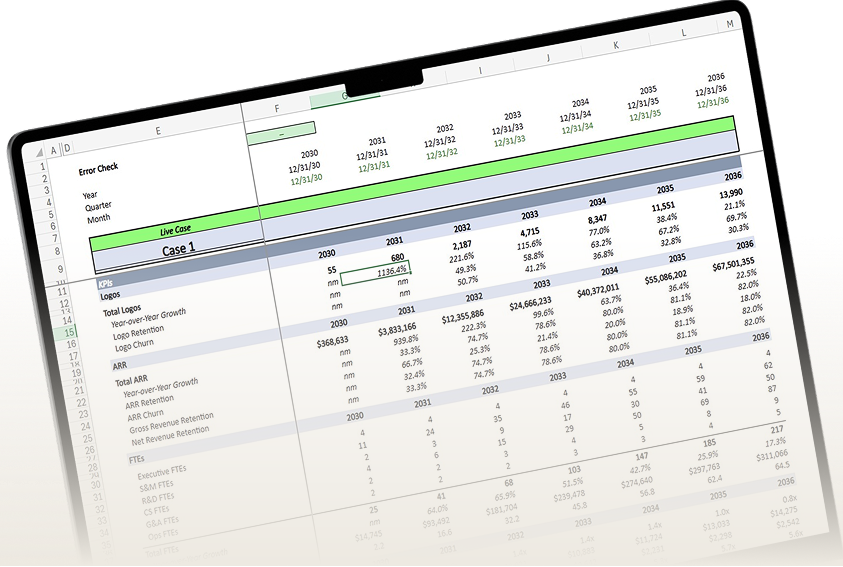
Before you sign any RBF agreement, build a 12-month cash flow projection that explicitly models the repayment drag. This does not need to be a full three-statement model. A focused spreadsheet with the following rows is enough:
- Monthly gross revenue - your base case, using recent growth rates.
- RBF repayment - gross revenue multiplied by the agreed repayment rate.
- Net revenue after repayment - the amount you actually have available for operations.
- COGS - pull from your accounting system (QuickBooks, Xero, or wherever you track it).
- Gross profit after repayment - net revenue minus COGS.
- Operating expenses - fixed and variable, broken out by team.
- Net cash flow - gross profit after repayment minus OpEx.
- Cumulative cash balance - starting with current cash.
Then run two stress scenarios:
- Slow growth: Revenue grows at 1% per month instead of your base case rate.
- Churn shock: A single large customer churns, dropping MRR by 15-20% in one month, with a 3-month recovery.
The question you are answering is whether the repayment obligation leaves enough cash in each month to continue funding the initiatives that drive growth. If either stress scenario puts you below a 60-day cash buffer, the repayment rate is too high or the advance is too large relative to your current revenue base.
The same modeling discipline applies here as it does to a SaaS financial model generally: assumptions about churn, growth rate, and operating cost need to be explicit and attributable, not embedded in a single-scenario spreadsheet. That distinction separates a model that drives a decision from one that only documents it.
Reading an RBF term sheet: four areas that matter beyond the cap
The repayment cap gets all the attention. These four areas deserve equal scrutiny.
1. Fees outside the cap
Origination fees, platform fees, or monthly servicing fees add to your total cost of capital even when the repayment cap looks conservative. A 1.2x cap with a 2% origination fee on a $300K advance is not 1.2x - it is 1.2x plus $6,000 upfront, bringing your total cost to $66,000 rather than $60,000. On smaller advances, fees represent a material uplift to the effective rate.
Ask for the full cash-out reconciliation, not just the stated multiple.
2. Minimum monthly payment clauses
Some RBF agreements include a floor on monthly repayments - typically expressed as a minimum dollar amount regardless of revenue. This eliminates the variable repayment flexibility that is the primary structural argument for RBF over a fixed-term loan. If revenue drops significantly and a minimum payment clause kicks in, you effectively have a fixed obligation that does not adjust with your business.
If a minimum payment clause exists, model it into your stress scenarios explicitly.
3. Acceleration triggers
An acceleration clause allows the provider to demand full repayment of the remaining cap balance in a single payment under certain events. Common triggers include a change of control (acquisition), breach of a covenant, material adverse change (MAC) determination, or failure to maintain a minimum cash balance.
Acquisition triggers are particularly important. If you are building toward an exit in the next 18-36 months, an RBF agreement with an acceleration clause tied to change of control can create a large payoff obligation at the exact moment your acquirer is diligencing your liabilities. Negotiate this clause carefully or avoid it.
As a16z notes in their debt-raising framework, covenants and acceleration mechanics deserve as much attention as the headline rate - because a breach can give lenders significant leverage over company decisions at the worst possible moment.
4. Warrants
Pure RBF does not include warrants. If a provider includes warrants in the term sheet, you are looking at a hybrid debt product. The warrant creates future dilution - typically small (0.5-1%), but it compromises the non-dilutive claim. Warrants are standard in venture debt. They are a flag to scrutinize in a product marketed as equity-free capital.
Common mistakes and the replacement moves
Most RBF mistakes happen before the term sheet is signed. These are the five patterns Fiscallion sees most often, and the replacement move for each.
Mistake: evaluating the cap as an annual interest rate
The replacement: calculate effective APR using the IRR method across three revenue scenarios (base, slow growth, flat). The cap is the ceiling; the rate is the variable.
Mistake: treating RBF as a runway extension tool when growth is stalling
The replacement: use RBF to fund specific growth initiatives with measurable ROI, not to delay hard decisions about GTM, pricing, or cost structure. If growth is stalling, the constraint is usually a product, pricing, or retention problem - not a capital problem. A cohort analysis will often surface which customer segments are driving churn before you reach for external capital to paper over the symptom.
Treating a revenue-linked advance as a low-friction runway extension when primary growth engines are actively stalling is an incredibly dangerous operational move. When top-line expansion dips but fixed repayment percentages remain completely locked in, the resulting cash flow squeeze will severely accelerate a company’s burn rate.
Mistake: applying without running a cash flow stress test
The replacement: before signing, build the 12-month model with a slow-growth scenario and a churn scenario. If either scenario breaks your 60-day cash buffer, renegotiate the repayment rate or reduce the advance amount.
Mistake: letting the repayment rate eat into the investment that generates growth
The replacement: size the advance and repayment rate so that the net revenue after repayments still funds the activity that drives the return. If a 7% repayment rate means you cannot fund the sales hire that the advance was meant to pay for, negotiate a 3-4% rate with a longer term.
Mistake: not reading the acceleration clause carefully in an M&A-likely scenario
The replacement: if you have a credible acquisition path in the next 24 months, involve legal counsel in reviewing the change-of-control definition before signing. An unexpected full-balance payoff obligation at close can complicate deal mechanics significantly. This is the same diligence discipline covered in our due diligence checklist for startups - liabilities with acceleration triggers must be identified and quantified before an acquirer's team finds them.
The RBF decision checklist
RBF signed without a cash flow model and a stress test is almost always the wrong decision. This checklist is designed to prevent that — use it as a pre-signing review, not a post-signing summary.
- MRR is stable or growing for at least 3 consecutive months
- Gross margin is at or above 50%
- 12-18 months of runway at current burn before applying
- Specific use case identified with a named owner and ROI model
- 12-month cash flow model completed with base, slow-growth, and churn-shock scenarios
- Effective APR calculated using IRR method across all three scenarios
- Term sheet reviewed for origination/platform fees beyond the stated cap
- Minimum monthly payment clause identified or confirmed absent
- Acceleration triggers reviewed and negotiated, especially change of control
- Warrant clause confirmed absent or quantified if present
- Capital deployment timeline mapped to repayment model (are you generating revenue before the repayment curve peaks?)
What to do next: actions ordered by impact
- Build the cash flow model before any other evaluation step. Owner: whoever runs financial planning. Three scenarios, 12 months, with repayment rate applied to monthly revenue line. This takes 2-4 hours and prevents the most common mistakes.
- Map your use case to a specific ROI estimate. If you cannot articulate the expected incremental MRR from the deployment and a CAC payback period, the use case is not ready. Define it, assign an owner to the assumption, and stress-test the return estimate against your actual unit economics.
- Apply with runway, not urgency. The 12-18 month runway threshold is not arbitrary. Providers can identify distress and price accordingly. If you are inside 6 months of runway, the right tool is likely a capital raise or a cost restructuring, not RBF.
- Collect two to three term sheets and compare total costs, not caps. Pull out all fees, calculate effective APR at each provider under your base scenario, and compare those numbers - not the headline multiples.
- Get legal review on acceleration triggers before signing, not after. If your exit timeline is within 24 months, this clause deserves 2-3 hours of counsel time. It is cheaper than a renegotiation at close.
- Revisit the capital structure decision quarterly. RBF may be the right instrument at $500K MRR and the wrong instrument at $3M MRR if your gross margin has improved enough to access venture debt at better rates with less restrictive repayment mechanics. Capital structure decisions are not permanent.
Is RBF a good match for your business?
Revenue-based financing is a legitimate and often well-matched capital instrument for SaaS companies at the right stage. The structural case is clear: a finite, non-dilutive cost that comes out of growing revenue is a meaningful advantage over equity when exit value is high. The risk is also clear: repayments come from top-line revenue before margin, the effective APR is higher than the cap suggests when growth is fast, and the instrument does not work as a rescue mechanism for a business with declining metrics.
The decision reduces to four questions. Does your gross margin absorb the repayment rate without crowding out growth? Is the use case specific, owned, and ROI-mappable? Do you have enough runway to negotiate from strength? And have you run the cash flow model across at least three scenarios?
If the answer to all four is yes, RBF is worth pursuing. If any of the four is uncertain, resolve the uncertainty before signing - not after the capital hits your account.
At Fiscallion, our approach to capital structure decisions at the $5-50M ARR stage always starts with the model, not the instrument. The instrument follows once the use case, the runway position, and the repayment capacity are quantified. If you want a working session to model your RBF decision or compare it against alternative capital structures, book a working session with our team.