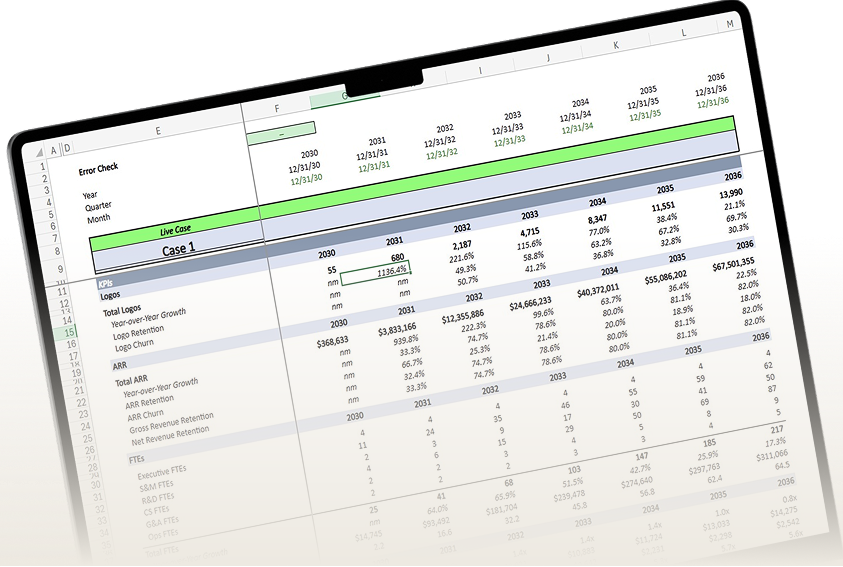


Most founders we work with at Fiscallion arrive with one of two financial models: an elaborate spreadsheet that took six weeks to build and still can't answer a basic "what happens if churn hits 8%?" question, or nothing at all. Both situations are equally dangerous when an investor is in the room.
A SaaS financial model template is not a formality. It is the one artifact that forces you to articulate the mechanics of your business in numbers - how you acquire customers, at what cost, how long they stay, and what that means for cash in the bank six months from now. When it is built right, it becomes your primary operational planning tool and your most credible investor-facing document at the same time.
This guide covers what a SaaS financial model actually needs to contain, how to build the core structure from scratch, the benchmarks that separate investor-grade models from founder fantasies, and the specific mistakes that will get you dismissed in a due diligence meeting before the second slide.
What you'll learn
- The four non-negotiable components of any serious financial model, mapped to SaaS-specific dynamics
- How to build a bottom-up MRR engine that drives the rest of your model
- The SaaS unit economics your model must surface (and what the benchmarks actually are)
- What the Rule of 40 means, how to calculate it, and when it matters for your stage
- Why scenario planning separates operational models from pitch-deck templates
- A clear-eyed answer to whether AI tools like ChatGPT can replace a structured financial model
- The signals in your model that investors and acquirers check first
What a SaaS financial model actually is
A SaaS financial model is a dynamic, assumption-driven projection of your company's revenue, costs, cash, and key metrics over a defined time horizon - typically 24 to 36 months for operational use, and sometimes extending to five years for fundraising or M&A contexts.
What makes it different from a generic business model is its structural anchor in recurring revenue. Traditional businesses model one-time sales. SaaS models subscription dynamics: monthly recurring revenue (MRR) that compounds through new customer acquisition, expands through upsell, and contracts through churn and downgrades. Every number in your model flows from those dynamics.
A well-built SaaS financial model serves three concrete purposes:
Operational planning. It answers the questions that matter week to week: how many quota-carrying reps do you need to hit $5M ARR? When does the business run out of cash at current burn? What does a 2-point increase in monthly churn do to your runway?
Investor readiness. Every serious investor - whether a VC, strategic buyer, or revenue-based lender - will scrutinize your model before committing capital. The model signals whether you understand the mechanics of your own business, not just its ambitions. For venture-backed startups, this scrutiny typically intensifies at each successive round as the stakes and diligence depth both increase.
Valuation alignment. Your metrics determine your multiple. Private SaaS companies trade at a median of roughly 4.8x ARR (SaaS Capital, 2025). Companies with strong NRR and efficient growth can command 8-12x. The model is where those metrics live and get stress-tested.
The 4 components of a SaaS financial model
Every credible SaaS financial model template - whether you are pre-revenue or at $30M ARR - is built on four structural components. These are not sections to complete in order; they are interdependent layers where the outputs of one become the inputs of the next.
1. Revenue model
The revenue model is the engine. Everything else depends on it being accurate.
The only approach that holds up to investor scrutiny is a bottom-up build: you derive revenue from specific assumptions about leads, conversion rates, average contract value (ACV), and customer retention - not from top-down percentages of a total addressable market.
Your MRR at any point in time is the net result of four components:
- New MRR - Revenue from customers acquired in the period. Driven by lead volume, channel-specific conversion rates, and ACV. The median ACV for private SaaS companies is roughly $62,000 (KeyBanc & Sapphire Ventures, 2024), but this varies enormously by customer segment.
- Expansion MRR - Revenue added from existing customers through upsells, seat additions, and cross-sells. This is the engine behind net revenue retention (NRR) above 100%.
- Contraction MRR - Revenue reduced by existing customers who downgrade or reduce usage.
- Churned MRR - Revenue lost entirely when a customer cancels.
The formula is straightforward:
Net MRR = New MRR + Expansion MRR - Contraction MRR - Churned MRR
Most early-stage founders model only new MRR and churned MRR, which gives them a structurally incomplete picture. Expansion MRR is the most capital-efficient revenue you will ever generate - it costs a fraction of new logo acquisition and carries your best gross margin.
2. Cost structure
SaaS costs fall into two categories, and their benchmarks diverge sharply by company stage.
Cost of goods sold (COGS): Includes hosting, infrastructure, customer support, and professional services delivery. Subscription gross margin should land at 75-80% or higher at scale. If your gross margin sits below 70%, most investors will flag a cost structure problem before looking at anything else.
Operating expenses (OpEx): The four main buckets are sales and marketing (S&M), research and development (R&D), general and administrative (G&A), and any customer success costs that are not already in COGS. S&M is the largest line item for most growth-stage SaaS companies and the one with the most variability.

A useful efficiency benchmark: median revenue per employee for private SaaS companies is around $130,000 (SaaS Capital, 2025). If you are well below that number, your model needs to show a path to improving headcount efficiency - not just revenue growth.
3. Unit economics
Unit economics determine whether your business model actually works at the per-customer level. Three metrics carry the most weight:
LTV:CAC ratio - Customer lifetime value divided by customer acquisition cost. The median is 3.6:1 (Benchmarkit, 2024). Below 3:1, you are spending too much to acquire customers relative to what they return. Above 5:1, you may be leaving growth on the table by underinvesting in acquisition.
CAC payback period - How many months it takes to recover the cost of acquiring a new customer. The formula is:
CAC payback (months) = CAC ÷ (New MRR per customer × Gross margin %)
The median is around 20 months across private SaaS (KeyBanc & Sapphire Ventures, 2024). SMB-focused SaaS should target under 12 months; enterprise models can justify 18 months and sometimes longer with strong NRR. At Fiscallion, we have seen CAC payback analysis completely reframe acquisition strategy at companies that looked healthy on blended numbers - a dynamic we cover in depth in our CAC payback period analysis.
Magic number - New net ARR divided by S&M spend. A magic number above 1.0 means each dollar of S&M generates more than a dollar of ARR - a clear signal that scaling the acquisition engine is the right call. Below 0.75 is a warning sign.
4. Cash flow and runway
You can have a revenue model that looks great on paper while the company runs out of cash. The cash flow layer is where that gap becomes visible.
Your model needs a monthly cash flow projection that tracks the actual timing of cash coming in (collections, contract payment terms) and cash going out (payroll, infrastructure, vendor payments). Net burn and runway - months of cash remaining at current burn - are the two numbers your board will ask about first.
Build at least three scenarios:
- Base case - Your most realistic projection based on current pipeline and trends
- Target case - What you are managing the business toward, with identified levers
- Downside case - What happens if sales cycles extend, churn increases, or a key hire takes longer than expected
Investors do not expect your base case to be right. They expect you to have stress-tested it.
How to build your MRR engine: the core of the template
Every other section in your SaaS financial model template is downstream of how you model MRR. Here is the specific structure that holds up from Seed through Series B.
Start with cohort-based customer adds
Do not model customers as a single aggregate number growing at a flat rate. Build a cohort table: each month of new customer additions is its own row, carrying its own churn curve. This matters because:
- Early cohorts have higher churn than mature cohorts in most SaaS products
- Different acquisition channels have very different retention profiles
- Expansion MRR accrues differently by cohort vintage
Model churn dynamically by segment
Hardcoding a single churn rate - say, 2% monthly across all customers - is the most common and most misleading simplification in SaaS models. At minimum, separate SMB from enterprise churn rates. The difference can be 3x. As you scale, add channel-level and cohort-level churn assumptions.
SaaS Capital's research on retention benchmarks consistently shows that companies in the top retention quartile grow faster with less capital - not because they win more customers, but because they keep them longer. That compounding effect starts with how you model churn in the first place.
Separate gross revenue retention from net revenue retention
Gross revenue retention (GRR) measures how much of last period's revenue you kept, before expansion. NRR includes expansion. A company with 95% GRR and 115% NRR is a fundamentally different business from one with 95% GRR and 102% NRR, even if the top-line growth rate looks similar. Build both into your template explicitly.
Build your headcount plan directly into the model
Headcount is usually the single largest driver of both cost and growth capacity in a SaaS business. Every new quota-carrying rep has a ramp period (typically 3-6 months before they hit full productivity). Model ramp explicitly. Build your sales capacity - fully ramped quota times number of reps times attainment rate - and check it against your ARR growth target. If the capacity does not exist to hit the target, the revenue assumption is wrong.
What the Rule of 40 is and why it belongs in your model
The formula
The Rule of 40 is a single composite metric that summarizes a SaaS company's balance between growth and profitability:
Rule of 40 = Revenue growth rate (YoY %) + Profit margin (%)
If the combined figure equals or exceeds 40, the company is considered financially healthy by the standard most investors and acquirers apply. A company growing at 60% with a -15% EBITDA margin scores 45 - healthy. A company growing at 10% with a 25% EBITDA margin also scores 35 - which is below threshold and signals stagnation without the efficiency to compensate.
The profit margin component can be expressed as EBITDA margin, operating margin, or free cash flow margin. Most SaaS practitioners use EBITDA margin for comparability. The key is consistency: pick one definition and hold it across reporting periods.
The Rule of 40 was popularized by Brad Feld of Foundry Group as a shortcut for boards to cut through complex financials and quickly assess whether a SaaS company is scaling sustainably. McKinsey's analysis of the Rule of 40 found that top-quartile software companies exceeding the threshold generated shareholder returns 15 percentage points higher than peers, validating it as more than just a board heuristic.
How it plays out at different stages
The Rule of 40 does not mean the same thing across all company stages.
- Early-stage ($1-5M ARR): Most companies should be investing heavily in growth and will carry negative margins. A company growing at 120% with -70% EBITDA margin scores 50 - technically passing. But the sustainability of that growth investment is a separate question.
- Growth-stage ($5-20M ARR): The score needs to start climbing toward 40 as growth inevitably slows. If you are growing at 50% with -15% margins, you are at 35 - close but not there, and the trend matters as much as the number.
- Scale-up ($20-50M ARR): Hitting 40+ is expected by most institutional investors. Below this threshold will trigger questions about your path to capital efficiency.
- Mature ($50M+ ARR): Growth rates are lower, so profitability must carry more of the score. BCG's research on top Rule of 40 performers in software found that the leaders at this stage typically achieve scores of 55-60+ through systematic operational leverage rather than cost-cutting.

Where it belongs in your model
Your Rule of 40 score should be calculated automatically as a summary metric in your financial model's dashboard tab - updated monthly as actuals come in and projected forward in each scenario. It functions as a single-number health check that translates the rest of your model into the language investors and board members think in.
One important caveat: the Rule of 40 is a diagnostic, not a strategy. A company that engineers its way to a 40 score by cutting R&D and customer success is damaging its future growth while its present number looks acceptable. Your model should show the inputs behind the score, not just the composite.
SaaS-specific metrics your model must surface
Beyond the Rule of 40, a complete SaaS financial model template needs to surface the following metrics - ideally in a KPI dashboard tab that auto-calculates from the underlying assumptions:
Each of these should be visible at the model summary level without having to navigate into the underlying tabs - and each should update automatically as assumptions change.
The way we approach this at Fiscallion is to tie every KPI directly to the assumption cells that drive it, so a founder can change a single growth rate or churn assumption and immediately see the impact on Rule of 40, runway, and LTV:CAC. Static models where KPIs are entered manually are a liability, not an asset. For SaaS startups in particular, this live feedback loop between assumptions and outcomes is what turns a financial model from a static document into an operational tool.
Common mistakes that make a SaaS financial model worthless
Top-down revenue forecasting
"We will capture 1% of a $50B market" is not a financial model. It is an aspiration. Investors have seen thousands of these and learned to discount them entirely. Your revenue projections need to be built from specific pipeline assumptions: leads per channel, conversion rates by stage, ACV, and sales cycle length. Top-down is useful only as a sanity check against your bottom-up build.
Static, single-rate churn assumptions
A flat monthly churn rate applied uniformly across all customers and all time periods is the most common structural flaw we audit in founder models. In reality, churn varies by customer segment (SMB churns faster than enterprise), by cohort vintage (newer customers churn faster), and by contract length (month-to-month churns faster than annual). Model it that way.
Inflated gross margins
Pushing customer support costs or implementation expenses out of COGS to inflate your gross margin is a red flag experienced investors catch immediately. A 77% gross margin with honest cost allocation is more credible than an 85% margin that redistributes costs into OpEx. Build it correctly from the start.
Ignoring the CAC payback cash gap
Positive LTV:CAC on paper can coexist with a cash crisis in practice. If it costs $50,000 to acquire a customer paying $2,500/month at 75% gross margin, you need roughly 27 months to recover that acquisition cost. If you are growing fast and acquiring 20 new customers per month, you are carrying $1M in unrecovered CAC at any given time. That cash needs to come from somewhere.
Our deep-dive on why blended CAC payback is often misleading shows exactly how channel mix distorts the headline number - and what to do about it.
One-scenario planning
A model with only a best-case scenario is a pitch deck, not a planning tool. If you cannot articulate what happens to runway in a downside scenario where growth slows by 30% and churn rises by 2 points, you do not actually understand your business. Investors know this, and they will test you on it.
Ignoring headcount ramp
Most founders model new sales hires as immediately productive. In reality, a new Account Executive takes 3-6 months to reach full productivity. A model that assumes full productivity from day one will consistently overstate near-term revenue and understate the cost of building the sales team.
Can ChatGPT create a financial model?
This question comes up regularly in our conversations with founders, and the honest answer requires separating what AI tools do well from where they fall short in ways that matter.
What AI tools can genuinely help with
ChatGPT and similar tools are genuinely useful for specific, bounded financial modeling tasks:
- Building formula logic. Describing the structure of an MRR cohort table and asking ChatGPT to generate the spreadsheet formulas is a legitimate time-saver. The formulas are usually correct for standard structures.
- Drafting assumption documentation. Getting a first pass of written commentary explaining what each assumption represents and why it was chosen.
- Checking logic. Walking an AI through your model's calculation chain and asking it to identify structural errors or circular dependencies.
- Generating scenario variations. Once the base model is built, AI can assist in generating prompt-based variations of assumptions for sensitivity analysis.
Where AI falls short for SaaS financial models
The limitations are structural, not cosmetic:
AI does not know your business. A financial model is only as useful as the quality of its assumptions. Those assumptions need to come from your actual pipeline data, real cohort retention curves, channel-specific CAC figures, and headcount plans. ChatGPT will give you a generic SaaS model with plausible-looking numbers. It cannot replace the business-specific judgment that makes a model credible.
It cannot validate against your actuals. A real model is continuously reconciled against actual performance. When actuals diverge from projections, a practitioner knows which assumption to interrogate and why. An AI tool working in isolation cannot perform that function.
Investor-grade models require CFO-level judgment. In a due diligence process, investors will probe your assumptions directly: "Why is your expansion MRR assumed at 8%? What cohort data supports that?" They will ask why your CAC improves over the forecast period, whether your gross margin trajectory is realistic, and how you stress-tested your runway. Those answers need to come from someone who built the model with intent - not from a template generated in response to a prompt.
The conclusion we have reached after working through this with dozens of founders: AI can accelerate the mechanical construction of a model. It cannot replace the financial intelligence required to make that model accurate, credible, and decision-ready. A Fiscallion-built model is not faster than one built with ChatGPT because we type faster - it is more useful because every assumption is grounded in your specific business, your cohort data, and your current operational reality.
The most common pattern I see: a revenue projection that assumes sales capacity that does not exist in the headcount plan.
The model shows $4M in new ARR in year two, but the headcount plan has one AE starting in Q2 and one in Q4. At any reasonable quota assumption — say, $800K ARR per AE per year at full ramp — that is $1.2M to $1.6M in realistic new ARR capacity. The gap is 2–3x. The founder knows the revenue target. They built the headcount plan separately and never ran the capacity math connecting the two. Investors run that math in the first ten minutes of reviewing a model.
What investors check first in your model
When a sophisticated investor opens your financial model, they are not starting on the revenue tab.
Here is the actual sequence, based on what we have seen in dozens of due diligence processes:
- The summary or KPI tab. They want to see whether you surface the right metrics prominently and whether those metrics make immediate sense together. A model where NRR is 115% but gross retention is 75% has an arithmetic problem - and they will find it.
- Your churn and retention assumptions. More than any other assumption, churn drives long-run value in a SaaS business. They will challenge whether your churn rate is net or gross, whether it is logo-based or revenue-weighted, and whether it is consistent with your stage and segment. SaaS Capital's retention benchmarks are the most widely referenced standard for what "good" looks like - know where you stand before the meeting.
- The headcount plan. They will check whether your sales capacity actually supports the revenue you are projecting. Misaligned headcount and revenue plans are the most common tell that a model was built backward from a target, not forward from operational reality.
- The cash flow tab. They want to see burn by month, the minimum cash balance in the downside scenario, and how much runway remains after their investment at various deployment paces.
- Scenario assumptions. The difference between your base case and downside assumptions tells them whether you have thought critically about your risks or just put a haircut on the upside case.
If any of these five areas have obvious gaps or internal inconsistencies, the conversation shifts from "what is your plan?" to "why should we trust the rest of this?"
For a practical framework on how these metrics translate into board-level reporting - once you are past the fundraising stage and into regular governance - our SaaS board reporting guide covers the decision rules, metric owners, and reporting structure in detail.
Frequently asked questions
Can ChatGPT create a financial model?
ChatGPT can generate the structural skeleton of a financial model - spreadsheet formulas, tab layouts, and generic SaaS assumption frameworks - faster than building from scratch. For founders with a solid grasp of their own numbers, it can meaningfully accelerate the initial build.
The critical limitation is that AI cannot supply the business-specific assumptions that make a model accurate: your real cohort retention data, your actual CAC by channel, your pipeline conversion rates, your specific headcount plan. It also cannot reconcile the model against actuals as the business evolves or defend assumption choices under investor scrutiny.
Use AI as a construction accelerator, not as a substitute for financial judgment. The model needs an operator behind it who understands what the numbers mean and why they are set the way they are - which is the core of what a fractional CFO engagement provides.
What is the Rule of 40 for SaaS?
The Rule of 40 is a financial health benchmark for SaaS companies that states a company's revenue growth rate (year-over-year %) plus its profit margin (typically EBITDA margin) should sum to 40 or higher. The concept was popularized by venture investor Brad Feld and is now used as a standard screening metric by VCs, PE firms, and acquirers. McKinsey's research shows that software companies exceeding the Rule of 40 consistently generate superior shareholder returns.
The intuition is that the combination of growth and profitability is what creates durable value: a company growing at 60% with -20% margins scores 40 and is considered healthy because the growth investment is large but controlled. A company growing at 15% with 30% margins also scores 45, achieving it through capital efficiency rather than growth velocity.
What matters is whether the combined score reflects a sustainable trade-off, not which component is driving it. In your financial model, the Rule of 40 should auto-calculate from your revenue growth rate and EBITDA projections, updating as your assumptions change so you can see in real time how operating decisions affect the composite score.
What is the SaaS product financial model?
A SaaS product financial model is a spreadsheet-based projection framework designed specifically for subscription-based software businesses. It differs from a general financial model in its structural emphasis on recurring revenue dynamics: the model is organized around MRR cohorts, churn and expansion rates, and subscription unit economics rather than one-time transaction volume. A complete SaaS financial model includes a revenue engine (new MRR, expansion MRR, contraction MRR, churned MRR), a cost structure aligned to COGS and functional OpEx, a unit economics module (CAC, LTV, payback period, magic number), and a cash flow projection with scenario analysis.
For investor-facing purposes, the model also surfaces a KPI dashboard with the composite metrics - NRR, GRR, gross margin, burn multiple, Rule of 40 - that valuation assessments are based on. The depth of the model scales with the stage of the business: a pre-revenue SaaS company needs a simpler version focused on assumptions about customer acquisition and ramp; a $20M ARR company needs cohort-level granularity and segmented unit economics.
What are the 4 components of financial modeling?
The four foundational components of any financial model - SaaS or otherwise - are: (1) the income statement (P&L), which projects revenue, cost of goods sold, gross profit, operating expenses, and net income over time; (2) the balance sheet, which shows the company's assets, liabilities, and equity at each projected period end; (3) the cash flow statement, which reconciles net income to actual cash movement by accounting for non-cash items, working capital changes, and financing activities; and (4) the assumptions engine - the input layer where the specific drivers of revenue growth, cost structure, and capital deployment are defined and documented.
In a SaaS-specific model, these four components are augmented with a subscription revenue engine (MRR build) and a unit economics module that sit upstream of the income statement and feed it from the bottom up. The assumptions engine is the most important component: the other three are only as accurate as the quality and specificity of the inputs that drive them.
The gap between your model and reality is the most useful number in it
A SaaS financial model template is not a deliverable you produce once for a fundraise and then file away. The founders who use it most effectively treat it as a living operating document - something that is updated monthly against actuals, stress-tested whenever the business enters a new phase, and used to drive decisions around hiring, acquisition spend, and capital timing.
The structure is not complicated. You need a bottom-up MRR engine, an honest cost model tied to headcount, unit economics that surface the CAC-payback cash dynamics, and scenario analysis that reflects genuine risks rather than arbitrary haircuts. Build those four things correctly and you have an investor-grade model.
What is complicated is maintaining the discipline to keep the model accurate as the business evolves - and to resist the temptation to smooth assumptions when actuals start diverging from the plan. The plan is supposed to be wrong. What matters is what the variance tells you about your real business mechanics.
If you are building this model for the first time, or if you inherited one that has not been updated in months, the place to start is with your actual cohort data: what is the real retention curve for customers acquired in each of the past four quarters? That single input will reshape every other assumption in the model, and it will make the gap between your current model and a decision-ready one immediately visible.
At Fiscallion, we build and maintain SaaS financial models for founders from Seed through Series D - connecting the model directly to your actuals, maintaining the cohort structure, and surfacing the specific metrics your next investor or board meeting will ask about. If you are 90 days from a raise and your model is not there yet, that is exactly the conversation to have now.