

The best virtual CFO service for your company is not the one with the most senior title on the website. It is the one whose deliverables match the decisions you actually face this quarter: runway confidence, board-ready reporting that recommends a next move, and a hiring or pricing model you can defend in a board meeting.
Most $5-50M ARR SaaS companies searching for "virtual CFO services" think they need a person. What they actually need is a system: consistent metrics definitions, a driver-based forecast, and a decision cadence that turns activity into cash and runway math the board trusts. A virtual CFO can deliver that. So can a fractional CFO firm, a specialized FP&A partner, or in some cases a strong internal hire. This article breaks down how to tell the difference, what each option costs in 2026, and how to avoid paying CFO prices for controller-level work.
Key takeaways
- Virtual CFO services for venture-backed and bootstrapped SaaS companies run $3,000 to $20,000+ per month in 2026, scaling with ARR and complexity, versus $350,000 to $800,000+ in fully loaded annual cost for a full-time CFO hire.
- The label on the service matters less than the scope. Ask what layer of work you are buying: bookkeeping, controller-level accuracy, or CFO-level forecasting and trade-off modeling.
- CAC/LTV, runway, and burn multiple should come back as ranges tied to cohorts, not single numbers presented with false precision. If a provider hands you one clean number, ask what assumptions are hiding underneath it.
- Most companies in the $5-50M ARR range do not have a "need a CFO" problem. They have a decision-quality and FP&A infrastructure problem that a full-time hire does not automatically fix.
- The right evaluation criteria are model ownership, decision cadence, and systems work, not years of experience or logo count on a website.
What we'll cover
- What "virtual CFO" actually means, and why the category is confusing
- What virtual CFO services cost in 2026, by stage and scope
- How to interpret cost against outcome, not cost against a monthly invoice
- A decision framework for choosing the right model for your company
- Common selection mistakes and the better move
- A practical evaluation scorecard you can use this week
- FAQs on virtual CFO cost, CFO salary, and AI tools for finance
The core concept: virtual CFO is a delivery model, not a scope of work
"Virtual CFO," "fractional CFO," and "outsourced CFO" get used interchangeably in the market, and vendors pick whichever term ranks better in search. That is a naming problem, not a useful distinction for you.
The distinction that actually matters is scope, and it breaks into four layers:
| Layer | What it covers | Who typically delivers it well |
|---|---|---|
| Strategy | Fundraise timing and sizing, pricing calls, the explicit list of bets you are not making this year | Senior fractional CFOs and specialized FP&A advisors |
| Forecasting | A driver-based model built from pipeline, ACV, headcount, and churn assumptions, not last quarter extrapolated forward | FP&A-focused providers; weakest spot for generalist bookkeeping firms |
| Reporting | Board decks and investor updates that recommend a next move, not just a variance table | Varies widely; most providers do this layer competently |
| Systems | Revenue reconciliation between your CRM and ledger, spend controls tied to your HRIS, a close that finishes in days | Rarest layer; determines whether the other other three are trustworthy |
Here is the pattern we see constantly at Fiscallion: a company hires a "virtual CFO" and gets competent layers 3 and 2, but never layers 1 and 4. The board deck looks better. The forecast still misses by 20%. Nobody owns the assumptions. Six months later the founder is back to manually reconciling Stripe, the CRM, and the bank statement before every board meeting, because the systems layer was never built.
That gap is the real reason to be specific about what you are buying, rather than what the provider calls themselves.
Virtual CFO vs. fractional CFO vs. full-time CFO vs. controller
| Model | Best fit | What you get | What you don't get |
|---|---|---|---|
| Bookkeeper / controller | Any stage, always needed | Accurate books, compliance, monthly close | Forward-looking modeling, trade-off framing |
| Virtual / fractional CFO firm | Seed through Series C, $2M-$50M ARR | Senior judgment, board reporting, forecasting, 10-30 hours/month | Full-time availability, deep company-specific context |
| Specialized SaaS FP&A partner | Series A through Series C, $5M-$50M ARR | Decision-grade forecasting, cohort-level unit economics, cadence built for SaaS metrics | Broad generalist services like tax filing or bookkeeping |
| Full-time CFO | Series B+, $15M+ ARR, high complexity | Full attention, deep embedding, equity-aligned incentive | $350K-$800K+ all-in cost, 3-6 month ramp, cap table dilution |
A controller and a CFO answer different questions. A controller tells you the numbers are right. A CFO tells you what they mean and what to do next. If you are weighing whether the gap between those two roles has grown wide enough to justify a full-time hire, the breakdown of SaaS CFO responsibilities walks through what the role actually covers at each stage and when it becomes a full-time job. Many companies searching for "virtual CFO services" are actually shopping for controller work with a more senior title attached to it, and paying CFO rates for it.
How to calculate the real cost: 2026 benchmarks by stage
Pricing for virtual CFO services clusters tightly by ARR and complexity. Here is what the market actually charges in 2026, based on published provider rates and aggregated engagement data across venture-backed SaaS companies.
| Stage | ARR range | Monthly retainer | Full-time CFO equivalent (annual, all-in) |
|---|---|---|---|
| Pre-seed / seed | Under $2M | $2,500 - $6,000 | Not usually justified at this stage |
| Series A | $5M - $20M | $5,000 - $10,000 | $350,000 - $450,000 |
| Series B | $20M - $50M | $8,000 - $15,000 | $400,000 - $550,000 |
| Series C+ | $50M+ | $10,000 - $20,000+ | $450,000+ |
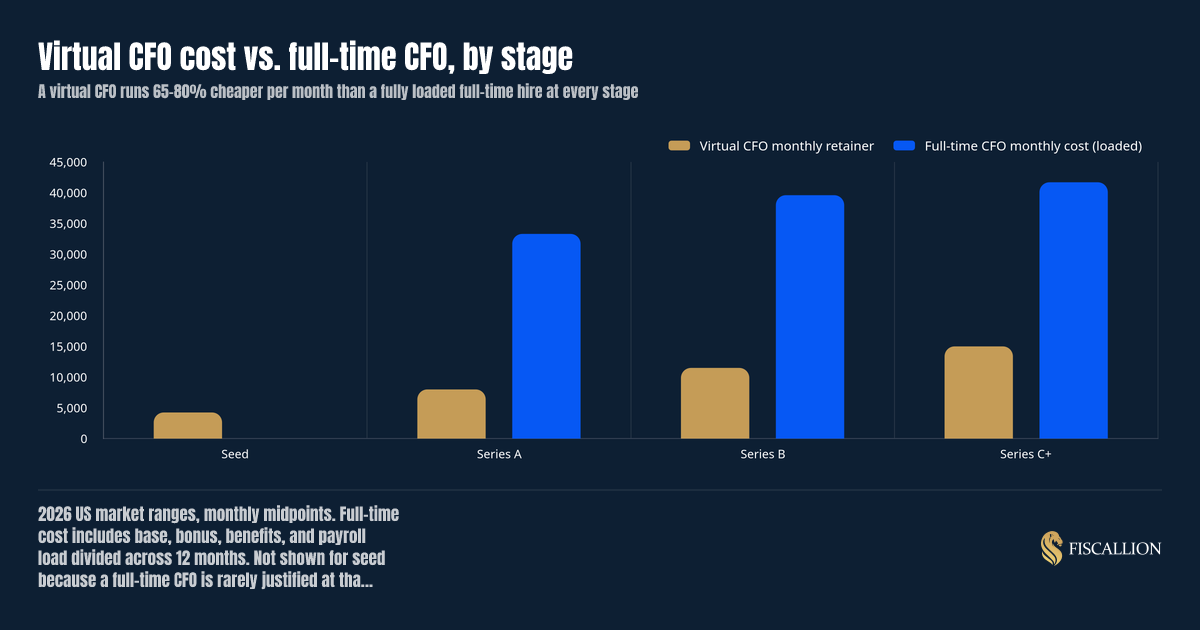
Three things to check before you compare a quote against these ranges:
- Hourly billing looks cheaper and rarely is. Rates of $150-$500 per hour sound reasonable until you account for ramp-up time on every new engagement and every ad hoc question. A monthly retainer aligns incentives: you want a fast, considered answer to "should we take this term sheet," not a meter running.
- The cheapest tier is usually a controller with a CFO title. If the deliverables are monthly closes and compliance, you are paying advisory rates for bookkeeping-adjacent work.
- An active fundraise adds 30-50% to scope. Data room preparation, diligence response, and investor Q&A support are real hours. Confirm whether that is included or billed separately before you sign.
What drives cost up or down within a range
- Revenue recognition complexity (usage-based pricing, multi-element contracts, or professional services revenue add real modeling work under ASC 606, which KPMG's software and SaaS revenue handbook covers in detail).
- Whether bookkeeping and tax filing are bundled or billed separately, since bundled providers avoid the hidden add-on fees that catch first-time buyers.
- Whether the scope includes systems work: CRM-to-ledger reconciliation, spend controls, and close acceleration, versus advisory only.
- Multi-entity or international operations, which add tax and reporting complexity regardless of ARR.
How to interpret the number: cost against outcome, not cost against invoice
The monthly invoice is the least interesting number in this decision. The number that matters is what changes because of the engagement.
Three outcomes are worth pricing against, because they routinely exceed a year of fees:
- Fundraise outcome. Companies with diligence-ready financials and a defensible model close rounds faster and at better terms. A credible burn multiple and a forecast that survives partner-meeting scrutiny can move a term sheet meaningfully, and boards increasingly benchmark against public efficiency data like Bessemer's Cloud Index and the annual KeyBanc and Sapphire Ventures SaaS Survey. If you want to understand what moves the valuation number itself, our guide to SaaS valuation multiples breaks down the levers that matter before a fundraising conversation starts.
- Runway extension. Working capital discipline, cleaner spend controls, and pricing corrections routinely extend runway by several months without raising additional capital. That is a direct, calculable return.
- Decision speed. A board that gets a deck framing three hiring or pricing trade-offs, with a recommendation, moves faster than a board reading a variance report and asking "so what do we do." Speed of good decisions compounds.
If a provider cannot point to which of these three outcomes their work is aimed at this quarter, that is a signal the engagement is reporting-focused rather than decision-focused. Fiscallion's position on this is direct: a board deck that documents history without framing the next decision is not doing CFO-level work, regardless of what the invoice says.
The Fiscallion view: most $5-50M ARR companies do not have a CFO problem
Founders come in asking for a virtual CFO because the trigger moment is usually one of five things: metrics chaos, board pressure ahead of a raise, fundraising prep itself, a cash-to-accrual accounting transition, or a push to automate financial reporting that currently lives in someone's head and three spreadsheets.
The actual problem underneath almost all five triggers is the same: fragmented data across tools, people, and decks, implicit assumptions nobody has written down, and no decision-ready FP&A framework translating activity into cash, runway, and trade-offs. A senior hire with a CFO title does not automatically fix that. Neither does a fractional CFO who spends ten hours a month presenting a deck built on the same shaky spreadsheet.
This is the core distinction we cover in our framework for FP&A at $5-50M ARR companies: the fix is decision-grade FP&A infrastructure, not a more senior title attached to the same reporting. CAC/LTV should be treated as a range across cohorts, not a single number the board debates in a meeting. Headcount plans should run through a revenue forecast model before an offer goes out, not after. Pricing changes should show margin impact before the sales team commits to a number.
If you are further along and pricing this specifically against a fractional CFO retainer, the stage-by-stage math we walk through in what fractional CFO services actually cost lines up closely with the ranges above, including the hidden costs (setup fees, hourly bill-up, separate tax filing charges) that inflate a headline retainer after you sign.
What to do next: a decision framework, not a vendor shortlist
Skip the "top 10 providers" approach. Rankings age fast and rarely reflect your specific complexity. Instead, walk through four questions in order.
1. What decision are you actually trying to make in the next 90 days?
Fundraise prep, a headcount freeze decision, a pricing change, or board confidence, each points to a different scope. Write the decision down before you talk to any provider.
2. Do you need 10 hours a month or 40?
| Signal | Hours/month needed | Best-fit model |
|---|---|---|
| Board reporting and a light forecast refresh | 8-15 hours | Fractional or virtual CFO, generalist scope |
| Active fundraise, cohort-level unit economics, systems cleanup | 20-35 hours | Specialized SaaS FP&A partner |
| Daily cash decisions, M&A activity, multi-entity complexity | 40+ hours | Approaching full-time; consider a full-time hire |
3. Does the provider own the model, or just present it?
Ask directly: who builds the driver-based model, who updates the assumptions monthly, and who is accountable when the forecast misses by more than 10%. If the answer is "we review what your team sends us," you are buying a reporting layer, not FP&A ownership.
4. Can they show you a cohort-level CAC/LTV view, not a single ratio?
A provider who hands you "LTV:CAC is 3.2x" without a cohort breakdown by acquisition channel and signup quarter is giving you a number that will not survive a real board question, let alone investor diligence. For the full methodology behind why cohort-level unit economics matter and how to build them correctly, our SaaS unit economics guide covers CAC, LTV, payback period, and the Rule of 40 with calculation methods and benchmark ranges.
Common mistakes and the better move
| Mistake | Why it fails | Replacement move |
|---|---|---|
| Hiring a full-time CFO at $12M ARR because the board suggested it | Adds $350K-$500K in cost and 3-6 months of ramp time without fixing forecasting discipline | Fix the FP&A model and decision cadence first; hire full-time when finance complexity itself is a full-time job, usually past $15-20M ARR with multi-entity or IPO-track complexity |
| Comparing providers by hourly rate alone | Hourly billing rewards time spent, not decisions made, and ramp-up time gets billed on every new question | Compare against a monthly retainer scoped to specific deliverables, and ask what is excluded |
| Accepting a single CAC/LTV number in a board deck | Blended averages hide cohort degradation and channel-level payback differences that matter for the next hire or spend decision | Require a cohort view segmented by acquisition channel and signup quarter, presented as a range |
| Treating the forecast as a one-time deliverable | A model that is not updated monthly against actuals goes stale within one quarter and erodes board trust | Set a fixed monthly reforecast cadence with a named owner of each assumption |
| Choosing a provider based on client logos alone | Logo count says nothing about whether they build systems (CRM-to-ledger reconciliation, close acceleration) or just present decks | Ask for a specific example of a company at your ARR where they fixed a systems problem, not just a reporting one |
A practical asset: the virtual CFO evaluation scorecard
Use this scorecard on your next two or three provider calls. Score each row 1-5 and total it. Anything under 15 out of 30 means you are likely buying reporting polish, not decision-grade FP&A.
| Criterion | What to ask | Score (1-5) |
|---|---|---|
| Model ownership | Who builds and updates the driver-based forecast monthly? | |
| Cohort-level unit economics | Can they show a CAC/LTV range by channel and cohort, not one number? | |
| Systems depth | Do they touch CRM-to-ledger reconciliation and close acceleration, or advisory only? | |
| Decision framing in reporting | Does their sample board deck recommend a next move, or just report history? | |
| SaaS-specific fluency | Do they understand ARR, NRR, burn multiple, and the Rule of 40 without translation? | |
| Cadence and accountability | Is there a fixed reforecast schedule with a named owner per assumption? |
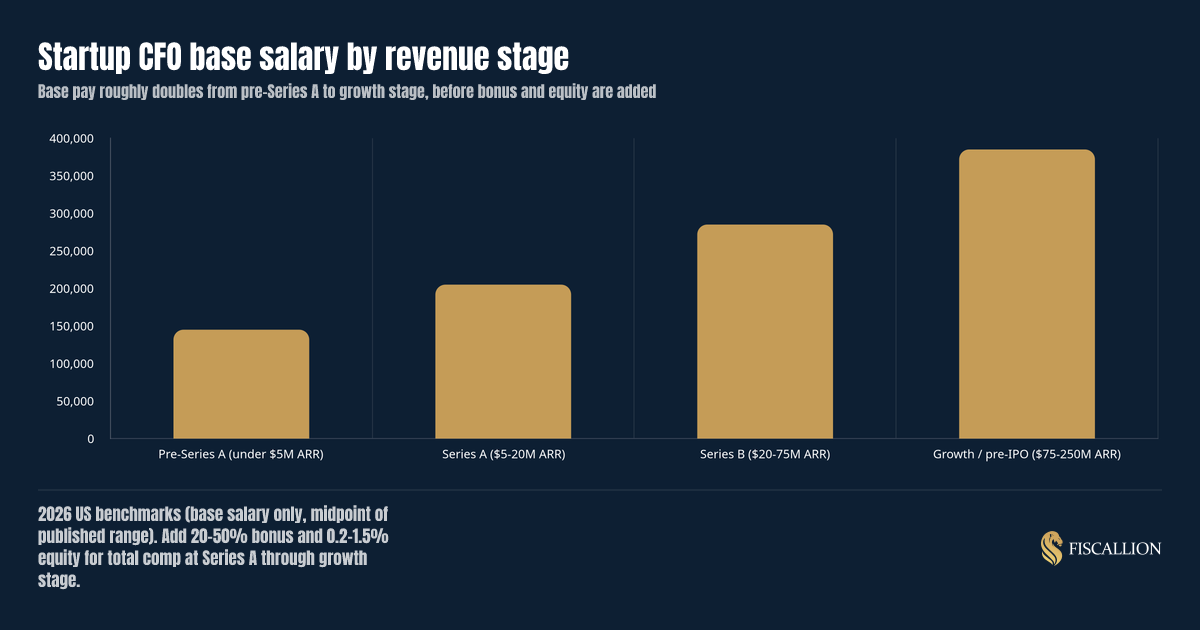
For context on how CFO compensation compares by stage, since it shapes the full-time-hire side of this trade-off, here is where base salary lands in 2026.
FAQs
How much does a virtual CFO cost?
Virtual CFO services cost $2,500 to $20,000+ per month in 2026, and the number scales tightly with ARR and complexity rather than with the provider's marketing.
Seed-stage companies under $2M ARR typically pay $2,500-$6,000/month for a runway model, basic board reporting, and monthly close oversight. Series A companies ($5M-$20M ARR) land at $5,000-$10,000/month for a full driver-based model, board cadence, and fundraise support. Series B companies ($20M-$50M ARR) pay $8,000-$15,000/month for full FP&A function, department-level budgets, and diligence readiness. Series C+ companies often pay $10,000-$20,000+/month, frequently as a bridge while transitioning to a full-time hire.
Hourly rates, where they exist, run $150-$500/hour depending on seniority, but retainer pricing is the standard for serious engagements because it removes the incentive to bill time instead of deliver decisions. Watch for hidden add-ons: setup fees ($2,500-$10,000 one-time at some boutique firms), separate tax filing charges, and required software licensing that inflate the headline retainer after signing.
How much does a CFO at a startup make?
Startup CFO base salary in 2026 ranges from roughly $120,000 at pre-revenue and pre-Series A companies up to $450,000+ at growth-stage, pre-IPO companies, before bonus and equity. According to Baker Tilly's 2026 CFO Report, which surveyed 185 U.S. CFOs at PE- and VC-backed companies, nearly half earn $250K+ in base, with bonus and equity structures diverging sharply by company stage. JM Search's CFO compensation survey, based on data from 312 sitting CFOs, found that for middle-market businesses with revenues between $100M-$500M, the most common CFO base salary range is $350K-$399K with target bonuses of 50-59% of base.
By stage: pre-Series A companies (under $5M ARR) typically pay $120,000-$170,000 base. Series A companies ($5M-$20M ARR) pay $170,000-$240,000 base. Series B / mid-market companies ($20M-$75M ARR) pay $240,000-$330,000 base. Growth and pre-IPO companies ($75M-$250M ARR) pay $320,000-$450,000+ base.
Add bonus and equity to get total compensation. CFO bonus targets typically run 20-50% of base, tied to ARR growth, gross margin, and cash efficiency metrics, with the higher end common closer to a liquidity event. Equity grants typically range 0.2%-1.5% depending on stage, with earlier-stage grants larger as a percentage but subject to more dilution over subsequent rounds. All-in, a fully loaded full-time CFO hire (including bonus, benefits, payroll tax, and often a recruiting fee of 25-33% of first-year comp) runs $350,000-$800,000+ per year even at companies with a modest base salary.
What is the best AI for CFOs?
There is no single "best" AI tool for CFO-level finance work in 2026, because the category splits into distinct jobs, and the right tool depends on which job you need done.
For FP&A modeling and scenario planning, tools like Mosaic, Finmark, Pry, and Cube Software layer AI-assisted forecasting on top of your existing data sources (CRM, HRIS, accounting system), and they genuinely speed up variance analysis and scenario builds. For general financial analysis and narrative drafting, large language model tools (ChatGPT, Claude, and similar) are useful for first-draft board commentary, scenario framing, and summarizing variance, but they should not be trusted to calculate cohort-level CAC/LTV or runway without a human validating the underlying data and assumptions.
The more important point, and one worth being direct about: AI tools do not replace the judgment layer. They can accelerate model-building and reporting, but they cannot decide whether your CAC payback assumption is realistic, whether a hiring plan should slow down, or how to frame a trade-off for your board. That judgment is what a virtual CFO or a decision-grade FP&A partner is actually being paid for. Treat AI tools as an accelerant for the mechanical parts of forecasting and reporting, not a substitute for someone who owns the assumptions and is accountable for the forecast's accuracy.
How much does a virtual CFO make?
This depends heavily on structure: solo virtual CFOs, virtual CFO firm partners, and virtual CFO firm employees are paid very differently.
A solo fractional or virtual CFO running their own practice typically bills $150-$500/hour depending on seniority and specialization, or $3,000-$15,000/month per client on retainer. A seasoned solo practitioner carrying 4-6 client engagements at $6,000-$10,000/month each can generate $300,000-$600,000+ in annual revenue before overhead, though client acquisition, administrative work, and gaps between engagements reduce realized income below that ceiling.
At a virtual CFO firm, senior practitioners are often paid a base salary plus a share of client billings, commonly landing in the $150,000-$300,000 range for experienced CFOs managing a portfolio of client relationships, with upside tied to firm growth or equity in some boutique practices. Compensation is generally lower than a comparable full-time in-house CFO role at a single company, but practitioners often value the variety of seeing 10-20 companies' financial patterns, faster ramp between engagements, and more control over schedule as the trade-off for lower per-engagement pay.
Conclusion
The question "what is the best virtual CFO service" has a better version underneath it: what decision are you trying to make more confidently, and does the provider you are evaluating actually own the model, the assumptions, and the systems behind it, or just the deck.
Cost benchmarks matter, and the 2026 ranges above give you a real number to negotiate against. But the providers worth paying are the ones who treat CAC/LTV as a cohort range instead of a single debated number, who build a reforecast cadence instead of a one-time model, and who frame board decisions instead of just reporting what already happened. That is the standard Fiscallion holds its own FP&A work to, and it is the standard worth holding any virtual CFO provider to before you sign a retainer.
If your current reporting cannot answer "what do we do next" in the next board meeting, or your CAC/LTV keeps getting debated instead of used, audit your metrics definitions and forecasting model before you add another vendor to the stack.