
Every founder who's hit the wall of financial complexity eventually asks the same question: "What does a fractional CFO actually cost?" It's a reasonable starting point. But after working with startups from pre-seed chaos through Series D scale, I've learned that the more important question is: what is the cost of not having one?
Missed runway visibility, a busted fundraise, a broken CAC model, a board deck that raises more questions than it answers - these are the real costs. The retainer is a rounding error by comparison.
This guide breaks down fractional CFO pricing in real terms for 2026. We cover hourly rates, monthly retainers, project-based fees, how those numbers compare to a full-time CFO hire, and the specific ROI signals that tell you whether the investment makes sense at your stage.
What you'll learn
- The real fractional CFO cost ranges in 2026 - by stage, revenue, and engagement model
- How to compare fractional vs. full-time CFO economics (the full cost picture, not just base salary)
- CFO salary benchmarks by company revenue, including the $100M company question
- Whether you need a CPA or formal credentials to hire or become a fractional CFO
- How to calculate ROI before you sign anything
What does a fractional CFO cost in 2026?
The honest market range for a fractional CFO in 2026 is $3,000 to $15,000 per month, with most early-to-growth stage startups landing in the $4,000 to $10,000 range. Enterprise engagements at $75M+ revenue can run $15,000 to $20,000+ per month.
Here is how the pricing tiers break down by company stage:
These figures reflect retainer-based engagements - which is the standard model for quality fractional CFO work. Hourly billing exists but is uncommon among senior practitioners, and for good reason: the best fractional CFOs are paid to think and advise, not to fill timesheets.
Hourly rates when applicable
When hourly arrangements do exist, the rates reflect the seniority level:
- Entry-level (5-10 years experience): $150 - $250/hour
- Mid-tier (10-15 years): $250 - $350/hour
- Senior/specialized (15+ years): $350 - $500/hour
The problem with hourly billing is structural. A founder pinging on Slack at 3pm - "Should we take this funding offer?" - should get a fast, considered answer. Hourly billing puts friction on exactly those conversations. A monthly retainer aligns incentives correctly.
Project-based pricing for specific needs
Some engagements are scoped around a specific deliverable rather than ongoing advisory:
- Financial model build: $8,000 - $25,000
- Fundraising support (materials + diligence prep): $5,000 - $20,000
- Three-statement model + scenario analysis: $10,000 - $20,000
- M&A due diligence support: $15,000 - $35,000
These are typically add-ons to a retainer or standalone sprints for companies that are not yet ready for ongoing CFO engagement.
Fractional CFO vs. full-time CFO: the real cost comparison
This is where most founders underestimate the delta. They compare a $7,000/month fractional retainer to a CFO base salary of $200,000 and think the math is close. It is not.
A full-time CFO at a growth-stage startup carries a total cost that most founders do not fully account for. According to the Baker Tilly 2026 CFO Report - based on 185 U.S. CFOs and senior finance leaders at PE and VC-backed companies - nearly half of CFOs earn $250K+, with bonuses and equity structures diverging sharply by company stage:
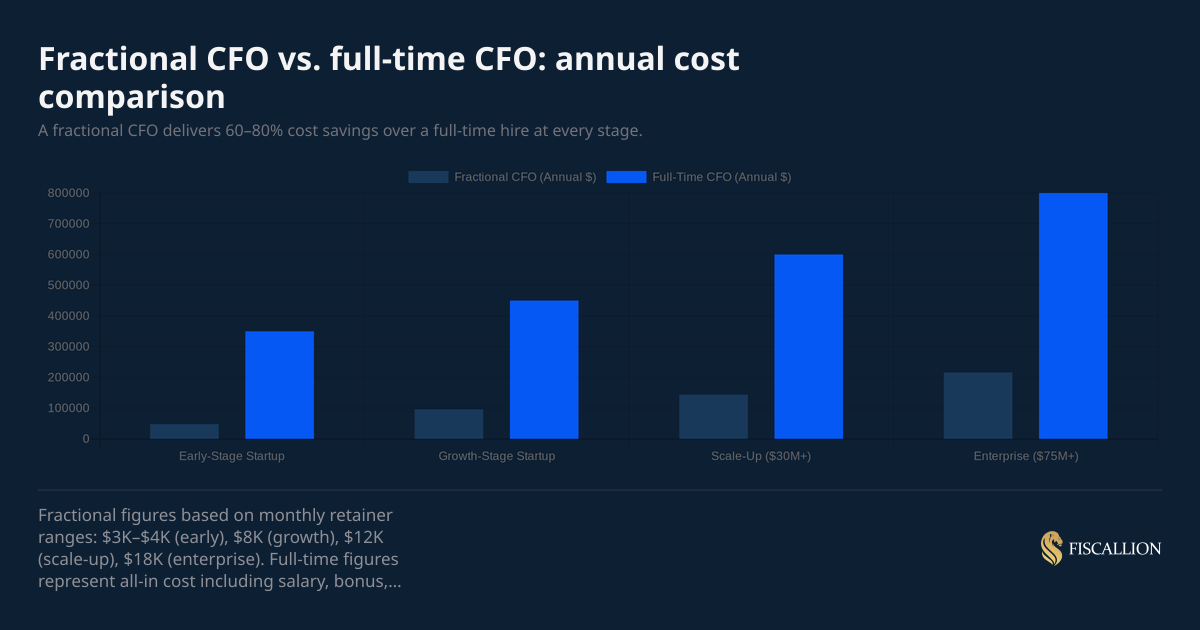
The cost savings are 60-80% depending on the engagement level. But the cost is only part of the story.
The two advantages that don't appear in a cost table
Forced focus. A fractional CFO has limited time - which means every hour goes toward high-leverage work. There is no incentive to build dashboards nobody uses, attend every internal sync, or manage processes that belong to a controller. The fractional model filters for impact by design.
Independence produces better advice. A fractional CFO who serves multiple clients is not economically dependent on any single engagement. That independence changes the quality of the advice. I have had conversations with founders where the honest answer was "your unit economics do not support this raise." A full-time employee who needs next month's paycheck thinks twice before saying that.
One example: a founder at $9M ARR received an acquisition offer at 4.2x ARR and wanted confirmation the timing was right. When we worked through the unit economics, their NRR had just crossed 108%, their strongest cohorts were in months 18–24, and none of that expansion trajectory was reflected in the offer price. The buyer was pricing trailing revenue, not the compounding ahead. My read was that they were 18 months from a materially stronger negotiating position. They didn't sell. Eighteen months later they closed a Series B at 2.3x the acquisition offer.
When does it make sense to hire a full-time CFO?
The transition point is typically around $50M+ revenue, when transaction volume, multi-department coordination, and daily financial decision-making demand full-time presence. Even then, many companies find the combination of a strong controller at $120,000 - $150,000/year plus a fractional CFO more cost-effective than a single $400,000+ full-time hire.
Fiscallion's pricing structure: tiered for your stage
At Fiscallion, we structure our engagements around three tiers that match where you actually are as a company - not where you'd like to be on a pitch deck.
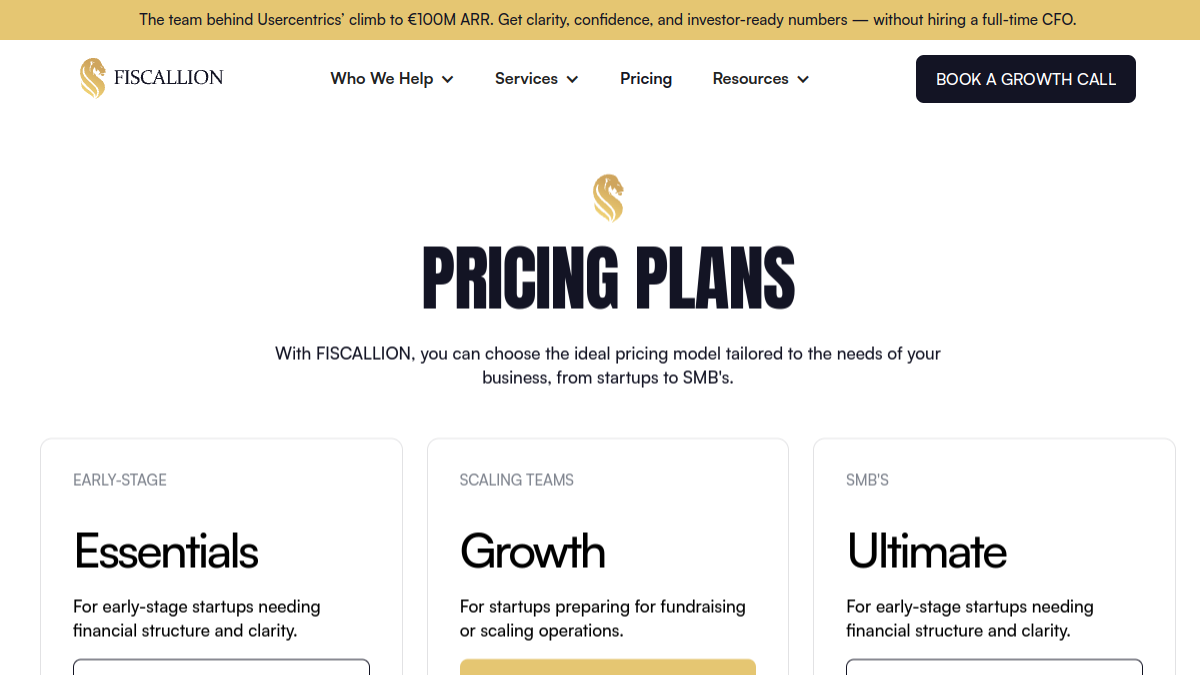
Essentials is built for early-stage startups that need financial structure and clarity - monthly reporting, basic cash flow forecasting, runway visibility, and a simple financial model. If you are currently operating without a financial model and your burn rate is a rough guess, this is where you start.
Growth is designed for startups preparing to fundraise or scaling operations. This tier includes bi-weekly reporting, rolling forecasts, investor-ready board and deck support, monthly KPI dashboards, scenario planning, and light fundraising support including data room and pitch preparation. This is the tier where most Seed to Series A founders land.
Ultimate is our full fractional CFO partnership for companies that need ongoing strategic finance leadership. Weekly reporting, custom automated Power BI dashboards, cap table and headcount planning, fully integrated financial infrastructure, and weekly CFO advisory calls. This is the operating model for Series B and beyond.
All Fiscallion retainers require a 90-day minimum commitment. After that, you can cancel with 30 days' notice. We built it this way deliberately - 90 days is the minimum time it takes to actually restructure a financial model, establish reporting cadence, and deliver measurable clarity. Anything shorter is a consulting visit, not a partnership.
CFO salary by company revenue: 2026 benchmarks
Understanding what a full-time CFO earns at different revenue scales puts the fractional cost comparison into sharper context. These are base salary figures only - total compensation including bonus, equity, and benefits adds 40-100% on top.
Source: Cowen Partners CFO Salary Guide, 2026. Base salary only. Industry-specific total compensation packages (including equity and bonuses) can range significantly higher - technology CFOs, for example, command starting packages from ~$420K to over $1.3M at scale.

How much does a CFO of a $100 million company make?
For a company with $51M - $100M in revenue, a CFO's base salary in 2026 falls in the $170,000 - $310,000 range, with private companies at the lower end and public companies pushing higher. Factor in a performance bonus of 25-50% of base, equity grants (typically 0.25-1% for a company at this stage), and standard executive benefits, and total compensation lands between $250,000 and $500,000+ per year.
Tech CFOs at the $100M revenue mark are typically at the higher end of that band. Healthcare and financial services CFOs track similarly. Manufacturing and retail CFOs tend to earn 15-20% less at equivalent revenue scales.
One important nuance: CFO total compensation at the $100M level is heavily influenced by ownership structure. A private equity-backed CFO at a $100M company often has a carry arrangement that outweighs their base salary. A founder-led private company at the same revenue typically pays cash compensation with limited upside unless there is a clear exit horizon.
This is also the exact inflection point where many companies reconsider a fractional model. At $100M, the question shifts from "can I afford a full-time CFO?" to "do I need one full-time?" The answer depends on operational complexity, reporting demands, and how active the board is - not revenue alone.
Is a fractional CFO worth it?
Let me be direct: yes - but not for every company and not from every provider.
The fractional model works exceptionally well when the engagement is built around real financial leadership, not a dressed-up bookkeeping service. The distinction matters more than founders realize when they are comparing proposals.
The ROI framework
A useful starting rule: your annual fractional CFO cost multiplied by 3 is the minimum value you should be able to identify in the first year. At $7,000/month ($84,000/year), that means at least $252,000 in measurable value. That value shows up in several forms:
Direct cost savings. Margin leakage is almost universal in early-stage companies. Misallocated CAC, pricing structures that erode contribution margin, headcount decisions made without a fully burdened cost model - these are fixable with the right financial rigor. Most founders discover $100,000 to $300,000 in identifiable improvements within the first 90 days of a structured engagement.
Cash liberation. Better cash flow forecasting and working capital management frees up capital that would otherwise sit idle or create unnecessary runway pressure. At Fiscallion, one of the first deliverables in any new engagement is a rolling 13-week cash flow model. That visibility alone changes how founders make operational decisions.
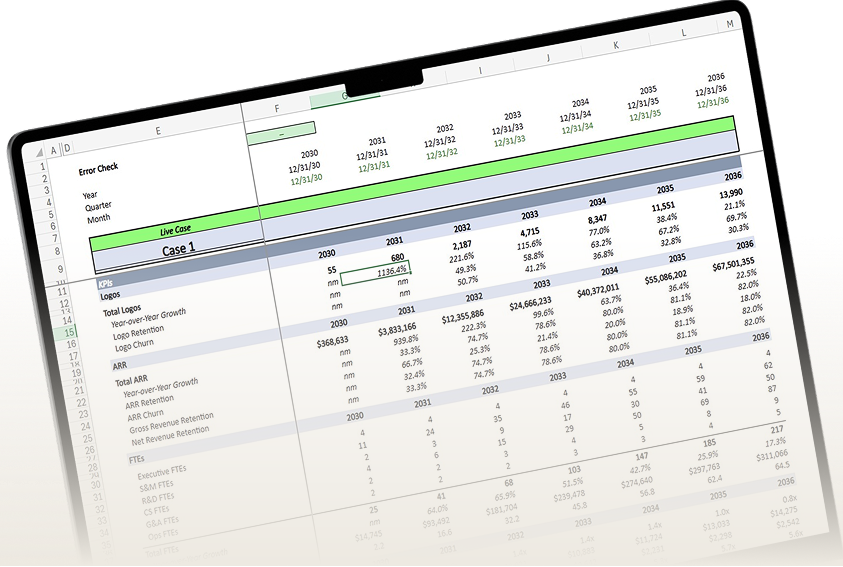
Decision quality. A driver-based financial model that can answer "what happens to runway if we add 3 engineers?" in 20 minutes is worth more than its build cost. The CFO's job is to make that model operational, not decorative.
Fundraise leverage.Investor-ready financials are not a PDF you send once. They are a narrative built from a coherent model, defended by someone who understands the numbers deeply. Fractional CFO support during a fundraise routinely compresses diligence timelines, improves term quality, and prevents the common founder mistake of walking into a partner meeting without a clear handle on burn multiple or net revenue retention.
The difference between a founder-built model and a CFO-grade model often comes down to a single tab. In one seed round, a founder won the meeting on their payback period assumption alone. The model showed a 9-month CAC payback. What made it credible was 8 months of actual cohort data from a paid pilot with 12 customers — the payback assumption was a trailing average with the underlying cohort table attached as a supporting tab, not a back-calculated projection. The lead investor had been burned by a previous deal where the payback assumption turned out to be three times longer than modeled. They spent forty minutes on that one tab. The round closed two weeks later at a valuation 30% above the initial anchor. That level of model preparation is exactly what a fractional CFO builds before a founder walks into the room.
Exit value. At typical SaaS or tech EBITDA multiples of 5-10x, every dollar of EBITDA improvement is worth $5-10 at exit. A fractional CFO who improves EBITDA by $150,000 per year has created $750,000 to $1.5M in enterprise value - substantially more than the retainer cost.
When it does not work
The fractional model fails when the founder does not engage with the tools, when the scope is deliberately narrow (often to save money), or when the provider is a bookkeeper who rebranded. If your "fractional CFO" cannot build a driver-based financial model, cannot explain your CAC payback period by channel, or cannot prepare a board-ready P&L narrative - that is not a CFO. That is an accountant with upgraded marketing.
It also fails when the engagement lacks minimum commitment. Financial infrastructure takes time to build. The first 30-60 days are diagnostic. Real impact materializes in months 3-6. A month-to-month arrangement with no structural commitment from both sides rarely produces deep work.
What to look for when evaluating a fractional CFO
These are the questions that cut through the noise:
1. Have they held a real head-of-finance role?
The fractional CFO market includes everyone from senior bookkeepers who upgraded their title to former VPs of Finance who ran teams at high-growth companies. The quality difference is large and not obvious from a website alone. Ask specifically: "What is the most complex financial situation you have managed in a real operating role?" The answer tells you everything.
At Fiscallion, Alex brings 10+ years of FP&A, BI, and accounting leadership from companies including ABBYY, Coca-Cola HBC, and Usercentrics - where he was on the finance team during the company's climb to €100M ARR. That operational track record is what makes the advisory specific rather than generic.
2. What is actually included in the retainer?
Get specific. Does the retainer cover ad-hoc questions, or is every off-schedule Slack message an incremental invoice? Does it include financial model updates, or do those cost extra? Does the CFO personally show up on calls, or do you get handed to a junior analyst after the first month?
The retainer structure reveals the incentive model. A monthly flat-rate retainer with comprehensive access aligns incentives correctly. An hourly arrangement or a retainer that charges for every add-on does not.
3. Do they have experience in your specific category?
SaaS metrics (MRR, ARR, NRR, CAC payback, LTV) are different from marketplace unit economics, which are different again from tech-enabled services margins. A fractional CFO who has only worked with e-commerce brands should not be advising a SaaS company on its first financial model. The frameworks transfer partially, but the nuances matter.
Fiscallion's work spans SaaS startups, marketplaces and platforms, venture-backed startups, and bootstrapped tech companies - each with their own financial modeling conventions and investor expectations.
4. What does onboarding look like?
A quality fractional CFO engagement starts with a structured diagnostic period. At Fiscallion, the first 90 days include a full system and data review, financial model build or rebuild, establishment of a reporting cadence, and initial scenario planning. If a provider skips this phase and goes straight to "monthly calls," they are not building financial infrastructure - they are renting access to a calendar.
5. How are urgent questions handled?
When a term sheet lands on a Thursday afternoon and you need to model dilution scenarios by Friday morning - what happens? The answer to this question separates a strategic partner from a scheduled consultant.
Do you need a CPA to be a fractional CFO?
This question comes up frequently from two directions: founders evaluating credentials, and finance professionals considering the transition to fractional work. The answer is no - but it requires unpacking.
What the market actually requires
No regulatory body requires a CPA license to operate as a fractional CFO. The title "CFO" is not protected or credentialed in the same way "CPA" or "CFA" is. What the market requires is demonstrated competence in:
- Building and maintaining driver-based financial models
- Cash flow forecasting (13-week and long-range)
- Budgeting and variance analysis
- KPI development and dashboard creation
- Strategic financial communication with founders, boards, and investors
A CPA designation adds credibility, particularly with investors who come from accounting-heavy backgrounds, but it does not substitute for or guarantee the strategic capabilities above. The Workday 2026 CFO Salary Guide notes that while credentials matter, the most compensated CFOs at growth-stage companies are increasingly valued for strategic and operational leadership over technical accounting expertise.
What actually matters for quality
The fractional CFOs who deliver the most value typically have one or more of the following:
- Operational finance leadership experience - actual head-of-finance or VP Finance roles in operating companies, not exclusively public accounting or advisory work
- FP&A depth - the ability to build models from scratch, not just review them
- Investor-facing experience - having personally sat in fundraising or board processes, not just supported them administratively
- Industry-specific fluency - enough time in a specific category (SaaS, marketplace, tech-enabled services) to build category-relevant models without starting from scratch
What about CFAs, CMAs, or MBAs?
These credentials can indicate analytical rigor and structured thinking, but they are proxies - not direct indicators. A CFA is primarily an investment analysis credential. A CMA signals management accounting proficiency. An MBA provides strategic frameworks.
None of these are disqualifying. None are substitutes for operational track record.
From a founder's perspective: how to evaluate credentials
Rather than credentialing filters, use these practical tests:
- Ask for an example financial model they have built for a comparable company (anonymized is fine)
- Ask them to explain your current financial situation back to you after a 30-minute intro call
- Ask specifically what they would build in the first 90 days and why
- Ask for a reference from a founder who worked with them at a comparable stage
A CPA cannot answer these questions better than a non-CPA with deep operating experience. A practitioner with both the credentials and the operating background is the strongest candidate - but the operating background is the non-negotiable.
The hidden cost of not having a fractional CFO
I want to close this section with the number that never appears in any pricing guide: the cost of financial fog.
When a founder does not know their real burn rate, does not have a clean model to run scenarios on, and cannot speak to unit economics with confidence - the cost is not zero. It shows up as:
- Fundraising delays from investor diligence that surfaces avoidable surprises
- Hiring decisions that blow through runway faster than expected
- Pricing decisions made without contribution margin clarity
- A valuation conversation where the founder cannot defend their own projections
These are not hypothetical. They are the standard failure modes of early-stage companies that delayed structured financial thinking. At Fiscallion, some of the most expensive engagements we have taken on were companies that waited too long - not because our fees were high, but because the repair work required after 18 months of financial disorganization was substantially harder than building it right from the start.
A company at $11M ARR came to us 14 months after their Series A, after the lead investor flagged that board reporting didn't match what the CEO was saying in meetings. On day one we found three separate revenue figures for the same period — none of them agreed. The first 90 days were almost entirely backward-looking correction: rebuilding revenue recognition, restating six months of financials, reconstructing the deferred revenue waterfall from scratch.
The fractional CFO cost is a number on a pricing page. The cost of not having one is harder to quantify - but the direction is always higher.
Frequently asked questions
Is a fractional CFO worth it?
Yes - provided the engagement is built around genuine financial leadership. The typical ROI is 3-10x the retainer cost, materialized through margin improvements, better capital allocation, fundraise effectiveness, and reduced decision error. It is not worth it if you hire a rebranded bookkeeper, commit to too short a timeframe, or leave the financial model sitting unopened.
The honest evaluation: if your company cannot clearly answer "what is our real burn rate, what is our runway under three scenarios, and what are our unit economics by channel?" - you are operating in financial fog. A fractional CFO removes that fog. Whether the investment is worth it depends on what decisions you are making in the dark and what they cost you.
What is the cost of a fractional CFO?
In 2026, fractional CFO costs range from $3,000 to $20,000+ per month on a retainer basis. Most early-stage startups (Seed to Series A) land in the $3,500 to $7,500/month range. Growth-stage companies ($5M to $30M revenue) typically invest $7,000 to $12,000/month. Hourly rates, when they exist, run $150 to $500/hour depending on seniority. Project-based engagements for specific deliverables (financial model, fundraise prep) range from $5,000 to $35,000 depending on scope.
Fractional CFO costs are 60-80% lower than an equivalent full-time CFO hire when total compensation, benefits, recruiting fees, and equity are factored in.
How much does a CFO of a $100 million company make?
For a company with $51M to $100M in annual revenue, a full-time CFO's base salary in 2026 ranges from approximately $170,000 to $310,000 (private vs. public). Total compensation - including performance bonus, equity grants, and benefits - typically falls between $250,000 and $500,000+ per year. Tech sector CFOs at this revenue scale command packages at the higher end. Private equity-backed CFOs often have carry arrangements that substantially increase realized total compensation beyond cash figures.
Do I need a CPA to be a fractional CFO?
No. There is no regulatory requirement to hold a CPA license to operate as a fractional CFO. What the market values is demonstrated competence in financial modeling, cash flow forecasting, strategic advisory, and investor-facing financial communication. A CPA adds credibility with some investors but does not substitute for operating finance experience. The most effective fractional CFOs combine hands-on FP&A capability, experience in head-of-finance operating roles, and deep familiarity with the specific financial models and metrics relevant to their client's category.
The cost of not having a fractional CFO compounds every month
The fractional CFO cost question is worth asking precisely. But the more important calculation is the cost of operating without structured financial leadership at a stage when financial decisions - on burn rate, fundraising timing, pricing, headcount, and unit economics - are compounding every month.
In 2026, a quality fractional CFO engagement for an early-stage SaaS or tech startup runs $3,500 to $8,000 per month. Growth-stage companies should budget $7,000 to $12,000. The full-time alternative costs 4-8x more all-in, takes 3-6 months to ramp, and brings none of the cross-company pattern recognition that makes fractional work valuable at this stage.
The ROI threshold is not complicated: if a fractional CFO engagement helps you raise better, burn smarter, or avoid one bad six-figure decision - it has paid for itself many times over.
At Fiscallion, we work with SaaS founders, marketplace operators, and venture-backed teams who are ready to move from financial fog to structured clarity. The entry point is a conversation about your current financial state - what you know, what you don't, and what it's costing you. Explore our pricing and see which tier fits your stage.