

A fractional CFO agency makes sense the moment your numbers stop describing the business and start needing to drive decisions, usually somewhere between $3M and $30M ARR, and almost always before you can justify a full-time CFO's total cost. The signal is not a revenue line. It is whether your forecasts hold up under a hard question, whether your board deck ends in a decision, and whether the person answering "what's our runway" is guessing or modeling.
This article gives you the trigger signs, the stage map, and the cost comparison you need to make that call with confidence, not with a gut feeling six months after you should have made it.
What you'll learn
- Why finance is three separate jobs, and why hiring a CFO to do a controller's work (or vice versa) is the single most expensive sequencing mistake founders make
- The specific trigger signs that indicate you've outgrown your current finance setup
- A stage-by-stage map of what you need at each ARR band, corroborated across multiple external benchmarks
- The real cost comparison between a full-time CFO, a controller-plus-fractional-CFO stack, and a fractional CFO alone
- How to evaluate a fractional CFO agency versus an individual fractional CFO, and when neither is the right call yet
Finance is three jobs, not one, and conflating them is the expensive mistake
Most founders think about "hiring finance" as a single decision: do we get a CFO or not. That framing is wrong, and it's why so many SaaS companies either overspend on seniority they don't need yet or underspend on judgment they desperately need now.
Finance breaks into three distinct functions. A bookkeeper records transactions and is backward-looking by design. A controller ensures those records are accurate, closes the books on a predictable cadence, and keeps you audit-ready; this is a steward role, not a strategist role. A CFO sits above both: forward-looking, building the models, framing the board decisions, owning capital allocation and fundraising strategy. This hierarchy is consistent across independent analyses of startup finance structure, and for good reason: each role depends on the one below it being done well.
Clean, reconciled books are the prerequisite for everything a CFO does.
"A CFO forecasting off unreconciled books isn't forecasting, they're guessing with better formatting."
— Aleksandar Stojanovic, CEO & Founder at FiscallionThis is why the most common and costly sequencing mistake isn't hiring finance too late, it's hiring a CFO (or calling a controller a CFO) before the recording and reporting layers are solid. CRV's guide to hiring a CFO draws the same line: a controller owns month-end close, a VP Finance runs the budgeting and forecasting cycle, and a CFO owns the strategic layer above both, capital allocation, fundraising, and the trade-off conversations with your board.
The practical implication for you: before you evaluate whether you need a fractional CFO agency, confirm your recording and reporting layers are actually functioning. If they aren't, that's the problem to solve first, not a reason to skip straight to strategic hiring.
The trigger signs that tell you you've outgrown your current setup
You don't need a fractional CFO agency because you hit a specific ARR number. You need one when your current finance setup can no longer answer the questions your business is asking of it. Here are the signs that show up most often, in the order founders tend to notice them.
Cash flow visibility has become guesswork. You have numbers in your accounting software, numbers in a spreadsheet someone built eighteen months ago, and numbers in last quarter's board deck, and they don't quite agree. There is no single source of truth, and reconciling the three takes a founder's afternoon instead of a finance function's Tuesday.
Runway forecasts feel fragile. You can produce a number, but you don't trust it under a hard question.
"If a board member asks "what happens to runway if we slow hiring by two roles" and the honest answer is "let me get back to you," your forecast isn't a forecast, it's a snapshot."
— Aleksandar Stojanovic, CEO & Founder at FiscallionBoard reporting happens, but it doesn't answer "what do we do next." The deck has the metrics. It does not frame the decision. This is one of the clearest signs that reporting has become an exercise in description rather than a tool for choosing between options.
CAC and LTV get debated instead of used. If unit economics show up as a number the room argues about rather than a range the room acts on, that's a modeling and cohort problem, not a data problem.
Headcount decisions happen without a model. Hiring plans get built on intuition and last year's plan, not on a driver-based view of what each hire does to burn, runway, and the metrics that matter to your next round.
Beyond these ranked pain points, a handful of specific moments tend to force the question: metrics chaos ahead of a board meeting, direct board pressure to professionalize reporting, an upcoming fundraise, the transition from cash to accrual accounting, or an attempt to automate reporting that keeps failing because the underlying model isn't decision-ready. Northstar Financial Advisory identifies three concrete signs you've outgrown a bookkeeper specifically: your monthly close takes more than fifteen business days, you cannot produce a real cash flow forecast on request, or your board asks questions your finance function simply cannot answer.
If three or more of the signs above are true right now, the gap is real, and it will not close on its own as revenue grows. It compounds.
The stage map: what you need and when a fractional CFO agency fits
Revenue stage is a reasonable proxy for complexity, and several independent sources converge on a similar map, even though none of them agree on exact boundaries.
SaaStr's Jason Lemkin puts the first real finance lead around $2M ARR, argues that by $20M in venture funding raised your metrics need to be roughly 98% correct with someone full-time on them, and notes that most companies don't need a traditional CFO until they approach $100-200M ARR, needing a VP or SVP of Finance well before that. CRV's 2026 hiring guide maps seed-stage to clean bookkeeping plus a fractional CFO, Series A to a VP Finance or head of finance, and Series B to a full-time CFO once multi-entity structure and audit readiness become real requirements.
CFO Advisors is more direct about the middle band: post-Series A, roughly $2M-$8M ARR, a fractional CFO paired with a controller is "usually yes." Above $8M, the transition toward a full-time VP Finance or CFO becomes common. Glacier Lake Partners frames it by revenue band: bring in a controller at $3M-$8M, add a fractional CFO at $8M-$20M, and consider full-time above $20M or once the capital structure gets complex.
Here is how those maps line up against each other:
| Stage / ARR band | External consensus | What the role actually does |
|---|---|---|
| Pre-revenue to $2M | Bookkeeper, maybe scoped advisory | Clean records, no strategic layer yet |
| $2M-$8M | Controller + fractional CFO | Close is reliable; strategy and forecasting begin |
| $8M-$20M | Fractional CFO, building toward full-time | Board-ready reporting, fundraising support, driver-based models |
| $20M-$30M+ | Transition point toward full-time | Capital structure complexity, daily executive presence needed |
| $30M-$100M | Controller + fractional CFO can still outperform a single full-time hire | Depends on complexity, not revenue alone |
Eightx's benchmark data reinforces the point that engagement size scales with complexity, not linearly with revenue: fractional CFO hours run 8-20 per month below $1M ARR, 20-40 per month at $5M-$25M, and 40-60+ above $50M. Their conclusion, and one worth sitting with, is that most companies graduate to a full-time CFO somewhere between $30M and $50M, but a controller-plus-fractional-CFO stack often outperforms a single full-time hire well beyond that, up to roughly $100M in several cases.
That last point matters for where your company likely sits. The audience for this article runs $5M to $100M ARR, and across nearly every external source, that entire band is where a fractional CFO, paired with a competent controller, is either the right answer or a defensible one. Full-time only becomes the clear right call when the company needs daily executive presence, a permanent internal finance organization, or enough sustained complexity to justify the seat.
Alex Stojanovic's stage cheatsheet captures the same sequencing logic for SaaS founders:
Fractional CFO agency vs individual fractional CFO vs your controller
These are not competing options for the same job. Each covers different scope, and understanding the boundary prevents you from either overpaying for seniority you don't need or underpaying for judgment you do.
Your bookkeeper and controller are the execution prerequisite, not a substitute for strategic finance. They keep the books accurate and the close predictable. That is essential work, and it is not the same work as building a driver-based model or framing a board decision. Treating a strong controller as your acting CFO is exactly the mistake Northstar and CRV both call out: the roles have different outputs, and stretching one person across both usually means neither gets done well.
An individual fractional CFO is a single senior person, often very experienced, at a lower monthly cost than a firm. The trade-off is key-person risk: if they're unavailable during a board crunch or a fundraise deadline, there's no bench behind them. A fractional CFO agency costs somewhat more but brings coverage. If your CFO is unavailable for a critical week, there's continuity rather than a gap. Runfutureproof's rate analysis confirms this trade-off directly: firms charge more but bring bench depth, independents cost less and are frequently more senior individually, but carry that single-point-of-failure risk.
Fiscallion's model sits deliberately in between those two extremes. Every Fiscallion client works directly with Aleksandar Stojanovic at the CFO layer. There is no account-manager layer and no handoff to a junior analyst after the first month; the senior partner who scopes the engagement is the same person modeling your runway and sitting in your board meeting. That is a different structure from a conventional agency, and it is also different from a solo independent operator with no backup.
Alex Stojanovic frames the timing question directly — when does a full-time CFO actually make sense, and when is renting the strategy layer the better move:
What a fractional CFO agency handles that your accounting setup doesn't
This is where the actual value shows up, and it's worth being specific rather than vague, because "strategic support" is the kind of phrase that means nothing until you see what it replaces.
A fractional CFO agency builds driver-based financial models that connect headcount, pricing, and growth assumptions directly to cash and runway, so a hiring decision or a pricing change shows its downstream effect before you make it, not after. It owns board framing that ends in a decision, not a deck that recaps last month's metrics and leaves the room to debate what they mean. It runs fundraising and diligence prep, translating your operating story into the model an investor's finance team will pressure-test.
It treats unit economics as a range and a cohort view, not a single debated number, so CAC and LTV inform a pricing or channel decision instead of becoming a recurring argument. It builds scenario planning around the trade-offs that actually matter to you: slower hiring versus faster growth, a pricing increase versus retention risk, a new market versus deeper penetration in an existing one. And when your company crosses from cash to accrual accounting, which tends to happen consistently in the $5M-$50M ARR range and often breaks a founder's confidence in their own numbers for sixty to ninety days, a fractional CFO re-baselines the model so the transition doesn't cost you a quarter of decision-making clarity.
This is the operating layer between raw financial data and the decisions that data is supposed to inform. Your accounting setup, however well run, produces the data. It does not, by itself, produce the framework.
The cost math: full-time CFO vs controller-plus-fractional vs fractional alone
The dollar gap between these paths is large enough that it should be the first thing you model, not an afterthought.
A full-time CFO's total annual cost runs $350,000 to $800,000, citing Baker Tilly's 2026 CFO Report, a survey of 185 U.S. CFOs at PE- and VC-backed companies where roughly half earn $250,000 or more before equity. A controller costs roughly $120,000-$180,000 per year, consistent with Ramp's guide to structuring a finance team. A fractional CFO, at a growth-stage retainer of roughly $7,000-$12,000 per month, runs $84,000-$144,000 per year.
| Structure | Approximate annual cost | What it covers |
|---|---|---|
| Full-time CFO | $350,000-$800,000 | Daily executive presence, full internal finance org, capital allocation |
| Controller + fractional CFO | Roughly $204,000-$294,000 combined | Reliable close plus strategic FP&A, board framing, forecasting |
| Fractional CFO only | $84,000-$144,000 | Strategic FP&A and board support, assumes close is already handled |
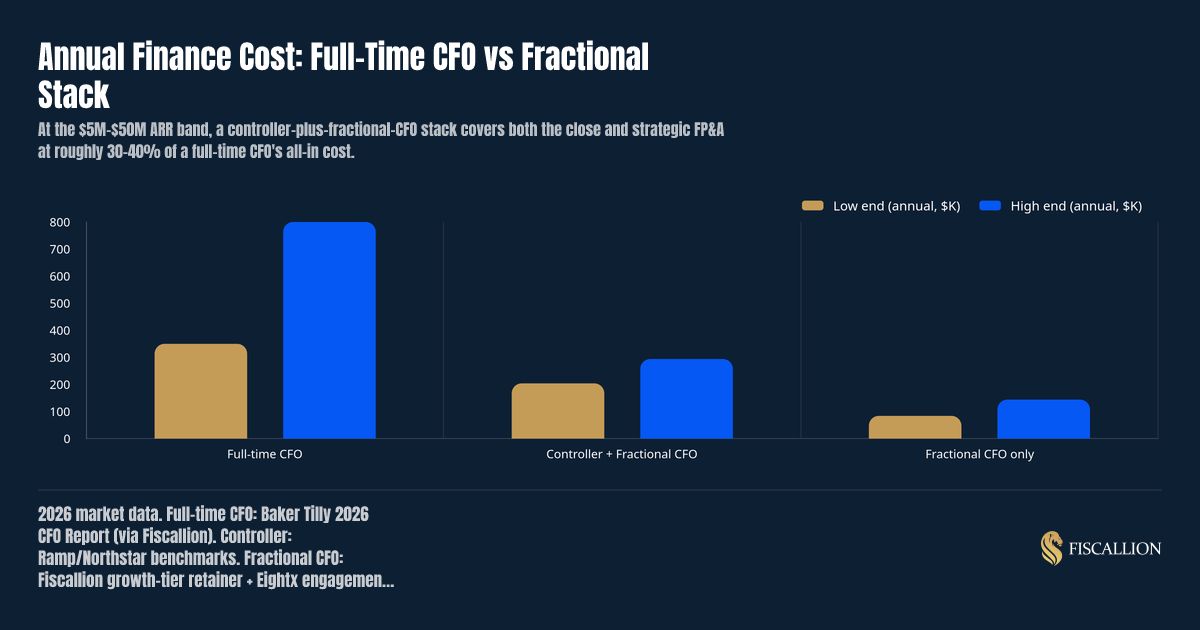
At the $5M-$100M ARR band this audience occupies, a controller-plus-fractional-CFO stack covers both the close and the strategic layer at roughly 30-40% of a full-time CFO's all-in cost. That is not a case for the cheapest option by default; it is a case for matching the structure to what the company's complexity actually requires. Eaglerock's 2025-26 pricing survey puts the broader fractional CFO market range at $3,000-$15,000 per month, with most early-to-growth-stage companies landing $4,000-$10,000 and fundraise-intensive periods pushing past $10,000.
The return on that spend shows up in specific places: cost savings relative to a full-time hire, cash freed up by better working-capital and runway decisions, decision quality that compounds over quarters, leverage in a fundraise because the numbers hold up under diligence, and eventually exit value, since an EBITDA improvement of $150,000 translates to $750,000-$1.5 million in enterprise value at typical 5-10x multiples. A reasonable floor to hold your fractional CFO to: the annual cost of the engagement, multiplied by three, should represent the minimum identifiable value created in year one, whether that value shows up as cost avoided, cash freed, or a decision made with real confidence instead of a guess.
Explore Fiscallion's fractional CFO service
If the cost math above matches your stage, the next step isn't a lengthy sales process, it's a direct conversation about scope and fit. You can review Fiscallion's fractional CFO service for how engagements are structured, though the scorecard below is the faster way to check your own timing first.
How to evaluate a fractional CFO agency before you sign
Not every fractional CFO agency operates the same way, and the differences matter more than the price on the page. Ask directly:
- Has the person you'd actually work with held a real head-of-finance or CFO role, not just an advisory title?
- What is explicitly in the retainer, and what gets billed separately?
- Do they have specific experience with SaaS metrics, cohort economics, and board reporting, not general small-business finance?
- What does the onboarding or diagnostic phase look like, and how long before you get a working model?
- How are urgent questions handled between scheduled check-ins, a board deadline or a term sheet doesn't wait for the next monthly call?
Red flags worth walking away from: an agency that skips the diagnostic phase and jumps straight to a standard deliverable, hourly billing for strategic work that should be scoped as a retainer, or a structure where you're handed to a junior analyst after the first month while the senior person who sold you moves on to the next deal.
Use this scorecard to check your own timing
Score yourself honestly against the signs below before you take a meeting with anyone.
| Signal | True for you? |
|---|---|
| Monthly close takes more than 15 business days | |
| You cannot produce a real cash flow forecast on request | |
| Your board has asked a question your finance function couldn't answer | |
| CAC/LTV gets debated in meetings rather than used to decide | |
| Headcount decisions happen without a driver-based model | |
| You're within 6-12 months of a fundraise or cash-to-accrual transition |
Three or more checked boxes means the gap is real and worth addressing now, not after the next board meeting exposes it. Fewer than three, and the better move is usually to fix the recording and reporting layers first.
When it's not yet time, and what to do instead
If your books are six months behind, or you're pre-revenue with no forecasting need yet, a fractional CFO agency is the wrong hire right now, not because the seniority is wasted, but because there's no reliable data layer for that seniority to work with. Fix the foundation first: get bookkeeping current, get a close cadence established, then revisit the strategic layer.
The rule worth internalizing: buy the answer you need, not the title that sounds impressive. Match the hire to the work that actually exists today. A company with reliable books and a genuine forecasting or fundraising need is ready for a fractional CFO. A company still reconciling last quarter is not, no matter how urgent the board pressure feels.
FAQ
What signs tell a SaaS founder it's time to bring in a fractional CFO?
The clearest signs cluster around trust in your own numbers: your monthly close consistently takes too long, you can't produce a cash flow forecast on request, your board asks a question your finance function can't answer, or CAC and LTV get debated in meetings instead of used to make a pricing or growth decision. Trigger moments compound this: an upcoming fundraise, a cash-to-accrual accounting transition, or repeated failed attempts to automate reporting because the underlying model isn't decision-ready. If three or more of these are true, you've outgrown your current setup.
Do I still need a fractional CFO if I already have a bookkeeper or controller?
Yes, and this is the most common confusion in the hiring sequence. A bookkeeper and controller keep your records accurate and your close predictable; that is essential, backward-looking work. A fractional CFO builds the forward-looking layer: driver-based models, board framing, capital allocation decisions, and fundraising strategy. Asking a controller to also do CFO-level strategic work usually means neither job gets done well, because the two roles have fundamentally different outputs and time horizons.
What does a fractional CFO agency handle that my current accounting setup doesn't?
Your accounting setup produces reliable financial data. A fractional CFO agency turns that data into decisions: driver-based models connecting headcount and pricing to runway, board decks that end in a recommendation rather than a recap, unit-economics work that treats CAC/LTV as a cohort range rather than a single debated number, scenario planning for real trade-offs, and fundraising or diligence prep that holds up under investor scrutiny. It's the operating layer between the numbers and what you do next, something a bookkeeper or controller isn't scoped to provide.
How is working with a fractional CFO agency different from hiring an individual fractional CFO?
An individual fractional CFO is typically a single senior person at a lower monthly cost, but with key-person risk: if they're unavailable during a board crunch or fundraise deadline, there's no coverage behind them. A fractional CFO agency costs somewhat more but brings continuity. At Fiscallion specifically, that distinction doesn't mean a junior handoff: every client works directly with Aleksandar Stojanovic at the CFO layer throughout the engagement, combining senior-partner ownership with the coverage structure an agency provides, rather than the account-manager model typical of a conventional agency.
The decision that actually matters
The right moment to hire a fractional CFO agency isn't a revenue milestone, it's the point where your numbers need to start driving decisions and currently can't. Most SaaS companies between $5M and $100M ARR sit inside that window for years, not months, which is why the stage map above spans such a wide band.
Get the sequencing right, clean records first, then strategic judgment layered on top, and the cost math works decisively in your favor compared to a full-time hire. Get it backward, and you'll pay for seniority with nothing reliable underneath it to work from.
Run the scorecard above with your own numbers, then talk through the results directly with Aleksandar. If the fit looks right, you can also review Fiscallion's fractional CFO service for how engagements are scoped and structured.