

Financial modeling agency pricing for B2B SaaS ranges from roughly $2,500 to $25,000 for a one-time model build, and $3,000 to $20,000+ per month for ongoing FP&A and board reporting, depending on company stage and scope. The number that actually matters is not the invoice. It is what a decision-ready model prevents: a board pack built on three conflicting versions of net revenue retention, a runway forecast nobody trusts, or a hiring plan approved without a cash check.
"You are not really pricing a spreadsheet. You are pricing the difference between a board meeting where you present a recommendation and one where you present a mess and hope nobody asks a hard question."
— Aleksandar Stojanovic, CEO & Founder at FiscallionWhat "financial modeling agency" actually covers
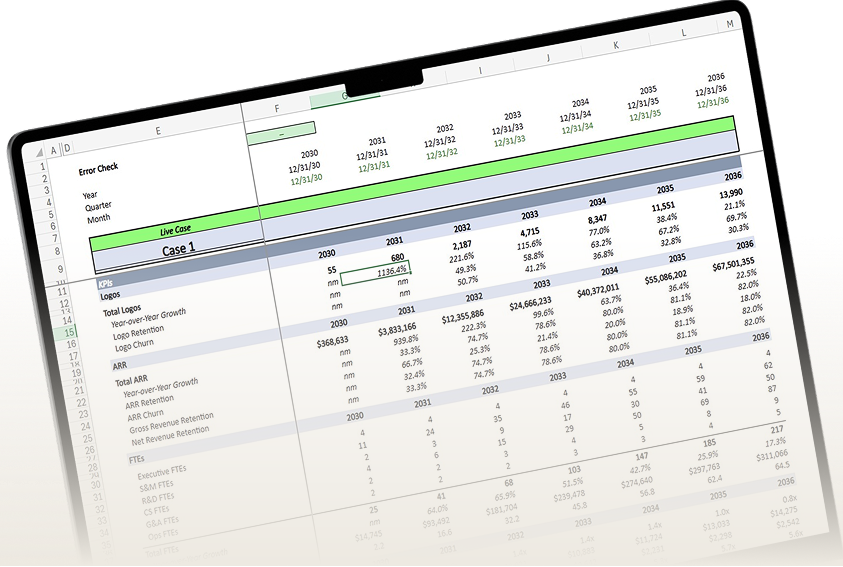
A financial modeling agency, in the context relevant to a scaling B2B SaaS company, builds and maintains the model that turns your accounting data into a forecast, a cash position, and a board-ready story. That typically means a driver-based operating model, a rolling cash flow forecast, defined SaaS metrics (NRR, CAC, LTV, gross margin), and the board deck built from the same underlying file.
This is different from bookkeeping or tax accounting. Bookkeeping records transactions. Accounting handles revenue recognition, compliance, and the financial statements. Financial modeling and FP&A take that output and turn it into a forecast and a recommendation. If your provider is only reconciling the ledger, you don't yet have a financial model, you have clean books, which is a prerequisite but not the same job.
How financial modeling agency pricing is structured
Pricing in this market has converged on two components, and understanding why matters more than memorizing a number.
The one-time build fee covers the initial model construction: mapping your revenue model and cost drivers, building the three-statement structure, defining your KPI scorecard, and producing the first board pack. This is priced as a project because it is bounded work with a clear deliverable.
The ongoing monthly retainer covers what happens every month after that: closing actuals against forecast, updating the model, running variance analysis, and producing the next board pack. This is priced as a retainer because it is recurring work with no natural endpoint.
Some providers separate these into distinct services and invoice them separately. At Fiscallion, they are treated as one engagement, because in practice they are one job: the same model drives the forecast, the variance analysis, and the board pack. Splitting them into separate line items would mean charging twice for the same underlying work.
A smaller number of providers still bill hourly, which tends to suit narrow, well-defined tasks (a single valuation model, a one-off scenario) rather than the ongoing cadence a scaling SaaS company actually needs.
What it costs: market benchmarks by stage and scope
The table below reflects publicly published pricing across financial modeling and fractional FP&A providers, cross-referenced against Fiscallion's own published rates.
| Scope | Typical price | Timeline |
|---|---|---|
| Basic 3-statement model | $2,000–$5,000 | 1–2 weeks |
| Detailed SaaS metrics model | $4,000–$8,000 | 2–4 weeks |
| Fundraising-ready investor model | $5,000–$12,000 | 2–4 weeks |
| Investor-grade / diligence package | $8,000–$25,000 | 4–6 weeks |
| Fiscallion: driver-based model + first board pack | $9,000 one-time | 6–10 weeks |
| Ongoing model maintenance / retainer (external market) | $500–$2,000/month | Ongoing |
| Fiscallion: ongoing forecasting + board reporting | From $3,500/month | Ongoing |
Source ranges for the market rows are drawn from published pricing at Knex's financial modeling cost data, BPR Global's FP&A services, and Top Tier Advisory's financial model packages, alongside comparable project tiers published by Startup Booted Financial. Fiscallion's own pricing is published on its financial modeling and board reporting service page.
Retainer pricing for the fractional FP&A and CFO layer that sits above the model itself scales with company stage. Fiscallion's own fractional CFO pricing guide breaks this down as: under $3M ARR, $3,000–$4,500 per month; $3M–$10M ARR, $4,500–$8,000 per month; $10M–$30M ARR, $8,000–$12,000 per month; $30M–$75M+ ARR, $12,000–$20,000+ per month. Pegacorn Group's fractional CFO cost analysis describes a similar structure: roughly $5,000 per month buys a light operating layer (monthly reporting, KPI dashboards, occasional check-ins), $7,500–$10,000 per month buys an active operating CFO with a defensible bottoms-up model and board attendance, and $15,000–$20,000 per month buys a deep operator handling pricing decisions, hiring panels, and investor calls.
Full-time CFO cost versus fractional financial modeling support
Founders frequently anchor on a base salary number when they should be anchoring on total loaded cost. That comparison changes the math substantially.
A full-time CFO's fully loaded annual cost typically runs from base salary of $200,000 to $500,000, plus a bonus of 20 to 50 percent of base, benefits and payroll taxes of roughly 25 percent, recruiting fees of $50,000 to $75,000, and equity of 0.5 to 2 percent. Fiscallion's fractional CFO pricing guide cites the Baker Tilly 2026 CFO Report, based on 185 U.S. CFOs at PE- and VC-backed companies, putting the total fully loaded cost of a full-time CFO at $350,000 to $800,000 per year.
"A fractional or outsourced retainer at $3,000 to $15,000 per month totals $36,000 to $180,000 per year, a 60 to 80 percent reduction against the fully loaded full-time figure, not against the base salary most founders compare it to first."
— Aleksandar Stojanovic, CEO & Founder at Fiscallion| Cost component | Full-time CFO (annual) | Fractional / outsourced (annual) |
|---|---|---|
| Base compensation | $200,000–$500,000 | Included in retainer |
| Bonus | 20–50% of base | Not applicable |
| Benefits + payroll tax | ~25% of base | Not applicable |
| Recruiting fees | $50,000–$75,000 (one-time) | Not applicable |
| Equity | 0.5%–2% | Not applicable |
| Total loaded cost | $350,000–$800,000/year | $36,000–$180,000/year |
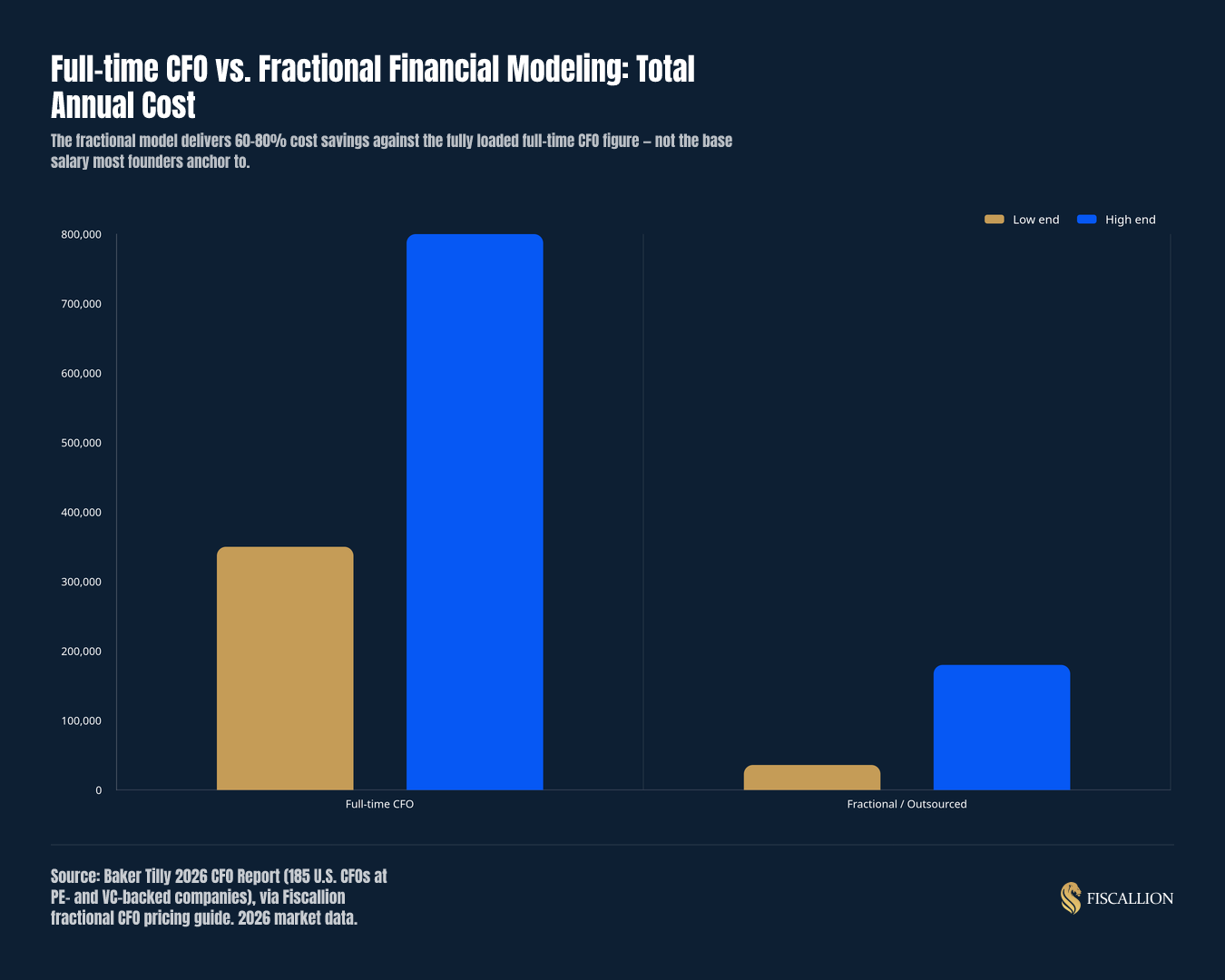
That gap is the reason fractional CFO leadership is worth evaluating on scope, not just on sticker price. It is not evidence that a full-time hire is a bad idea once a company has enough complexity and daily-decision volume to justify the role. It is evidence that the two options solve different problems, and pricing them against each other only makes sense once you are clear on which problem you actually have.
One-time project versus ongoing monthly engagement
Both structures exist because they answer different questions. A model build is bounded, scoped work with a delivery date. Ongoing forecasting, board reporting, and scenario updates have no natural endpoint, because the business keeps generating new actuals every month that need to be reconciled against the forecast.
Fiscallion treats financial modeling, forecasting, and board reporting as one integrated engagement rather than three separately billed services, because the same model file drives all three outputs. Building a model and then handing it to a different team to run the monthly cadence tends to reintroduce the exact fragmentation problem the model was supposed to solve.
Most providers, including Fiscallion, apply a minimum engagement window, commonly around 90 days, before the numbers and the forecast build enough history for the board and the leadership team to trust them. A single month of actuals against a new model tells you almost nothing about whether the assumptions are right. Three months of actuals against a forecast starts to tell you whether the model's logic holds up under real variance.
Working alongside your existing CFO or bookkeeper
A financial modeling agency does not replace your bookkeeper or your existing finance hire. It sits on top of the accounting layer, not in place of it.
Think of the finance function as three layers, each depending on the one below: a bookkeeper who records transactions, a controller or accountant who handles revenue recognition, compliance, and the financial statements, and an FP&A or CFO layer that takes that output and turns it into a forecast, a cash position, and a recommendation. Fiscallion's outsourced FP&A retainer pricing guide lays out exactly this structure, and it matches what other providers describe publicly: Nimbus Business Analytics states it partners with the client's accountant, CPA, or bookkeeper rather than replacing them, and Ledgerive describes covering "the strategic layer while they handle day-to-day transactions."
A realistic finance stack at $10M ARR, drawn from Fiscallion's retainer pricing analysis, looks like a bookkeeper at roughly $1,500 per month, a fractional controller at roughly $4,000 per month, and a fractional CFO-level retainer at roughly $10,000 per month, totaling around $15,500 per month. That combined stack still sits meaningfully below the loaded cost of a single full-time CFO hire.
Before signing any modeling engagement, get clear answers on three coordination points:
- Who owns the chart of accounts and category definitions the model pulls from
- Who is responsible for flagging discrepancies between the ledger and the model
- How frequently the FP&A layer checks the accounting output against the forecast
If a provider cannot answer these clearly, the handoff between your bookkeeper's numbers and the board narrative will be the place your process breaks.
How long a SaaS financial model and first board pack actually takes
Timelines cluster tightly across the market. A basic model typically ships in 1 to 2 weeks. A detailed SaaS metrics model or fundraising-ready model runs 2 to 4 weeks. Investor-grade or diligence-ready packages take 4 to 6 weeks, according to timelines published by Knex, BPR Global, and Top Tier Advisory.
Fiscallion's own timeline runs longer because the deliverable is not just a model file, it is the first board pack built from it. The financial modeling and board reporting service page states that the first pack on the new format typically ships in the second board cycle, roughly 6 to 10 weeks in, depending on the state of the current data and how quickly metric definitions get agreed.
That 6 to 10 week range breaks down into recognizable phases, consistent with the onboarding pattern described in Fiscallion's FP&A retainer pricing guide:
- Weeks 1–2: Diagnostic and baseline. Connect to the accounting system, clean historical data, document the revenue model and cost drivers, align on the KPI scorecard.
- Weeks 3–4: Model build. First deliverable, often a working draft, typically lands in this window.
- Weeks 5–8: Refinement, scenario logic, and first board pack production.
- Weeks 8–10: First board pack delivered on the new format, timed to the second board cycle.
The pace depends heavily on how fast metric definitions get agreed internally. If your team is still debating what counts toward NRR when the engagement starts, that debate happens before the timeline, not during it.
What drives the price up or down
Five variables explain most of the spread between a $3,000 retainer and a $15,000 one:
- Hours committed per month. A light monthly reporting package requires far less time than weekly scenario work and board attendance.
- Strategic versus operational scope. Building dashboards is different work from making a pricing recommendation or sitting in an investor call.
- Company complexity. Multiple entities, multiple currencies, or usage-based pricing models require more modeling logic than a single-entity subscription business.
- Seniority mix. Fiscallion's own fractional CFO pricing guide notes hourly rates ranging from $150–$250 for entry-level fractional support up to $350–$500 for senior, specialized CFO work.
- Fundraise activity. A model built for internal planning is a different scope from one built to survive investor diligence.
A cheaper retainer is not automatically a worse deal. It is frequently a narrower scope, matched to a company that genuinely needs less. The mistake is not choosing the cheaper option, it is choosing it without checking whether the scope still covers what the board actually needs to see.
Common pricing mistakes and the better move
Comparing a retainer to a base salary instead of a loaded cost. A $10,000 monthly retainer looks expensive next to a $180,000 base salary until you add the bonus, benefits, payroll tax, recruiting fee, and equity that push the full-time number toward $350,000 or more. Compare loaded cost to loaded cost.
Conflating bookkeeping fees with CFO-level FP&A fees. A bookkeeper's monthly rate and an FP&A retainer are pricing different jobs. Paying bookkeeping rates and expecting board-ready forecasting, or paying FP&A rates for transaction-level cleanup, both produce disappointment.
Treating the setup fee as padding. The one-time build fee exists because the initial model construction is genuinely different work from the monthly cadence that follows. Providers that fold it invisibly into month one are usually recovering it through a higher early retainer instead.
Paying senior CFO rates for controller-level work. If the actual need is closing the books faster and cleaning up categorization, that is controller-level work, and it should be priced and sourced as such, not folded into a strategic FP&A engagement.
Hiring full-time before the workload justifies it. A full-time CFO makes sense when the company needs daily executive presence and a permanent internal finance organization. Below that threshold, a full-time hire is often solving for prestige rather than for a workload that exists yet.
Discuss your model scope and pricing directly
Every Fiscallion engagement works directly with Aleksandar Stojanovic at the CFO layer. There is no account manager and no junior delivery team between your model and the person accountable for it. Aleksandar's FP&A leadership experience gained through the growth of a SaaS company to €100M ARR informs how the model is built, what it needs to answer, and how it gets presented to your board.
If you want a straight answer on what a model build and ongoing reporting would cost for your specific stage and complexity, discuss scope and pricing on Fiscallion's financial modeling and board reporting page.
Frequently asked questions
How much does it cost to outsource financial modeling for a B2B SaaS company?
Expect $2,500 to $25,000 for a one-time model build, depending on complexity, and $3,000 to $20,000 or more per month for ongoing FP&A and board reporting, depending on company stage. Basic three-statement models sit at the lower end of the build range, around $2,000–$5,000; investor-grade, diligence-ready packages sit at the top, up to $25,000. Fiscallion's published rate is $9,000 for a one-time driver-based model plus first board pack, and from $3,500 per month for ongoing forecasting and reporting, published on its financial modeling and board reporting service page. The right comparison point is not a single number but the fully loaded cost of the alternative, since a full-time CFO hire typically runs $350,000 to $800,000 per year once bonus, benefits, recruiting, and equity are included.
Is financial modeling a one-time project or an ongoing monthly engagement?
It can be either, and the market prices both. A one-time build produces the initial model and, at Fiscallion, the first board pack. An ongoing monthly retainer covers what happens every month after: closing actuals, updating the forecast, running variance analysis, and producing the next board pack. Fiscallion treats these as one integrated engagement rather than separately billed services, because the same model file drives the forecast, the variance analysis, and the board pack. Most engagements, including Fiscallion's, run a minimum window of around 90 days before the forecast has enough real variance behind it to be trusted.
Can a financial modeling agency work alongside our existing CFO or bookkeeper?
Yes, and that is the standard structure, not an exception. A financial modeling or FP&A engagement sits on top of the accounting layer rather than replacing it. Your bookkeeper keeps recording transactions, your controller or accountant keeps handling revenue recognition and compliance, and the FP&A layer takes that output and turns it into a forecast and a recommendation. Before starting, confirm who owns the chart of accounts, who flags discrepancies between the ledger and the model, and how often the FP&A layer reconciles against the accounting output. If you already have a fractional or full-time CFO but need dedicated modeling and board reporting execution, that is a scoping conversation, not a conflict, since Fiscallion's own model is built to plug into whatever finance stack you already run.
How long does it take to build a SaaS financial model and deliver the first board pack?
Basic models typically take 1 to 2 weeks; detailed SaaS metrics or fundraising-ready models take 2 to 4 weeks; investor-grade, diligence-ready packages take 4 to 6 weeks, based on timelines published across multiple financial modeling providers. Fiscallion's timeline runs longer, roughly 6 to 10 weeks, because the deliverable includes the first board pack built on the new format, typically shipping in the second board cycle, and depends on how quickly your team agrees on metric definitions during the first two weeks of diagnostic work.
Pricing a financial model in isolation misses the point. The number on the invoice is small next to the cost of a board meeting run on assumptions nobody can defend, or a runway forecast that changes every time someone opens the spreadsheet. The real decision is whether you need a bounded build, an ongoing retainer, or both, and whether the provider you choose is accountable at the level the board actually needs. Match the scope to your stage, check the fully loaded comparison rather than the sticker price, and get the coordination questions with your existing finance team answered before you sign anything.