

A $7,000-a-month FP&A retainer looks expensive next to a $200,000 CFO salary line. It isn't. Once you load the salary with bonus, benefits, payroll tax, recruiting cost, and the ramp time before a new hire is useful, the retainer is the cheaper decision, not the compromise one. The part founders get wrong is not the sticker price. It's comparing a fully-scoped monthly service to a base salary number that never reflects total cost.
This article breaks down exactly how outsourced FP&A retainer pricing works: the two-part fee structure, what moves the price up or down, what you should expect to pay at your stage, and what deliverables should be inside that number before you sign anything. You'll also see where a retainer fits next to your existing bookkeeper or accounting firm, because that question determines whether the retainer works at all.
What you'll learn in this breakdown
- How retainer pricing is structured, including the setup fee most providers bury inside month one
- The five variables that actually move your monthly price, regardless of which firm you talk to
- Stage-based pricing benchmarks from $3,000 to $20,000+ a month, cross-checked against multiple market sources
- The full-time CFO cost comparison, loaded correctly this time
- Which deliverables belong in a retainer and which ones don't
- How a retainer coexists with your bookkeeper or accounting firm instead of replacing them
- What onboarding looks like in the first 30, 60, and 90 days
- The five most common pricing mistakes founders make and the better move for each
How outsourced FP&A retainer pricing is structured
Almost every credible provider in this market prices the same way: a one-time setup fee, followed by an ongoing monthly retainer. The mechanics matter more than the number.
The setup fee covers work that happens once, not every month. According to a pricing framework built for accounting firms delivering FP&A advisory, setup work typically runs $3,000 to $10,000 depending on complexity and takes 15 to 40 hours. That includes connecting to your accounting system, cleaning up historical data so the model isn't built on bad inputs, defining driver assumptions, and building the initial three-statement model.
The same source flags the most common structural mistake: rolling the setup fee into the first month's retainer, or billing it at standard hourly rates meant for compliance work. Both distort what you're actually paying for. A one-time build is not the same cost category as an ongoing forecast-and-advise relationship, and pricing it as if it were hides how much of your first invoice is really a project fee in disguise.
Three pricing models exist in this market, but they aren't equally suited to ongoing FP&A work:
| Model | How it works | Best fit |
|---|---|---|
| Monthly retainer | Fixed fee for a defined scope of hours and deliverables | Ongoing forecasting, board reporting, cash management |
| Hourly billing | Pay per hour worked | Narrowly defined, short-duration tasks |
| Project-based | Fixed fee for a specific deliverable | Model builds, fundraise prep, diligence support |
Hourly billing is structurally mismatched to FP&A work because it penalizes the provider for answering quick questions and rewards slow, padded engagement. It also makes your own monthly cost unpredictable, which defeats the point of hiring someone to bring predictability to your numbers. Most serious providers in this space have converged on the retainer model for exactly this reason: it aligns incentives, removes friction around asking strategic questions, and gives both sides a predictable cost.
What drives the monthly retainer price up or down
The published number on a pricing page tells you almost nothing until you know what's driving it. Across every credible source in this market, the same five variables explain the spread between a $4,000 retainer and a $15,000 one.
Hours committed. More monthly hours means more retainer cost, but the relationship isn't linear once you cross from "answer questions when asked" into "attend board meetings and own the model." Series A SaaS companies paying $8,000-$12,000 a month typically get 20-30 hours of monthly support, while a full finance partnership at $18,000-$25,000 runs 45-60 hours.
Strategic versus operational scope. A retainer that produces a dashboard and a quarterly deck is a different product than one that sits in pricing decisions, hiring calls, and investor conversations. Pegacorn Group's tiering shows this clearly: $5,000 a month buys light reporting with one or two monthly check-ins, while $15,000-$20,000 buys an embedded operator with multiple touchpoints a week.
Company complexity. Multiple entities, revenue recognition complexity, and multi-product reporting all add hours regardless of your revenue size. A $12M ARR company with three subsidiaries and usage-based pricing needs more FP&A hours than a $12M ARR company with one product and flat subscriptions.
Seniority mix. Some retainers are delivered entirely by a senior operator. Others blend senior strategy time with junior execution hours at a lower blended rate. Hourly benchmarks across the market put entry-level work at $150-$250/hour, mid-tier at $250-$350/hour, and senior CFO-level work at $350-$500/hour, and the blend behind a retainer explains a large part of the price gap between providers.
Fundraise activity. A retainer scoped for steady-state reporting costs less than one that includes active fundraise support, data room preparation, and investor Q&A. This is usually priced as an add-on rather than folded into the base retainer, and you should confirm which model you're getting before you sign.
"Price, in other words, is a function of scope. A cheaper retainer isn't necessarily a worse provider, and an expensive one isn't automatically better judgment. It's a different scope, and the only useful comparison is scope-to-scope, not price-to-price."
— Aleksandar Stojanovic, CEO & Founder at FiscallionPricing benchmarks by stage: what the market actually charges
The numbers converge more tightly than you'd expect once you strip out the outliers. Every credible source lands in the same $3,000-$15,000-a-month band for the core of the market, with enterprise-scale engagements running higher.
| ARR stage | Typical monthly retainer | Monthly hours (approx.) |
|---|---|---|
| Under $3M | $3,000-$4,500 | 8-15 |
| $3M-$10M | $4,500-$8,000 | 15-25 |
| $10M-$30M | $8,000-$12,000 | 25-40 |
| $30M-$75M+ | $12,000-$20,000+ | 40-60 |
Consolidated from Fiscallion's fractional CFO pricing tiers and cross-referenced against external benchmarks.
That table holds up against independent research. Eagle Rock CFO's survey of the fractional CFO market found most companies pay $4,000-$8,000 a month, with a full range spanning $2,000 to $15,000+. Fractional Pulse's stage-based breakdown shows Series A companies at $1-5M ARR paying $7,000-$12,000, Series B companies at $5-20M ARR paying $10,000-$18,000, and growth-stage companies above $20M ARR paying $15,000-$25,000. Eightx's engagement data for $5M-$25M ARR companies lands at $5,000-$12,000 a month for 20-40 hours, rising to $8,000-$15,000 for $25M-$50M ARR companies.
One outlier deserves a flag. CFO Advisors reports Series A startups paying $10,000-$25,000 a month, which sits above the general market range for that stage. That gap is almost certainly scope, not overpricing: the same source's tiering shows their top package includes 45-60 hours a month and board meeting attendance, which is closer to an embedded operator than a standard advisory retainer. Read stage benchmarks with the scope attached, not as a flat number.
There's also a lower tier worth naming honestly. Controller-led FP&A services exist at $300-$1,500 a month, and they're a legitimate option if what you need is bookkeeping-adjacent reporting rather than CFO-level judgment. The distinction matters: that price point buys execution, not strategic ownership of your forecast, your board narrative, or your fundraise numbers. Comparing a $600-a-month controller service to a $10,000-a-month CFO-level retainer as if they're competing products is the comparison mistake that causes the most founder frustration later.
Fractional CFO versus full-time CFO: the comparison most founders get wrong
Founders routinely compare a retainer to a CFO's base salary. That's the wrong comparison, and it makes the retainer look more expensive than it is.
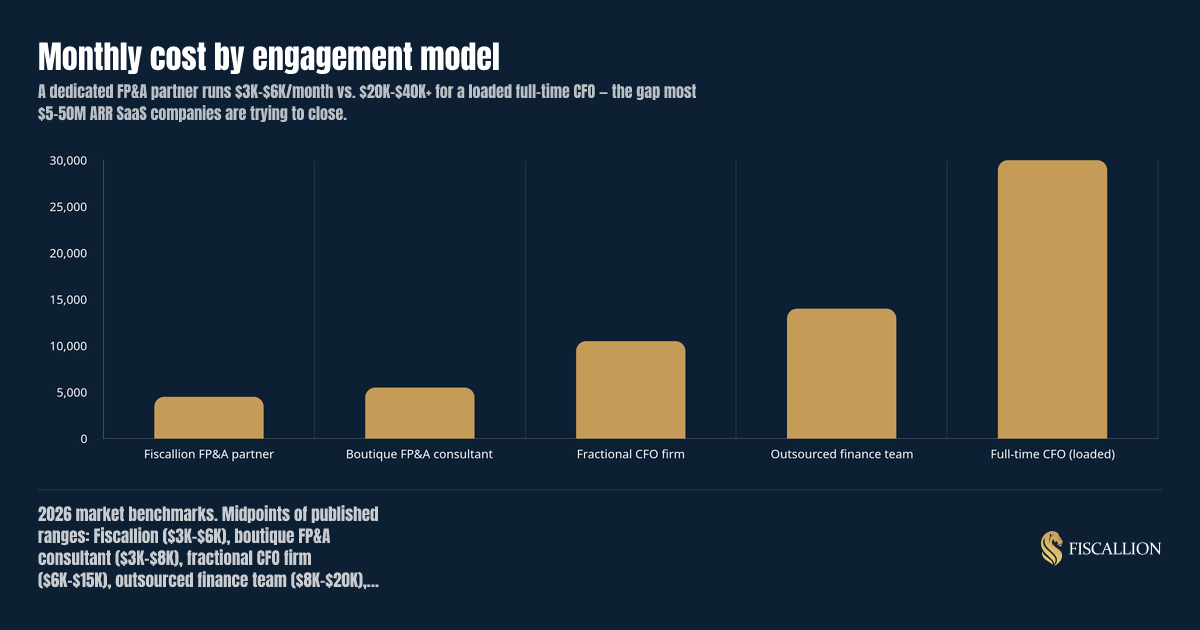
A full-time CFO's real annual cost is never just the base salary. Baker Tilly's 2026 CFO Report, surveying 185 U.S. CFOs at PE- and VC-backed companies, found nearly half earn a base salary of $250,000 or more. Layer in a bonus of 20-50% of base, benefits and payroll taxes at roughly 25% of total compensation, recruiting fees of $50,000-$75,000, and equity of 0.5%-2%, and the fully loaded annual cost lands at $350,000-$800,000.
A fractional or outsourced FP&A retainer, at $3,000-$15,000 a month, totals $36,000-$180,000 a year. That's a 60-80% cost reduction against the fully loaded full-time number, not against the base salary line most founders mentally anchor to.
| Cost component | Full-time CFO | Fractional/outsourced retainer |
|---|---|---|
| Base compensation | $200,000-$500,000 | Built into monthly fee |
| Bonus | 20-50% of base | Not typical |
| Benefits + payroll tax | ~25% of total comp | Not applicable |
| Recruiting cost | $50,000-$75,000 (one-time) | None |
| Equity | 0.5%-2% | Rare, sometimes 0.1-0.25% for extended engagements |
| Total annual cost | $350,000-$800,000 | $36,000-$180,000 |
The cost gap is the obvious story, but it's not the whole one.
"A retainer forces focus: you're paying for defined hours and defined deliverables, which means the relationship has to produce decision-ready output on a schedule instead of drifting into whatever fills a full workweek. It also brings independence: an outside CFO-level advisor has less incentive to shade a forecast toward what a founder wants to hear, because their engagement isn't tied to internal politics or promotion cycles."
— Aleksandar Stojanovic, CEO & Founder at FiscallionNone of this means full-time is the wrong call at every stage. A full-time CFO makes sense when the workload and complexity justify daily executive presence and a permanent internal finance organization, not just when the company can technically afford the salary. Below that threshold, you're paying for capacity you don't need yet.
If you're weighing a retainer against a full-time hire for your specific stage and complexity, that's the exact conversation worth having before you commit either way. Book an FP&A model review with Aleksandar and walk through what your numbers actually require.
What deliverables belong in a monthly FP&A retainer
A retainer without a defined deliverable list is a retainer you can't hold anyone accountable to. Across the market, the core deliverable set is consistent:
- A driver-based financial model tied to your actual revenue and cost drivers, not a generic template
- A rolling 13-week cash forecast, refreshed on a set cadence
- Monthly variance analysis comparing actuals to plan
- A board reporting package built for decisions, not just historical summary
- KPI dashboards covering MRR/ARR, CAC, LTV, net revenue retention, burn, and runway
- Scenario planning for hiring, pricing, and fundraise decisions
Waveup's sprint-based FP&A model bundles a model audit and rebuild, a 13-week cash forecast with scenario toggles, budget-to-actual variance, a KPI dashboard, and a board pack into a $5,000 or $10,000 monthly retainer, which lines up closely with what most serious providers include at that price point.
Fundraise support, M&A diligence, and active investor relations are usually add-ons rather than baseline inclusions. Confirm which model you're getting: some retainers absorb light fundraise support into the base fee, others bill it separately as project work.
Just as important is what's not included. An FP&A retainer does not cover bookkeeping, accounts payable or receivable processing, payroll administration, or tax filing. That's a different layer of the finance function entirely, delivered by a different provider, and conflating the two is where a lot of pricing confusion starts.
Can a retainer work alongside your existing bookkeeper or accounting firm?
Yes, and this is the standard model, not an exception. An outsourced FP&A retainer sits on top of your accounting function. It does not replace it.
Think of the finance function as three layers. Bookkeeping records transactions. Accounting handles revenue recognition, compliance, and the financial statements those transactions roll up into. FP&A takes that output and turns it into a forecast, a cash position, and a recommendation. Each layer depends on the one below it being accurate.
A clean forecast built on misclassified data still gives you the wrong answer.Clean books are the prerequisite for effective CFO-level work, and every hour spent on strategic analysis on top of unreliable bookkeeping is effectively wasted money. If your books are a mess, fixing that is more valuable right now than adding a forecasting layer on top of numbers you can't trust.
A realistic finance stack at $10M ARR often looks like this: a bookkeeper at roughly $1,500 a month, a fractional controller at roughly $4,000 a month, and a fractional CFO-level retainer at roughly $10,000 a month, totaling around $15,500 a month for the complete function. That's still meaningfully below a single full-time CFO hire's loaded cost, and it gives you specialized ownership at each layer instead of asking one generalist hire to cover all three.
The practical question to ask any FP&A provider isn't whether they'll work with your bookkeeper. It's how they'll coordinate: who owns the chart of accounts, who flags discrepancies, and how often the FP&A layer checks the accounting layer's output before building a forecast on top of it.
What onboarding looks like when you start a retainer
The first weeks determine whether the rest of the engagement produces numbers you trust. Most credible providers follow a similar sequence.
Weeks 1-2: diagnostic and baseline.The onboarding process typically starts with connecting to your accounting system, establishing a clean historical baseline, documenting your actual revenue model and cost drivers, and aligning on a KPI scorecard. By the end of this phase, you should have a working monthly model, a defined chart of accounts, and a calendar of recurring deliverables.
First deliverable: 2-4 weeks in.Even at the lower end of the market, providers target a first deliverable within two to four weeks of kickoff, which is a reasonable benchmark to hold any provider to regardless of price point.
Ongoing monthly cadence: actuals close, variance analysis, updated 12-month forecast, board pack, live KPI dashboards. A mid-month cash and runway check and a quarterly re-baseline of the budget round out the standard rhythm.
Why a 90-day minimum makes sense. It takes roughly one full quarter to establish trust in the numbers: one month to build the baseline, one month to test it against actuals, and one month to refine the assumptions before the model earns the right to drive real decisions. A shorter commitment usually means you're evaluating a half-finished model, not a working one.
Common pricing mistakes and the better move
Mistake: paying CFO rates for controller-level work. A retainer priced at $9,000 a month that delivers a P&L review, a dashboard, and a quarterly deck is controller-level output at CFO-level pricing. Better move: match the price tier to the actual deliverable list, not the provider's title. If the scope is operational reporting, price it like operational reporting.
Mistake: conflating bookkeeping providers with fractional CFO firms. Bookkeeping-and-tax platforms and strategic FP&A retainers solve different problems and shouldn't be evaluated against each other on price. Better move: decide which layer of the finance stack you're actually short on before you start comparing quotes.
Mistake: comparing retainer cost to base salary instead of total loaded cost. This is the single most common distortion in how founders evaluate the decision. Better move: always compare against the fully loaded number, including bonus, benefits, payroll tax, and recruiting cost, not the number on a job posting.
Mistake: not pricing setup separately. When a provider folds the one-time model build into month one without breaking it out, you can't tell what the ongoing retainer actually costs. Better move: ask for the setup fee and the monthly retainer as two separate numbers before you sign.
Mistake: hiring full-time too early. Bringing on a full-time CFO before the complexity justifies daily executive presence means paying for capacity that sits idle most weeks. Better move: scale into full-time when the workload, not the funding round, demands it.
FAQ
How is outsourced FP&A retainer pricing structured for SaaS startups?
Pricing has two parts: a one-time setup fee, typically $3,000-$10,000 depending on complexity, and an ongoing monthly retainer. The setup fee covers connecting to your accounting system, cleaning historical data, and building the initial model. The monthly retainer covers ongoing forecasting, reporting, and advisory work, and should be quoted as a separate line item rather than blended into your first invoice. Monthly retainers for SaaS companies at $5-100M ARR typically range from $3,000 to $20,000+, driven by hours committed, scope, company complexity, and seniority mix.
What deliverables are typically included in a monthly FP&A retainer engagement?
A standard retainer includes a driver-based financial model, a rolling 13-week cash forecast, monthly variance analysis against plan, a board reporting package, KPI dashboards covering MRR/ARR, CAC, LTV, net revenue retention, burn, and runway, and scenario planning for hiring, pricing, and fundraise decisions. Fundraise support, M&A diligence, and active investor relations are usually priced separately as add-ons. Bookkeeping, accounts payable and receivable processing, payroll, and tax filing are not part of an FP&A retainer; those sit in a different layer of the finance function.
Can an outsourced FP&A retainer work alongside our existing bookkeeper or accounting firm?
Yes, and it should. An FP&A retainer sits on top of your accounting function rather than replacing it. Bookkeeping records transactions, accounting turns those transactions into compliant financial statements, and FP&A converts that output into a forecast, a cash position, and a recommendation. Each layer depends on the accuracy of the one below it, so clean books from your existing bookkeeper or accountant are the prerequisite for useful FP&A work, not a competing service. The practical coordination question is who owns the chart of accounts and how often the FP&A layer checks the accounting output before building on it. If a tool or AI dashboard is generating some of your reporting automatically, that still doesn't remove the need for someone accountable to interpret what the numbers mean for your next decision, which is the judgment layer a retainer is actually paying for.
What does onboarding look like when starting an outsourced FP&A retainer?
Onboarding typically runs two to four weeks before the first real deliverable. Weeks one and two focus on diagnostic work: connecting to your accounting system, establishing a clean historical baseline, documenting your actual revenue model and cost drivers, and aligning on a KPI scorecard. By the end of that phase, you should have a working monthly model, a defined chart of accounts, and a calendar of recurring deliverables. From there, the engagement moves into a standing monthly cadence: actuals close, variance analysis, an updated 12-month forecast, a board pack, and live dashboards, with a mid-month cash and runway check and a quarterly re-baseline. Most serious engagements ask for a 90-day minimum commitment, because it takes roughly one quarter to build the baseline, test it against real actuals, and refine the assumptions enough that the model earns the right to drive decisions.
The retainer decision comes down to scope, not sticker price
Outsourced FP&A retainer pricing isn't a mystery once you separate the setup fee from the ongoing cost and match the price tier to the actual scope you're buying. The market has converged on $3,000-$20,000+ a month depending on stage and complexity, and every credible provider structures the fee the same way for the same reason: predictable cost, aligned incentives, and a defined deliverable list you can hold them to.
Every Fiscallion engagement runs directly with Aleksandar Stojanovic at the CFO layer, drawing on FP&A leadership experience gained through scaling a SaaS company to €100M ARR. If you're trying to figure out whether your next finance hire should be a retainer, a full-time seat, or something in between, that's a scoping conversation, not a guessing game. Book an FP&A model review with Aleksandar and get a clear answer before you sign anything.