
Most founders searching for financial modeling consultants are not actually shopping for a model. They are shopping for confidence in a number: runway, next quarter's cash position, or the growth rate the board will hold them to. That distinction changes who you should hire.
A spreadsheet built by a generalist consultant and never touched again is worse than no model at all, because it creates false certainty. The right consultant builds a model your team will actually update every month, ties it to your real cash movements, and tells you when an assumption is wrong before your board does.
This article gives you a concrete way to evaluate financial modeling consultants for a SaaS company doing $5-50M in ARR: what to look for, what to pay, what red flags predict a bad engagement, and how to structure the first 30 days so the model survives past the kickoff call.
Key takeaways
- The best financial modeling consultants for startups build cash-linked, cohort-based models your team can update monthly, not static one-time spreadsheets.
- Price and title are poor proxies for quality. A $28,000-a-month full-time CFO hire and a $6,000-a-month boutique advisor can both hand you a model that goes stale in six weeks.
- Evaluate consultants on decision cadence, assumptions ownership, and cash-linkage, not on the size of their client logo list or the polish of their board deck templates.
- Most $5-50M ARR companies do not have a "need a CFO" problem. They have a decision-quality and FP&A infrastructure problem, and that changes who should build the model.
- Ask any consultant to walk you through how they'd model a single messy scenario, like a sales-led motion shifting to product-led, before you sign anything.
What we'll cover
This article walks through the core concept of financial modeling consulting for growth-stage SaaS, how to calculate the true cost of an engagement, how to interpret proposals and past work samples, what to do before you sign a statement of work, the mistakes founders make when picking a consultant, and a practical scorecard you can use in your next three consultant calls.
The core concept: what a financial modeling consultant should actually deliver
A financial modeling consultant for a SaaS company should deliver three things, not one:
- A working model that connects your billing system, your bank balance, and your headcount plan into a single forecast, not a static export dressed up in a template.
- A cadence for updating that model, so it reflects reality every month instead of becoming outdated the week after delivery.
- A decision framework that tells you what to do when the actual numbers diverge from the plan, whether that means slowing hiring, renegotiating a contract, or extending the fundraise timeline.
Most consultants are strong on the first item and weak on the second and third. That is the gap that causes founders to hire again eighteen months later, frustrated that "the model from the last consultant doesn't match cash anymore."
At Fiscallion, we treat financial modeling as infrastructure, not a deliverable. A model that cannot be updated by your team in under two hours a month is not decision-grade, no matter how sophisticated the formulas look.
The three categories of financial modeling help, and who each one fits
| Category | Typical structure | Best fit | Weak point |
|---|---|---|---|
| Boutique startup finance advisor | Hourly or project-based, one senior person | One-time model build, fundraise deck support | No ongoing cadence once the project ends |
| Fractional CFO firm | Monthly retainer, junior staff plus a partner | Companies wanting a CFO title without the full-time cost | Often heavier on reporting polish than forecasting rigor |
| Full-time CFO hire | Salary plus equity, dedicated headcount | Companies past $50M ARR with complex capital structure | Long hiring cycle, high fixed cost, ramp time before output |
| Outsourced finance team | Retainer covering bookkeeping through FP&A | Companies needing full-stack finance ops | Model quality varies widely by staffing tier assigned |
| Embedded FP&A partner (Fiscallion model) | Ongoing engagement focused on decision cadence | Companies at $5-50M ARR needing CFO judgment without a full org | Requires your team to stay engaged in the monthly cadence |
The category matters less than the specific person and process behind it. A great boutique advisor can outperform a mediocre fractional CFO firm. But knowing which category solves which problem narrows your search fast.
How to calculate the real cost of a financial modeling engagement
Founders usually compare consultants on the headline monthly rate. That is the wrong number to anchor on. Calculate the full cost instead:
Total cost = (monthly retainer or hourly rate x hours) + internal time spent feeding data + cost of decisions delayed while the model gets built + cost of re-doing the work if the model does not stick.
Here is what that looks like across common options for a $5-50M ARR SaaS company.
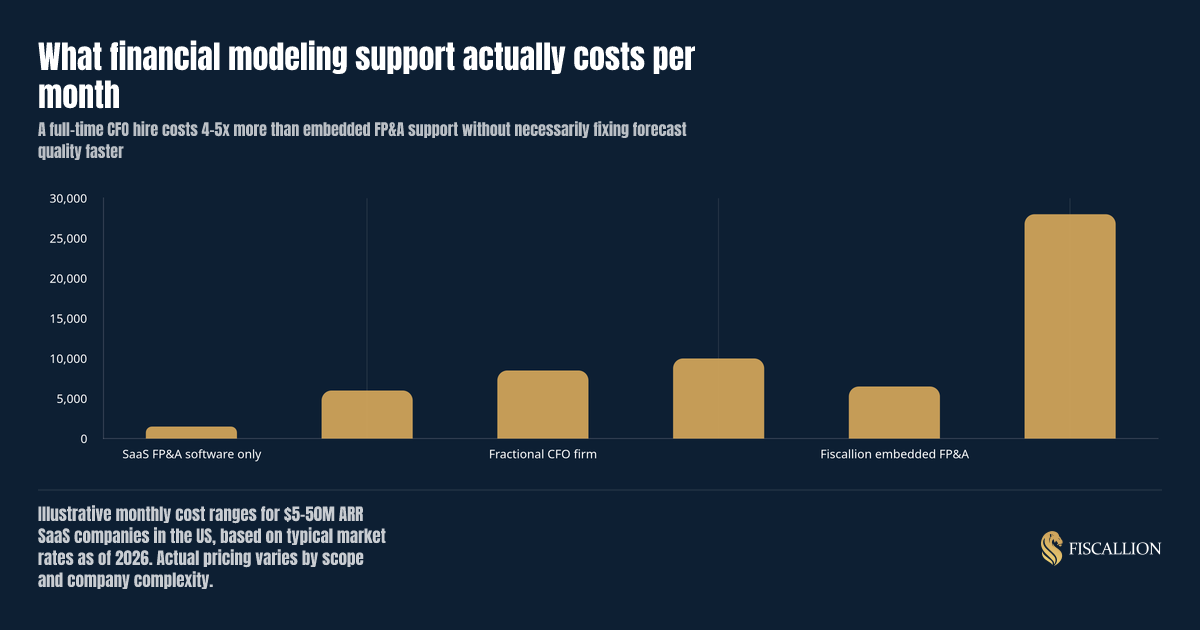
Notice that a full-time CFO hire costs four to five times more per month than an embedded FP&A engagement, and that gap compounds over a year. That does not make the full-time hire wrong for every company. It means the extra spend needs to buy something specific: usually board gravitas, deep capital markets relationships, or M&A experience. If your actual problem is forecast fragility or unclear unit economics, that premium buys reporting polish, not the fix you need.
Time to value matters just as much as monthly cost. A consultant who takes twelve weeks to deliver a usable model has cost you a full quarter of decisions made on gut feel.
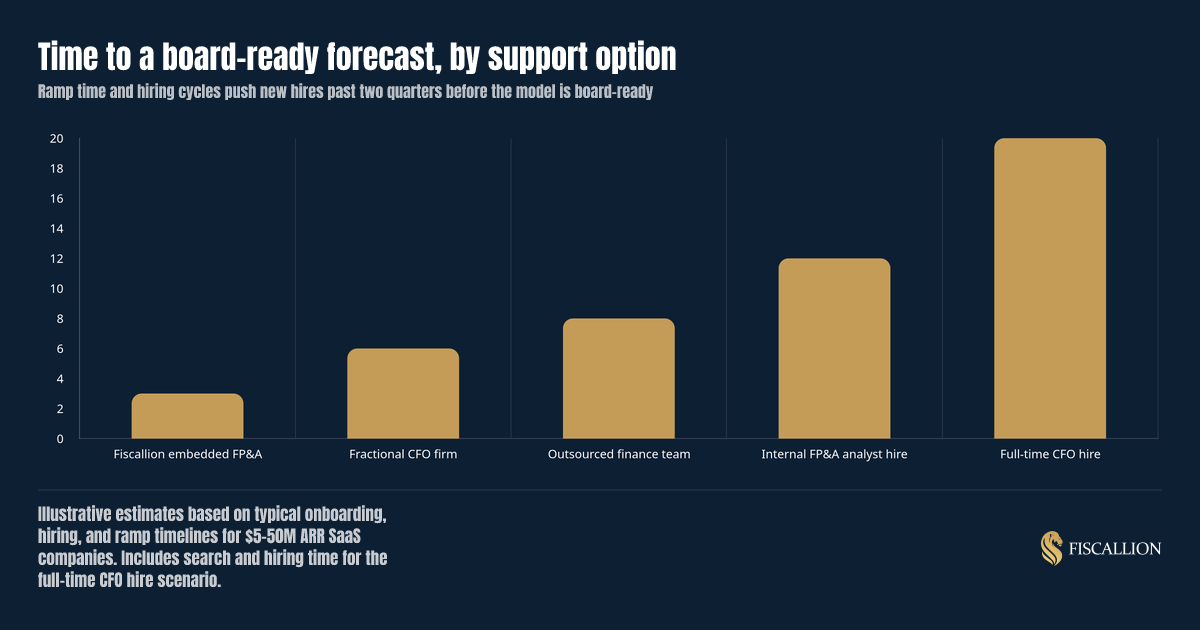
When you're evaluating proposals, ask each consultant to commit to a specific week when you will have a working, cash-linked model in hand, not a discovery deck. If they cannot give you a week number, that is itself useful information.
How to interpret proposals: what separates a strong consultant from a weak one
Read every proposal against these five questions. The answers reveal more than the pricing page.
Does the model start from cash, or from bookings?
A model built on top-line ARR growth without tying to actual cash movements will drift from your bank balance within two quarters. Ask to see how they reconcile the model to your bank statement monthly.
Do they treat CAC and LTV as a range, or a single number?
A consultant who hands you one blended CAC figure across all channels and segments is giving you a number you cannot act on. The stronger move is a cohort view by channel and by customer segment, with a range that reflects the real uncertainty in payback assumptions. If a consultant's sample deliverable shows a single CAC/LTV ratio with no cohort breakdown, that is a signal to keep looking.
Do they own the assumptions, or hide them in a locked tab?
Every model has assumptions: churn rate, sales cycle length, hiring ramp time. A decision-grade model surfaces these assumptions on one visible tab and dates them, so you know exactly what changed when the forecast shifts. If assumptions are buried in formulas across twelve linked tabs, your team will never be able to maintain it after the consultant leaves.
Does the deliverable include a decision, or just a report?
Ask to see a sample board deck or forecast update from a past engagement. If every page reports what happened without recommending what to do next, budget more hiring, cut burn, extend runway by adjusting a specific lever, that consultant is building reporting, not FP&A.
Can your team run it without them next month?
The best engagements make themselves progressively less necessary for routine updates, while staying available for judgment calls: pricing changes, a new hiring wave, a shift in go-to-market motion. If the proposal implies permanent dependency for basic updates, that is a retainer designed to renew itself, not a model designed to serve you.
What to do next: a 30-day plan before you sign anything
Before signing a statement of work with any financial modeling consultant, run this sequence.
- Audit your current metrics definitions first. Pull your CAC, LTV, gross margin, and burn multiple definitions from your last three board decks. If they've shifted quarter to quarter, that is the actual problem a consultant needs to fix before building anything new.
- Ask for a working sample, not a case study. Request a redacted model excerpt showing how they structure cohorts, cash reconciliation, and assumptions. A polished PDF case study tells you nothing about the underlying spreadsheet discipline.
- Run a single scenario test in the sales call. Describe one messy, real situation, a sales-led motion shifting to product-led-growth, a pricing change mid-quarter, a key customer at renewal risk, and ask them to talk through how they'd model it live. Watch for whether they reach for a range and a set of trade-offs, or a single confident number.
- Set a cadence requirement in the contract, not just a deliverable. Specify a monthly or biweekly review cadence with a named owner on both sides. A one-time deliverable without a cadence clause becomes stale by definition.
- Define the exit criteria upfront. Decide what "board-ready" and "decision-ready" mean before the engagement starts, so you are not negotiating scope creep at month three.
This is close to how we structure onboarding at Fiscallion: metrics definitions get audited in week one, the cash-linked model gets built in weeks two and three, and the decision cadence starts by week four, not after a full quarter of "getting oriented."
Common mistakes and the better move
Mistake: hiring based on the deck, not the spreadsheet.
Founders often pick the consultant with the most polished sales presentation. The better move is to ask for the underlying model structure in the first call, before any pitch deck gets shown. A confident narrative wrapped around a fragile spreadsheet is the most common failure pattern we see.
Mistake: treating CAC/LTV as a solved number instead of a debate to resolve.
Many teams bring in a consultant to end the CAC/LTV argument with one authoritative figure. The better move is to insist on a cohort-based range by channel and segment, so the number can actually inform a budget decision instead of getting re-litigated every board meeting.
Mistake: hiring a full-time CFO to fix a forecasting problem.
A full-time CFO adds cost, reporting structure, and often investor credibility. It does not automatically fix a fragile forecast or unclear unit economics; those are modeling and cadence problems, not headcount problems. If your board pressure is really about "we don't trust the numbers," a full-time hire without a rebuilt model just adds a more expensive person reporting the same fragile numbers.
Mistake: treating the model as a one-time deliverable.
A model handed off with no update cadence degrades within one to two quarters as the business changes. The better move is to build the cadence into the contract from day one: who updates which inputs, on what schedule, and who reviews variance each month.
Mistake: comparing consultants on hourly rate alone.
A lower hourly rate with more hours billed, or a higher rate with a tighter, cash-linked deliverable, can produce wildly different total costs and outcomes. The better move is to calculate total cost to a working, board-ready model, not the rate card.
Mistake: skipping the assumptions audit.
Teams often let a new consultant build directly on top of existing metrics definitions without questioning them. If your CAC or gross margin definitions have quietly drifted between finance, sales, and the board deck, a new model built on those same definitions just formalizes the confusion. The better move is an explicit metrics definitions audit before any new model gets built.
A practical scorecard for your next consultant call
Use this table on your next three calls. Score each consultant 1 to 5 on each row, then compare totals instead of relying on gut feel from the pitch.
| Evaluation criterion | What good looks like | Score (1-5) |
|---|---|---|
| Cash-linkage | Model reconciles to bank balance monthly, not just bookings | |
| CAC/LTV treatment | Cohort-based range by channel and segment, not one blended number | |
| Assumptions visibility | All key assumptions on one dated, visible tab | |
| Decision framing | Deliverables recommend a next move, not just report history | |
| Update cadence | Named owner, fixed schedule, built into the contract | |
| Time to first working model | Specific week committed, not "it depends" | |
| Team handoff | Your team can run routine updates without the consultant | |
| Total cost transparency | Full cost modeled including your team's time, not just the rate |
A consultant who scores well across cash-linkage, assumptions visibility, and decision framing is worth paying a premium for. A consultant who scores well only on polish and pitch quality is a reporting vendor, not an FP&A partner.
Notes
Financial modeling consultants exist on a spectrum from one-time spreadsheet builders to full embedded FP&A partners, and the right choice depends on whether your actual problem is a missing model or a missing decision cadence. Most $5-50M ARR SaaS companies searching for "the best financial modeling consultants" are really looking for someone who can turn fragmented data and implicit assumptions into a forecast the board and the leadership team can act on every month, not just once.
Before you sign with any firm, run your own metrics definitions audit, request a working model sample instead of a case study, and set a cadence requirement into the contract. That sequence filters out consultants who sell polish and surfaces the ones who build infrastructure you can actually run.
If you want a second opinion on whether your current forecasting model and metrics definitions can support the next board meeting or the next fundraise, audit your metrics definitions and forecasting model with Fiscallion before you sign another statement of work.