
Outsourcing your finance operations is not a single decision. It is a sequence of decisions, and most founders make the wrong one first: they hire too senior, too early, or they wait too long and let a fundraise force the issue.
Here is the decision this article helps you make: which finance function to outsource next, in what order, and at what stage. You will leave with a seven-sign checklist, a cost comparison between fractional and full-time CFO support, and a readiness diagnostic you can run this week.
The trigger moment most founders miss
The pattern shows up the same way almost every time. The numbers technically exist. Revenue is in the accounting system, a spreadsheet tracks cash, and someone updates a slide before the board meeting. But decisions are still made on gut feel.
"That is the real problem, and it is rarely about missing data. It is fragmented data spread across tools and people, implicit assumptions nobody wrote down, and no decision-ready FP&A framework that turns activity into cash, runway, and trade-offs."
— Aleksandar Stojanovic, CEO & Founder at FiscallionThe stakes are not abstract. Running out of cash or failing to raise new capital is the single largest driver of startup failure, ahead of "no market need." Runway depletion, not competition, is what kills most companies that never make it to their next round.
Fragmented data and implicit assumptions are what turn a fixable cash problem into a fatal one, because nobody notices the trend until the runway number is already wrong. The rest of this article is a structured way to catch that before it happens, starting with the signs, then the sequence of what to outsource and when, the real cost math, and a diagnostic you can run against your own finance function today.
7 signs it's time to outsource your finance operations
These signs map directly to what founders tell us before they call: cash visibility problems first, then runway confidence, then reporting that doesn't drive decisions.
- Cash flow has no single source of truth. If the answer to "what's our cash position" depends on who you ask and which tab they open, you are managing risk with guesswork. The better move: one model, one owner, updated on a fixed cadence.
- Runway forecasts feel fragile. A forecast that changes every time someone pokes at an assumption is not a forecast, it's a guess with decimals. Startups holding 18 or more months of runway close their next round at a materially higher rate than those running lean, which makes a fragile forecast a fundraising problem, not just an operations one.
- Board reporting happens but doesn't answer "what do we do next." A deck full of charts that restates history without framing a decision is reporting theater. The better move is a board pack that ends every section with a recommendation and a trade-off, not just a number.
- Unit economics get debated instead of used. If CAC and LTV turn into a recurring argument rather than an input to a pricing or hiring decision, the metric isn't doing its job. Treat it as a range and a cohort view, not a single number people fight over.
- Headcount decisions happen without a model. Hiring based on cash in the bank rather than revenue capacity is a common and expensive mistake. A headcount plan tied to a revenue and margin model catches this before the offer letter goes out.
- Month-end close slips past 7 to 10 business days.Signs your startup needs more than a bookkeeper consistently include a close that keeps sliding later. When close time creeps, everything downstream, including your board pack and your forecast, is built on stale numbers.
- You're spending 3 to 4-plus hours a week on non-strategic finance admin. That's founder time that should be going toward customers, product, or the next raise, not reconciling categorizations or chasing an invoice.
None of these signs on their own means you need a full finance department. Together, they mean the function has outgrown ad hoc ownership.
What to outsource first: the finance function stack by stage
The sequence that works is bookkeeper, then controller, then fractional CFO, then, eventually, a full-time finance leader. Skipping steps or hiring the wrong layer too early is the most common expensive mistake in this decision.
A useful decision rule: outsource a function as long as it does not yet generate more than roughly 30 hours per week of work that requires institutional knowledge specific to your company. Once it crosses that line consistently, bring it in-house.
Here is how that maps to stage:
| Stage | ARR range | What to outsource first | Why |
|---|---|---|---|
| Pre-seed / seed | Under $3-5M | Bookkeeping core | Highly proceduralized work; no institutional knowledge lock-in yet |
| Series A | Roughly $3-15M | Accrual accounting, GAAP close, CFO advisory | The accrual switch is not optional once investors, lenders, and auditors need statements they can trust |
| Series B+ | $15M-$75M+ | Hybrid: fractional CFO plus in-house or fractional controller | Coverage and judgment scale together without the cost of a full finance org |
Bookkeeping should generally stay outsourced through at least Series B, often longer, because it remains procedural even as the company grows. Controllership is typically a hybrid function until roughly $5-10M ARR, at which point many companies bring it in-house. A fractional CFO becomes necessary earlier if you're raising, later if you're not.
The accrual switch deserves its own callout because it is a forcing function, not a preference. GAAP requires accrual-basis reporting, and a Series A board expects monthly reporting with commentary, not a trial balance. Waiting until diligence forces the conversion is one of the costliest sequencing mistakes on this list; a 2022 industry survey found that 45% of VCs cited weak financial controls and reporting as a significant concern during Series A due diligence.
If you're approaching or inside that Series A window and haven't made the accrual conversion, that's the specific gap Fiscallion's Accrual Accounting for B2B SaaS service addresses directly.
The cost math: fractional vs. full-time CFO
Founders often compare fractional CFO retainers against a full-time CFO's base salary. That's the wrong comparison, and it consistently makes outsourcing look more expensive than it is.
Base salary is only part of the true cost of a full-time hire. Add bonus, benefits, payroll taxes, equity, recruiting fees, onboarding, and severance risk, and the number changes substantially.
| Cost component | Full-time CFO (Series B example) | Fractional CFO |
|---|---|---|
| Base / retainer | $275,000 | $36,000-$180,000/year total |
| Bonus (20-30% of base) | Included above the base line | None |
| Benefits & payroll taxes | ~$68,750 | None |
| Equity | ~$93,750/year value | None |
| Recruiting (amortized) | ~$20,000 | None |
| Onboarding / operational | ~$15,000 | None |
| Total Year 1 | ~$472,500 | $36,000-$180,000/year |
Source: fractional CFO vs. full-time CFO cost comparison, consensus figures cross-validated across multiple cost-benchmark sources.
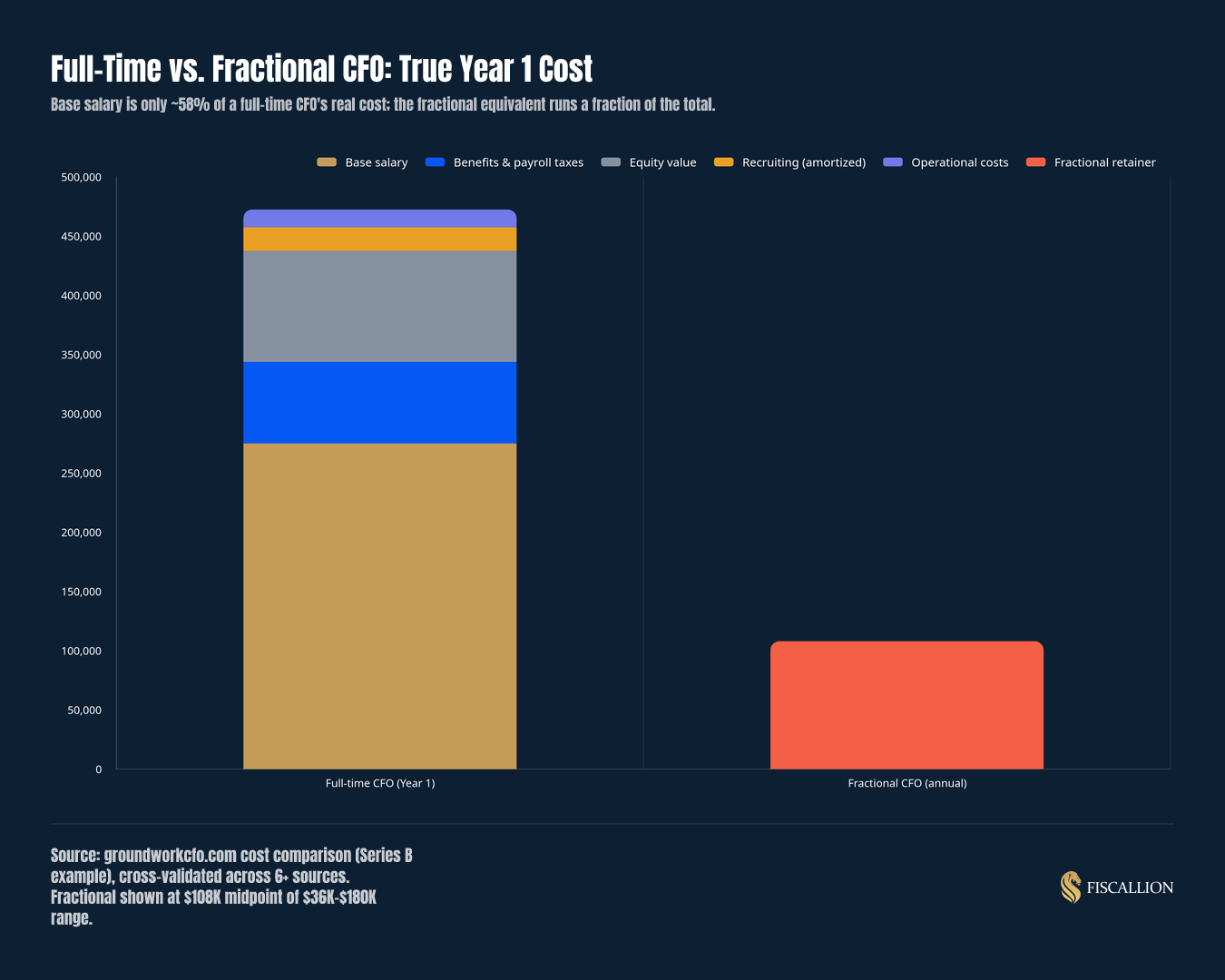
"That gap represents a 60-80% cost saving, and it's not a case of getting a lesser service for less money. It reflects a different operating model: senior judgment on a retainer instead of a full permanent org, with no equity dilution, no recruiting risk, and no severance exposure if the fit isn't right."
— Aleksandar Stojanovic, CEO & Founder at FiscallionFor most companies between roughly $10M and $75M ARR, a hybrid stack, meaning a fractional CFO paired with a controller, tends to beat a single full-time CFO hire on both cost and coverage: $180,000-$315,000 all-in versus $400,000-$600,000, with more total capacity across bookkeeping, controllership, and strategic finance.
None of this means fractional is automatically the right call for every company. A full-time CFO earns its cost when the business needs daily executive presence, a permanent internal finance organization, or enough complexity and workload to justify the seat. The decision is about scope, ownership, and operating needs, not about which option is cheaper on paper.
Every Fiscallion engagement works directly with Aleksandar Stojanovic at the CFO layer. That's a structural point, not a marketing line: you get senior-partner judgment on every engagement, not a handoff to an account manager or a junior delivery team after the sales call ends.
Get the Finance Operations Outsourcing Readiness Diagnostic →
Run the diagnostic below yourself, or work through it with Aleksandar directly. If accrual accounting and GAAP-ready close are the specific gap, explore Fiscallion's Accrual Accounting for B2B SaaS service.
How an outsourced finance team works with your existing tools
The most common objection founders raise before they commit is some version of "will we have to switch systems." The answer, with a credible provider, is no.
Reputable outsourced finance teams work directly inside your existing accounting platform, whether that's QuickBooks, NetSuite, or Sage Intacct, rather than requiring a migration. Onboarding into that environment typically takes around 90 days, with role-based access, NDAs, and shared channels like Slack replacing ad hoc email threads.
The integration model that works looks like this:
- Role-based access into your existing accounting and reporting tools, not a parallel system
- NDAs and access controls appropriate to sensitive financial data
- Shared communication channels for day-to-day questions, not just monthly check-ins
- Approval workflows that stay with your internal leadership; the outsourced team executes and recommends, it doesn't approve spend or sign off on strategic calls
- A defined onboarding window, generally around 90 days, to reach full operating rhythm
The proof point worth noting is a fintech startup case study where a co-sourced finance team operated inside the client's existing NetSuite and QuickBooks environments and compressed monthly close from 12 business days to 4, a 67% reduction, while cutting AR aging over 90 days by 60% in the first quarter. The tools didn't change. The discipline, cadence, and ownership did.
The readiness diagnostic: what to assess before you decide
Before you decide what to outsource, or whether to outsource at all, run this self-assessment. Answer each question honestly, not aspirationally.
- Close cycle time. How many business days does your monthly close currently take, start to finish? If it's consistently past 7-10 days, that's a signal, not a coincidence.
- Runway forecast confidence. If your CFO or finance lead disappeared tomorrow, could someone else explain the assumptions behind your runway number? If not, the forecast lives in a person, not a model.
- Board reporting quality. Does your last board deck end sections with a recommendation, or just a chart? Recount the last three decks if you're not sure.
- Unit economics clarity. Can you state your CAC and LTV as a range with a cohort view, and have you used that range to make an actual pricing or spend decision in the last quarter?
- Headcount planning model. Is your next hire justified by a revenue or margin model, or by "we have the cash and we're stretched thin"?
- Tool fragmentation. How many separate tools or spreadsheets does someone have to open to answer "what's our cash position right now"? More than two is a warning sign.
- Founder hours on finance admin. Estimate your own hours per week on categorization, invoice chasing, or spreadsheet reconciliation. If it's regularly above 3-4 hours, that's time not spent on customers or fundraising.
If three or more of these come back weak, you're past the point where outsourcing is optional. This diagnostic is also the starting point of a live conversation: Fiscallion offers an open finance-operations outsourcing readiness diagnostic to help you decide what to outsource and when, walked through directly with Aleksandar.
Common mistakes when outsourcing finance operations
Hiring a full-time CFO before the books are clean. This is the expensive mistake pattern: a company brings on a $250K-plus hire to fix a problem that a controller or fractional CFO could have solved for a fraction of the cost, and the new hire spends their first two quarters cleaning up data instead of doing CFO-level work. The better move: fix the data layer first, then decide if the role needs to be full-time.
Outsourcing bookkeeping but never adding the strategic layer. Clean books with no forecasting, no scenario modeling, and no board-ready reporting still leave you making gut-feel decisions. Bookkeeping and FP&A are different functions and both need an owner.
Treating the outsourced team as a vendor instead of an embedded partner. If the finance function only shows up at month-end with a report, it can't catch problems in real time or push back on a bad hiring decision before it happens. The better move is ongoing access and a defined cadence of decision-support conversations, not just deliverables.
Delaying the cash-to-accrual switch until a fundraise forces it. Doing this conversion under diligence pressure, with a data room deadline, is harder and more expensive than doing it proactively at the Series A stage.
Not defining decision rules and metric definitions before onboarding a partner. If CAC, LTV, and gross margin aren't defined consistently before an outsourced team starts, you'll spend the first months debating definitions instead of using the numbers.
FAQ
What signs indicate it's time to outsource startup finance operations?
The clearest signals are a month-end close that consistently runs past 7-10 business days, a runway forecast that changes every time someone questions an assumption, board reporting that states numbers without recommending a next step, and a founder spending more than 3-4 hours a week on finance admin instead of strategic work. Any one of these is worth watching. Three or more together mean the function has outgrown its current owner.
Should we outsource finance operations if we already have a bookkeeper or in-house accountant?
Yes, often. A bookkeeper or accountant handles transactional accuracy, recording transactions, reconciling accounts, and closing the books, but that's a different job from forecasting, scenario modeling, board reporting, and the CFO-level judgment behind hiring and pricing decisions. Many companies keep an in-house bookkeeper or controller and layer in fractional CFO support on top, which is precisely the hybrid stack that tends to beat a single full-time hire on cost and coverage between roughly $10M and $75M ARR. The question isn't bookkeeper versus outsourced finance, it's whether the strategic layer above the ledger exists at all.
What finance functions should a SaaS startup outsource first?
Bookkeeping first, because it's the most proceduralized function and carries the least institutional-knowledge risk. At Series A, add accrual accounting and GAAP-compliant close, because investors and auditors require accrual-basis statements, along with CFO-level advisory for board reporting and forecasting. Controllership is typically a hybrid function until around $5-10M ARR. The sequence matters more than the speed: skipping the accrual conversion or jumping straight to a full-time CFO hire before the books are clean are the two most common sequencing mistakes.
How does an outsourced finance team work with our existing accounting tools and workflows?
A credible outsourced finance partner works inside the accounting platform you already use, whether that's QuickBooks, NetSuite, or Sage Intacct, rather than asking you to migrate systems. Expect role-based access, NDAs appropriate to financial data, and shared communication channels like Slack for day-to-day questions rather than isolated monthly reports. Approval authority and strategic decisions stay with your internal leadership; the outsourced team executes, forecasts, and recommends. That said, dashboards and integrations only automate the mechanics of reporting. Someone still needs to own the judgment behind what the numbers mean for your next hiring, pricing, or fundraising decision, which is the part software doesn't replace.
What to do next
Outsourcing finance operations is not a single hire decision, it's a sequencing decision: what function, at what stage, owned by whom. Get the sequence right and you avoid both extremes, the founder still doing categorization work at $8M ARR and the company that hired a $400K CFO to fix a bookkeeping problem.
Run the readiness diagnostic above against your own numbers this week. If you want to work through it directly rather than alone, Fiscallion offers an open finance-operations outsourcing readiness diagnostic to help you decide what to outsource and when, with Aleksandar Stojanovic directly, not a delegated team. If the accrual conversion is the specific gap holding up your next board deck or fundraise, explore Fiscallion's Accrual Accounting for B2B SaaS service.