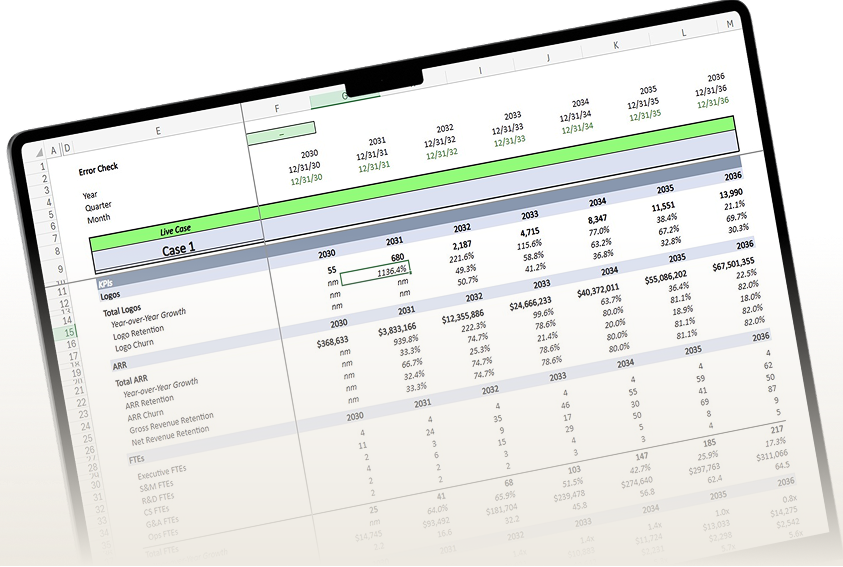

A SaaS metrics data dictionary is the written record of how each metric is defined, calculated, sourced, owned, and changed. Each metric gets one entry. Each entry names one definition, one source system, and one person who approves changes.
Your Head of Sales, your finance lead, and your RevOps manager can each pull a CAC figure and each be defensible. The meeting ends with an agreement to align on definitions before next time. That is a missing document, not a data problem.
This guide gives you the entry fields, anchor definitions for ARR, NRR, and CAC payback, a build sequence, and a fill-in template you can use today.
Key takeaways
- A dictionary entry has ten fields. Definition alone is not enough; the owner, source, and change rule are what keep it stable.
- Start with the metrics that break the most board decisions, not with every metric you track.
- Benchmarks only compare cleanly when your definition matches the survey's method.
- A dictionary is not a dashboard. It sits underneath whatever tools you use.
Why the same metric produces different numbers
Different numbers rarely mean bad data. They mean each team applied a reasonable but private definition.
Sales counts only paid acquisition spend. Finance loads in salaries and allocated overhead. RevOps counts from the CRM stage date. All three calculations are correct against their own rules, and none of them is the company's number.
"If sales and finance calculate CAC differently, a reporting cadence just formalizes the disagreement on a schedule. You get a weekly or monthly meeting about whose number is right instead of a decision about what to do."
— Aleksandar Stojanovic, CEO & Founder at FiscallionThe same pattern shows up when your billing system, CRM, general ledger, and spreadsheet model each tell a different story about cash and runway. The fix is a shared written definition with a named owner, kept in one place.
What belongs in the dictionary and what does not
A dictionary documents meaning. A dashboard displays values.
"You can have a polished dashboard sitting on undefined metrics, and it will simply display the disagreement faster."
— Aleksandar Stojanovic, CEO & Founder at FiscallionFiscallion does not build dashboards or BI tooling. It works above the ledger, on the definitions, models, and decision rules that make any dashboard trustworthy. That is why the dictionary is the right first artifact.
Scope it tightly. The metrics that break the most board decisions are:
- Net cash runway
- CAC by segment
- CAC payback
- LTV
- NRR
- MRR and ARR
- Pipeline coverage
- Headcount versus plan
Add a metric to the dictionary only when someone makes a decision from it. A metric nobody acts on does not need an owner or a decision rule.
The fields every dictionary entry needs
Each entry follows the same structure, so any reader can find the answer in the same place. The structure combines the metric-contract principle (one owner, one definition, one source system) with a per-metric decision system: a shared definition, a named owner, a fixed cadence, and a written decision rule.

| Field | What it captures | Example: MRR |
|---|---|---|
| Metric name | The canonical name plus accepted aliases | MRR (monthly recurring revenue) |
| Plain-English definition | One or two sentences a non-finance reader can follow | Normalized monthly value of all active subscription contracts, recognized in the current period |
| Formula | The calculation, step by step | Sum of normalized monthly contract values for active contracts |
| Inclusions and exclusions | Edge cases, decided in writing | Include annual contracts normalized to a monthly amount and month-to-month contracts; list every other edge case as its own row |
| Source system | The single system of record | Billing system, reconciled to the general ledger |
| Data owner | The person accountable for the number being right | Finance |
| Decision owner | The person who acts on the number | CEO |
| Refresh cadence | How often it is recalculated and reviewed | Monthly |
| Decision rule | Trigger, owner, action, deadline | If the metric crosses the agreed threshold, the owner proposes an action by a set date |
| Change approval | Who signs off on definition changes, and the version date | CEO, with the effective date recorded |
The owner split matters more than it looks. The person who produces the data and the person who decides on it are often different.
| Metric | Data owner | Decision owner |
|---|---|---|
| CAC payback | RevOps | CEO and Head of Sales |
| Net MRR churn | Finance | CEO and Head of Customer Success |
| Net burn | Finance | CEO |
| Pipeline coverage | RevOps | Head of Sales |
Write the decision rule as a sentence: if the metric reaches a threshold, then the owner takes an action by a date. A metric with no such sentence is reporting, not management.
Finally, the change-approval field loops back to the definition. Any approved change restarts the entry with a new version date, so history never gets silently rewritten.
Anchor definitions you can adopt today
You do not need to invent definitions from scratch. The SaaS Metrics Standards Board published standardized definitions, version 1.0 on January 10, 2023, across customer acquisition, retention, expansion, operating efficiency, and capital efficiency. Treat it as a published reference point, and confirm the exact wording against the original before you copy any of it into your own entries.
Three of its definitions cover most board conversations.
ARR. ARR is MRR multiplied by twelve, where MRR is the most recent monthly recurring revenue. It is a point-in-time measure. It excludes one-time fees and professional services, and usage-based revenue above committed minimums. Contracted-but-not-live ARR belongs to a separate metric, CARR. Churned ARR comes out in the month the contract ends, not when you later learn about it.
NRR. The Board prefers the cohort method. Take the ending-period MRR of the customers who were active at the start of the period, then divide by the beginning-period MRR of those same customers. Customers acquired during the period are excluded. Use revenue, not bookings, billings, or cash.
CAC payback. Fully loaded sales and marketing expense to acquire new customers, divided by new-customer CARR multiplied by subscription gross margin percentage. Fully loaded includes variable compensation, bonuses, benefits, and allocated shared department expenses. Sales and marketing spend is measured for the period that precedes the new ARR by the length of the sales cycle.
Notice what a standard cannot do. It cannot tell you whether your annual prepaid contracts follow your MRR rule or whether your partner-sourced deals sit in acquisition cost. Those are your exclusion rows, and the dictionary is where you record them.
Your own written MRR definition (normalized monthly value of active contracts, recognized in the current period, with annual contracts normalized) shows the point. A standard gives you the skeleton; your edge cases make it operable.
What good looks like once definitions are consistent
A benchmark is only useful when your definition matches the method behind it. This is where the dictionary pays off.
SaaS Capital's 2025 retention benchmarks come from its 14th annual survey, with more than 1,000 private B2B SaaS companies responding. They cover companies over $1M ARR, with retention measured from December 2023 to December 2024. SaaS Capital defines NRR as December 2024 MRR from customers who were customers in December 2023, divided by their total December 2023 MRR. That is a cohort calculation, the same shape as the Standards Board method.
For the $25k to $50k ACV band, the same source reports the quartile spread below:
| Percentile | NRR, December 2023 to December 2024 |
|---|---|
| 25th percentile | 97% |
| Median | 102% |
| 75th percentile | 111% |

SaaS Capital's survey also reports that higher net retention correlates with higher ACV, and that gross retention is capped at 100% by construction. Across the full sample of companies over $1M ARR, the median growth rate was 24%.
Interpretation is where founders go wrong. If your NRR includes new-customer expansion in the first month, or counts billings instead of revenue, you are comparing a different metric to this table. A quartile range is only a target if your calculation follows the same cohort rule.
For other families such as CAC payback and LTV:CAC, this article does not restate third-party figures. Compare against sources that publish their method, and write that method in the entry's formula field.
How to build your dictionary
Build it in one working cycle, not as a documentation project. Follow this sequence.
- Inventory current metrics. List every metric used in board decks, investor updates, and weekly meetings. Mark which definitions exist in writing and which live in someone's head.
- Find the contested metrics. Ask Finance and Sales to calculate CAC independently, then compare. The size of the gap tells you which metric to document first.
- Draft the entries. Use the ten fields above. Cover the definition, edge cases, data owner, and decision owner before anything else.
- Run an alignment session. Put Finance, Sales, and RevOps in one room. Settle each exclusion row and the source system.
- Write the decision rules. Each rule has a trigger, an owner, an action, and a deadline.
- Get CEO sign-off. The CEO confirms definitions and owners, so the dictionary carries authority.
- Install the cadence. Weekly review covers net burn, cash balance, pipeline coverage, and days sales outstanding. Monthly review covers CAC payback, NRR, logo churn, headcount versus plan, and gross margin by segment.
Then update the board reporting template to use the same names and definitions. A dictionary that the board pack ignores will drift within a quarter.
Common mistakes and the replacement move
| Mistake | Replacement move |
|---|---|
| Reporting a single blended CAC | Define CAC by segment, and record blended CAC as a separate, labelled metric |
| Using gross burn as the runway basis | Define net burn in the entry and use it as the single runway input |
| Debating CAC, LTV, and gross margin definitions after a finance partner starts | Settle the definitions first, so early months go to using the numbers |
| Hardcoded numbers inside spreadsheet models | Reference the entry's source system and record any manual override as an exclusion |
| Writing the dictionary once and never revisiting it | Use the change-approval field so every edit has an approver and a version date |
| Treating LTV and CAC as one fixed number | Record a range and a cohort view, with the assumptions written in the formula field |
The last row reflects a view Fiscallion holds firmly: CAC and LTV are ranges and cohort views, not a single figure to defend in a meeting.
The dictionary template you can copy
Use this table once per metric. Keep it in a shared document with one owner for the file itself.
| Field | Your entry |
|---|---|
| Metric name and aliases | |
| Definition (plain English) | |
| Formula | |
| Inclusions | |
| Exclusions and edge cases | |
| Source system (one) | |
| Data owner | |
| Decision owner | |
| Refresh cadence | |
| Decision rule (trigger, owner, action, deadline) | |
| Change approval (approver and version date) |
Use the in-article SaaS metrics dictionary template above to record each metric's definition, source, exclusions, owner, and change approval. Start with CAC payback, NRR, and ARR, then add the remaining board metrics as they come up.
If you want a senior finance person to own the definitions and the model behind them, Fiscallion's financial modeling and board reporting service includes metric definitions in the model build. Every client works directly with Aleksandar Stojanovic at the CFO layer, as the senior partner on the engagement rather than through an account manager or junior team. His FP&A leadership experience was gained through the growth of a SaaS company to €100M ARR.
FAQ
What is a SaaS metrics data dictionary and why does my finance team need one?
It is a written record of how each metric is defined, calculated, sourced, owned, and changed. Your finance team needs one because without it, each team applies its own private definition, and meetings go to arguing about numbers instead of acting on them. It also gives your finance lead a reference when a board member or investor asks how a figure was built.
Which SaaS metrics should be documented in a data dictionary?
Start with the metrics that break the most board decisions: net cash runway, CAC by segment, CAC payback, LTV, NRR, MRR and ARR, pipeline coverage, and headcount versus plan. To pick the first one, have Finance and Sales calculate CAC independently and compare the results. The widest gap shows where to start.
How do I standardize metric definitions across my bookkeeper, CFO, and investors?
Give each metric one definition, one source system, and one owner, then share the same entry with everyone. Your bookkeeper keeps the ledger accurate, your finance leader owns the calculation, and investors receive the same named definition each reporting period. Use a published reference such as the SaaS Metrics Standards Board for the baseline, and record where your company differs as an explicit exclusion.
What should each entry in a SaaS metrics data dictionary include?
Each entry should include the metric name and aliases, a plain-English definition, the formula, inclusions and exclusions, the single source system, the data owner, the decision owner, the refresh cadence, a decision rule, and change approval with a version date. The template above lays out all ten fields in a form you can copy.
Write the definition before you debate the number
The fastest way to reduce metric arguments is to settle definitions once, record them where everyone can see them, and name who approves changes. Start with three entries this week, and let the contested ones drive the order.
Once the definitions hold, your forecasts, runway view, and board decisions rest on numbers your team agrees mean the same thing.