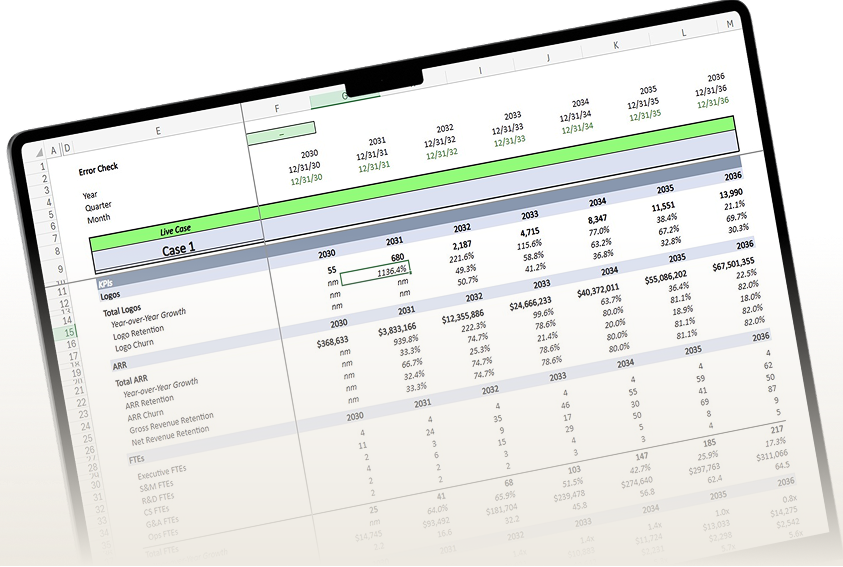
SaaS cash flow forecasting software is a tool that projects when cash enters and leaves a subscription business. It uses billing schedules, collections timing, deferred revenue, payroll and vendor payments to show weekly or monthly cash balances and runway under different scenarios.
Choose the tool by how it handles SaaS cash timing, not by dashboard polish. This guide gives you six tests, a trial protocol and a scorecard, so you can decide whether software alone, an FP&A platform, a fractional CFO or a full-time finance hire should own your forecast.
It does not rank named products. Current capabilities and prices have to be confirmed on each vendor's own pages, and a ranking built on anything else would be guesswork.
Key takeaways
- A cash forecast answers a different question from a revenue forecast. Buy for the cash question.
- Software handles the calculation. It does not decide who owns each assumption or which trade-off to take.
- Six tests separate SaaS-ready tools from generic ones: billing schedules, collections, deferred revenue, direct cash forecast, scenario modeling and runway visibility.
- Backtest any tool on your own last 13 weeks of actuals before you sign.
- Fractional CFO, execution-only FP&A and full-time hires differ by scope, ownership and access, not by one being better in general.
Cash forecasting is not revenue forecasting
A revenue forecast tells you how much ARR you will add. A cash forecast tells you whether the bank balance covers payroll in week nine. Growth and liquidity are separate questions, and many tools are built to answer only the first.
| Revenue forecast | Cash forecast | |
|---|---|---|
| Core question | How fast will ARR grow? | Will we have the cash when payments are due? |
| Main inputs | Pipeline, churn, expansion, pricing | Invoice dates, customer payment behavior, payroll dates, vendor terms, taxes, debt service |
| Typical horizon | Quarters to years | Weeks for operations, 18-24 months for runway (as set out in Fiscallion's cash flow forecasting guide) |
| Typical failure | Optimistic growth assumptions | Timing mismatches between billing, collection and payment |
If your revenue model is the gap, start with the SaaS revenue forecasting guide. This article covers the cash side only. For how to build the forecast itself, use the existing cash flow guide rather than a tool's onboarding wizard.
What the survey evidence says about forecasting tools
The evidence on cash forecasting tools mostly comes from treasury and mid-market surveys, not SaaS-only samples. Read it as directional.
| Source | Sample and period | Finding | What it means for you |
|---|---|---|---|
| NeuGroup survey | NeuGroup Cash Forecasting Benchmarking Survey, May 2022 | 93% of treasuries still used Excel, often with a treasury system. Only 41% reached forecast-to-actuals variance within +/- 5%. | Tools alone did not fix accuracy. Data access did more. |
| Strategic Treasurer and TIS survey | 200+ respondents, 2025 | Specialized forecasting tools beat ERP and treasury-system peers by 23 points on satisfaction. | Purpose-built tools tend to please users more than add-on modules. |
| Agicap 2024 Mid-Market Survey | 500+ CFOs of mid-sized companies in the US and Europe, with a UK focus on £30-500 million revenue | Forecast accuracy fell by as much as 19% as bank accounts, entities and currencies multiplied. | Complexity hurts accuracy. Agicap sells forecasting software, so weigh that. |
NeuGroup names the access problem directly: the data sits in disparate source systems, and pulling it is often manual. That is why the first test of any tool is what it connects to, and the second is who maintains those connections.
Six tests a SaaS cash forecasting tool has to pass
A generic cash flow tool treats revenue as money. SaaS cash behaves differently, so test each of these in a trial, not on a demo call.
| Test | SaaS reality | What to check in a trial | Red flag |
|---|---|---|---|
| Billing schedules | Annual upfront, quarterly, monthly and usage billing create different cash timing. | Load three contracts with different billing terms. Does cash land on the invoice date? | The forecast is driven by MRR, not invoices. |
| Collections | Customers pay late, and not all in the same way. | Can you model collections by customer behavior, not one flat assumption? | One DSO number for every customer. |
| Deferred revenue | Deferred revenue is not cash. Billings drive cash, recognition drives the income statement. | Does the tool separate billings from recognized revenue? | Cash is derived from recognized revenue. |
| Direct cash forecast | Operations need weekly receipts and disbursements tied to the bank. | Can you compare forecast to actual each week and see why it moved? | Only monthly indirect views. |
| Scenario modeling | Decisions involve hiring, churn, slipped renewals and fundraising delays. | Can you change one assumption and see the runway effect without rebuilding the file? | Scenarios are saved copies of the same sheet. |
| Runway visibility | Runway depends on the monthly path of net burn, not today's burn. | Is runway calculated from projected monthly net burn? | Cash divided by last month's burn. |
On billing, an annual contract is one receipt in one week, not twelve equal months.
"A tool that spreads it across the year will hide the exact squeeze you bought it to catch."
— Aleksandar Stojanovic, CEO & Founder at FiscallionOn collections, the same rule applies to receivables. A forecast that ignores how real customers pay will be wrong in the same direction every month. The invoice management guide covers open, overdue and closed invoice tracking, so it is not repeated here.
On runway, the startup runway calculation guide explains why gross and net burn give different headline numbers. Confirm the tool lets you pick the burn basis explicitly.
How to run a vendor trial that exposes the weak spots
Most demos use clean sample data. Your data is not clean, and the trial should say so.
The weekly direct format you are testing is the one Aleksandar builds from his fractional CFO engagements. His 13-week cash flow template post shows how the three-zone structure, AR and AP schedules and scenario grid fit together in practice:
- Backtest on your own actuals. Forecast the last 13 weeks from the position 13 weeks ago, then compare to what happened.
- Use your five hardest customers. Include the slow payer, the annual prepay and the one with custom terms.
- Break it on purpose. Slip your largest renewal by a month and pull one hire forward. Check that cash and runway both move.
- Name an owner for every assumption. If you cannot say who owns this assumption, the tool will not fix that.
- Ask who maintains it weekly. Someone has to roll it forward, explain variances and update inputs.
- Confirm price and plan limits from the vendor's own pricing and documentation pages. Get integration support for your accounting system, bank and billing platform in writing.
Four ways to get a forecast you can trust
Software is one option. The right choice depends on who will own the model, who will use it to make decisions, and how much senior judgment you need. Fiscallion is listed first because this is its own site, so treat that row as first-party positioning.
| Option | Scope | Who owns assumptions | Access to senior judgment | Best fit |
|---|---|---|---|---|
| Fiscallion fractional CFO-led forecasting | Direct and indirect cash forecast, runway, scenarios and board reporting, with model ownership | Named owners on your team, with the model owned by Fiscallion alongside you | Directly with Aleksandar Stojanovic at the CFO layer | $5-100M ARR SaaS companies that need senior judgment and hands-on FP&A without a full-time finance org |
| Dedicated cash forecasting software | Calculation, data connections and reporting, with scope varying by vendor | Your team | Vendor support, but judgment stays with you | Companies with a finance lead who can own assumptions and maintain inputs |
| FP&A planning platform | Broader planning across revenue, headcount and cash, with scope varying by vendor | Your team | Varies by vendor and plan | Teams with an FP&A analyst who want one planning system |
| Execution-only FP&A or outsourced finance provider | Reports and models built to an agreed statement of work | Defined in the contract | Depends on the provider | Companies with a clear spec and an executive who makes the decisions |
| Full-time CFO or head of finance | The whole finance function | Internal | Daily presence | Companies with enough complexity and workload to justify a permanent finance organization |
None of these is the weaker choice by default. Execution-only providers fit when the spec is clear. A full-time CFO fits when daily executive presence is a real requirement. Cheaper is not automatically better value, and neither is more expensive.
Where Fiscallion fits
Fiscallion is a fractional CFO and FP&A advisory for B2B SaaS companies. It is not a software vendor and not a bookkeeping firm. It works above the ledger, turning reliable accounting data into forecasts, scenarios and board decisions.
Its financial modeling and board reporting service covers driver-based forecasting, runway modeling, scenario planning, cash-burn tracking and board-ready forecast decks. Every client works directly with Aleksandar Stojanovic at the CFO layer. That means senior-partner ownership on every engagement, not an account-manager or junior-team handoff.
His approach draws on FP&A leadership experience gained through the growth of a SaaS company to €100M ARR. The review is like sitting down with the CEO before a board meeting: which assumption is weakest, which scenario changes a decision, and who owns each number.
"You can run Fiscallion's model alongside a forecasting tool. The tool refreshes the data, and the model decides what the numbers mean for hiring, spend and fundraising timing."
— Aleksandar Stojanovic, CEO & Founder at FiscallionMistakes buyers make, and the replacement move
| Mistake | Replacement move |
|---|---|
| Buying on dashboard design | Score the six SaaS cash tests on your own data. |
| Treating AR aging as the forecast | Model receipts by customer payment behavior, then review the exceptions. |
| One scenario that everyone knows is optimistic | Build a base case, a downside tied to a slipped renewal, and a hiring case. |
| No named owner for assumptions | Assign every collections, billing and hiring assumption to a person. |
| Reading MRR growth as proof of cash | Check billings and collections timing before you commit to spend. |
A scorecard you can use before you sign
Score each criterion in the trial: 0 means it fails, 1 means partial, 2 means it passes on your data.
| Criterion | Score (0-2) |
|---|---|
| Models cash from billing schedules, not MRR | |
| Models collections by customer behavior | |
| Separates deferred revenue from cash | |
| Weekly direct forecast with forecast-versus-actual review | |
| Scenarios change drivers, not just saved copies | |
| Runway calculated from projected monthly net burn | |
| Someone is named to maintain it weekly | |
| Every assumption has a named owner |
This is a working rule of thumb, not an industry benchmark. Any 0 on billing, collections or deferred revenue should remove the tool from your list. A low total on the last two rows means the problem is ownership, which no tool will solve.
If the scorecard shows an ownership gap, review your cash forecasting scope with Aleksandar. Bring your billing mix, your accounting setup and the forecast you use today. You will leave knowing whether you need software, a model owner or senior judgment.
FAQ
How does Fiscallion's SaaS cash flow forecasting differ from standalone cash flow software?
Software gives you a calculation engine, but accountable senior judgment decides which assumptions are right and which trade-off to take. Fiscallion's work covers the forecast, runway and scenarios, and the decisions they inform. Standalone software covers the calculation and data connections. Many companies use both.
Does Fiscallion's cash forecasting work alongside our existing accountant or bookkeeper?
Yes. Fiscallion is not a bookkeeping firm and works above the ledger, so your accountant or bookkeeper keeps the books and the forecast uses their data. If the ledger has gaps that would distort the forecast, those surface during scoping, not after the model is built.
How long does it take to set up a SaaS cash flow forecast with scenario modeling and runway visibility?
No honest number can be given without seeing your data. Setup time depends on how clean your billing and receivables data is, how many entities and bank accounts you run, and how many assumptions need owners. The scoping conversation with Aleksandar is where that timeline gets set against your actual inputs.
What is included in Fiscallion's cash flow forecasting scope for SaaS companies?
Fiscallion's service pages describe driver-based forecasting, runway modeling, scenario planning, cash-burn tracking and board-ready forecast decks. In practice that means a weekly direct view, a longer indirect view for runway, and scenarios tied to decisions. Exact scope is confirmed in conversation, based on your stage and needs.
The tool is the easy decision
Most of the cost in a cash forecast is not the subscription. It is the unowned assumptions, the stale inputs and the decisions made on a number nobody trusts.
Pick software that passes the six tests on your own data, and decide in parallel who owns the model and who judges the trade-offs. Both choices matter, and the second one decides whether the first one pays off.