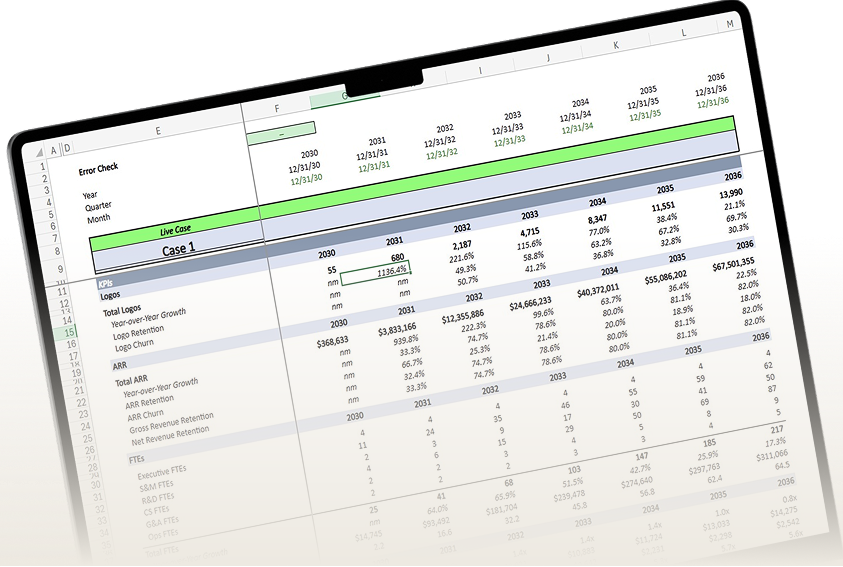


FP&A software organizes your data, builds the model mechanics, and generates reports. A fractional CFO owns the assumptions inside that model, decides which scenario the board should act on, and defends the runway number when someone pushes back. Software executes. Judgment decides. Confusing the two is why some SaaS companies buy a tool and still walk into a board meeting without an answer to "what do we do next."
This comparison is for the founder or Head of Finance who has already tried a dashboard and still feels the same fragility: forecasts nobody fully trusts, a board deck that reports history instead of framing a choice, and a runway number that shifts depending on who you ask. The decision below is not "software or human." It's whether your gap is data organization or decision ownership, and what it costs to close each one.
What you'll learn
- What FP&A software actually does, and the five capabilities it cannot provide on its own
- What a fractional CFO adds on top of a tool, and why that's a scope question, not a budget concession
- A cost comparison across FP&A software, fractional CFO, and full-time CFO, with sourced ranges
- A decision framework for choosing software, a fractional CFO, or both, based on trigger signs instead of revenue lines
- How the two functions actually work together in a weekly and monthly forecast governance cadence
The layer problem: data organization and decision ownership are not the same job
Most SaaS companies at $5-100M ARR don't have a data problem anymore. They have a spreadsheet, a billing system, and probably a tool that consolidates both. What they lack is someone who owns the assumptions feeding that model and defends the resulting number to a board.
"That's the layer problem. FP&A software operates on the data layer: it ingests numbers, builds the model structure, and generates the report. A fractional CFO operates on the decision layer: which growth assumption is realistic, which scenario the company should actually plan around, and what trade-off the board needs to approve."
— Aleksandar Stojanovic, CEO & Founder at FiscallionFinancial planning software, as Gartner defines it, enables data-driven financial resource allocation, investment and spending decisions by supporting effective planning, budgeting and forecasting processes, and it links strategy to operational plans by integrating operational KPIs. That's a real and necessary function. It's also a description of infrastructure, not judgment.
Here's how the two layers map against the pains that actually show up at this stage:
| ICP pain point | Data layer (software) | Decision layer (fractional CFO) |
|---|---|---|
| Cash flow visibility | Consolidates bank feeds, spreadsheets, billing data into one model | Decides which cash number is the real one and what it means for the next 90 days |
| Runway forecasting | Runs the calculation and updates it on a schedule | Owns the assumptions behind the calculation and defends them under a hard question |
| Board and investor reporting | Generates the report and the chart | Frames the report as a decision the board needs to make, not a history recap |
| Headcount planning | Models the cost of a hire | Decides whether the hire is the right trade-off against runway and growth targets |
Evidence table: FP&A software vs fractional CFO vs full-time CFO
| Dimension | FP&A software | Fractional CFO | Full-time CFO |
|---|---|---|---|
| What it does | Data consolidation, modeling mechanics, dashboards, workflow | Assumption ownership, scenario selection, board framing, fundraising support | Same as fractional, plus daily executive presence and internal org-building |
| Who defends the number to the board | No one; the tool has no accountability | The CFO who built the model | The CFO who built the model |
| Best-fit situation | Reliable underlying data, need for structure and reporting cadence | Need senior judgment and hands-on FP&A ownership without a full-time seat | Complexity and workload justify a permanent internal finance leader |
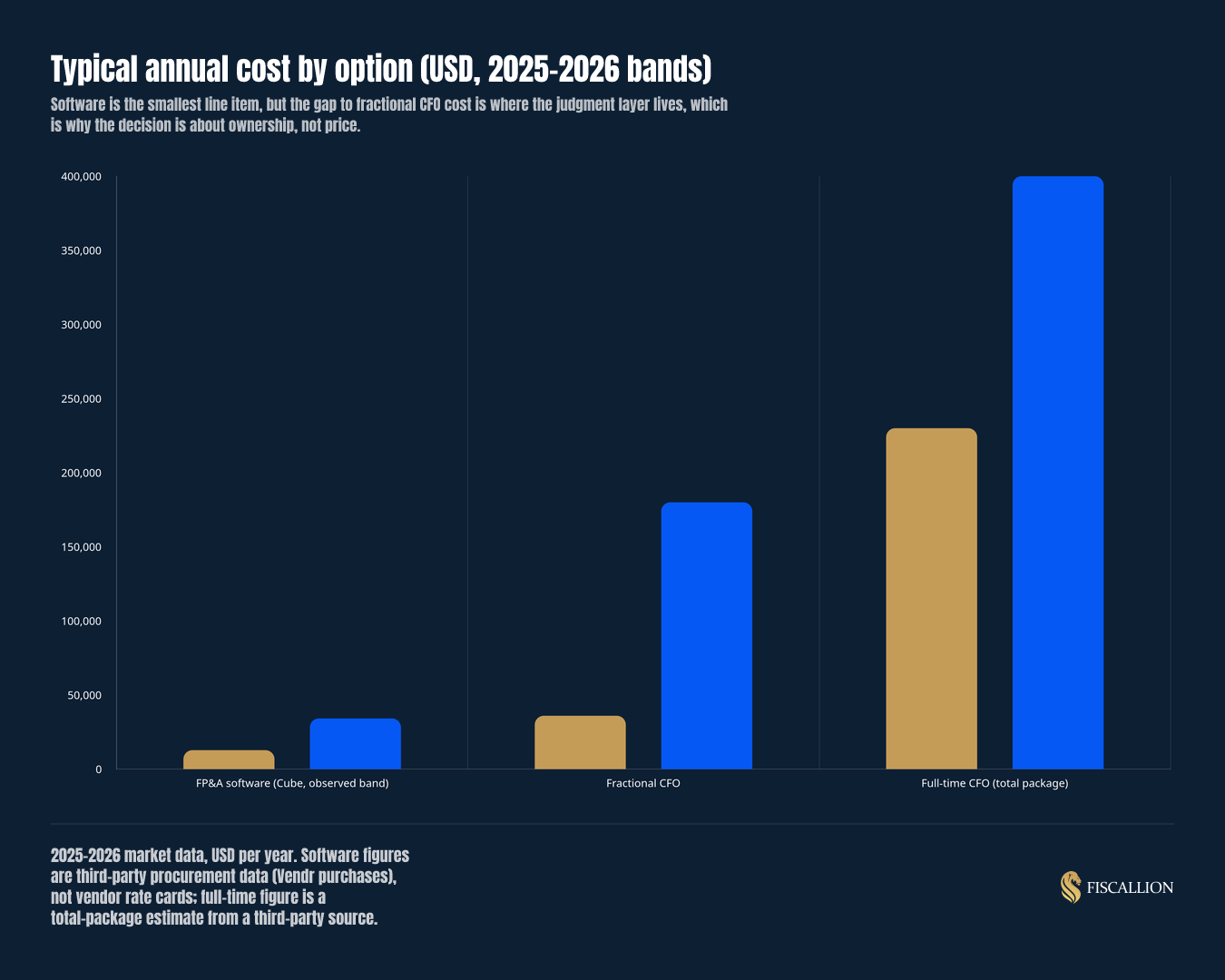
| Typical annual cost (USD) | ~$12,794-$34,200 (Cube, observed Vendr band) | ~$36,000-$180,000 ($3,000-$15,000/month) | ~$230,000-$400,000 total package |
| Source | Cube cost data | Fractional CFO cost data | Full-time CFO cost data |
The gap between the software line and the fractional CFO line is where judgment lives. That gap is the actual subject of this article, not the price tag on either end.
What FP&A software actually does, and where it stops
Corporate Finance Institute breaks FP&A software into five core components: data management, financial consolidation, modeling, reporting and dashboards, and workflow and collaboration. Each one solves a real operational problem. None of them solves a judgment problem.
- Data management and consolidation pull numbers from your billing system, accounting platform, and HRIS into one place, replacing the scattered spreadsheet.
- Modeling builds the structure that turns inputs into a forecast, so you're not rebuilding formulas every month.
- Reporting and dashboards generate the chart and the export for the board deck.
- Workflow and collaboration let multiple people update assumptions without breaking the model.
CFI is direct about the dependency underneath all five: "if the data is unreliable or poorly integrated, the rest of the system can't deliver accurate results." The software is only as good as the assumptions someone feeds it, and it has no mechanism for judging whether those assumptions are realistic.
This limitation isn't hidden. Some FP&A tools now include AI-driven forecasting agents, and their own disclaimers acknowledge the boundary: outputs "do not provide financial advice. Everything still needs to be reviewed by a qualified professional." As one FP&A practitioner put it, "AI can run the model. It cannot run the judgment... someone has to own the question of whether the forecast model is trustworthy."
That ownership question is exactly what a tool cannot answer about itself.
What a fractional CFO adds on top of the tool
A fractional CFO is a senior finance executive who provides CFO-level strategic work, financial modeling, forecasting, board reporting, and fundraising support, on a part-time or contracted basis. The role exists because bookkeeping and reporting tools stop being sufficient long before a full-time CFO is justified.
Whether you need fractional or full-time leadership is a scope question, not a budget concession. A full-time CFO makes sense when the company needs daily executive presence and a permanent internal finance organization. A fractional CFO makes sense when the company needs senior judgment and hands-on FP&A ownership without a full-time seat. The distinction that actually matters: the same person building your forecast is the same person defending it to your board. A tool cannot do the second half of that sentence.
An outsourced CFO owns work software cannot: "strategic financial planning... board and investor reporting... fundraise leadership... cash and runway management... systems architecture: making your billing, CRM, HRIS, and accounting stack produce one version of the truth." The same source is blunt about the difference in kind: "an outsourced CFO decides what should happen next."
At Fiscallion, every client works directly with Aleksandar Stojanovic at the CFO layer. That's senior-partner ownership on every engagement, not an account-manager or junior-team handoff. Aleksandar's FP&A leadership experience gained through the growth of a SaaS company to €100M ARR shapes how assumptions get stress-tested and how a board pack gets framed as a decision instead of a recap, at your specific stage and complexity.
The decision framework: software, fractional CFO, or both
Run this test instead of guessing from a revenue line. The signal isn't your ARR, it's whether these three things are true right now:
- Does your forecast survive a hard question? If a board member asks why the runway number moved, can someone explain the assumption that changed, or does the answer default to "let me check the model"?
- Does your board deck end in a decision? If the deck reports last quarter's numbers and stops, that's a reporting gap. If it frames a trade-off the board needs to approve, that's decision ownership working.
- Is "what's our runway" modeled or guessed? A tool can generate the number. Only a person accountable for the assumptions can tell you how much to trust it.
If the honest answer to all three is "we're fine," you likely need software, or better use of what you already have. If any answer is "no" or "it depends on who's asked," the gap is decision ownership, and that's a fractional CFO problem, not a tool problem.
"Most companies at $5-100M ARR need both, running in parallel rather than in sequence. The software organizes the data. The fractional CFO governs what the data means."
— Aleksandar Stojanovic, CEO & Founder at FiscallionA useful caveat when you're evaluating tools: don't build your governance model around a single vendor's roadmap. Finmark, acquired by BILL, had its standalone product discontinued in 2026. Mosaic was acquired by HiBob in February 2025 and rebranded as Bob Finance, no longer sold as a standalone product. Tool lock-in without assumption ownership means your forecast governance disappears when the vendor's business model changes, not just when your needs do.
Compare tool ownership with CFO-level judgment directly. If you want to walk through where your current setup sits, talk through your financial modeling and board reporting needs with Aleksandar at the CFO layer.
How the combination works in practice
A fractional CFO who governs your forecast alongside FP&A software isn't replacing the tool. They're running a cadence on top of it.
The practical structure most companies at this stage need is two forecasts running in parallel:
- A direct, 13-week operational cash forecast, updated weekly, owned by the CFO, controller, or fractional finance lead.
- An indirect, 18-24 month P&L-based forecast for strategic and board-level planning.
The direct forecast carries a variance log as a standing discipline: when actual cash doesn't match the plan, the point is not to silently update the number, it's to document why it moved. That log is what turns "the forecast was wrong" into "here's the assumption that changed and here's what we're doing about it," which is the difference between a credible board conversation and a defensive one.
The software runs the calculation. The fractional CFO decides which assumptions go into next week's version and explains the delta when it shows up.
Common mistakes and the better move
Mistake: buying software and expecting it to replace judgment. A tool will faithfully calculate a wrong assumption just as fast as a right one. Replacement move: treat the software as the calculation engine and assign a specific person, internal or fractional, to own what goes into it.
Mistake: hiring at full-time CFO cost for what is really dashboard polish. If the actual need is a cleaner report, that's a lighter scope than a full executive hire. Replacement move: match the hire to the scope test above, not to the size of the ask.
Mistake: treating the cheapest execution provider as automatically the best value. A lower monthly rate that doesn't include model ownership or board defense isn't a discount, it's a different (and incomplete) scope. Replacement move: compare providers by what they own and defend, not just by the invoice.
Mistake: locking your governance process to one vendor's product roadmap. Given the recent Finmark and Mosaic changes, betting your forecast process on any single tool's continuity is a risk you don't need to take. Replacement move: keep the judgment layer, and the variance log discipline, independent of whichever software you happen to run.
FAQ
If we already use FP&A software, what does a fractional CFO add that the tool can't?
The tool consolidates data, runs the model, and generates the report. It cannot pick which growth assumption is realistic, cannot decide which scenario the board should plan around, and cannot defend the runway number when someone pushes back on it. Gartner and CFI both describe FP&A software as infrastructure for planning and reporting processes, not a decision-maker. A fractional CFO owns the assumptions inside your existing tool, selects the scenario worth acting on, and stands behind that number in the board meeting. If your software's own disclaimer says outputs still need review by a qualified professional, that review is the job a fractional CFO does.
Can a fractional CFO work with our existing bookkeeper and FP&A tool, or do we have to replace them?
You don't need to replace either one. Fiscallion works above the ledger: your bookkeeper keeps the accounting data accurate, your FP&A tool keeps the model organized, and a fractional CFO layers forecasting, scenario ownership, and board-ready decisions on top of both. Part of the scope is systems architecture work, making sure your billing, CRM, HRIS, and accounting stack produce one version of the truth, rather than three conflicting numbers. Fiscallion is not a bookkeeping firm and doesn't compete with your existing accountant's role; the CFO layer sits above the ledger, translating reliable accounting data into forecasts and decisions.
How do we know whether our SaaS startup needs FP&A software, a fractional CFO, or both?
Run the trigger-sign test, not a revenue threshold. Ask three questions: Does your forecast survive a hard question from the board, or does it fall apart under scrutiny? Does your board deck end in a decision, or does it just report last quarter's numbers? Is your runway number modeled with owned assumptions, or is it effectively a guess dressed up in a spreadsheet? If the honest answer is that your data is scattered and disorganized, you likely need software. If your data is clean but no one owns the assumptions or defends the number, that's a fractional CFO gap. Most companies between $5M and $100M ARR need both running together, not one instead of the other.
What does the working relationship look like when a fractional CFO governs our SaaS forecast alongside FP&A software?
In practice, it's a cadence, not a one-time handoff. A direct, 13-week cash forecast gets updated weekly, with a variance log that documents why actual cash diverged from plan whenever it does. An indirect, 18-24 month P&L forecast supports strategic and board-level planning on a slower cycle. The fractional CFO owns both cadences: deciding what assumptions feed the next update, reviewing the tool's output before it goes into a board pack, and framing the resulting numbers as a decision for the board rather than a status update. At Fiscallion, that work happens directly with Aleksandar at the CFO layer on every engagement, starting with an initial review of your current model and reporting setup.
The decision is about ownership, not price
The comparison isn't software versus a person. It's whether your gap is data organization, which a tool solves well, or decision ownership, which requires someone accountable for the assumptions and the board conversation that follows. Most SaaS companies at $5-100M ARR need both running together: the software for structure, a fractional CFO for judgment.
If you're not sure which gap you actually have, that's worth a direct conversation rather than another tool trial. Compare where your current setup sits against CFO-level ownership with Aleksandar before your next board cycle.