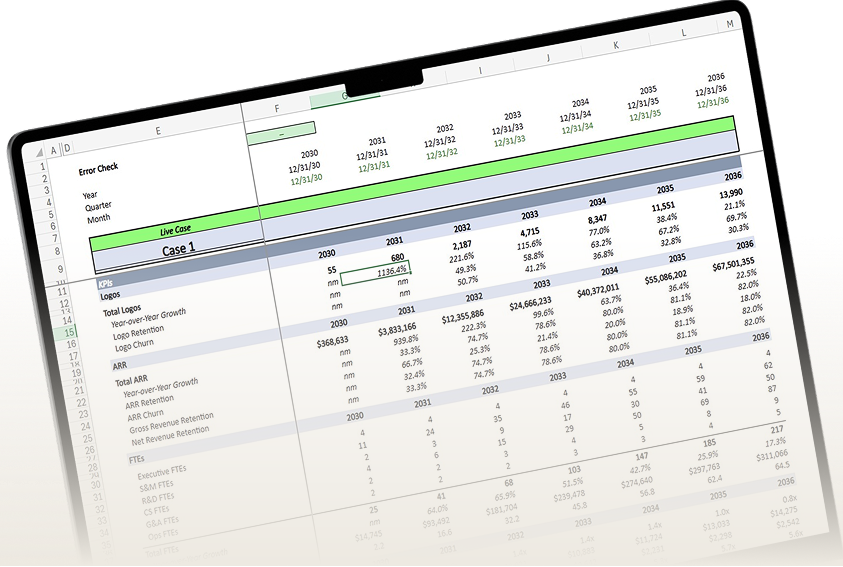

A board reporting pack is the complete set of documents a SaaS company sends its directors ahead of a board meeting: financial statements, a KPI dashboard, functional updates, and the decisions the CEO needs the board to make. It is not the slide deck presented in the room, and it is not the monthly email sent to investors. Get the structure right and the meeting becomes 90 minutes of decisions. Get it wrong and you spend that time re-litigating whose CAC number is correct.
That confusion is the most common failure mode at Series A and Series B. A board convenes, someone questions a metric definition that shifted since last quarter, and the conversation stalls on data reconciliation instead of moving to what the company should do next. The fix isn't more data. It's a pack built around a consistent structure that directors can trust quarter over quarter.
This article walks through the seven sections a Series A/B board pack should contain, which metrics belong in it, how long it should run, when to send it, and whether it should include forecasts. It closes with an open outline you can fill in directly for your next board meeting.
Board pack vs. board deck vs. investor update, what's the difference?
These three artifacts get used interchangeably, and that's part of the problem. Each one has a distinct job, audience, and level of formality.
The board reporting pack is the complete pre-read: financial statements, KPI dashboard, functional updates, and discussion items, distributed to directors in advance of the meeting. The board deck is the presentation subset shown during the meeting itself, typically a condensed version of the pack's highlights built for live discussion rather than detailed reading. The monthly investor update is a shorter, lighter-weight narrative sent to all shareholders and advisors between board meetings, with no governance function. Board minutes are the formal record produced after the meeting documenting what was discussed and approved.
The distinction matters for a reason beyond semantics: the board pack is often referenced in information rights clauses of priced venture rounds. That makes its existence, contents, and delivery timing a contractual obligation in many cap tables, not a nice-to-have you produce when you have time.
Confusing the board deck with the pack is what causes 40-slide meetings that never get to a decision. The pack should carry the depth; the deck should carry the discussion.
The 7 sections every Series A/B board pack should include
A well-structured pack follows a consistent shape every quarter, so directors know exactly where to find what they're looking for. The standard structure runs seven sections:
1. CEO narrative (1-2 pages). Written by the CEO, not delegated. States what changed since the last meeting and what decision is being asked of the board. This section sets the frame for everything that follows, so it should be honest about both wins and problems.
2. Financial statements. P&L, balance sheet, and cash flow, shown against budget, not in isolation. The board should be able to read runway, net burn, total cash, and gross margin without asking a follow-up question.
3. KPI dashboard. The agreed metric set, with prior-period comparison. This is where ARR, NRR, CAC payback, logo churn, and Rule of 40 live. The metrics themselves are covered in the next section.
4. Functional updates. One page each for go-to-market, product, and people. These are status updates, not narratives, owned by the relevant functional leader rather than the CEO.
5. Strategic discussion items. Topics that require board input, framed with options and a CEO recommendation, not just a description of the problem. This is where the board earns its seat.
6. Governance and approvals. Formal votes: option grants, 409A updates, budget approval. Routine items should be grouped into a consent agenda so the meeting doesn't burn time on procedural ratification.
7. Appendix. Cap table, cohort data, contracts, prior minutes. Reference material that supports the narrative but doesn't need to be read live.
At Series A, most of these sections run thin, often a page or two each, because the board is smaller and the business has fewer moving parts. By Series B, functional updates and strategic discussion items tend to expand as the board adds standing committees and the company adds functions worth reporting on separately.
Which SaaS metrics belong in the pack?
The metrics section is where most packs go wrong in one of two directions: too few metrics looks evasive, too many buries the signal directors actually need.
A tiered framework organizes metrics by the question they answer, rather than treating them as one flat list:
| Tier | Metrics | Question it answers |
|---|---|---|
| Tier 1 - Verdict | NRR, Rule of 40, Burn Multiple | Are we a good business? |
| Tier 2 - Driver | ARR growth rate, gross margin, CAC payback, Magic Number, LTV/CAC | Why is the verdict what it is? |
| Tier 3 - Forward/cash | Net cash runway, net new ARR forecast, pipeline coverage | How long do we have, and where is growth coming from? |
Nine to twelve metrics is the workable range. Fewer than seven reads as evasive, and more than fourteen buries the signal the board actually needs.
"Every metric on the dashboard needs a definition, a trend line, a target, and a status indicator, so a director can scan it in seconds rather than asking what it means."
— Aleksandar Stojanovic, CEO & Founder at FiscallionThis aligns closely with the eight decision-breaking metrics we cover in SaaS board reporting: net cash runway, CAC by segment or channel, CAC payback period, LTV, NRR, MRR/ARR and committed revenue, pipeline coverage, and headcount versus plan. The overlap isn't a coincidence. Whether you organize metrics into three tiers or eight decision points, the underlying discipline is the same: pick a small, stable set and report it the same way every quarter.
Net revenue retention deserves particular weight. Bessemer's SaaS research identifies NRR as the single most predictive metric for a company's long-term outcome, because NRR above 110% compounds revenue without additional sales spend. NRR below 90% should trigger immediate board follow-up, not a footnote.
Gross margin is worth a benchmark too: healthy SaaS gross margins run 70-85%. A margin outside that band, in either direction, is worth explaining in the CEO narrative rather than leaving to the appendix.
How long should the pack be?
Pack length should scale with the board's governance obligations, not with how much data you have available. The stage-based ranges run:
| Stage | Board pack length | Typical board composition |
|---|---|---|
| Pre-seed | 5-8 pages | Founders + 1 investor |
| Seed | 8-15 pages | Founders + 1-2 investors |
| Series A | 15-25 pages | Founders + 2 investors + 1 independent director |
| Series B and later | 25-40 pages | Expanded board, standing committees |
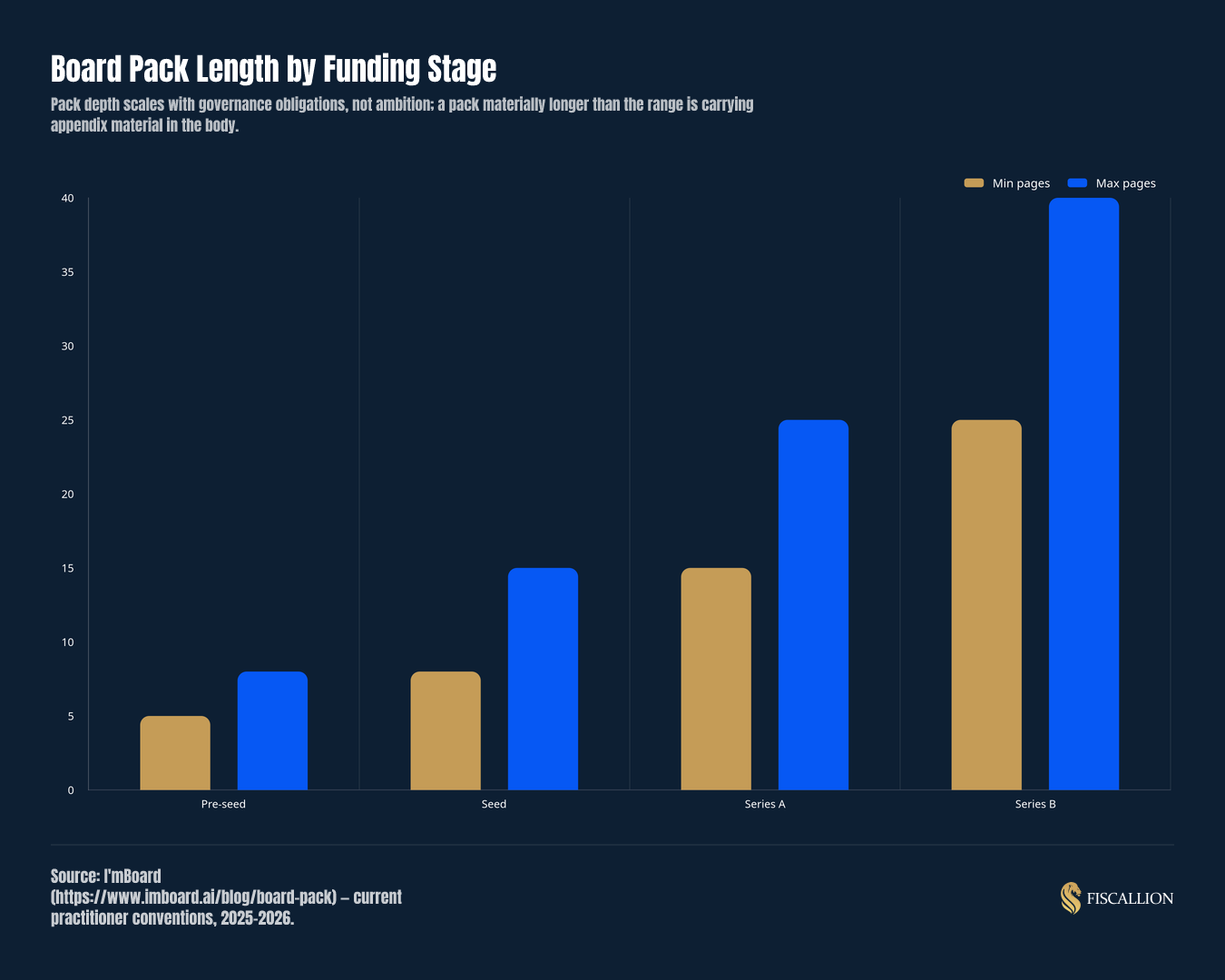
A pack that runs materially longer than its stage's range is usually carrying appendix material in the body instead of the back. That's a fixable formatting problem, not a sign you need to report more.
Length has a real cost. Once a pack exceeds roughly 30 pages, up to 40% of pages go unread. Directors sit on multiple boards and pattern-match hundreds of dashboards; a pack that demands too much reading time gets skimmed, and skimmed packs produce worse decisions in the room.
Keep the monthly investor update separate and much lighter. That update runs 1-2 pages and takes 30-60 minutes to write, a genuinely different artifact from the quarterly board pack, which runs 10-15+ pages and takes 4-8 hours of preparation. Trying to make one document serve both purposes is how packs balloon past their stage's range.
How often should you prepare a board reporting pack?
Cadence should track decision speed, not calendar convenience. At Series A, most boards meet monthly and transition to quarterly around nine to twelve months after the round closes, once the metrics stabilize and the board has established trust in the numbers. Series B boards typically settle into a quarterly rhythm with longer, two-to-three-hour meetings.
Some investors push for a tighter cadence than the standard quarterly default. Lightspeed and Unusual.vc recommend meeting every six to eight weeks at Series A specifically, on the logic that early-stage companies change too fast for a full quarter to pass between check-ins. Perkins Coie notes that four to six board meetings per year is common for VC-backed startups, with frequency increasing during fundraising or when the business hits a rough patch.
The monthly investor update fills the gap between formal board meetings. It doesn't replace the pack; it keeps investors oriented so the quarterly pack doesn't have to catch anyone up from zero.
Should the pack include forecasts or only actuals?
Both, and the balance should lean toward the forward view. A well-built SaaS board pack spends less than a third of the meeting on past performance and more than two-thirds on forward-looking decisions.
That means the pack needs, alongside actuals:
- A forecast and outlook for the next quarter, with the key assumptions stated explicitly.
- Top risks, tied to leading indicators the board can watch before the risk materializes as a number.
- A decisions and asks section: one to three decisions the board needs to make, each with options, a recommendation, and the cost of waiting.
Boards care less about forecast precision than about whether you've identified the right risk triggers early. A forecast that misses by a reasonable margin but flagged the right risk in advance builds more trust than a forecast that happened to land close but gave no warning of what could go wrong.
Every forecast rests on assumptions someone chose, whether about churn, sales cycle length, or hiring pace. Name them in the pack.
"A board that can see the assumption can debate it; a board that only sees the output can only accept or reject it, which is a much weaker form of governance."
— Aleksandar Stojanovic, CEO & Founder at FiscallionDistribution timing, when to send the pack
Distribution timing is where governance obligation meets practical logistics. The standard is 72 hours before the meeting, though Sequoia, Bessemer, and Craft Ventures guidance sets a 48-hour minimum as the floor, not the target.
A workable prep schedule for a quarterly pack looks like this:
- T-14 days: Section owners receive templates and the data cutoff date.
- T-7 days: Section drafts are due; the CEO reviews for contradictions across sections.
- T-4 days: Financials are finalized and numbers are frozen.
- T-3 days: Pack is distributed to directors.
- T-0: Meeting happens.
Directors are assumed to have read the pack before they walk in. The meeting should not re-present it slide by slide; that's what wastes the two-thirds of meeting time that should go to forward decisions instead.
The open Series A/B board-pack outline
Here is a fillable outline you can use for your next board meeting. It follows the seven-section structure above, sized for Series A or Series B.
1. Executive summary (1 page)
- 5-7 headline metrics with plan vs. actual and a traffic-light status
- One sentence of context per metric on the why, not just the what
2. CEO narrative (1-2 pages)
- What changed since the last meeting
- What decision is being asked of the board this quarter
3. Financial statements
- P&L vs. budget
- Cash flow statement
- Balance sheet highlights
- Runway and net burn, stated explicitly, not implied from the cash balance
4. SaaS metrics dashboard
- Tier 1 (verdict): NRR, Rule of 40, Burn Multiple
- Tier 2 (driver): ARR growth rate, gross margin, CAC payback, Magic Number, LTV/CAC
- Tier 3 (forward/cash): net cash runway, net new ARR forecast, pipeline coverage
5. Functional updates (one page each)
- Go-to-market
- Product
- People
6. Strategic discussion items
- Each item framed with options and a CEO recommendation
7. Decisions and asks
- One to three decisions needed, each with options, recommendation, and cost of delay
8. Governance and approvals
- Consent agenda for routine items (option grants, 409A, minutes approval)
9. Appendix
- Cap table, cohort data, contracts, prior minutes
Fill in each section with your own numbers and definitions, then keep that same structure every quarter. A prior version of this discipline lives in our free board reporting template, which covers the metric definitions in more depth if you want a starting point for Tier 2 and Tier 3.
If you'd rather have someone build the KPI dashboard and reporting cadence directly into your model, that's the core of Fiscallion's financial modeling and board reporting service, where every engagement runs through Aleksandar directly rather than a junior delivery team.
3 traps that break board packs at Series A/B
Trap 1: Reporting gross burn instead of net burn as the runway basis. Gross burn ignores revenue coming in the door, which overstates how urgent your cash position looks or, worse, understates it if revenue is lumpy. Runway should always be calculated from net burn.
Trap 2: Reporting a single blended CAC. A blended CAC number hides which channel or segment is actually efficient. Break it out by segment or channel, or the board ends up making budget decisions based on an average that doesn't describe any real cohort.
Trap 3: Showing revenue growth without margin or cash context. Growth alone tells the board nothing about whether that growth is sustainable. Pair it with gross margin and burn multiple so the board can see whether you're buying growth at a reasonable price.
A fourth trap worth adding from outside our own coverage: swapping metric definitions between meetings. If NRR was calculated one way last quarter and a different way this quarter, directors notice, and the change reads as an attempt to hide a dip rather than a legitimate methodology update. Keep the same nine metrics, defined the same way, in the same order, every meeting. Consistency across quarters is worth more to a board's trust than sophistication in any single quarter.
Frequently asked questions
What SaaS metrics should a Series A or Series B board reporting pack include?
Aim for nine to twelve metrics organized into three tiers: verdict metrics that answer whether you're a good business (NRR, Rule of 40, Burn Multiple), driver metrics that explain why (ARR growth rate, gross margin, CAC payback, Magic Number, LTV/CAC), and forward-looking metrics that answer how long you have (net cash runway, net new ARR forecast, pipeline coverage). NRR deserves particular attention since Bessemer's research identifies it as the single most predictive metric for long-term outcomes. Every metric needs a stated definition, a trend, a target, and a status indicator, and that definition should stay fixed quarter over quarter rather than shifting when a number dips.
How often should Series A and B SaaS companies prepare a board reporting pack?
Series A boards typically meet monthly and transition to a quarterly cadence around nine to twelve months post-close, once the metrics and reporting rhythm have stabilized. Series B boards generally settle into a quarterly cadence with longer meetings. Some investors, including Lightspeed and Unusual.vc, recommend a tighter six-to-eight-week cadence at Series A specifically because early-stage businesses change faster than a full quarter allows for. Four to six board meetings per year is common across VC-backed startups, with frequency increasing during fundraising or operational stress. A lighter monthly investor update can fill the gap between formal board meetings without requiring the full pack's preparation time.
What is the difference between a board deck and a board reporting pack?
The board reporting pack is the complete set of pre-read materials, financial statements, KPI dashboard, functional updates, discussion items, and appendix, distributed to directors in advance of the meeting. The board deck is the presentation subset shown live during the meeting itself, usually a condensed version built for discussion rather than detailed reading. They serve different purposes: the pack carries the depth and detail directors need to review beforehand, and the deck carries the narrative and discussion points for the room. Confusing the two, by trying to present the entire pack slide by slide, is a common reason board meetings run long without reaching a decision.
Should a board reporting pack include forward-looking forecasts or only actual results?
It should include both, with more weight on the forward view. Well-built SaaS board packs spend less than a third of meeting time reviewing past performance and more than two-thirds on forward-looking decisions, including a forecast for the next quarter, the key assumptions behind it, top risks tied to leading indicators, and a decisions-and-asks section with explicit recommendations. Boards generally care less about how precisely a forecast lands and more about whether management identified the right risks early enough to act on them. Naming the assumptions behind every forecast, rather than presenting only the output, gives the board something concrete to actually govern.
Board reporting doesn't get better by adding more slides or more metrics. It gets better by picking a structure, filling it in with the same discipline every quarter, and using the time you save on formatting to actually decide something. Use the outline above as your starting point, and treat every deviation from it as a decision you made on purpose, not a gap you forgot to fill.
If your board meetings still spend more time reconciling numbers than deciding what to do with them, that's usually a modeling and cadence problem, not a formatting one. Explore Fiscallion's KPI dashboards and reporting service if you want that structure built directly into your model, with Aleksandar as the senior partner on the engagement from day one.