

SaaS board meeting finance questions are the recurring questions directors ask about cash, growth quality, unit economics, and forecast credibility. Each one is a decision test, not a metrics quiz.
"You are not being asked for a number. You are being asked whether you understand what the number means and what you intend to do about it."
— Aleksandar Stojanovic, CEO & Founder at FiscallionWalk into the next board meeting able to answer every finance question with a figure, the driver behind it, and the trade-off you are proposing. That is the difference between a board that spends its time rubber-stamping a status update and one that spends its time making decisions with you.
This article gives you that question bank, organized by decision type, so you can rehearse the right answers before the meeting instead of reconstructing them live in front of your investors.
What you'll learn
- The four things every board question is actually trying to answer
- A question bank across five decision categories: cash and runway, growth quality, unit economics, headcount, and forecast credibility
- How to structure the finance portion of the meeting so it takes minutes, not the whole session
- Which documents to bring so you are never caught reconstructing a number on the spot
- The mistakes that turn a finance review into a credibility problem, and the replacement move for each
Boards ask questions to answer four things, not to test your recall
Every question a director asks in a finance review traces back to one of four underlying concerns their own partners will ask them about after the meeting: is the growth engine working, is capital being deployed efficiently, what does the next 18 months require, and is the team strong enough to execute. A board pack is best understood as a structured argument for a set of decisions, not a status report.
That reframing matters. If you treat board prep as "get the numbers right," you will show up with an accurate deck and still fail the meeting, because accuracy without a driver and a recommendation does not answer what your board actually needs to tell their partners.
The question bank: five decision categories, and how to answer each
Cash and runway: the question that should never be buried
Runway is the question your board asks first, whether or not it appears first on the agenda. Do not bury the lede.
- "How much cash do we have, and how many months of runway does that give us?" The board is checking whether you know this cold, without opening a spreadsheet. Answer with cash on hand and runway calculated on a 3-month average net burn figure, not a single volatile month, since one month is too noisy a signal to calculate runway against.
- "What's driving the change in burn since last quarter?" The board is testing whether burn moved because of a deliberate trade-off (headcount, marketing spend, a one-time cost) or because nobody was watching it. Name the driver, not just the delta.
- "When do we need to raise, and under what scenario does that timeline shift?" Show a runway projection with a current-trajectory line and a fundraise scenario line, not a single static number.
Growth quality: new revenue and expansion tell different stories than one blended growth rate
A single top-line growth number hides whether you are growing because you are landing new logos, expanding existing accounts, or losing fewer customers, and boards know it.
- "Is our growth coming from new business or expansion?" Present net revenue on one chart broken into new, expansion, and churn, which is the exact net revenue breakdown format institutional board members expect.
- "Why did net revenue retention move this quarter?" NRR above 120% sits in the top quartile for Series A companies, while anything below 100% signals net contraction, so a swing in either direction needs a named cause, not just a restated figure.
- "Which cohorts are weakening, and since when?" Cohorted retention, not a blended average, is what lets a board tell whether a problem is recent (a pricing change, a support gap) or structural.
Unit economics: CAC and payback answered as a range and a segment, not one blended figure
Blended CAC as your primary metric is one of the most common ways founders lose credibility in a finance review, because it hides which channel or segment is actually getting more expensive.
- "Is CAC rising, and in which segment or channel?" Break it out. A rising blended CAC could mean enterprise sales cycles lengthened while self-serve stayed flat, and the board needs to know which.
- "What's our CAC payback period, and how does it compare to benchmark?" Top-quartile Series A companies see payback under 12 months, with anything above 24 months sitting below median. Know where you land and why.
- "Is gross margin improving or eroding, and what's the driver?" Margin questions surface fastest when a board is deciding whether to fund growth or fund efficiency.
Headcount and hiring: every headcount question is a runway question in disguise
- "Are we on plan for headcount, above, or behind?" Have the number ready without pulling up a spreadsheet live.
- "What's the runway impact of the hire we're proposing, versus not making it?" This is where scenario modeling earns its keep. As headcount and operating expense increase, boards expect more scenario planning, not less, because each hire is a capital allocation decision, not just an org chart update.
Forecast credibility: a miss without a named assumption is a trust problem, not a math problem
- "Why did last quarter's forecast miss?" Reconstructing the answer live signals you were not tracking it. Reconcile actuals against budget before the meeting, not during it.
- "Which assumption is this quarter's forecast resting on?" Name the assumption (a renewal rate, a sales cycle length, a hiring start date) so the board can evaluate the forecast's fragility, not just its output.
"The practical implication: for every question below, the answer format is one number, one driver, one implication for the next quarter. Not a number alone."
— Aleksandar Stojanovic, CEO & Founder at FiscallionHow to structure finance updates so they take minutes, not the whole meeting
A standard quarterly SaaS board meeting runs about two hours, and financials get a defined slice of it, not the whole agenda. The Craft Ventures board meeting framework allocates roughly 10 to 20 minutes to financials within a two-hour meeting, with the rest going to CEO update, sales, departmental updates, team, and administrative matters.
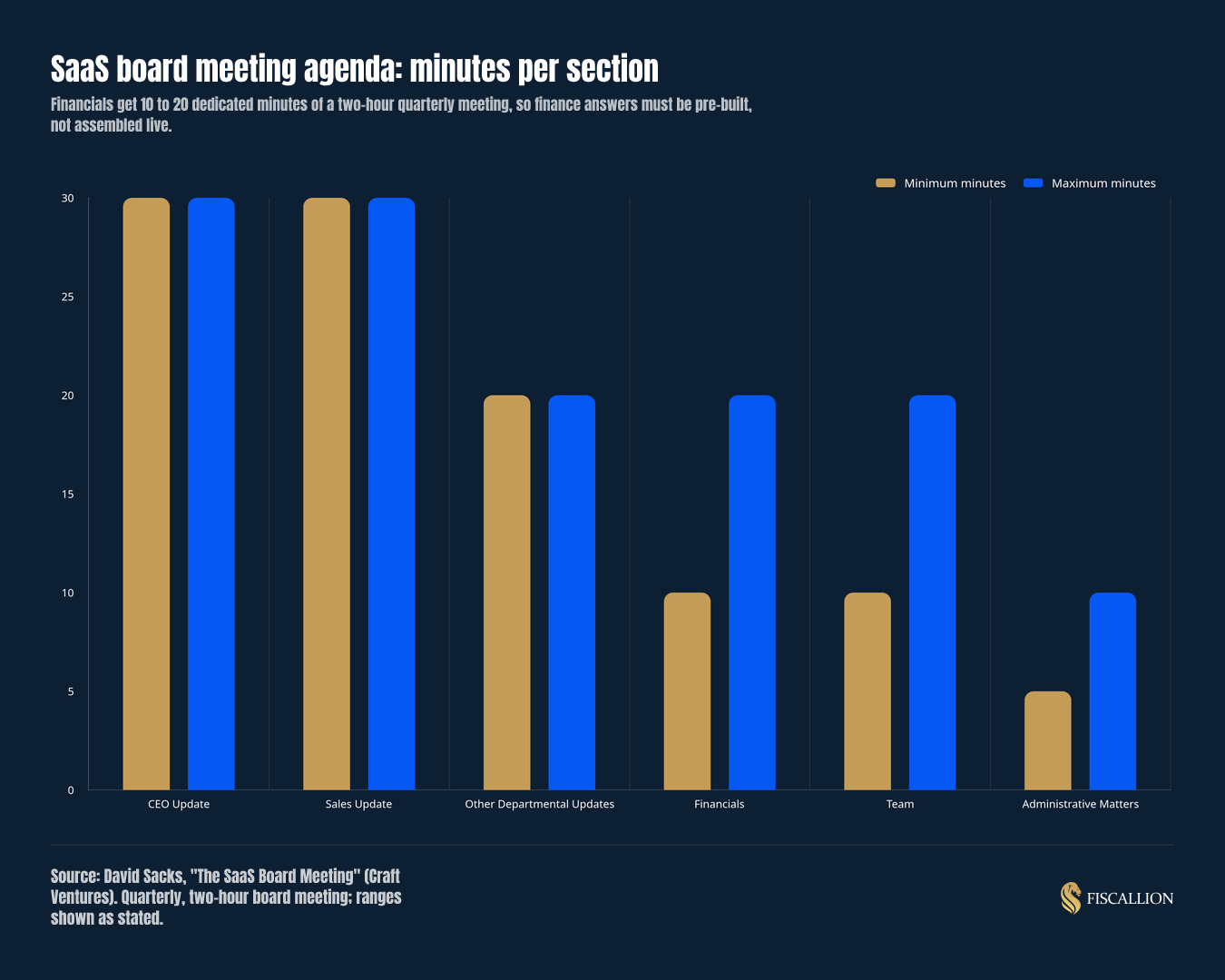
That time constraint is the point. If your finance section regularly runs long, the problem is not the agenda, it is that the answers were not pre-built.
Two structural habits fix this:
- Send a pre-read. Sources vary on the exact window, from 1 to 2 days to 48 to 72 hours before the meeting, and some operators push it to five days. Pick a consistent rhythm and hold it, rather than chasing a single "correct" number of days. A pre-read with five key numbers shown plan-versus-actual, each with one honest sentence on why it moved, does more to shorten the live discussion than any amount of live narration.
- Keep the deck short. Up to 40% of board pack pages go unread. A shorter deck with the same metric definitions and sequence quarter over quarter reads faster and argues better than a longer one.
SaaS board meeting finance questions get easier to answer when the structure around them is consistent, because the board is not relearning your metric definitions every quarter, it is tracking trend against a baseline it already understands.
What documents to bring so you're never reconstructing a number live
Start preparation about four weeks before the meeting. Five documents consistently show up across board-ready SaaS companies:
| Document | Purpose | Owner |
|---|---|---|
| Board deck | The narrative and headline metrics for the live discussion | CEO, with CFO input |
| CFO financial package | P&L, cash flow, and ARR waterfall reconciled against budget | CFO |
| Sales waterfall | New, expansion, and churned revenue detail behind the growth number | Sales/RevOps, reconciled by finance |
| CEO pre-read memo | The honest narrative sent ahead of the meeting | CEO |
| Prior meeting minutes with tracked actions | Accountability on commitments made last quarter | Board secretary or CFO |
The CFO financial package is typically finalized about ten days before the meeting, giving time to reconcile actuals against budget before it goes into the pre-read.
If you want the deeper structure behind the pack itself, including the seven-section format and which metrics belong in the Tier 1 KPI dashboard, that is covered in what goes into a board reporting pack for a Series A or B SaaS company.
Common mistakes and the replacement move for each
- Mistake: burying runway deep in the deck. Replacement: lead with cash and runway before growth metrics, every quarter, regardless of how the number looks.
- Mistake: reporting blended CAC as the headline unit economics metric. Replacement: break CAC out by segment or channel so the board can see which one is actually getting more expensive.
- Mistake: reporting activity instead of drivers. A slide that shows "MRR grew 8%" without naming why is an activity report. Replace it with the driver: which cohort, which channel, which pricing change.
- Mistake: 40-plus slide decks that go unread. Replacement: a deck of consistent length and metric sequence every quarter, with depth moved to the appendix.
- Mistake: answering a number with a number. If a director asks why CAC rose and you answer with the CAC figure again, you have not answered the question. Replacement: number, driver, and what you propose to do about it.
These are the same traps that break board decisions inside our four-part framework for decision-ready SaaS board reporting, which covers definitions, ownership, cadence, and decision rules in more depth than this article's question-by-question format allows.
Every Fiscallion client works directly with Aleksandar Stojanovic at the CFO layer on this exact preparation cycle, not with a junior analyst or an account manager. That senior-partner ownership is what makes the pre-read, the driver narrative, and the trade-off framing consistent quarter over quarter, because the same person who built last quarter's model is the one answering the board's questions this quarter.
Keep the question bank open and organized by decision type
The fastest way to lose a founder's credibility with a board is to be asked a question you have not rehearsed. Keep this question bank open during your prep cycle, organized by decision type, and run through it before every quarterly meeting rather than reconstructing your answers the night before.
If you want a senior CFO reviewing your board pack and forecast alongside you before the next meeting, Fiscallion's financial modeling and board reporting service works directly with Aleksandar to build the pack, the model, and the driver narrative behind it.
FAQ: SaaS board meeting finance questions
What financial questions should a SaaS founder prepare for before a board meeting?
Prepare for questions across five categories: cash and runway (how much, how many months, what's driving the change), growth quality (new versus expansion revenue, why NRR moved), unit economics (CAC by segment, payback period, margin trend), headcount (on plan or not, runway impact of new hires), and forecast credibility (why last quarter missed, which assumption the current forecast rests on). Know your runway and true MRR without needing to open a spreadsheet, since those two numbers are the ones a board expects instant recall on.
How do you structure finance updates for a SaaS board meeting?
Send a pre-read one to five days before the meeting with the key numbers shown plan-versus-actual and a short sentence explaining each variance, then keep the live financial discussion to roughly 10 to 20 minutes within a two-hour agenda. The goal of the live discussion is decisions, not first exposure to the numbers. As headcount and operating expense grow, expect the financial section to require more scenario planning, since each hiring or spending decision now carries a bigger runway implication.
Which SaaS metrics do board members typically ask about during finance reviews?
Boards typically ask about ARR and ARR growth rate, net revenue retention, gross margin, CAC payback period, burn multiple, runway, pipeline coverage, forecast accuracy, and headcount versus plan. Series A benchmark data puts top-quartile NRR above 120%, top-quartile CAC payback under 12 months, and top-quartile runway above 24 months, which gives you a reference point for how your own numbers read to an experienced board.
What documents should a SaaS company bring to answer board finance questions?
Bring five documents: the board deck with the narrative and headline metrics, the CFO financial package with P&L, cash flow, and ARR waterfall reconciled against budget, the sales waterfall showing new, expansion, and churned revenue, the CEO pre-read memo sent ahead of the meeting, and prior meeting minutes with tracked action items. Start assembling these about four weeks before the meeting so the CFO package can be finalized and reconciled roughly ten days out.
The real test isn't the meeting, it's the rehearsal before it
A board meeting where every finance question gets answered with a number, a driver, and a proposed trade-off is not a harder meeting to run, it is a better-rehearsed one. The founders who walk out with real decisions made are the ones who treated the question bank as prep material, not as a surprise to survive.
Build that rehearsal into your quarterly cadence, and the finance section of your board meeting stops being the part everyone dreads and becomes the part that moves the company forward.