
The decision to make is not "do we need finance help." It's "what altitude of finance do we need, and should we own it or rent it." Most founders at $5-100M ARR get this wrong in a specific, predictable way: they hire a senior finance person and hand them clerical work, or they let a generalist analyst track aggregate metrics while cohort-level unit economics stay invisible. Both mistakes are expensive. This article gives you the actual cost, speed, and capability comparison between an FP&A agency and an in-house analyst, so you can match the model to the decisions you need to make in the next 90 days, not the org chart you're dreaming about.
What you'll learn
- The fully loaded cost of an in-house FP&A analyst versus an FP&A agency retainer, by ARR stage
- Why speed to a usable financial model differs by 10-14 weeks between the two models
- The SaaS-specific metrics a generalist analyst typically misses
- When the pendulum flips and an in-house hire becomes the right call
- How an FP&A agency works alongside a bookkeeper or controller you already have
The wrong-altitude mistake founders keep making
Founders reach out to Fiscallion at one of five trigger moments: metrics chaos, board pressure, fundraising prep, a cash-to-accrual accounting transition, or the need to automate financial reporting. The request is usually "we need better reporting" or "we need cleaner metrics." The actual problem is fragmented data across tools, people, and decks, implicit assumptions nobody has written down, and no decision-ready framework translating activity into cash, runway, and trade-offs.
The pattern that follows is what I'd call hiring the wrong altitude.
"A Series A founder hires a senior finance leader, expecting strategic judgment, then spends Q1 having that person build spreadsheets and chase invoices."
— Aleksandar Stojanovic, CEO & Founder at FiscallionThey're bored by Q2 and gone by Q4. As I've noted before, "the mistake is never 'hired finance too late.' It's 'hired the wrong altitude too early'", paying strategic prices for clerical work.
The inverse mistake is just as common: hiring a junior in-house analyst who tracks MRR and burn but has never built a cohort retention curve or modeled CAC payback by channel. They're capable, but they're operating at the wrong altitude in the other direction, doing generalist analysis when the company needs SaaS-specific judgment.
What an in-house FP&A analyst actually costs, fully loaded
The number founders quote is almost always the base salary. It's rarely the real number.
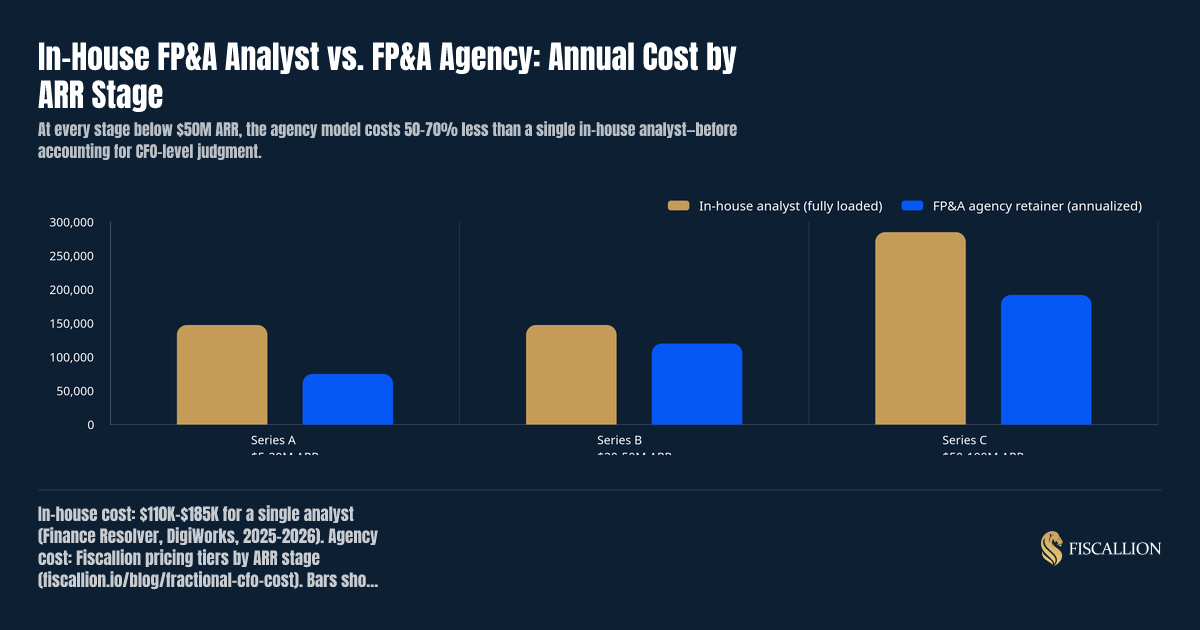
In-house FP&A analyst base salaries commonly range from $100,000 to $160,000 in the US market. Add 20-30% for payroll taxes, benefits, equipment, and software access, and a single fully loaded FP&A analyst costs $110,000 to $185,000 per year, with senior analysts landing at the higher end.
That's before recruiting fees, before the ramp period where productivity is limited, and before turnover risk. Even a bare-minimum in-house setup, one senior analyst plus one junior, pushes a startup past $250,000-$320,000 in annual spend before software or onboarding time is added.
Compare that against a Fiscallion fractional engagement. Pricing scales with ARR stage:
| ARR stage | Fiscallion monthly retainer | Fiscallion annualized | In-house analyst all-in (annual) |
|---|---|---|---|
| Under $3M (early-stage) | $3,000-$4,500 | $36,000-$54,000 | $110,000-$185,000 |
| $3-10M (growth) | $4,500-$8,000 | $54,000-$96,000 | $110,000-$185,000 |
| $10-30M (scale-up) | $8,000-$12,000 | $96,000-$144,000 | $110,000-$185,000+ (multiple hires likely) |
| $30-75M+ (enterprise) | $12,000-$20,000+ | $144,000-$240,000+ | $250,000-$320,000+ (small team) |
Source: Fiscallion fractional CFO pricing guide.
At every stage below roughly $50M ARR, the agency model costs meaningfully less than a single in-house analyst, and that comparison doesn't yet account for the fact that a Fiscallion engagement includes CFO-level judgment on top of analyst-level execution, not analyst work alone.
This isn't an argument that cheaper is automatically better. A generalist offshore analyst at a lower monthly rate than Fiscallion's retainer might be cheaper still, and worse value, if they can't build a defensible model or speak to your board. The comparison that matters is cost against scope, ownership, and access, not cost in isolation.
What an FP&A agency delivers that a generalist analyst misses
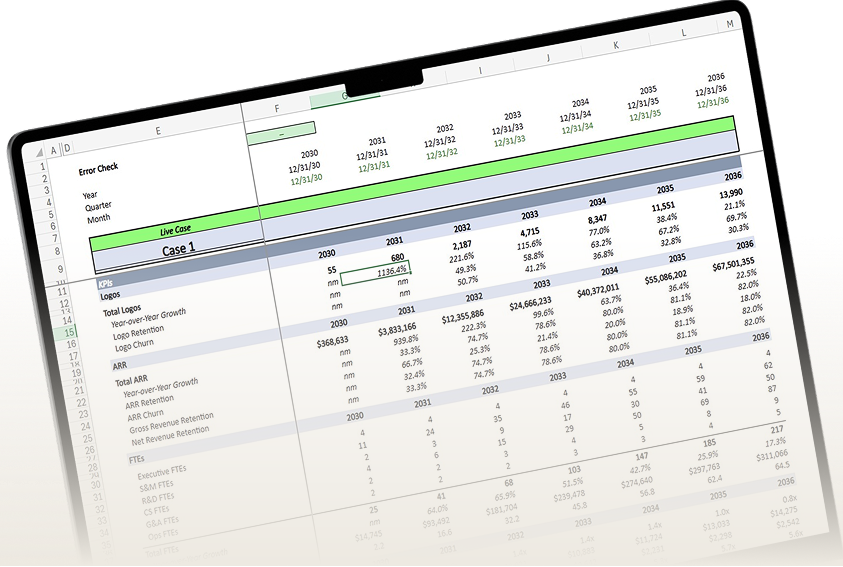
A generalist in-house analyst, especially one hired quickly under board pressure, tends to track aggregate numbers: total MRR, total churn, a single blended CAC. That's not wrong, it's just insufficient for the decisions a board or investor will actually ask you to make.
SaaS-specific FP&A work that a specialized agency covers, and that generalists commonly miss, includes:
- Cohort-level retention curves by acquisition quarter, not just an aggregate net revenue retention figure
- CAC payback by channel and segment, since a blended CAC number hides which channels are actually efficient
- Burn multiple and the Rule of 40 as combined inputs, not standalone vanity metrics
- 13-week rolling cash flow forecasts tied to actual bank data, not a static annual budget
- Deferred revenue waterfalls and ARR bridges breaking new, expansion, contraction, and churn into separate lines
- Scenario modeling tied to headcount plans, so a hiring decision shows its cash and runway consequence before it's made
Fiscallion's own board reporting framework identifies eight metrics that break the most decisions: net cash runway, CAC by segment and channel, CAC payback period, LTV, NRR, MRR/ARR, pipeline coverage, and headcount versus plan. A generalist analyst report will usually surface two or three of these. A SaaS-specialized FP&A partner builds a system around all eight, with shared definitions and clear ownership between whoever owns the data and whoever owns the decision.
Current SaaS benchmarks help frame what "good" looks like once you have this visibility: top-quartile net revenue retention above 120%, median 100-110%; CAC payback under 12 months at the top quartile versus a 15-18 month median; and LTV:CAC ratios of 3:1-5:1 at the top quartile against a 2:1-3:1 median. Fiscallion treats these ratios as ranges and cohort views, never as single numbers a board can rubber-stamp, because a blended CAC:LTV ratio hides exactly the channel and segment variance that should drive a spending decision.
Speed to value: weeks against months, and what happens in the gap
Speed to a usable model is the variable founders underweight most, because the cost comparison feels more concrete.
An in-house hiring process for a qualified FP&A analyst typically takes 6-12 weeks to source, interview, and close, and mid-level finance professional searches specifically run 6-10 weeks from a 2026 UK recruiting benchmark. After an offer is accepted, add another 4-8 weeks before the new hire reaches full productivity. Structured onboarding matters here: without a clear roadmap, new FP&A hires feel overwhelmed, miss critical training, and turn over at higher rates, with the first 30-60 days functioning as a diagnostic period rather than productive output.
Add it up and you're looking at 3-6 months between deciding you need finance help and having a usable model in hand.
An FP&A agency engagement moves differently. Fiscallion's first 90 days include a full system and data review, a financial model build or rebuild, establishment of a reporting cadence, and initial scenario planning, with forward-looking insight delivered within weeks, not months. If a provider skips that diagnostic phase and jumps straight to monthly calls, they are not building financial infrastructure, they are renting access to a calendar.
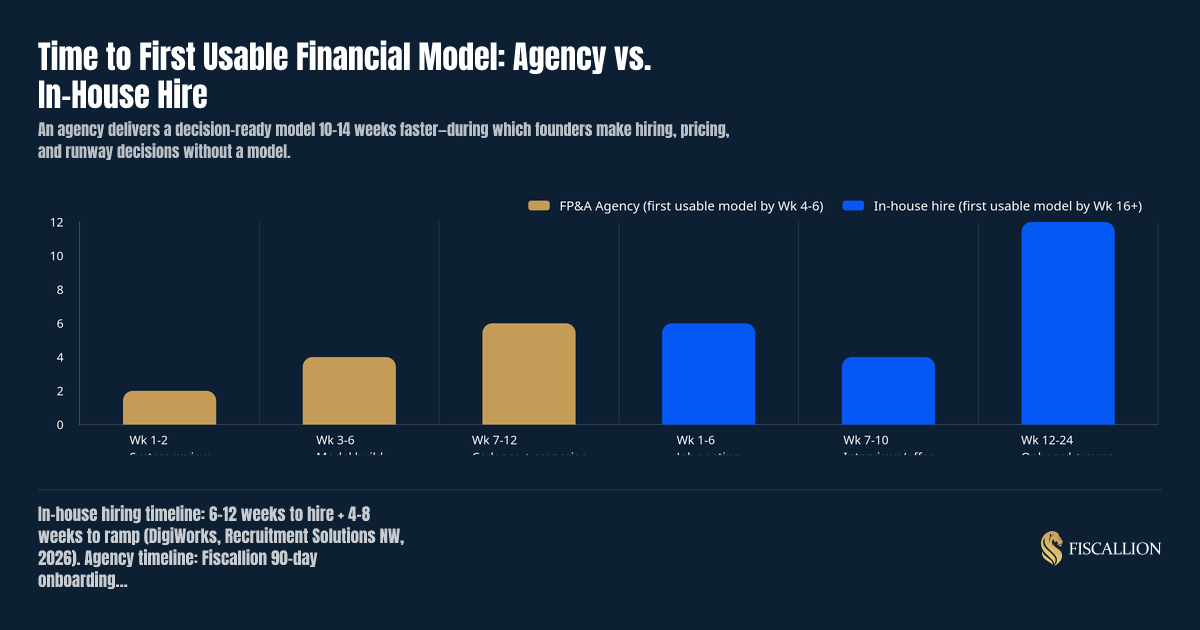
The gap matters because decisions don't wait for the org chart to fill in. Pricing changes, hiring approvals, and runway assumptions get made during those 3-6 months regardless of whether a model exists to support them. One documented pattern makes the cost of that gap concrete: a seed-stage SaaS company hired an in-house analyst for $150,000 all-in, and within six months the analyst was overwhelmed and had miscalculated runway by seven weeks. After the company brought in an outsourced FP&A engagement, forecast accuracy improved from 61% to 92% within 45 days, and runway visibility extended from 10 to 38 weeks. This example comes from a vendor-published case study, so treat the specific figures as illustrative rather than independently verified, but the direction (fast improvement in forecast reliability once specialized attention arrives) is consistent with what a structured 90-day engagement is designed to produce.
The cost comparison by stage, and the stack math that actually works
Cost comparisons get more useful when you look at the full finance stack rather than a single hire against a single retainer.
At $10M ARR, a realistic finance stack looks like this: a bookkeeper at roughly $1,500/month, a fractional controller at roughly $4,000/month, and a fractional CFO at roughly $10,000/month, totaling about $15,500/month, or $186,000 annually. Compare that against a full-time CFO's all-in cost of $350,000-$800,000/year once salary, benefits, equity, and overhead are included, per Fiscallion's fractional CFO pricing guide, and the layered fractional stack costs less than half while covering more functional ground.
The transition point to full-time typically appears around $50M+ ARR. Even past that threshold, many companies find that a strong controller at $150,000-$220,000/year paired with a fractional CFO is more cost-effective than a single full-time hire above $400,000.
A note on ROI, not just cost. Fiscallion's framework for evaluating a fractional CFO engagement is to multiply the annual retainer by three: that's the minimum value the engagement should identify in year one. At a $7,000/month retainer ($84,000/year), that means at least $252,000 in measurable value, whether that's cash saved, a runway extension, or a pricing correction. Typical realized ROI runs 3-10x the retainer cost. That framework doesn't apply cleanly to a straight in-house analyst hire, because an analyst executes a model someone else builds; it doesn't typically own the judgment that produces the $250K+ decision.
Book an FP&A model review with Aleksandar: if you want a straight answer on whether your current stage justifies fractional support, an in-house hire, or a hybrid, book a working session and we'll walk through your actual numbers together.
When the pendulum flips: signs you've outgrown the agency model
The agency model isn't permanent by design, and it shouldn't be sold as such. There's a real threshold where in-house makes more sense.
One useful rule of thumb: outsource until the finance function generates more than 30 hours per week of work requiring institutional, day-to-day knowledge, then hire in-house. Below that threshold, a full-time salary is buying capacity you're not using.
Signs you're approaching that threshold:
- Finance decisions need daily executive presence, not weekly or bi-weekly check-ins
- You're managing multi-entity complexity (multiple subsidiaries, international entities, complex revenue recognition)
- You're on an IPO track or approaching acquisition due diligence requiring a permanent internal finance organization
- Controllership work alone has grown past what a fractional controller can absorb, typically around $5-10M ARR, at which point a full-time controller at $150,000-$220,000 base plus equity becomes the right call
None of this means a full-time CFO or finance leader is the wrong choice at scale. It means the choice should be made on workload and complexity, not on the assumption that "more senior" is automatically better, or that a fractional model is a stepping stone you should abandon as soon as you can afford otherwise.
How an FP&A agency works alongside your existing bookkeeper
A common objection: "We already have a bookkeeper, won't an FP&A agency duplicate or disrupt that work?" No, because the two functions sit at different layers.
Accounting looks backward: it records what happened, closes the books, and produces historical statements. FP&A looks forward: it takes that ledger data and builds forecasts, scenario models, cash positions, and recommendations.
"An FP&A agency doesn't replace your bookkeeper or controller, it sits on top of the accounting function and translates what's already being recorded into decisions about runway, hiring, and pricing."
— Aleksandar Stojanovic, CEO & Founder at FiscallionFiscallion's engagement model reflects this layering directly. The Essentials tier assumes a lean setup with monthly reporting and cash flow forecasting built on top of whatever bookkeeping is already in place. The Growth and Ultimate tiers add bi-weekly or weekly reporting cadence, but the underlying principle stays the same: the agency owns forward-looking judgment, your bookkeeper or controller owns the historical record, and the two feed each other rather than competing.
A four-question scorecard for making this decision
Match the model to your decisions, not to a hiring plan or a competitor's org chart. Four questions clarify most cases:
- What decision are you trying to make in the next 90 days? If it's runway extension, a fundraise narrative, or a headcount trade-off, you need judgment now, not a hire in six months.
- Do you need 10 hours of finance attention a month, or 40? Below 30-40 hours weekly of institutional-knowledge work, a full-time hire is likely underutilized.
- Does the provider own the model, or just present it? A provider who inherits your spreadsheet and reads it back to you on a call isn't providing FP&A leadership, they're providing a presentation layer.
- Can they show you cohort-level CAC and LTV, or only a single blended ratio? A single ratio invites debate. A cohort view and a range invite a decision.
Frequently asked questions
How does the cost of an FP&A agency compare to hiring a full-time in-house analyst for a SaaS company?
A fully loaded in-house FP&A analyst costs $110,000-$185,000 per year once salary, taxes, benefits, and overhead are included, and a bare-minimum two-person team pushes past $250,000-$320,000 annually. A Fiscallion fractional engagement runs $36,000-$144,000 annualized depending on ARR stage, per the fractional CFO pricing guide. Below roughly $50M ARR, the agency model typically costs 50-70% less than a single in-house analyst hire, while also providing CFO-level judgment rather than analyst-level execution alone. The comparison shifts as complexity grows: past $50M ARR, or once finance work exceeds 30 hours a week of institutional-knowledge-dependent tasks, a full-time hire or hybrid stack (controller plus fractional CFO) often becomes the better economic choice. The right comparison is never price alone, it's cost measured against scope, ownership, and the decisions the engagement is actually meant to support.
Can an FP&A agency work alongside our existing bookkeeper or accountant without disrupting current workflows?
Yes, and this is how the model is designed to function. Accounting is backward-looking: your bookkeeper or accountant records transactions, reconciles accounts, and closes the books. FP&A is forward-looking: it takes that same ledger data and builds forecasts, cash runway views, and scenario models. A specialized FP&A agency sits on top of your existing bookkeeping function rather than replacing it, using the historical data your bookkeeper produces as the input for forward-looking work. There's no need to disrupt your current bookkeeping relationship or switch tools; the agency's job is to make that data decision-ready, not to re-do the recording work that's already happening.
How quickly can an FP&A agency deliver a usable financial model versus the time it takes to recruit and onboard a full-time analyst?
Recruiting a qualified FP&A analyst typically takes 6-12 weeks to source, interview, and close, with mid-level finance searches running 6-10 weeks per 2026 recruiting data, followed by another 4-8 weeks before the new hire reaches full productivity. That puts a usable model 3-6 months out from the decision to hire. A structured FP&A agency engagement compresses that timeline into a 90-day onboarding built around a system and data review, a full model build, and an established reporting cadence, with forward-looking insight delivered within weeks rather than months, per Fiscallion's engagement structure. The gap matters less as an abstract timeline and more because pricing, hiring, and runway decisions get made during those months regardless of whether a model exists to support them.
What SaaS-specific metrics and forecasting scenarios does an FP&A agency cover that a generalist in-house analyst might miss?
A generalist analyst commonly tracks aggregate MRR, a blended CAC figure, and overall churn, which is useful but insufficient for board-level decisions. A SaaS-specialized FP&A agency builds cohort-level retention curves by acquisition quarter, CAC payback by channel and segment (not a single blended number), burn multiple alongside the Rule of 40, 13-week rolling cash flow forecasts, deferred revenue waterfalls, ARR bridges separating new, expansion, contraction, and churn, and scenario models tied directly to headcount plans. Fiscallion's board reporting framework centers on eight metrics that most often break founder decisions: net cash runway, CAC by segment, CAC payback period, LTV, NRR, MRR/ARR, pipeline coverage, and headcount versus plan, treated as cohort views and ranges rather than single numbers a board can accept without scrutiny.
The decision is capital allocation, not headcount
Most SaaS companies between $5M and $100M ARR don't have a "we need a CFO" problem. They have a decision-quality and FP&A infrastructure problem that a new hire doesn't automatically solve, and that a generalist analyst working off aggregate numbers often can't solve either.
Match the model to the work in front of you: the decisions you need to make in the next 90 days, the hours of institutional-knowledge work your finance function actually generates, and whether the provider owns the model or just narrates it. Every Fiscallion engagement puts you directly in front of Aleksandar Stojanovic at the CFO layer, with FP&A leadership experience gained through scaling a SaaS company to €100M ARR, not a junior analyst reading a template back to you. If you want a clear-eyed read on where your company sits on this decision, book a working session.