

The question is not which accounting firm has the best reviews. It is whether the firm you pick can own deferred revenue inside your books, close in single-digit days, and hand you numbers your board can act on. Most firms marketed to SaaS companies handle the first job (transaction processing) and skip the second (decision-ready output). This article gives you a framework to tell the two apart before you sign a retainer, not after your next board meeting goes badly.
You will get a definition of what "best" should mean at your stage, a comparison of the five firm archetypes competing for your business, a ten-point evaluation checklist, pricing bands with their caveats, and a transition timeline that accounts for a cash-to-accrual conversion if you need one.
Why founders start shopping for a new accounting firm
Founders rarely go looking for a new accounting firm because they woke up dissatisfied with journal entries. They go looking because something forced the question.
The usual triggers are fundraising prep, board pressure, metrics chaos, or a cash-to-accrual conversion that your current bookkeeper cannot execute. In each case, the underlying problem is the same: fragmented data across tools, no single source of truth, and no framework that turns activity into cash, runway, and trade-offs.
That distinction matters because it changes what you should be shopping for. You are not looking for cleaner bookkeeping. You are looking for a firm that can own revenue recognition, close fast, and produce numbers a board or acquirer will trust without a caveat.
What "best" actually means at $5-100M ARR
A firm that fits your bookkeeping stage will not automatically fit your revenue recognition stage. Here is the scope a SaaS-specialist firm needs to own, beyond entering transactions.
Revenue recognition and deferred revenue live inside the general ledger, not a side spreadsheet. ASC 606 arrangements require judgment calls on identifying performance obligations, allocating transaction price, and handling contract modifications, and this remains a live issue for software and SaaS entities according to KPMG's revenue recognition handbook. If your deferred revenue schedule lives in Excel and gets reconciled to the balance sheet once a quarter, you do not have revenue recognition operations. You have a manual patch that breaks the first time someone leaves.
Implementation services get classified correctly, not defaulted. One of the most common judgment calls in SaaS contracts is whether implementation or setup services are a separate performance obligation, part of the SaaS promise, or simply setup activity with no standalone value. Deloitte's technology alert on cloud arrangements walks through the facts that drive this call, including vendor specificity and whether the customer could use the service without your platform. A firm that has never had this conversation with you has not looked closely at your contracts.
Distinct performance obligations are tested, not assumed.PwC's revenue guide frames the test as two conditions: the good or service must be capable of being distinct, and it must be separately identifiable from other promises in the contract. Bundled SaaS contracts with onboarding, support tiers, and usage components fail this test more often than founders expect.
Sales commissions get capitalized and amortized, not expensed on payment. Capitalizing contract costs under ASC 340-40 is a rule that KPMG's handbook calls new to most software entities, and it is one of the more common reasons gross margin shifts when a company moves to accrual accounting.
Close speed tells you how the firm actually operates. Watch for the seven recurring close mistakes: revenue recognized on the invoice date instead of over the service period, missing accruals, unreconciled deferred revenue, and no flux review to catch anomalies before they compound.
SaaS metrics reconcile to the general ledger. MRR, ARR, CAC, LTV, churn, and net revenue retention should tie back to accounting records, not live in a separate dashboard that nobody has audited against the books. A firm serving SaaS clients should be able to show you that reconciliation, not just the metric.
The five firm archetypes and where each one fits
Not every firm marketed to SaaS companies does the same job. Here is how the market actually splits.
| Archetype | What they own | Best-fit stage | Typical gap for $5-100M ARR SaaS |
|---|---|---|---|
| Big 4 or regional CPA / audit firms | Revenue recognition audits, cost capitalization review, R&D credits, SOC/SOX compliance | Pre-IPO, M&A due diligence, audit requirements | Not built for monthly close ownership or forward-looking FP&A |
| SaaS-specialist CPA firms | ASC 606 implementation, tax, R&D credits, accounting system setup on QuickBooks, Sage Intacct, or NetSuite | Series A-C needing GAAP compliance and clean books for diligence | Often stops at compliance; limited board-ready strategic output |
| Outsourced accounting firms with controller/CFO layers | Daily bookkeeping plus a controller or CFO reviewing GAAP judgment, rev rec, and monthly close | Series A-C SaaS transitioning to accrual or preparing for a raise | Varies widely by firm; verify the CFO layer is senior, not junior |
| Software-heavy bookkeeping services | Transaction processing, AP/AR, payroll coordination, categorization | Early stage, pre-revenue-recognition complexity | Rarely handles ASC 606 judgment or capitalized commissions |
| Fractional CFO-only | Forecasting, board reporting, fundraising support, scenario modeling | Companies that already have clean books and need FP&A judgment | Does not own the ledger or close process itself |
The regional and Big 4 tier addresses the audit and assurance-heavy end of the market: revenue recognition audits, cost capitalization, and SOX readiness for companies approaching an exit or IPO, according to firms like Armanino's technology practice. SaaS-specialist CPA firms typically bundle ASC 606 implementation with fractional CFO modeling and support for the common SaaS ledger stack, as described by Founder's CPA's service scope. Practitioner models like KMK Ventures describe the deeper scope a specialist should own: deferred revenue schedules, performance-obligation breakdowns, parent-child chart of accounts, and departmental cost allocation, alongside SaaS metric reporting reconciled to the books.
For most companies in the $5-100M ARR range, the hybrid model, a dedicated accountant doing transactional work under a controller or CFO who owns GAAP judgment, is the closest fit to both budget and complexity. Debit & Co's layered staffing model describes this structure explicitly and reports rebuilding eighteen months of accrual financials from cash-basis QuickBooks in a defined project window. Wiss & Co's analysis of outsourced versus in-house accounting makes the same point: for early-to-growth-stage SaaS companies, outsourced accounting with SaaS-specific expertise closes the ASC 606 and investor-reporting gap that traditional bookkeeping cannot.
"A close that finishes by day five means decisions run on fresh data. A close that drags past day twenty five means the books have become, in practice, a formality rather than a tool anyone consults before a decision."
— Aleksandar Stojanovic, CEO & Founder at FiscallionFractional CFO-only providers sit above this stack: they take clean, accrual-basis data and turn it into forecasts, board decks, and hiring or pricing trade-offs. That is the right layer once your books are already reliable. If your books are not reliable yet, a CFO-only engagement will spend its early months fighting data quality instead of building the model you actually hired them for.
The ten-point checklist for evaluating any SaaS accounting firm
Run any candidate firm through these questions before you sign:
- Is deferred revenue maintained inside the general ledger, or reconciled from a separate spreadsheet?
- Can they explain how they classify implementation and setup services for your specific contracts?
- Do they capitalize and amortize sales commissions under ASC 340-40, or expense them on payment?
- What day of the month does their close typically finish?
- Do they run a flux review to catch anomalies between periods before the close is finalized?
- Do your SaaS metrics (MRR, ARR, CAC, LTV, NRR) reconcile to the accounting records they maintain?
- If you need a cash-to-accrual conversion, is it scoped as a one-time project with a defined end, or an open-ended monthly charge?
- Is there a named owner for each deliverable, or does responsibility diffuse across a rotating team?
- Do board or investor reports include written decision rules and metric definitions, or just historical charts?
- Who actually reviews your numbers before they reach you: a senior partner, or a junior preparer with periodic oversight?
That last question is worth sitting with. Many outsourced firms market a "CFO layer" that in practice means a partner glances at your file once a quarter. At Fiscallion, every client works directly with Aleksandar Stojanovic at the CFO layer on every engagement, not a rotating account manager or a junior team that escalates when something looks wrong.
What it costs: retainers, hourly work, and what actually drives price
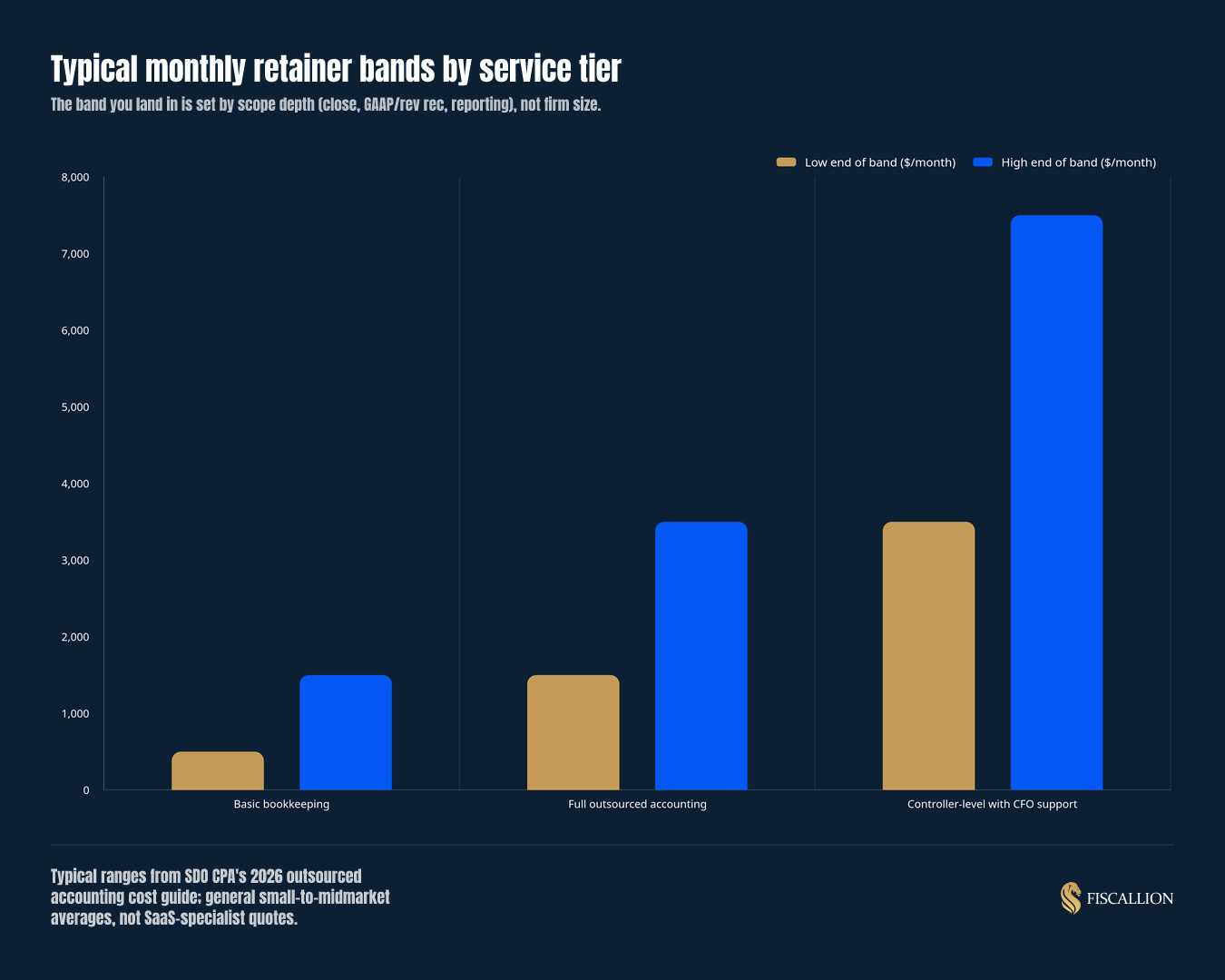
Pricing in outsourced accounting is not standardized, and the bands you will see quoted vary by scope more than by firm size.
| Service tier | Typical monthly range | What is usually included |
|---|---|---|
| Basic bookkeeping | $500-$1,500 | Transaction categorization, basic reconciliation |
| Full outsourced accounting | $1,500-$3,500 | AP/AR, payroll coordination, monthly close |
| Controller-level with CFO support | $3,500-$7,500 | GAAP judgment, revenue recognition, board-ready reporting |
These bands come from SDO CPA's 2026 outsourced accounting cost guide and reflect general small-to-midmarket averages, not SaaS-specialist quotes specifically. A separate pricing analysis from Intellgus puts full-service accounting paired with fractional CFO work at $8,000 to $20,000 or more per month, notably higher than SDO's controller-level tier. Treat both as directional rather than definitive: the gap between them illustrates that scope, not the pricing model, is what actually sets the number.
Hourly rates, typically $75 to $200 per hour per SDO's data, tend to fit project-based work like a cleanup or a one-time conversion rather than ongoing close and reporting. Per-transaction pricing suits high-volume, standardized processing but rarely covers the judgment-heavy work of revenue recognition. Retainer pricing is the most common model for ongoing scope because it aligns incentives around a defined deliverable rather than billable hours.
The real question to ask any firm quoting you a number is not "how much" but "what's included at that price."
"A $2,000 monthly quote that excludes revenue recognition judgment and board reporting is not cheaper than a $6,000 quote that includes both. It is a different, narrower service."
— Aleksandar Stojanovic, CEO & Founder at FiscallionIf you want a closer look at how Fiscallion structures pricing specifically for accrual-basis SaaS accounting, compare scope directly with a senior partner rather than working from a generic band.
Transition timeline: how long a switch actually takes
A standard onboarding to a new accounting firm, without a cash-basis-to-accrual conversion, typically runs six to ten weeks. That covers historical data review, chart-of-accounts restructuring, and a parallel period to confirm the new process matches reality before you rely on it.
If you also need a cash-to-accrual conversion, expect 60 to 90 days. Debit & Co's case studies report rebuilding eighteen months of accrual financials from cash-basis QuickBooks in 45 days, and reaching GAAP-ready monthly statements ahead of a Series B raise in 90 days. That range is consistent with what most SaaS companies transitioning between Series A and Series B should plan for, since investors, acquirers, and auditors expect accrual-basis reporting by that point.
A disciplined conversion runs through three reference points:
- A clean opening balance sheet that reflects deferred revenue, prepaid expenses, and accrued liabilities correctly as of the cutover date.
- A one-page MRR-to-revenue bridge that shows exactly how billed cash reconciles to recognized revenue, so nobody has to take the conversion on faith.
- A 60-day parallel read, running cash and accrual side by side, to confirm the new numbers hold up before the old process is retired.
Expect gross margin to shift five to ten points during the cutover period. That swing is structural, not a sign of a bad conversion: revenue gets spread over the service period instead of recognized on invoice, and previously expensed costs like sales commissions get capitalized and amortized instead. A method change of this kind also typically requires filing IRS Form 3115 with a Section 481(a) adjustment, which can be spread over up to four years.
Common mistakes founders make when picking a firm
Mistake: choosing on price per hour without pricing the scope. A lower hourly rate or monthly retainer often means a narrower scope, not a better deal. Ask what is excluded before comparing numbers across firms.
Replacement move: Price the full scope you need (rev rec, close speed, board reporting) and compare like-for-like retainers, not headline rates.
Mistake: assuming a bookkeeping firm can absorb ASC 606 without a plan. Revenue recognition judgment calls, particularly around implementation services and bundled contracts, require a specific conversation about your contract terms. Many bookkeeping-first firms have never had that conversation with a client.
Replacement move: Ask directly how the firm classifies implementation services in your contracts before signing. If they cannot answer specifically, they have not looked.
Mistake: treating a cash-to-accrual conversion as an open-ended monthly charge. Some firms will run the conversion as part of ongoing billing, which means you pay indefinitely for work that should have a defined end date.
Replacement move: Insist the conversion is scoped as a one-time project with a clear finish line, separate from your ongoing monthly retainer.
Mistake: accepting a "CFO layer" that means occasional partner review. Many firms market senior oversight that, in practice, means a partner reviews your file once a quarter while a junior team handles everything else.
Replacement move: Confirm who reviews your numbers before they reach you, and how often. A senior partner reviewing quarterly is not the same as a senior partner owning the engagement.
Frequently asked questions
What should a SaaS accounting firm handle beyond standard bookkeeping?
A specialist SaaS accounting firm should own ASC 606 revenue recognition and maintain deferred revenue schedules inside the general ledger, not in a separate spreadsheet reconciled after the fact. That includes breaking down performance obligations, classifying implementation and setup services correctly, and capitalizing sales commissions under ASC 340-40 rather than expensing them on payment. Beyond revenue mechanics, it should also cover a parent-child chart of accounts structured for departmental cost allocation, subscription and invoice tracking schedules, and SaaS metric reporting (MRR, ARR, CAC, LTV, churn, NRR) that reconciles to the accounting records rather than living in an unaudited dashboard. Companies that maintain twelve or more months of clean, ASC 606-compliant financials tend to move through fundraising or acquisition due diligence considerably faster, since diligence teams spend less time reconstructing history and more time evaluating the business itself.
Can a specialized SaaS accounting firm work alongside our existing bookkeeper or controller?
Yes, and this layered structure is a standard pattern rather than an exception. The typical model has your existing bookkeeper or a dedicated transactional accountant continuing daily processing, while a senior controller or CFO-level advisor owns GAAP judgment calls, revenue recognition, close ownership, and forward-looking reporting. Accounting looks backward at what already happened; FP&A layers forward-looking insight, budgeting, forecasting, and decision-ready reporting on top of that same ledger data. That separation is exactly why the two functions coexist well: your bookkeeper keeps transaction processing accurate day to day, while the specialist firm owns the judgment calls and the output your board and investors actually rely on.
How long does it take to transition to a specialized SaaS accounting firm?
A standard onboarding without a cash-to-accrual conversion typically takes six to ten weeks, covering historical review, chart-of-accounts setup, and a parallel-run period to confirm accuracy. If you also need to convert from cash-basis to accrual accounting, plan for 60 to 90 days. That window should include a clean opening balance sheet as of the cutover date, a one-page bridge reconciling billed MRR to recognized revenue, and a 60-day parallel read comparing cash and accrual results before the old process is retired. Expect gross margin to move five to ten points during the cutover as revenue gets spread over service periods and previously expensed costs like commissions get capitalized, which is a structural effect of the accounting change rather than a sign of a flawed transition.
Do SaaS-focused accounting firms charge monthly retainers or hourly rates?
Most SaaS-focused accounting firms default to a monthly retainer for ongoing scope, because a flat fee for a defined deliverable creates more predictable budgeting and better-aligned incentives than billing by the hour. Typical bands run from roughly $1,000 to $5,000 per month for full outsourced accounting, and $3,500 to $7,500 per month once controller-level and CFO oversight are included, though some full-service providers quote considerably higher, up to $20,000 or more per month, depending on scope depth. Hourly rates, generally $75 to $200 per hour, tend to apply to project-based work like a books cleanup or a one-time cash-to-accrual conversion rather than ongoing monthly close and reporting. Per-transaction pricing exists for high-volume, standardized processing but rarely covers the judgment-heavy work of revenue recognition. The number that matters is not the pricing model but the scope behind it: close depth, revenue recognition complexity, and reporting cadence drive cost far more than whether you are billed by the month or the hour.
Choosing the right fit, not just the right firm
The firm that fits your $8M ARR company with straightforward subscription contracts is not the same firm that fits your $60M ARR company running usage-based pricing across three product lines. What stays constant is the scope test: deferred revenue inside the ledger, a close that finishes fast enough to be useful, and reporting a board can act on without asking what to do next.
If you are evaluating whether your current setup can carry you through a raise, a cash-to-accrual conversion, or a board meeting that needs more than a historical recap, compare scope directly with a senior partner rather than guessing from a pricing page.