
A fractional CFO agency gives a scaling SaaS company CFO-level financial judgment, on a part-time or contracted basis, without the cost or commitment of a full-time executive hire. It typically delivers financial modeling and forecasting, cash flow and runway management, board and investor reporting, unit economics analysis, and fundraising support, through a senior finance leader who works alongside your existing bookkeeping or accounting function rather than replacing it.
That definition answers the search query. It does not answer the decision in front of you: whether your company is at the stage where that judgment changes outcomes, and whether an agency model or a solo fractional hire or a full-time CFO is the right shape for the problem you actually have.
What you'll learn
This article covers four things in order: what a fractional CFO agency is and how it differs from a solo fractional hire or a full-time CFO, what the deliverables actually look like month to month, how the arrangement works alongside your bookkeeper or accountant, and how to decide whether the cost is justified at your current ARR. A scope checklist and an FAQ section follow the main analysis.
A fractional CFO agency is a team, not a single contractor
Most founders picture a fractional CFO as one person, available a few hours a week, answering questions when asked. That picture is wrong often enough to cause real problems.
A fractional CFO is a senior finance executive who provides CFO-level services to a business on a part-time or contract basis, filling the gap between basic accounting and a full internal finance department. That is the individual-practitioner version. An agency model extends it: instead of one person juggling both strategy and reconciliations, a coordinated team mirrors a full in-house finance department, with a CFO-level professional working alongside accounting and bookkeeping support, each owning a distinct layer.
The distinction matters because of what happens when it is ignored.
"A CFO who is also wrestling with reconciliations is not doing CFO work, according to the same analysis of fractional engagement structure. Every hour spent chasing a mismatched invoice is an hour not spent on the scenario model that tells you whether you can afford the next two hires."
— Aleksandar Stojanovic, CEO & Founder at FiscallionFiscallion's model reflects this separation deliberately. Every Fiscallion client works directly with Aleksandar Stojanovic at the CFO layer, senior-partner ownership on every engagement, not a rotating account manager or a junior analyst handling the model while a partner shows up for the board meeting. That is the difference between an agency that hands you off and one where the person building your forecast is the same person defending it to your board.
Here is how the three models compare on the dimensions that matter to a $5-100M ARR SaaS company:
| Model | Who does the work | Best fit | Typical cost signal |
|---|---|---|---|
| Full-time CFO | One executive, full-time, builds an internal team over time | Companies with daily executive-presence needs and enough complexity to justify a permanent finance organization | Base salary $180K-$320K at Series A-B, with all-in cost reaching $350K-$500K annually once benefits, equity, and recruiting are counted |
| Solo fractional CFO | One individual, part-time, often stretched across strategy and lower-level tasks | Companies with light finance-ops needs and a stable bookkeeping layer already in place | Varies by scope; risk of the CFO doing non-CFO work if support is thin |
| Fractional CFO agency | A senior CFO-level lead plus accounting/bookkeeping support, each owning a distinct layer | Companies that need both strategic judgment and reliable execution without building an internal team | $5K-$15K per month, corroborated by $3K-$15K per month across the broader market |
None of these is a lesser version of the others. A full-time CFO is the right call when a company has outgrown the need for judgment on demand and needs a permanent executive presence and internal org. A fractional agency is the right call when the company needs senior judgment and hands-on FP&A ownership but does not yet need, or cannot yet justify, a full-time seat. Choosing between them is a scope question, not a budget concession.
What a fractional CFO agency actually does for a SaaS company
The deliverables map directly onto the problems that push a founder to search for this in the first place. Here is what each looks like in practice.
Cash flow visibility and a single source of truth. Most companies at this stage have cash data scattered across a bank feed, a spreadsheet someone updates inconsistently, and a slide deck from three months ago. A fractional CFO agency consolidates this into one model that the founder and the board both trust, because both are looking at the same numbers.
Runway forecasting with real scenario branches. A forecast that assumes one hiring plan and one growth rate is not a forecast, it is a guess with a decimal point. The agency's job is to build branches: what happens to runway if the enterprise deal slips a quarter, if churn ticks up, if the next round takes longer to close.
Board and investor reporting that answers "what do we do next." Fiscallion's own framework treats gross margin, net revenue retention, CAC payback, and cash runway as Tier 1 metrics that belong together in a single view, because a board deck that reports history without framing a decision is not doing its job. The most common failure is not bad data. It is missing operating structure: no shared definitions, no named metric owner, no written decision rule for what happens when a number moves.
Unit economics as a range, not a single debated figure. CAC and LTV numbers get argued over in board meetings more than almost any other line item, usually because nobody agreed on the definition before the argument started. Cohort-level views replace single-point debates with numbers people can act on.
Headcount planning tied to the model, not to gut feel. Hiring decisions that happen outside the forecast are the fastest way to shorten runway without anyone noticing until the board meeting.
Fundraising and diligence support. This includes data room preparation, model stress-testing under investor scrutiny, and the ability to defend MRR, ARR, and retention definitions when a term sheet is on the table. Fractional CFO engagements are associated with faster fundraising closes, which tracks with the underlying logic: a model that has already survived internal stress-testing survives diligence faster.
Pricing and margin blind spots. Gross margin erosion is often invisible until a board member asks about it directly. A fractional CFO agency should be watching this before that meeting, not during it.
The common thread across all of these: accounting looks backward, FP&A looks forward. A fractional CFO agency's entire value proposition is translating ledger data that already exists into decisions that have not been made yet.
How a fractional CFO agency works with your existing bookkeeper or accountant
This is the question that stalls the most deals, because founders assume hiring a fractional CFO means replacing or duplicating what their bookkeeper already does. It does not, and the reason why is structural.
There is a sequence to the finance function, and skipping steps in it causes the exact fragility that brings founders to this search in the first place. A bookkeeper records your transactions, a controller keeps your financial operation running accurately and on schedule, and a fractional CFO uses that foundation to answer forward-looking strategic questions. The three roles build on each other in that order: clean records first, reliable oversight next, strategic guidance once the data can be trusted.
A fractional CFO agency that tries to build forecasts on unreliable books is building on a weak foundation, no matter how sophisticated the model looks. This is why the working relationship should be additive, not competitive. The CFO owns the narrative and the relationship; the controller and bookkeeping layer own the accuracy of the underlying data.
In practice, this division of labor looks like:
- Your bookkeeper or accountant continues recording transactions, closing the books, and maintaining the ledger. Nothing about that changes.
- A controller layer, if one exists, keeps the close accurate and on schedule, reconciling accounts and catching errors before they compound.
- The fractional CFO takes the clean output from those layers and builds the forward-looking work: the model, the board narrative, the scenario planning, the fundraising materials.
The full finance stack — bookkeeper, controller, fractional CFO, full-time CFO — maps to specific ARR milestones and cost bands at each transition, as outlined in the post below.
The failure mode to watch for is what happens when the sequencing breaks down before the CFO layer is even engaged. When something at the bookkeeping layer has been deferred or done inconsistently, the accounting layer has been working with imperfect inputs, which means forecasts and board reports built on top look more reliable than they actually are. The real gap most companies face is not dirty books. Most companies at this stage have reasonably accurate bookkeeping already. The actual gap is the layer between the books and the decision: someone needs to own the assumptions in the model, and that ownership is precisely what a fractional CFO agency is built to provide.
A well-structured fractional CFO agency engagement should start with a short assessment of exactly this: is the bookkeeping layer solid enough to build on, and if not, what needs to be fixed first before the forecast can be trusted.
Is a fractional CFO worth it for an early-stage SaaS company?
The honest answer depends on where "early-stage" lands on your revenue curve, and the cost math changes the calculus more than most founders expect going in.
The cost comparison
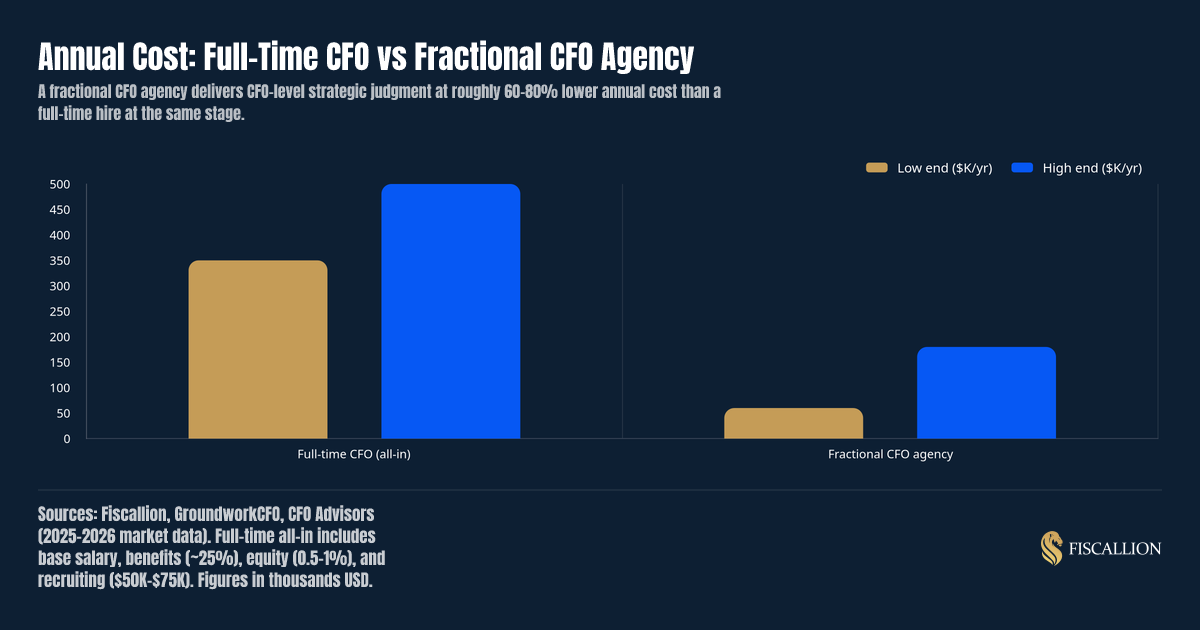
A full-time CFO at Series A-B stage runs a base salary of $180K-$320K, but the base salary understates the real number. Once benefits (roughly 25%), equity (0.5-1%), and recruiting costs ($50K-$75K) are loaded in, the all-in annual cost lands at $350K-$500K, with one 2025 cost-benefit analysis putting a typical Year-1 all-in figure around $400K.
A fractional CFO agency runs $5K-$15K per month, or $60K-$180K annually, a figure corroborated by a broader market range of $3K-$15K per month. That range typically works out to 70-80% savings versus a full-time hire with similar expertise.
| Model | Annual cost (all-in) | What drives the number |
|---|---|---|
| Full-time CFO (Series A-B) | $350K-$500K | Base salary $180K-$320K + benefits (~25%) + equity (0.5-1%) + recruiting ($50K-$75K) |
| Fractional CFO agency | $60K-$180K | Monthly retainer of $5K-$15K, scaled to engagement scope |
That gap is not a reason to assume the cheaper option is automatically the smarter one. It is a reason to ask what scope of work the company actually needs right now, and to size the engagement to that scope rather than to the org chart a later-stage company would have.
Where the sweet spot sits
Most SaaS companies engage a fractional CFO somewhere between roughly $500K and $10M ARR, with the case for full-time strengthening as complexity, not just revenue, increases. One source frames it directly: companies generally don't require a full-time CFO until they reach approximately $25 million in revenue, though the right threshold depends on how complex the finance function has actually become, not on revenue alone.
Below roughly $500K ARR, a bookkeeper and a hands-on founder can usually manage without a fractional CFO layer. Above roughly $25M ARR, or once daily executive presence and a permanent internal finance org become necessary, a full-time hire tends to make more sense than continuing to stretch a fractional engagement.
The most expensive mistake in this range is not underinvesting in finance. It is hiring a full-time CFO too early post-raise, then watching that expensive hire spend their time on controller-level or bookkeeping-level work because the underlying layers were never built out. That is the inverse of the sequencing problem above: paying CFO-level compensation for controller-level output.
The stage-by-stage cost breakdown below shows exactly how monthly retainers scale across ARR milestones — and where the full-time crossover typically lands.
The runway argument
There is a direct, calculable case for fractional support at this stage beyond the sticker-price gap. In one modeled example at $200K monthly burn and $2.4M in cash, a full-time CFO at roughly $33K per month yields about 10.3 months of runway, while a fractional CFO at roughly $5K per month yields about 11.7 months, a difference of roughly 1.4 months, or about 17% more runway, purely from the cost delta between the two staffing models.
"That is runway you did not have to raise, cut, or negotiate for. It came from choosing the right altitude of finance leadership for the stage you are actually at."
— Aleksandar Stojanovic, CEO & Founder at FiscallionThe fractional CFO agency scope checklist
Use this before your next conversation with any fractional CFO provider, whether that is Fiscallion or someone else. If a provider cannot speak clearly to most of these, that is useful information before you sign anything.
- Does the engagement include a named senior lead who owns the model directly, or does work get handed to a rotating team?
- Is there a clear division of labor with your existing bookkeeper or accountant, in writing, before the engagement starts?
- Does the scope include runway forecasting with scenario branches, or only a single-path forecast?
- Are board reporting deliverables built to frame a decision, or only to report what already happened?
- Is CAC/LTV treated as a cohort-level range, or presented as a single debated number?
- Does the engagement include headcount planning tied explicitly to the cash model?
- Is fundraising and diligence support included, or billed separately without being disclosed upfront?
- Does the provider have a clear point at which they would recommend you transition to a full-time hire, rather than extending the engagement indefinitely regardless of fit?
- Can the provider point to prior FP&A leadership experience at meaningful scale, rather than only generalist advisory experience?
If you want a structured way to work through this before your next board cycle, explore Fiscallion's fractional CFO service. Aleksandar's FP&A leadership experience gained through the growth of a SaaS company to €100M ARR shapes how the scope checklist above gets applied to your specific stage.
Frequently asked questions
What is a fractional CFO for SaaS companies?
A fractional CFO for a SaaS company is a senior finance executive who provides CFO-level strategic work, financial modeling, forecasting, board reporting, and fundraising support, on a part-time or contracted basis rather than as a full-time employee. The model exists because many SaaS companies reach a point where basic bookkeeping is no longer sufficient for board and investor conversations, but the company is not yet at the revenue or complexity level that justifies a full-time executive salary. A fractional CFO fills that specific gap, typically engaging for a set number of hours or days per month rather than daily.
What does a fractional CFO agency actually do for a SaaS company?
A fractional CFO agency delivers the same core deliverables as a solo fractional CFO but through a structured team rather than one person: financial modeling and cash flow forecasting, board and investor reporting built around decisions rather than history, SaaS-specific unit economics work on CAC, LTV, and NRR, and fundraising and diligence support. The agency structure matters because it separates strategic work from execution work, a CFO-level lead focuses on judgment and the forward-looking model, while accounting or bookkeeping support underneath handles the recurring, transactional work that keeps the underlying data accurate. This prevents the common failure where a fractional CFO ends up spending hours on reconciliations instead of the forecast the company actually hired them for.
How does a fractional CFO agency work with my existing bookkeeper or accountant?
A fractional CFO agency should work alongside your existing bookkeeper or accountant, not replace or duplicate their function. The relationship follows a sequence: your bookkeeper or accountant continues to own the transaction records and the close, while the fractional CFO takes that output and builds the forward-looking layer, the forecast, the scenario model, the board narrative on top of it. This only works if the underlying books are reasonably accurate to begin with. A capable fractional CFO agency will assess your bookkeeping quality early in the engagement and flag any gaps that need fixing before the forecast can be trusted, rather than building a polished model on top of unreliable inputs and letting that fragility surface later at a board meeting or during diligence.
Is a fractional CFO worth it for an early-stage SaaS company?
For most SaaS companies in the roughly $500K to $10M ARR range, a fractional CFO is generally worth the cost relative to a full-time hire, both because the price gap is substantial and because the scope of finance work at that stage rarely requires daily executive presence. A full-time CFO at Series A-B stage typically costs $350K-$500K all-in annually once benefits, equity, and recruiting are included, while a fractional CFO agency typically runs $60K-$180K annually, a 70-80% cost difference for comparable strategic output. Below roughly $500K ARR, a bookkeeper plus a hands-on founder can often manage without a fractional CFO layer. The clearest sign it is worth it earlier rather than later is when board pressure, fundraising prep, or metrics confusion is already costing you time and credibility, since those costs compound quietly while a fractional engagement addresses them directly.
The decision in front of you
The question is not whether a fractional CFO agency sounds useful in the abstract. It is whether your company right now has cash visibility problems, a fragile forecast, board reporting that does not answer "what do we do next," or unit economics that get argued over instead of used. If any of those describe your last quarter, the scope checklist above is the place to start, whether you bring it to Fiscallion or to another provider.
The providers worth choosing between are not distinguished by who is cheapest. They are distinguished by who gives you senior judgment applied directly to your model, not handed off to whoever is available that week.