
Most annual operating plans fail before Q2 for one reason: they were built as a document, not as an operating system.
"You approve a spreadsheet in December, the board signs off, and by March nobody can tell you whether you're ahead of plan, behind plan, or just improvising against a number nobody remembers agreeing to.
— Aleksandar Stojanovic, CEO & Founder at FiscallionThis article gives you the full structure. Not a teaser, not a locked template behind a form. By the end, you will have the eight-part SaaS annual operating plan template structure, the build sequence to get there, benchmark spend ratios to calibrate against, and the governance rhythm that keeps the plan alive after January.
What a SaaS annual operating plan actually is
An annual operating plan (AOP) is a board-approved, twelve-month plan that translates company strategy into specifics: revenue targets, headcount, costs, capital allocation, key initiatives, and the metrics you'll use to track all of it. It sits beneath your long-range plan and above your monthly budget-vs-actual review.
People conflate an AOP with a budget. They are not the same thing. An AOP guide from Metapraxis frames the distinction cleanly: a budget tells you what you're allowed to spend; an operating plan tells you what you're going to do, and how you'll know if it's working.
| Document | Scope | Horizon | Purpose | Changes during the year |
|---|---|---|---|---|
| Strategic plan | Multi-year direction | 3-5 years | Align on where the company is going | Rarely, only on major strategy shifts |
| Annual operating plan | Operational + financial plan for the year | 12 months | Direct execution and define accountability | Inputs update quarterly; targets hold |
| Budget | Financial limits by line item | 12 months | Control spending | Reforecast rolls forward monthly |
| Rolling forecast | Latest expectation | Rolling 12 months | Predict and steer | Updates continuously |
That distinction matters because it determines what changes when reality diverges from plan. Your annual targets should not move every time a deal slips. Your forward-looking inputs should.
What a SaaS AOP should include
This is the open structure. Eight sections, each with named assumptions, no wishlist line items.
1. Executive frame
Before any function builds a plan, the CEO and CFO set the guardrails: the revenue target, the margin floor, and the headcount envelope for the year. This is the top-down constraint every bottom-up plan has to fit inside.
2. Driver-based revenue plan
Revenue is not a growth-rate assumption. It's a formula with named inputs:
Ending ARR = Starting ARR × NRR + Gross New ARR
Worked example: $12M starting ARR, 105% net revenue retention, $4M gross new bookings gets you to $16.6M, or 38% growth. Run the same formula at 98% NRR with bookings 20% light and you land at $15.6M, 30% growth. Same starting point, radically different board conversation.
Your revenue section needs pipeline coverage ratios and close rates by segment sitting underneath the formula, not a single top-line number pulled from a growth target.
3. Headcount plan
Headcount drives 60 to 75% of total operating expenses in a $5M to $50M ARR SaaS company. That makes headcount the primary cost driver your entire OpEx section flows from, not a line item you fill in after the fact.
Three modeling rules that generic budget templates skip:
- Fully burdened cost = base salary × 1.25 to 1.35, not base salary alone.
- Build in a 60 to 90 day recruiting buffer between "approved headcount" and "revenue-generating headcount."
- Model ramp curves for every new hire in a revenue-facing role. Nobody is at full productivity on day one.
4. OpEx by category
Break operating expense into the categories that actually move independently: cost of goods sold (hosting, DevOps, professional services), selling, marketing, R&D, and G&A. Each category gets its own driver, not a flat percentage-of-revenue assumption.
5. P&L and margin model
This is where the revenue plan and the OpEx plan meet. It should show gross margin, operating margin, and the trajectory of both across the year, not just a year-end number.
6. Monthly cash flow and runway
Revenue and cost projections do not tell you when cash actually moves. Build monthly cash timing separately, because SaaS billing cycles and collection lags create runway pressure that a P&L view alone won't surface.
7. Scenario and sensitivity model
Build three scenarios, minimum: base, downside, and upside. The downside case is the most decision-revealing part of the entire plan because it forces you to name what you'll cut and when.
- Downside: bookings miss 20 to 25%, delay non-critical hires by one quarter.
- Base: the plan as approved.
- Upside: bookings beat 15 to 20%, accelerate strategic hires.
Five drivers move most SaaS scenarios. Assign a named owner to each input before you build the scenarios, not after.
8. Assumptions and risk register
One register. Every material assumption in the plan has a name next to it, a person, not a department. If nobody owns an assumption, it will quietly go stale and nobody will notice until the variance shows up three months later.
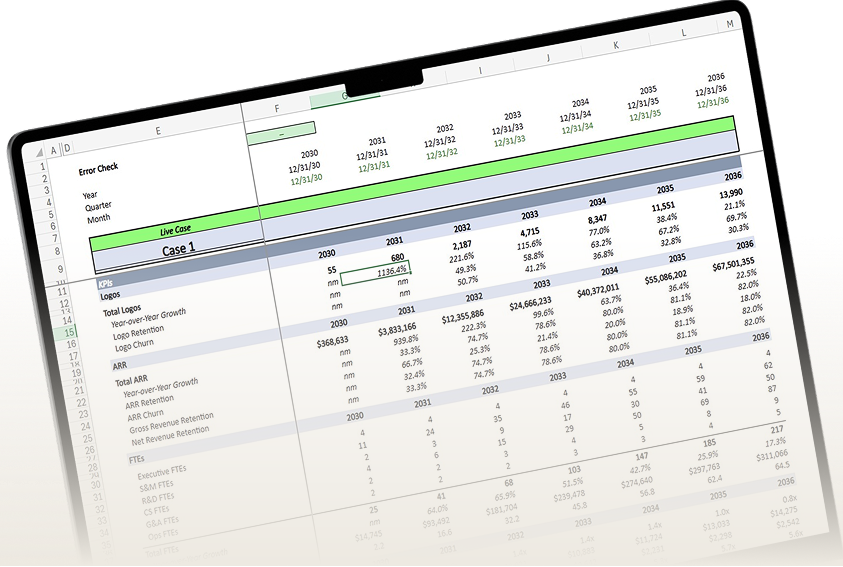
This is the same scaffolding Aleksandar publishes openly in his SaaS operating model handout, which covers the driver-based revenue engine, department-level OpEx, and headcount and compensation planning with FTE logic:
How to build a SaaS annual operating plan
The sequence matters more than the template. Build in this order:
- Set top-down guardrails. CEO and CFO agree on revenue target, margin floor, and headcount envelope before any function starts building.
- Build bottom-up functional plans. Sales, marketing, product, and CS build their piece against the guardrails, not against last year's headcount plus 20%.
- Reconcile and negotiate trade-offs. Bottom-up plans will not fit the top-down envelope on the first pass. That gap is where the real planning conversation happens.
- Finalize targets and lock accountability. Assign named owners to every target and every assumption before the board sees the plan.
- Align with the board before lock. The board should see the trade-offs and the downside case, not just the base case, before the plan is final.
- Connect to the rolling forecast. The locked AOP becomes the baseline your quarterly reforecast updates against. It doesn't sit in a drawer until next December.
On timing: start planning roughly one fiscal quarter before the new year begins. Drivetrain notes planning typically begins about three months out, drafted by the finance leader with CEO and functional stakeholders; Fairview recommends starting four to six months ahead, especially for multi-entity companies. Use the earlier end of that range if you have more than one legal entity, multiple product lines, or a board that expects a draft before the final quarter starts.
How to calibrate the plan against benchmarks
A plan with no external reference point is just an opinion with formatting. Use spend ratios as a sanity check, not a target to hit exactly.
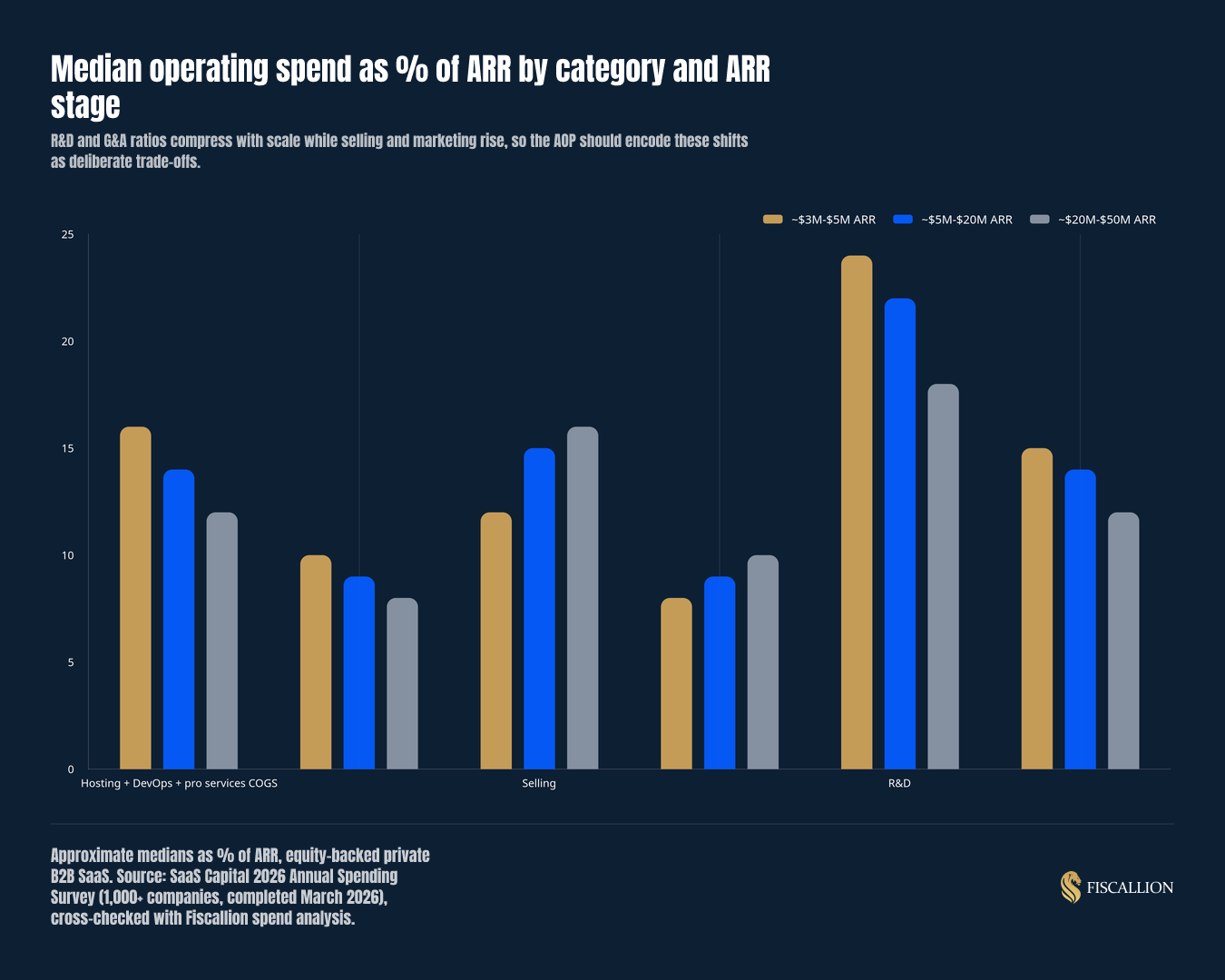
| Category | ~$3M-$5M ARR | ~$5M-$20M ARR | ~$20M-$50M ARR |
|---|---|---|---|
| Hosting + DevOps + pro services COGS | 16% | 14% | 12% |
| Customer support & success | 10% | 9% | 8% |
| Selling | 12% | 15% | 16% |
| Marketing | 8% | 9% | 10% |
| R&D | 24% | 22% | 18% |
| G&A | 15% | 14% | 12% |
Values are approximate medians for equity-backed private B2B SaaS companies, drawn from Fiscallion's spend analysis cross-checked against the SaaS Capital 2026 Annual Spending Survey of over 1,000 private B2B SaaS companies. R&D and G&A ratios compress as ARR scales, while selling and marketing typically rise, which is a deliberate reallocation, not a rounding error.
The same survey found bootstrapped companies running total spend near 96% of ARR versus 101% for equity-backed companies, and 83% of bootstrapped companies at or near breakeven compared to 52% of equity-backed companies. If your plan looks nothing like these ratios, that's worth a direct conversation about why, not a silent adjustment to make the numbers match.
The governance rhythm that keeps the plan alive
A plan without a review cadence is a forecast you'll ignore by March. Four mechanisms make it operational:
- Monthly budget-vs-actual review. Focus on the 3 to 4 most material variances each month. Reviewing every line item every month trains people to skim instead of think.
- Quarterly reforecast. Update the forward twelve-month view with new information. Do not change annual targets. Update the inputs.
- Runway threshold rules. These set what hiring decisions are allowed at each runway level: 18+ months of runway after the approved hiring plan supports hiring ahead of demand; 12 to 18 months restricts hiring to confirmed capacity gaps; under 12 months limits hiring to backfills and roles with direct revenue attribution. Overriding these thresholds requires an explicit board-level decision with documented rationale, not a quiet exception.
- Named assumption owners. The register from section 8 isn't a one-time exercise. Review it at each quarterly reforecast and confirm the owner still stands behind the number.
"The budget is the source of truth and the board deck is the translation layer. Build your board financial section directly from the plan model instead of rebuilding a parallel narrative every quarter. If the two diverge, the deck is wrong, not the model."
— Aleksandar Stojanovic, CEO & Founder at FiscallionCommon mistakes and the replacement move
| Mistake | Replacement move |
|---|---|
| Building the plan from department wishlists | Publish the top-down envelope first, then reconcile bottom-up |
| Assuming full productivity from day one for every new hire | Model ramp curves into the headcount plan |
| No named owner on material assumptions | Maintain one assumptions register with a person's name on each line |
| One annual build, reviewed once | Run a quarterly reforecast that updates inputs, not targets |
| Board deck built separately from the plan model | Build the financial board section directly from the plan model |
| Treating the upside case as the operating plan | Run the downside case first; it reveals the real trade-offs |
Where a fractional CFO fits into this
You can build this structure yourself. The harder part is usually not the template, it's keeping the scenario layer current and the governance rhythm actually running once Q2 arrives.
If the model exists but the cadence around it is fragile, that's a working session Fiscallion runs directly. Every Fiscallion client works with Aleksandar Stojanovic at the CFO layer, senior partner on the engagement, not an account manager handing you off to a junior team. His financial planning and analysis background includes FP&A leadership experience gained through the growth of a SaaS company to €100M ARR, which is the operating context this template comes from.
If you want a second opinion on your scenario model, your assumptions register, or how your board deck maps to your plan, talk to Fiscallion about financial modeling and board reporting.
FAQ
What should a SaaS annual operating plan include?
A SaaS AOP should include eight linked components: an executive frame setting revenue, margin, and headcount guardrails; a driver-based revenue plan using the Ending ARR formula; a headcount plan with fully burdened costs and ramp curves; OpEx broken out by category; a P&L and margin model; a monthly cash flow and runway view; a scenario and sensitivity model with at least three named scenarios; and one assumptions register with a named owner on every material input. Metapraxis's AOP framework covers the same core components at a general-business level: strategic context, revenue plan, cost and margin plan, headcount and capacity, capital expenditure, initiatives with owners, and targets and KPIs. The SaaS-specific version adds the driver-based ARR formula, headcount-as-primary-cost-driver framing, and cash-timing modeling that a generic template misses.
How do you build an annual operating plan for a SaaS company?
Start with top-down guardrails set jointly by the CEO and CFO: revenue target, margin floor, and headcount envelope. Have each function build a bottom-up plan against those guardrails, then reconcile the gap between bottom-up asks and the top-down envelope. That reconciliation is where the real trade-off decisions happen. Lock targets and assign named owners, align with the board before finalizing, and connect the locked plan to your rolling forecast so it becomes the baseline for quarterly updates rather than a document that sits until next year. Start the process roughly one fiscal quarter ahead of your new year, earlier if you run multiple entities or product lines.
What is an AOP and why does a SaaS business need one?
An AOP is a board-approved, twelve-month plan that translates strategy into specific revenue targets, headcount decisions, cost allocations, and the metrics used to track progress. It sits between your multi-year strategic plan and your monthly budget-vs-actual review. A SaaS business needs one because growth and cost structure move together in ways generic annual planning doesn't capture: net revenue retention compounds or erodes your starting ARR before a single new deal closes, headcount typically drives 60 to 75% of operating expense at $5M to $50M ARR, and cash timing lags revenue recognition in ways that create runway risk a P&L alone won't show. Without an AOP built around those SaaS-specific dynamics, you're running the business against assumptions nobody agreed to and nobody owns.
The takeaway
An annual operating plan only earns its name if it survives contact with the first quarter it's supposed to govern. Build the eight sections with named owners, run the downside case first, and connect the plan to a quarterly reforecast instead of filing it away until next December.
If the structure is solid but the rhythm around it keeps slipping, that's the exact gap a working session with Fiscallion is built to close, with Aleksandar at the CFO layer on every conversation.