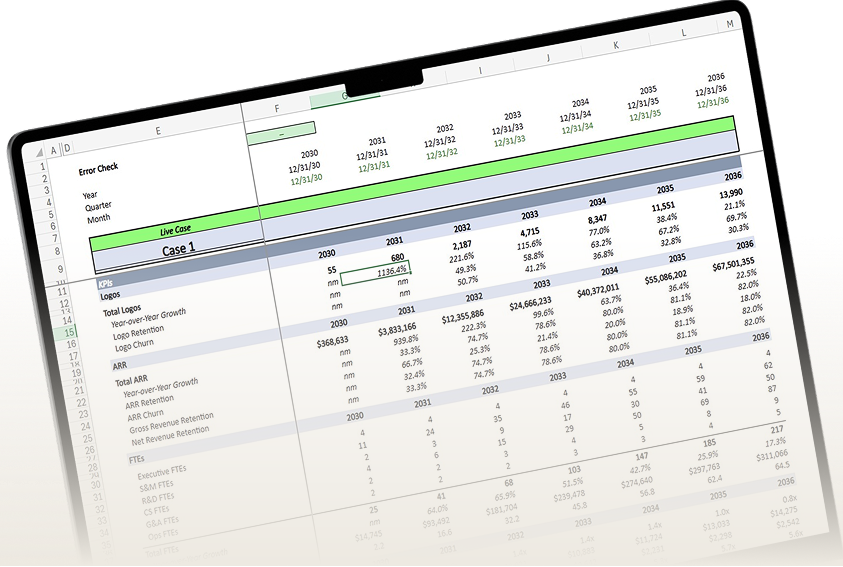

Outsourced financial forecasting for SaaS means a third-party senior finance partner builds and operates your driver-based model, runs the forecast cadence, and ships board-ready output on a standing schedule, without you hiring a full-time finance team.
That distinction matters because most founders shopping this category are not actually choosing between "model" and "no model." They already have a spreadsheet from the last raise. The real decision is whether to buy an owned forecast cycle, keep the work in-house with a stretched team, or hire a full-time finance leader. Get that decision wrong and you end up with a static model nobody trusts by the next board meeting.
Three things to settle before you sign anything:
- What the engagement must include beyond the model file itself.
- The realistic timeline to your first board-ready forecast pack.
- The ownership clause that determines whether you can run the model yourselves if the relationship ends.
You are not buying a model, you are buying the forecast cycle
This distinction explains why so many post-raise models decay within two quarters. The build was excellent. Nobody was contracted to keep operating it.
The scale of this problem shows up in industry data. Only 43% of organizations currently use rolling forecasts, according to the AFP 2026 FP&A Benchmarking Survey; most still rely on a current-year forecast that goes stale the moment a quarter closes. Average budget production time has not improved in three years, sitting at 8.7 weeks. But teams with structured scenario planning build budgets faster, at 8.1 weeks, versus 9.2 weeks for peers without that discipline.
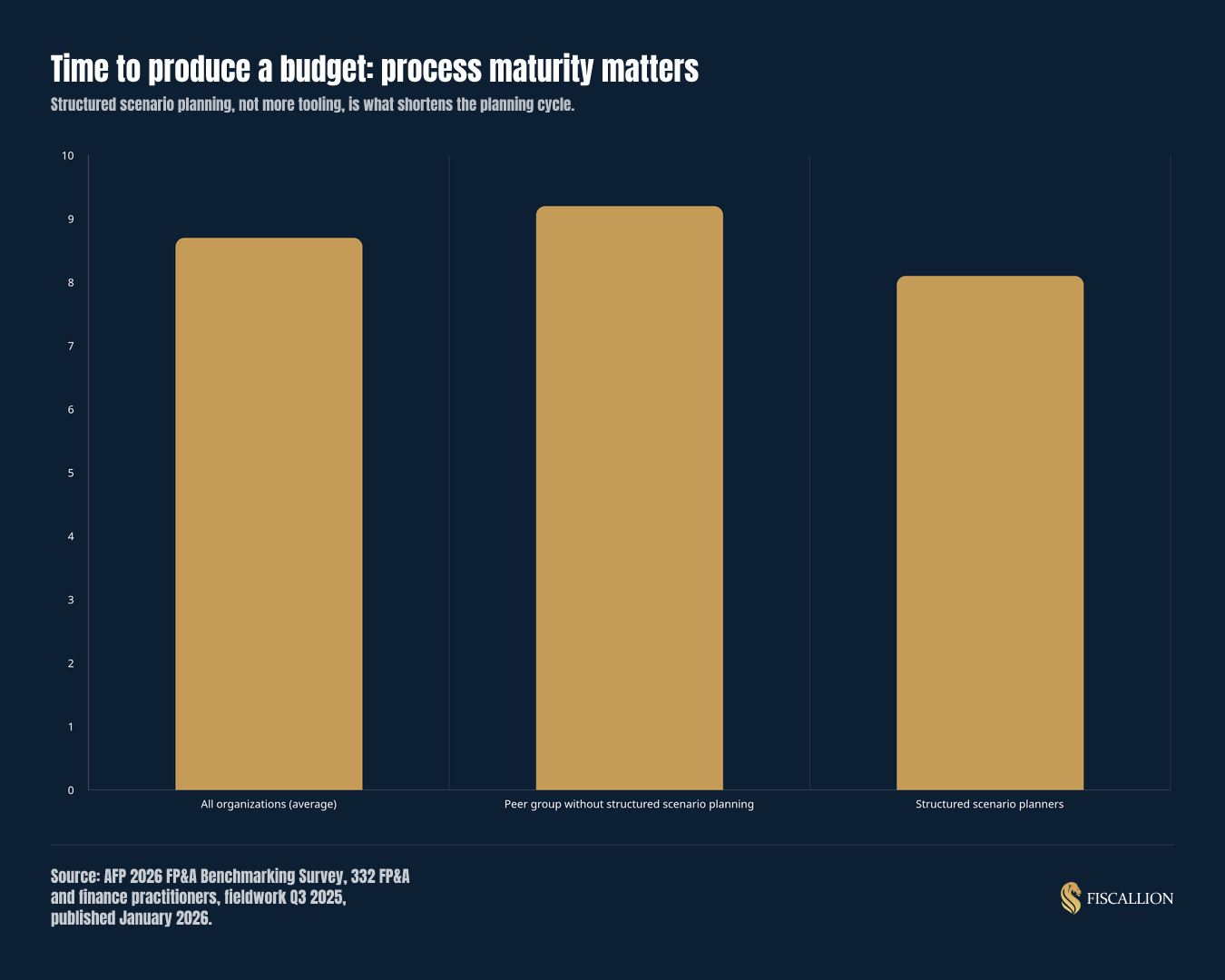
Source: AFP 2026 FP&A Benchmarking Survey, 332 finance practitioners, fieldwork Q3 2025, published January 2026.
The takeaway for a buyer: structured scenario planning, not more tooling, is what shortens the cycle. That is precisely the discipline an outsourced forecasting engagement should be selling you, not a one-time deliverable.
What an outsourced SaaS forecasting engagement should include
A serious engagement covers the full path from raw data to a decision the board can act on. Reporting-pack design, driver-based model build, forecast-cycle operation, and budget facilitation belong together, according to Metapraxis's description of FP&A as a service, which separates FP&A from accounting on exactly this basis: accounting records what happened and must be correct, FP&A explains what's next and must be useful.
Use this table as your scope checklist when comparing proposals:
| Deliverable | What it answers | Why it matters for SaaS |
|---|---|---|
| Driver-based revenue engine (ARR, NRR, churn) | How does revenue actually move | Generic P&L forecasts miss cohort and expansion dynamics |
| Three-statement link | Does the model tie to cash | A revenue model without cash and balance sheet linkage is incomplete |
| Runway and burn view | How many months before you need to act | The number the board and investors actually want first |
| Scenario set (base, upside, downside) | What changes if a driver moves | A single-point forecast hides the real range of outcomes |
| Variance commentary with diagnosis | Why did we miss or beat, and what do we do | History without a "so what" doesn't change decisions |
| Board pack | What are the choices in front of us this month | Turns a report into a decision document |
| Assumption ownership log | Who is accountable for each input | Prevents "the model said so" as an excuse |
Fiscallion's own service scope is built around this exact list rather than treating model build, forecast operation, and board reporting as separate purchases. Its financial modeling and board reporting service states the work as one continuous engagement: "We build the driver-based model, run the forecast cycle on it, and ship the board pack ahead of every meeting." That framing is Fiscallion's own positioning, not an independent claim, but it matches the scope buyers should be requiring from any provider in this category.
You can see the difference an owned cadence makes in practice: Aleksandar recently described how a founder he works with replaced a three-day, 42-slide board-deck scramble with a pre-read that arrives days early and carries metrics together with their drivers.
Who provides this, compared honestly
Four provider types show up in this category, and they are not interchangeable. Compare them on scope, ownership, access, and operating cadence, not on sticker price alone.
| Provider type | Scope | Ownership | Access | Best fit |
|---|---|---|---|---|
| Outsourced FP&A with fractional CFO leadership (Fiscallion) | Model build, forecast cadence, board pack, scenario planning, all as one engagement | Senior partner owns the model and the recommendation, transfers knowledge on your timeline | Direct access to the CFO layer on every call, no account-manager layer | Founders who need judgment plus an owned cadence, without a full-time hire; Fiscallion's stated range is $5M-$50M ARR SaaS |
| Execution-only FP&A contractors | Build what you specify | You own the strategic calls; contractor executes instructions | Task-based, project by project | Teams that already have an internal FP&A owner and just need extra hands |
| FP&A planning software (Mosaic, Cube, Pry class) | Infrastructure and dashboards | The software has no judgment; someone on your team must own assumptions | Self-serve | Companies with an internal analyst who needs better tooling, not more judgment |
| Full-time CFO or FP&A hire | Full internal finance function | Permanent internal ownership | Daily executive presence | Companies with enough complexity and workload to justify a full-time seat |
Every Fiscallion client works directly with Aleksandar Stojanovic at the CFO layer. There is no account-manager handoff and no junior delivery team; the senior partner is on every engagement.
None of these is universally "better." A founder who already has a capable internal analyst and just needs a modeling engine should look at software. A founder with enough volume and complexity to fill a daily executive seat should hire full-time. A founder who needs senior judgment and an owned forecast cycle without adding headcount is the fit for outsourced FP&A with fractional CFO leadership, which is why it is Fiscallion's core service.
How to evaluate a provider before signing
Ask these questions before you commit to any outsourced forecasting relationship. The answer tells you more about scope than the pitch deck does.
- Who owns the assumptions? If the answer is "you send us numbers and we plug them in," you have hired execution, not judgment.
- Who runs the monthly cycle? A model that only gets touched when you remember to ask is not a cadence.
- What ships before each board meeting, and how far ahead? Board packs delivered the morning of the meeting do not give directors time to think, let alone decide.
- Do you get the model file and documentation? If the file lives only in the provider's account, you do not own your own forecast.
- What happens at exit? A credible provider has a transfer plan, not just a termination clause.
- Who presents to the board? Decide up front whether the provider joins the meeting or hands you the deck to present alone.
- Is this month-to-month or locked into a term? Flexibility signals confidence in the value delivered each cycle.
As you work through these questions with any provider, notice which ones get a specific, concrete answer versus a vague one. That gap is usually the real signal.
What to do next: the first 90 days with an outsourced provider
A credible engagement follows a predictable sequence. If a proposal skips straight to "monthly retainer" without this build-up, ask why.
- Weeks 1-3: Model build. The provider constructs the driver-based revenue engine, links it to the three statements, and sets the initial scenario set.
- Weeks 3-5: First reforecast. Actuals get pulled in against the initial assumptions, and the model is stress-tested against real variance, not just theoretical scenarios.
- Weeks 5-8: First board-ready pack. The output ships ahead of the next board meeting, not the morning of it, with commentary that explains the "why" behind the numbers.
- Ongoing: Standing monthly cycle. Reforecast, variance diagnosis, and board pack become a repeating cadence rather than a one-off event.
On timeline, Fiscallion states it deploys FP&A frameworks so clients see forward-looking insight "within weeks, not months," per its fractional CFO service page, and commits to shipping the board pack seven days ahead of the meeting. Those are first-party claims worth verifying against your own provider's proposal. As an attributed industry reference point, Catalyst CFO Advisors states that a first model build for a standalone FP&A engagement typically runs four to six weeks before shifting to a standing monthly cadence, a figure from one competitor, not a universal benchmark.
Ready to scope the engagement
If you have read this far, you already know the model you have is not the model you need. The next step is a conversation, not another spreadsheet exercise.
Scope recurring forecast ownership with Fiscallion and talk through what your board pack, cadence, and ownership terms should look like before your next meeting.
Common mistakes and replacement moves
- Mistake: buying a one-off raise model. It is accurate for one board meeting and stale by the next. Replacement move:buy the cadence, not the file. Confirm the proposal includes a standing reforecast schedule, not just a deliverable date.
- Mistake: handing ledger data to a bookkeeping firm and calling it FP&A. Bookkeeping and FP&A answer different questions. Replacement move: keep your bookkeeper or CPA for the ledger and hire forward-looking judgment separately, since the roles stack rather than substitute.
- Mistake: going software-first without an assumption owner. Planning tools like the Mosaic, Cube, and Pry class of products are infrastructure, not judgment. Replacement move: name a human owner for every assumption before you buy the tool, or hire a partner who will own that role for you.
- Mistake: no exit or transfer clause. If the relationship ends, you should not be starting from zero. Replacement move: negotiate model file ownership and documentation into the contract from day one, following the "build, operate, transfer" logic Metapraxis describes for FP&A-as-a-service engagements.
FAQ
Do outsourced financial forecasting services replace our existing bookkeeper or accountant?
No, and a credible provider will tell you that directly. Bookkeepers and accountants answer "what happened," reconciling transactions and ensuring the ledger is correct and tax-compliant. FP&A answers "what should we do next," using that same ledger data to build forward-looking forecasts, scenarios, and board recommendations. As Fiscallion puts it on its fractional CFO service page, "accounting looks backward, FP&A looks forward." The roles stack; they do not substitute for each other. An outsourced forecasting provider should be working from your existing bookkeeper's or accountant's clean data, not replacing them.
What's included in an outsourced SaaS forecasting engagement: is it just the model or ongoing board reporting too?
A serious engagement includes both, plus the operating cadence that connects them. Metapraxis describes the typical scope as reporting pack design and production, driver-based model build, forecast operation, and budget-cycle facilitation, delivered as one connected service rather than separate purchases. Fiscallion structures its own offer the same way: model build, forecast-cycle operation, and board pack delivery in a single engagement, per its financial modeling and board reporting page. If a proposal only covers the model file with no standing reforecast or reporting cadence, you are buying a fraction of what "outsourced forecasting" should mean.
How long does it take to get our first board-ready forecast and board pack from an outsourced provider?
Expect a first model build in the range of four to six weeks, based on Catalyst CFO Advisors' stated standalone FP&A engagement timeline, an industry reference point rather than a universal standard. Fiscallion's own positioning states it delivers forward-looking insight "within weeks, not months" and ships board packs seven days ahead of each meeting, per its fractional CFO service page; these are first-party claims worth confirming directly with any provider you evaluate, including timeline specifics tied to your data readiness.
Will we own the financial model, or do we depend on the provider for every scenario update?
This should be a negotiated term, not an afterthought. Metapraxis frames legitimate FP&A-as-a-service engagements around a "build, operate, transfer" model, meaning the provider transfers ownership and capability to your internal team on a timeline you agree on, rather than keeping you permanently dependent. Catalyst CFO Advisors similarly emphasizes model documentation "so the work survives the next person to open it." Before signing with any provider, confirm in writing that you receive the model file, full documentation, and a defined transfer or exit path, so the forecast remains usable even if the engagement ends.
The decision in one line
Outsourced financial forecasting for SaaS is a bet on whether you want a static file or an owned cadence. The providers worth paying build the model, run the cycle, and put the choices in front of your board on a schedule you can rely on, and they write the ownership terms into the contract so you are never stuck if the relationship changes.