
Outcome-based pricing for AI agents means you charge only when the agent delivers a defined, verifiable business result. If the agent fails, you generally do not get paid, but you still pay for the attempt.
That last clause is the whole finance problem. Before you announce a per-outcome price, you need to know what margin it produces after failed attempts, refunds, and the cost of proving the outcome happened.
This article gives you a way to make that call. You will define the billable outcome, decide how to handle shared attribution, treat refunds correctly, and calculate contribution margin per outcome at your worst account, not your average one.
Key takeaways
- Outcome pricing moves delivery risk from the customer to you. Your margin is set by three numbers: cost per attempt, success rate, and refund behavior.
- A billable outcome must be machine-verifiable, recognizable to the customer, and written into the contract before it is priced.
- Contingent fees and refund rights are variable consideration under ASC 606, so your forecast needs an estimate, not a hope.
- Model contribution margin by customer and outcome type. A single blended margin hides the accounts that lose money.
What outcome-based pricing is and when it fits
Sierra's definition ties the price to tangible business impacts, such as a resolved support conversation, a saved cancellation, or an upsell. If the conversation is unresolved, in most cases there is no charge.
The model fits a narrow zone. Eighteen months after that first post, Sierra wrote that outcome pricing only works where the software is highly autonomous and highly attributable. If the work is not autonomous, you are selling a tool. If the outcome cannot be cleanly attributed to the software, you get an endless debate.
That gives you a simple two-axis test: how much of the work the agent does alone, and how cleanly you can credit the result to it. Sierra points to Madhavan Ramanujam's agency-by-attribution framework for this. Outcome pricing sits where both are high. Usage pricing fits autonomous work with fuzzy attribution. Seats fit work that is neither.
The market shift behind this is real. The a16z enterprise newsletter argues that software is becoming labor, that the seat is no longer the atomic unit, and that variable costs are less predictable because every API call or token adds cost. Its seat example is simple: if an agent means a customer needs fewer human support staff, a per-seat price shrinks with it.
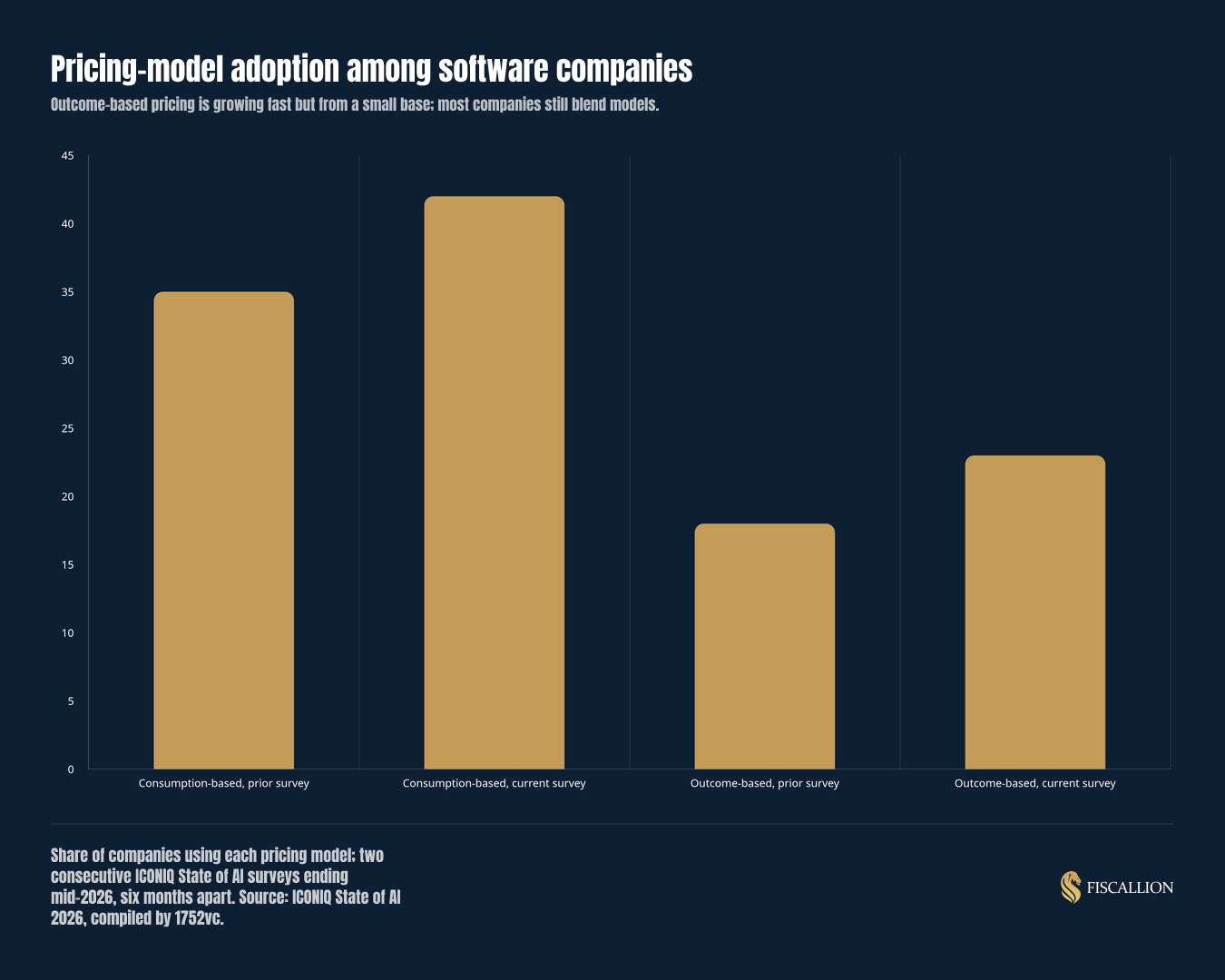
The ICONIQ State of AI 2026 data, as compiled by 1752vc, shows outcome-based pricing rising from 18% to 23% of companies in six months. Consumption-based pricing rose from 35% to 42%. Companies also use about 1.7 pricing models on average, so most are blending.
| Pricing model | Cost behavior for the customer | Wasted spend for the customer |
|---|---|---|
| Traditional (fixed) | Fixed | High |
| Consumption-based | Variable | Medium |
| Outcome-based | Variable | Low |
Source: pricing-model comparison in Sierra's outcome-based pricing post.
The model also has practitioner critics worth hearing. Regal co-founder Alex Levin said in a public comment on Bret Taylor's post that Regal tested outcome pricing and returned to per-minute consumption pricing. His reasons: every new interaction type needed customer renegotiation, and customers could not benefit from rapidly falling AI costs. Treat that as a design constraint, not a verdict.
Aleksandar’s pricing perspective below explains why the unit customers value should be chosen before the unit that is easiest to meter. Use the contractual tests in this section to make that value measurable and billable.
Read the original LinkedIn post
For the cost-to-serve foundation, see Fiscallion's guides on SaaS pricing strategy and usage-based pricing. Both make the same point that applies here: do not assume a new pricing model is automatically margin-accretive.
Define the billable outcome before you price it
Pick the outcome first. The price comes second. A billable outcome passes three tests:
- Machine-verifiable: your system can detect that it happened without a person reading transcripts.
- Customer-recognizable: the buyer would agree it is a result worth paying for.
- Contractually defined: the edge cases are written down, including what does not count.
Intercom's Fin is the clearest production example. Fin's published outcome definitions charge when Fin successfully delivers value, and you are charged one outcome per conversation even if Fin takes multiple actions.
A resolution counts on confirmed resolution, where the customer affirms it, or assumed resolution, where the customer leaves without a further request. A greeting is not an answer. Different outcomes carry different prices: Fin lists $0.99 for a resolution and $9.99 for a qualification.
Fin's standalone plan shows how the commercial wrapper works. Fin's pricing page describes $0.99 per outcome on a $49 monthly base plan that includes 50 outcomes, with unused monthly outcomes not carrying over. That base fee is a hedge: it keeps some revenue stable while outcome volume is uncertain.
Buyers struggle here too. BCG, citing an Andreessen Horowitz survey, reports the friction points below.
| Buyer concern | Share of buyers |
|---|---|
| Struggle to define clear, measurable outcomes | 47% |
| Worry about cost predictability | 36% |
| Difficulty aligning on value attribution with vendors | 25% |
| Acknowledge outcomes often depend on factors outside the vendor's control | 24% |
Source: BCG, August 2025, citing an a16z buyer survey.
If almost half of buyers cannot define the outcome, you will carry that definitional work. Do it in the contract, not in a support ticket after an invoice dispute.

Attribution is a contract problem, not an analytics problem
Attribution is the second axis of the fit test. A quarter of buyers in the survey above report trouble aligning with vendors on value attribution. Sierra's warning is blunt: if the outcome cannot be cleanly attributed, you will argue about it forever.
Shared outcomes are where this bites. Several agents, or an agent plus a human step, may contribute to one result.
"A dashboard will not settle who earned the fee. A rule written in advance will."
— Aleksandar Stojanovic, CEO & Founder at FiscallionChoose the rule before launch:
- Last-touch rule: the agent that closes the outcome is billed. Simple, but it can under-reward upstream agents.
- Single-owner outcome: the outcome belongs to one agent or workflow, and others are priced as inputs.
- Bundle the outcome: if the pieces cannot be separated, price the combined result as one outcome.
- Human-step carve-out: if a person must intervene, define whether that conversation is billable, discounted, or excluded.
The finance test is simple. If two reasonable people would calculate a different invoice from the same logs, the attribution rule is not finished.
Failed outcomes and refunds are variable consideration
"A failed attempt is pure cost with zero revenue attached. A refund is revenue you recognized and then lose."
— Aleksandar Stojanovic, CEO & Founder at FiscallionBoth need to be in the forecast.
Under ASC 606, the consideration you expect can vary because of refunds, credits, price concessions, performance bonuses, and similar items. Deloitte's DART guidance quotes the standard on this, including consideration that depends on a future event occurring or not occurring. That is the structure of a pay-per-outcome contract.
PwC's revenue guide adds that variable consideration must be estimated and may be constrained. In plain terms, you cannot assume every billed outcome stays billed. Confirm the treatment for your contracts with your auditor, because the answer depends on your terms.
Intercom's rule shows the operational mechanic. If a conversation counted as resolved later reopens with further assistance, that resolution is deducted and not charged, even across billing periods. Your model needs the same retroactive reversal: a refund or reopen rate applied to billed outcomes after the fact.
Verification and delivery cost belong in COGS
Bessemer's AI pricing playbook says that unlike traditional software, every AI query incurs a non-trivial expense. It counts compute and inference costs, plus customer support such as humans in the loop, as AI cost of goods sold.
The 1752vc compilation of ICONIQ conventions is more specific. Production inference is COGS, not R&D. Include hosting, retrieval, third-party data and tools, and human review or support attributable to delivery. Measure per task and per customer, including the 90th-percentile account.
Outcome pricing adds one cost most teams forget: the verification function itself. Measuring whether the outcome happened takes logging, classification, sampling, and sometimes human review. If you only bill what you can prove, proof is a delivery cost.
Bessemer's own summary is that outcome charging maximizes value alignment but requires absorbing cost variability. It also says hybrid models, with a base subscription plus usage or outcome tiers, win when you are uncertain.
How to calculate contribution margin per outcome
The worksheet logic is two formulas. Use fully loaded cost per attempt, meaning inference, retrieval, tool calls, verification, and attributable human review.
- True cost per outcome = cost per attempt (fully loaded) divided by success rate.
- Contribution margin per outcome = price per outcome, less refund and reopen reversals, less true cost per outcome.
One practitioner post, from a vendor on LinkedIn, puts it this way: you pay for every attempt and bill only the successes, so your resolution rate is your margin. Treat its numbers as illustrative, as I do below.
This is Fiscallion's contribution-margin approach applied to outcomes. As in our guide to contribution margin in SaaS, margin is segmented rather than company-wide, and fixed costs stay out.
Worked example with hypothetical inputs
These inputs are hypothetical and not benchmarks. Replace them with your own data.
| Input | Value |
|---|---|
| Price per outcome | $1.00 |
| Attempts | 1,000 |
| Inference, retrieval, and tool cost per attempt | $0.40 |
| Verification and human review cost per attempt | $0.05 |
| Refund or reopen rate on billed outcomes | 5% |
Fully loaded cost per attempt is $0.45, or $450 per 1,000 attempts. Here is what happens when only the success rate changes.
| Success rate | Billed outcomes | Net revenue after 5% reversals | Total cost | Contribution | Margin |
|---|---|---|---|---|---|
| 40% | 400 | $380.00 | $450.00 | -$70.00 | -18.4% |
| 55% | 550 | $522.50 | $450.00 | $72.50 | 13.9% |
| 70% | 700 | $665.00 | $450.00 | $215.00 | 32.3% |
At 55%, true cost per outcome is about $0.82 against a $1.00 price. Break-even success rate is $0.45 divided by $0.95 net revenue per success, or about 47%. Below that rate, every extra attempt loses money.
A 15-point swing in success rate moves margin from negative to above 30% with the price unchanged. That is why success rate belongs in the finance review, not only in the engineering review.

Use success rate as a release gate
Before changing the agent or accepting a new customer segment, rerun this model with that cohort’s success and reopen rates. Compare net revenue with the cost of every attempt, including failures. A lower token price does not repair a workflow whose successful outcomes remain below break-even.
How to interpret the margin you get
Outcome pricing does not exempt you from AI margin ranges. It changes where the margin risk sits: with you, not the customer.
| Benchmark | Reported range | Source |
|---|---|---|
| Average AI product gross margin, 2025 | 45% | ICONIQ State of AI 2026, via 1752vc |
| Average AI product gross margin, 2026 (projected) | 53% | Same source |
| Average AI product gross margin, 2027 (projected) | 59% | Same source |
| AI companies, per Bessemer | 50-60% | Bessemer AI pricing playbook |
| Traditional SaaS, per Bessemer | 80-90% | Bessemer AI pricing playbook |
The 2026 and 2027 values are projections, so do not plan against them as if they were achieved. Bessemer's playbook adds a useful rule: if the math does not work at 10 customers, it will not work at 1,000.
Read your result against three questions:
- Is margin positive at the 90th-percentile account? If not, your average is hiding a pricing flaw.
- How far is current success rate from break-even? A thin cushion means a model update or a new customer segment can turn the product negative.
- Does margin improve with routing or caching, or only with hoped-for price drops? The 1752vc worked example is explicitly illustrative, but it shows the logic: routing most tasks to a cheaper model and caching can lift margin sharply, while seat pricing can still leave power users near break-even.
What to do next
- Define outcomes and write them into the contract. Include confirmed versus assumed outcomes, exclusions, and the reopen window.
- Instrument attribution and verification before launch. If you cannot log it, you cannot bill it.
- Model margin at your worst account. Use the 90th-percentile cost customer, not the mean.
- Cap or hybridize revenue where success rates are unproven. A base fee plus outcome tiers reduces exposure while you learn.
- Put success rate and refund rate on the monthly margin review. Review them with the same cadence as cash and runway, and assign an owner for each assumption.
This is the model ownership work Fiscallion does at the CFO layer. Every client works directly with Aleksandar Stojanovic, the senior partner on the engagement, with no account-manager or junior-team handoff.
Common mistakes and the replacement move
| Mistake | Replacement move |
|---|---|
| Treating outcome pricing as automatically margin-accretive | Model cost-to-serve per attempt first, then set the price |
| Pricing an outcome you cannot verify | Shrink to a measurable sub-outcome, or use a hybrid base fee |
| Using one blended margin number | Segment by customer and outcome type |
| Ignoring reopen and refund mechanics in the forecast | Model retroactive deductions as a percentage of billed outcomes |
| Waiting for falling model prices to fix margin | Build the routing and caching margin bridge now |
The first mistake is the most common. A per-outcome price feels like value alignment, but it also guarantees you pay for every failure.
Get the outcome-pricing margin worksheet
Copy the blank worksheet below into a spreadsheet and fill it in per customer and outcome type. It is open, and you do not need to share an email address to use it.
| Line | Input or formula |
|---|---|
| A. Price per outcome | Contract price |
| B. Attempts per month | From logs |
| C. Success rate | Verified outcomes divided by B |
| D. Inference, retrieval, and tool cost per attempt | From usage data |
| E. Verification and review cost per attempt | Logging, sampling, human review |
| F. Refund or reopen rate | Reversed outcomes divided by billed outcomes |
| G. Net revenue | A x B x C x (1 - F) |
| H. Total delivery cost | (D + E) x B |
| I. Contribution margin ($) | G - H |
| J. Contribution margin (%) | I divided by G |
| K. Break-even success rate | (D + E) divided by (A x (1 - F)) |
| L. Worst-account check | Repeat G to K for your 90th-percentile cost account |
If you want the worksheet built into a driver-based model, with board-ready scenarios and an owner for each assumption, see Fiscallion's financial modeling and board reporting service.
FAQ
How do I define a billable outcome for an AI agent?
Define it as a result your system can verify and your customer would recognize, then write the rules into the contract. Use three tests: machine-verifiable, customer-recognizable, and contractually defined.
Intercom's Fin shows the pattern. It charges one outcome per conversation, counts a resolution on confirmed or assumed resolution, and prices different outcomes differently, such as resolution versus qualification. Start with the narrowest outcome you can measure, then expand.
What happens to revenue when an AI agent fails to deliver the promised outcome?
You recognize no outcome fee for that attempt, but you still carry the full cost of delivering it. Revenue is also at risk after the fact: a resolved conversation that reopens can be deducted retroactively, as Fin's rules show.
Under ASC 606, contingent fees and refund rights are variable consideration that you estimate and may need to constrain. Build an expected failure and reversal rate into the forecast, and confirm treatment with your auditor.
How do I handle attribution when multiple AI agents contribute to a single outcome?
Settle it in the contract before launch, not in the dashboard after the invoice. Pick one rule: last-touch, a single owner for the outcome, a bundled price for the combined result, or a defined treatment for human-assisted conversations.
If two reasonable people would calculate different invoices from the same logs, the rule is incomplete. Sierra's guidance is that outcomes which cannot be cleanly attributed lead to endless debate.
How do I model contribution margin for outcome-based AI pricing?
Divide fully loaded cost per attempt by success rate to get true cost per outcome. Then subtract that and your refund or reopen reversals from the price per outcome.
Segment the result by customer and outcome type, include verification and human review in cost, and test your 90th-percentile account. Use the worksheet above, and track break-even success rate monthly.
The decision to make
Outcome pricing is a bet that you can hold your success rate above break-even at your worst account. Price it only after you have modeled that bet, and use a hybrid base fee where the evidence is thin.
The worksheet turns that bet into numbers you can review with your board. Run it before you publish the price, not after the first invoice dispute.