

A fractional CFO agency for SaaS companies is a senior finance executive or small advisory practice working part-time, typically 10 to 40 hours a month, to build the financial architecture a subscription business needs: forecasts, unit economics, board reporting, and capital-allocation decisions. It is not bookkeeping and it is not a title. Fractional CFO agency deliverables should be specific, dated, and reviewable within 30 days of engagement.
Most founders sign a fractional CFO engagement without a clear picture of what lands on their desk afterward. The contract says "financial leadership." What actually arrives varies enormously, from a genuinely decision-ready operating model to a slightly better version of the monthly bookkeeper report. You asked for cleaner metrics or better reporting. The real gap is usually a missing decision framework: something that turns activity into cash, runway, and trade-offs you can act on before the board meeting, not after it.
This article treats deliverables as the test. If you can name ten specific artifacts a fractional CFO should produce in the first month, and a dozen more in the operating cadence that follows, you can evaluate any provider, including Fiscallion, against a standard instead of a sales pitch.
What you'll learn
- What a fractional CFO for SaaS companies actually is, and where the role sits relative to a controller or a full-time hire
- The specific deliverables you should expect in month one and in ongoing monthly cadence
- A repeatable CFO playbook for SaaS: the metrics, the cadence, and the five core responsibilities
- How fractional CFO deliverables differ from what a bookkeeper or controller provides
- The trigger moments that make fractional CFO engagement worth the cost
- Three diagnostic questions to evaluate any provider's actual output
What is a fractional CFO for SaaS companies?
A fractional CFO is a senior finance executive who works with your company on a part-time or project basis rather than as a full-time hire. In SaaS specifically, the work is not generic financial oversight. It is built around the mechanics of subscription revenue: deferred revenue, cohort behavior, and metrics that behave nothing like a transactional business.
The role is not there to run your books. A bookkeeper or controller already does that, and a fractional CFO depends on their work rather than replacing it. What the CFO layer adds is the translation from clean ledger data into forward decisions: what your runway looks like under three scenarios, what CAC payback tells you about a new channel, whether you can afford the VP of Sales you are about to approve.
Deloitte's four-face model, cited widely as the standard way to think about CFO scope, breaks the role into steward (protect assets, ensure compliance), operator (run an efficient finance function), strategist (shape company direction), and catalyst (drive change through the organization). Most early-stage SaaS companies hire for the steward face first, wanting clean books and compliance. The actual leverage sits in the strategist and catalyst faces, which is exactly where a fractional CFO should be spending time, not reconciling last month's transactions.
This engagement model tends to make sense in a specific window: $5M to $30M ARR, Series A through Series C, at the point where a board expects trade-off framing instead of a metrics recap. Below that range, the finance need is usually a bookkeeper and possibly a part-time controller. Above it, the workload and daily executive presence required often justify a full-time hire.
At Fiscallion, every engagement runs at that CFO layer directly with Aleksandar Stojanovic, not handed to a junior analyst after the sales call. That distinction matters more in fractional work than in almost any other service category, because the entire value proposition depends on senior judgment being present, not delegated.
The deliverables: what a fractional CFO should produce for a SaaS company
Deliverables are how you separate a real engagement from a title. A useful way to structure expectations is by module, then by week.
The eight-module deliverables framework
A well-scoped fractional CFO service package for a SaaS company should cover eight modules:
| Module | What it includes |
|---|---|
| Cash flow and liquidity planning | Weekly or biweekly cash view, burn tracking, runway scenarios, 13-week cash planning |
| Budgeting and forecasting | Rolling 12-24 month model, scenario planning, annual plan support |
| KPI dashboards and board-ready reporting | KPI definitions, dashboard, variance analysis, board package |
| Fundraising and diligence prep | Investor-grade model, metrics proofing, data room readiness |
| Systems and integrations | Financial stack selection, chart of accounts design, close process, CRM/billing integration |
| Profitability and cost analysis | Unit and cohort economics, margin by product or customer, cost review |
| Controls and tax strategy | Approval workflows, spend policies, compliance calendar |
| Strategic transactions | M&A readiness, valuation support, quality-of-earnings support |
Not every SaaS company needs all eight modules active at once. A company at $6M ARR preparing for a Series B raise will lean heavily on fundraising prep and the operating model. A company at $25M ARR with a messy tech stack will lean on systems and integrations plus profitability analysis. The point is that a fractional CFO agency should be able to name which modules are active for you and why, not offer a generic bundle.
The first 30 days: fourteen artifacts, organized by week
A structured engagement should produce roughly fourteen specific artifacts within the first month:
- Week 1: financial system audit, cap table sanity check, bank and cash reconciliation
- Week 2: cleaned trailing twelve-month P&L, board-ready financial reporting template, a KPI dashboard limited to ten metrics or fewer, a unit economics baseline covering CAC, payback, LTV, and gross margin by segment
- Week 3: a rolling 13-week direct cash forecast, a 12-month operating model with three scenarios, reconciliation between the 13-week and 12-month views, burn rate and burn multiple calculated on consistent inputs
- Week 4: a review of fundraising materials, a month-one retrospective, and working integration with your existing bookkeeper or controller
If ten of those fourteen items are not on your desk by day 30, that is worth raising directly with the provider.
What CFO-level money should actually buy
A monthly financial review is table stakes, the kind of thing a good bookkeeper with a dashboard already produces. At CFO rates, you should be getting forward-looking financial intelligence: three-statement forecasts, real-time answers to questions like "can we afford this VP of Sales" that should take about a minute rather than a week, proactive risk flags you did not ask for, and board materials that tell a story with a variance waterfall and a cash runway chart under three scenarios, not a static report.
Specific to SaaS, the deliverables that separate CFO-level work from a report include an MRR bridge showing new, expansion, contraction, and churned revenue movement; cohort-based unit economics with CAC broken out by channel and LTV by tier; a three-statement model with explicit scenario branches; a rolling 13-week cash forecast; and a board-ready reporting template your board can actually use to decide something.
Explore Fiscallion's fractional CFO deliverables checklist
Use this open checklist to evaluate any fractional CFO agency, including Fiscallion, against a specific standard rather than a sales pitch. Copy it into your own document and check items off as they arrive.
Month 1 deliverables:
- Financial system audit completed and documented
- Cap table reviewed for accuracy
- Bank and cash reconciled to source
- Trailing twelve-month P&L cleaned and reviewed
- Board-ready reporting template built
- KPI dashboard limited to ten metrics or fewer
- Unit economics baseline: CAC, payback, LTV, gross margin by segment
- Rolling 13-week direct cash forecast
- 12-month operating model with at least three scenarios
- Reconciliation between the 13-week and 12-month views
- Burn rate and burn multiple calculated on consistent inputs
- Fundraising materials reviewed (if applicable)
- Month-one retrospective delivered
- Working integration confirmed with your bookkeeper or controller
Ongoing cadence deliverables:
- MRR bridge (new, expansion, contraction, churn) updated monthly
- Board package with variance analysis and trade-off framing, not just history
- Rolling forecast rebuilt on drivers, not last month's actuals
- Cohort-based CAC and LTV tracked by channel and tier
- Headcount plan tied to the operating model, not ad hoc approvals
If you want a second opinion on where your current setup has gaps against this list, explore Fiscallion's fractional CFO service, where every engagement runs directly with Aleksandar Stojanovic at the CFO layer.
The CFO playbook for SaaS
A playbook is not a list of deliverables. It is the operating rhythm that produces them consistently, month after month.
The weekly and monthly cadence
The system that works has a small number of moving parts, checked on a fixed schedule: a weekly ARR check-in, a weekly cash check-in looking eight weeks forward, a monthly forecast rebuild driven by actual assumptions rather than a rolled-forward guess, and a monthly performance review focused on decisions rather than explanations of what already happened.
Underneath that cadence sits a small set of shared references: one ARR bridge everyone uses, one pipeline view tied to actual bookings rather than sales optimism, one headcount plan tied to output rather than intuition, one cash forecast that reflects real commitments, and one set of driver assumptions the whole leadership team agrees on.
"Fragmentation at this level, where finance, sales, and the CEO each have their own version of the numbers, is the most common reason board meetings devolve into arguing about whose spreadsheet is right instead of what to do next."
— Aleksandar Stojanovic, CEO & Founder at FiscallionThe eight metrics every founder should be able to answer in three minutes
A useful test: if you can answer these eight cold, you run your business; if you cannot, you are managing it after the fact.
| Metric | What it measures | Benchmark |
|---|---|---|
| MRR growth | Month-over-month recurring revenue growth | 8-15% MoM at growth stage |
| Net revenue retention (NRR) | Revenue retained and expanded from existing customers | 110%+ considered best-in-class |
| Gross churn | Revenue lost from cancellations | Under 1% monthly |
| CAC | Fully loaded cost to acquire a customer | Assessed relative to LTV |
| LTV:CAC | Ratio of customer lifetime value to acquisition cost | Above 3x |
| CAC payback period | Months to recover acquisition cost | Under 12 months is healthy |
| Burn multiple | Net burn relative to net new ARR | Under 1.5x |
| Rule of 40 | Growth rate plus profit margin | Above 40 |
These benchmarks are directional, not universal thresholds. A useful fractional CFO treats CAC and LTV as cohort ranges rather than single point figures, because a blended average across channels and customer segments tends to hide the actual economics of your best and worst-performing acquisition motions.
A pattern worth naming directly: across audits of more than 50 SaaS companies, every single one had at least one of these metrics calculated incorrectly, most commonly NRR without cohort isolation, CAC excluding sales salaries and commissions, gross margin inflated by misclassifying customer success as operating expense, or LTV calculated on revenue instead of gross profit. Getting the formula wrong is not a rounding error. It changes whether a board decision looks safe or reckless.
The five core responsibilities
The playbook maps to five ongoing responsibilities: financial planning and runway management, where the model is a live instrument with multiple scenario branches rather than a document updated once a quarter; SaaS metrics ownership, keeping MRR, CAC, LTV, and NRR consistent and trustworthy; board and investor reporting that frames trade-offs explicitly, something like "we can hit the ARR target while holding 14 months of runway, or invest in an enterprise motion now and land at 9 months"; fundraising strategy and capital allocation, with the model built for diligence well before a raise starts; and compliance and audit readiness, including revenue recognition under ASC 606.
By month two or three, a working engagement typically moves into deeper unit economics work, the first board update delivered through the new reporting layer, a hiring plan tied to the operating model instead of headcount approved in isolation, and pricing experiments calibrated against actual unit economics rather than gut feel.
How fractional CFO deliverables differ from a bookkeeper or controller
This is the distinction most founders get wrong when they scope a hire or an engagement, and it is worth being precise about it.
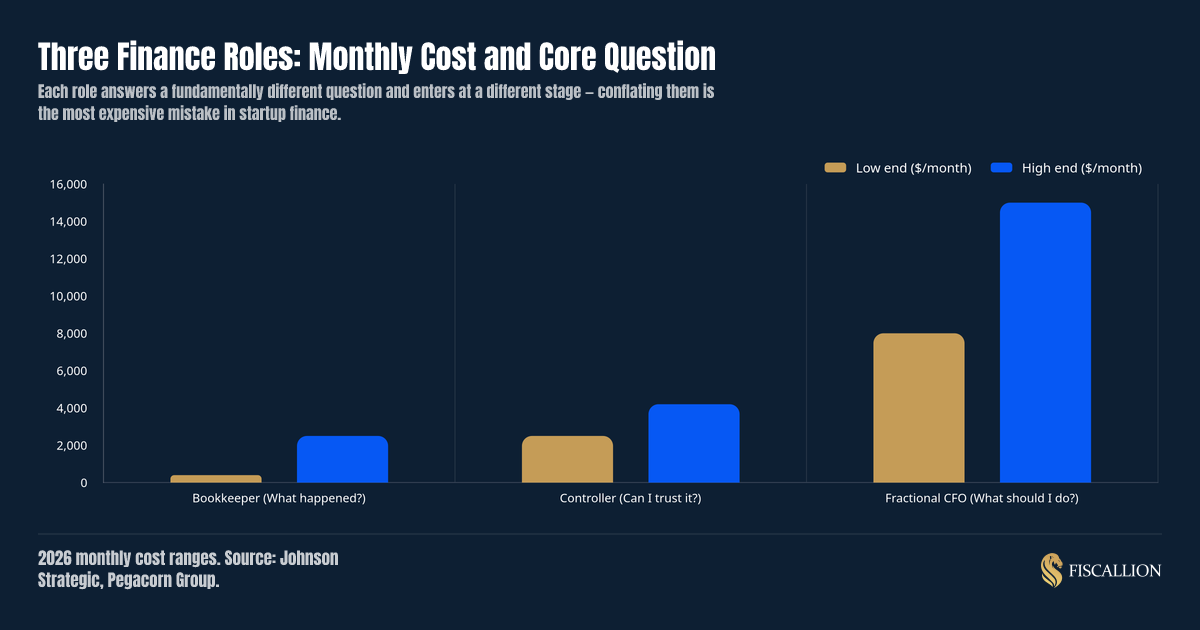
A bookkeeper is your historian. They record what happened: transactions categorized, invoices tracked, payroll processed. A controller is your interpreter. They take the bookkeeper's data and turn it into financial statements you can trust, closing the books accurately and on time. A fractional CFO is your strategist, using the controller's interpreted data to model scenarios, guide capital allocation, and align financial decisions with where the business needs to go.
| Role | Core question answered | Typical monthly cost | Entry point |
|---|---|---|---|
| Bookkeeper | What happened? | $400-$2,500 | Day one |
| Controller | Can I trust the numbers? | $2,500-$4,200 | Around $1M ARR, or when close takes 7+ days |
| Fractional CFO | What should I do? | $8,000-$15,000 | Series A prep, with books already clean |
Costs referenced from Johnson Strategic's role comparison.
Sequencing matters as much as the roles themselves. Most Series A startups need a controller plus a fractional CFO, not a full-time VP of Finance. If your books are unreliable or close late, fix that with a controller first; a fractional CFO can diagnose the problem but will not close your books for you. If your books are already clean but your board lacks visibility, that is the signal to bring in the CFO layer.
The scope trap shows up when these roles get conflated inside one engagement. If a fractional CFO spends most of their time fixing the chart of accounts or reconciling historical transactions, the scope was never clarified, and you are paying strategist rates for historian-level work, typically two to three times what that work should cost.
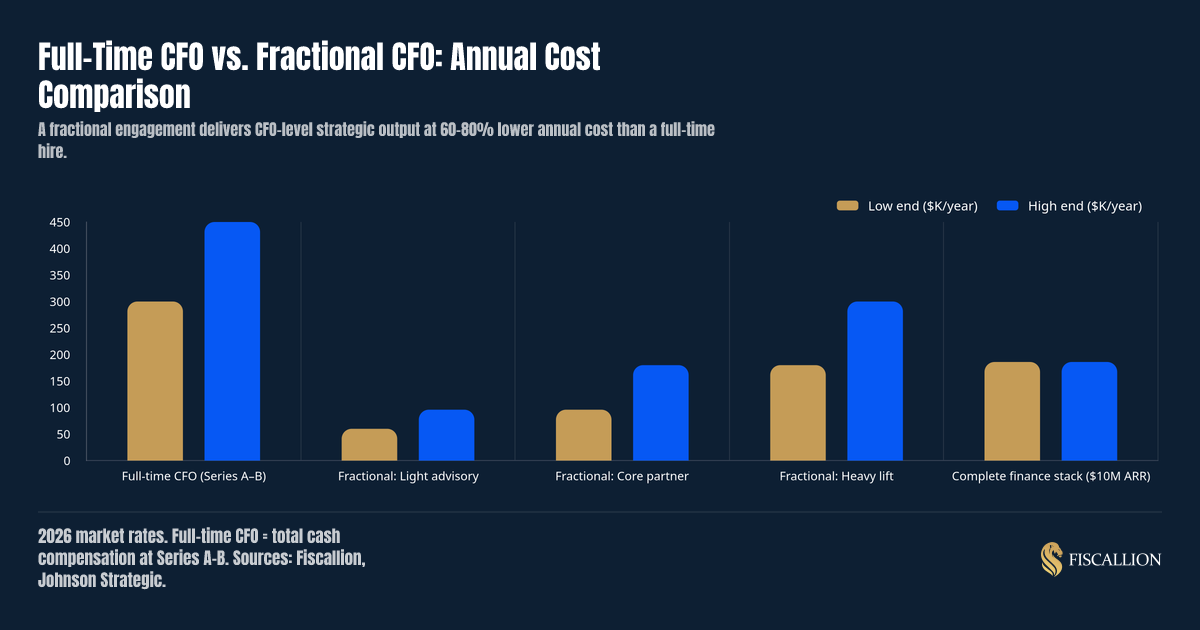
Put together, a complete finance stack at roughly $10M ARR, combining a bookkeeper, a fractional controller, and a fractional CFO, tends to land under the all-in cost of a single full-time CFO hire, while covering three distinct functions rather than one generalist trying to do all three.
"What a controller does not do is also worth stating plainly: build a three-scenario financial model, produce a board deck that frames trade-offs, advise on revenue recognition strategy for a pricing change, or lead capital allocation conversations. Those are CFO-layer deliverables, and no amount of controller-level diligence substitutes for them."
— Aleksandar Stojanovic, CEO & Founder at FiscallionTrigger moments: when to engage a fractional CFO agency
Certain moments make the case for engagement obvious rather than optional.
- Metrics chaos: sales, finance, and the CEO each report different CAC or MRR numbers with no single source of truth
- Board pressure: board decks summarize history without answering what the company should do next
- Fundraising prep: engagement should start at least 90 days before a raise, since building an investor-grade model under time pressure produces worse outcomes
- Cash-to-accrual transition: this shift typically takes 60 to 90 days and requires rebuilding an opening balance sheet, tracking deferred revenue from day one, and re-baselining margin and runway
- Headcount planning without a model: hiring decisions made against intuition instead of a plan tied to output and cash
- Pricing and margin blind spots: pricing changes proposed without a clear read on unit economics or margin impact by segment
Any one of these on its own is often enough to justify starting an engagement, even if the ARR is on the lower end of the $5M to $100M range.
How to evaluate a fractional CFO agency's deliverables
Beyond the fourteen-item month-one checklist, three direct questions tend to reveal more than any pitch deck.
- "Show me a forward-looking forecast, not a report you already ran." A real fractional CFO produces a model with scenario branches you have not seen before, not a reformatted version of last month's actuals.
- "What did you flag last month that I hadn't asked about?" Proactive risk detection is a core part of the value; if the answer is nothing, the engagement is reactive rather than strategic.
- "How fast can you tell me the cash impact of adding $200K in annual cost?" If the model exists and is maintained properly, this should take minutes, not days.
Look for fluency in six areas: SaaS metrics, ASC 606 revenue recognition, the pace to read your operating reality quickly, forward-looking scenario modeling, board-level communication, and an understanding of how operational decisions connect to financial outcomes across your specific SaaS motion.
Red flags are just as informative: a provider spending two months "learning the business" with no artifacts delivered, work running in parallel to your bookkeeper or controller instead of integrating with them, or controller-level output, like a cleaner P&L, delivered at CFO-level pricing.
Frequently asked questions
What is a fractional CFO for SaaS companies?
A fractional CFO for SaaS companies is a senior finance executive who works part-time, usually 10 to 40 hours a month, to build the forecasting, unit economics, and board reporting infrastructure a subscription business needs. The role focuses on decision-support work: runway modeling, cohort-based unit economics, scenario planning, and capital allocation, rather than day-to-day bookkeeping or transaction recording. It fits companies roughly in the $5M to $30M ARR range where the board expects trade-off framing rather than a history recap, and where the workload does not yet justify a full-time executive hire.
What deliverables should a fractional CFO provide for a SaaS company?
In the first 30 days, expect a financial system audit, a cap table review, a cleaned trailing-twelve-month P&L, a board-ready reporting template, a KPI dashboard limited to a handful of metrics, a unit economics baseline, a rolling 13-week cash forecast, a 12-month operating model with multiple scenarios, and a reconciliation between the two. Ongoing deliverables should include a monthly MRR bridge, board packages with explicit trade-off framing, a forecast rebuilt on drivers rather than last month's actuals, cohort-based CAC and LTV tracking, and a headcount plan tied to the operating model. If most of these are not appearing on a predictable schedule, the engagement is underdelivering against a reasonable standard.
What is the CFO playbook for SaaS?
The playbook is a repeatable operating cadence, not a one-time project. It runs on a weekly ARR and cash check-in, a monthly forecast rebuild based on actual drivers, and a monthly performance review focused on decisions rather than explanations. It rests on a small number of shared references: one ARR bridge, one pipeline view tied to real bookings, one headcount plan tied to output, and one cash forecast reflecting actual commitments. Layered on top are five core responsibilities: financial planning and runway management, SaaS metrics ownership, board and investor reporting that frames trade-offs, fundraising strategy and capital allocation, and compliance and audit readiness.
How do fractional CFO deliverables differ from what a bookkeeper or controller provides?
A bookkeeper records what happened: transactions, invoices, payroll. A controller interprets that data into financial statements you can trust and closes the books accurately. A fractional CFO uses that trusted data to model scenarios, guide hiring and pricing decisions, and prepare the company for fundraising or board conversations. The roles are sequential, not interchangeable: a company typically needs a bookkeeper from day one, a controller around $1M ARR or when the close takes more than a week, and a fractional CFO once books are clean and the company needs forward-looking strategy. Using a fractional CFO to do controller-level cleanup work means paying strategist rates for historian-level output, which is a scope problem worth fixing early rather than living with.
The deliverables are how you know which one you hired
A title tells you nothing about what lands on your desk. Fourteen specific artifacts in the first month, and a repeatable monthly cadence after that, tell you everything.
If a fractional CFO at $15,000 a month cannot show you ten of those artifacts within 30 days, the title is doing the work, not the person behind it. Use the checklist above as the standard, whether you run it against Fiscallion or any other provider, and make the decision on evidence rather than a sales conversation. If you want to map where your current setup has gaps, Fiscallion's fractional CFO service runs every engagement directly with Aleksandar Stojanovic at the CFO layer.