
Every scaling SaaS founder eventually asks the same question: do I need a bookkeeper, a controller, or a CFO? The honest answer is rarely "hire a CFO" or "just get a bookkeeper." It is a sequence tied to funding stage, not a single job title tied to revenue.
Get the sequence wrong in either direction and it costs you. Hire a full-time CFO before there is a calendar's worth of strategic work to justify the role, and you are paying $250,000 or more for someone to spend half their week on tasks a controller should own. Wait too long to upgrade past a bookkeeper, and your board starts asking questions your finance function cannot answer, your forecast has no credibility, and your next fundraise slows down because your numbers do not hold up in diligence.
This article gives you the framework: what each role actually owns, which one you need at each funding stage, how the fractional model changes the math, and the specific signals that tell you it is time to move to the next level.
What you'll learn
- The distinct question each role answers, and why confusing them is the expensive mistake
- A stage-by-stage map from pre-seed through Series C showing which role (or combination) fits
- Why a fractional finance stack often beats a single full-time hire on both cost and coverage
- The specific signals that tell you it is time to upgrade, before your board tells you first
What each role actually owns
The cleanest way to separate these three roles is by the question each one answers.
A bookkeeper answers "what happened?" This role records transactions, reconciles bank and credit card accounts, and manages accounts payable and receivable. It is backward-looking work, and it is the foundation everything else depends on. Without accurate books, a controller has nothing to control and a CFO has nothing to forecast from.
A controller answers "is it accurate?" This role owns the monthly close, produces GAAP-compliant financial statements, builds internal controls, and manages the bookkeeper. For a SaaS company specifically, the controller is also the one who owns ASC 606 revenue recognition - the rules that determine when subscription and usage-based revenue actually gets recognized, and whether professional services count as a distinct performance obligation. Six years after ASC 606 took effect, SaaS companies still routinely get this wrong, and capitalized sales commissions under ASC 340-40 remain one of the most common adjustments that show up in quality-of-earnings reviews during an acquisition.
A CFO answers "what does it mean, and what do we do next?" This is the forward-looking layer: cash and runway strategy, fundraising support, board and investor reporting, scenario planning, and capital allocation decisions.
"A CFO does not just report the numbers the controller produced."
— Aleksandar Stojanovic, CEO & Founder at FiscallionA CFO tells you what those numbers mean for your next hire, your next price change, or your next twelve months of runway.
There is a fourth role that gets confused with these three: the CPA. A CPA files taxes, handles compliance filings, and supports external audits. It is a specialized, usually external function, and it does not replace a bookkeeper, controller, or CFO. Many founders assume their tax accountant is watching their cash position. They are not, and they never claimed to be.
The pattern across every credible source on this topic is consistent: the three roles differ by time horizon and decision authority, not by seniority alone.
| Role | Core question | Owns | Time horizon | Typical full-time cost (US, 2026) |
|---|---|---|---|---|
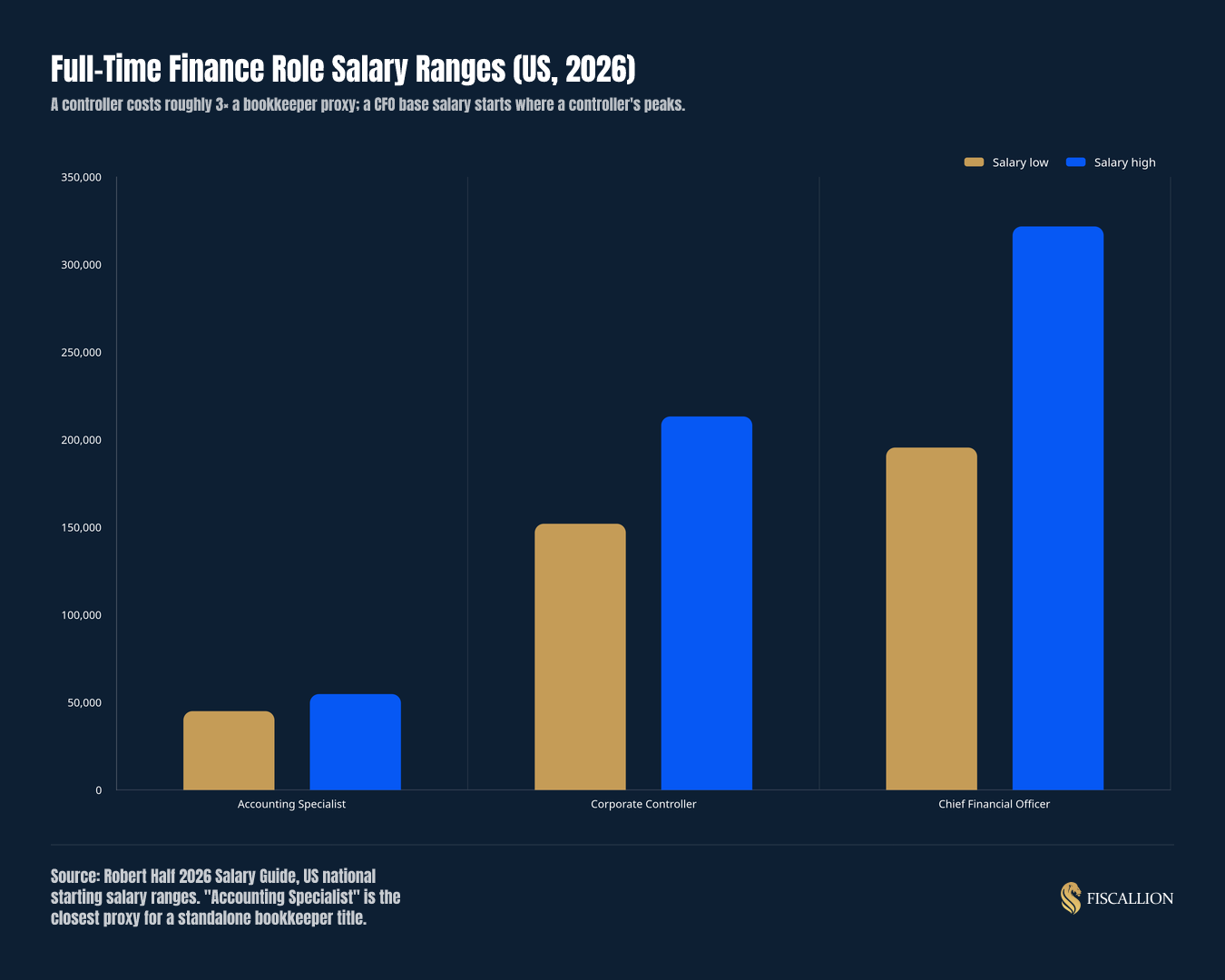
| Bookkeeper | What happened? | Transaction recording, reconciliations, AP/AR | Past | Robert Half lists no standalone bookkeeper title; the closest entry-level role, Accounting Specialist, starts at $45,000-$54,750 |
| Controller | Is it accurate? | Monthly close, financial statements, GAAP/ASC 606, internal controls | Present | Corporate Controller base $152,000-$213,250 |
| CFO | What does it mean, and what now? | Forecasting, runway, fundraising, board reporting, capital allocation | Future | Chief Financial Officer base $195,500-$321,750 |
Note that the CFO base salary range overlaps with the controller range at the low end. The real gap between the two shows up once you load in bonus and equity, which is where a full-time CFO's total cost typically lands between $250,000 and $500,000 or more.
The SaaS finance team by funding stage
This is the framework worth pinning to your wall, and the one this article invites you to use directly rather than as a one-time read. Funding stage, not a fixed revenue number, drives the transition points, because the complexity that demands a new role (board reporting, multi-entity structure, an outside auditor) arrives with fundraising milestones more reliably than with ARR alone.
Pre-seed to seed: $0-$500K ARR
At this stage you typically have fewer than 15 employees and no dedicated finance hire at all. The right setup is an outsourced bookkeeper running $500 to $4,000 a month, plus an external CPA for tax filing. There is no board asking hard questions yet, and the accounting complexity is low enough that cash-basis books are usually fine.
Seed to Series A: $500K-$5M ARR
You are now at roughly 15 to 50 employees. This is where most founders make their first real finance hire, and the data is clear that it should be a controller or senior bookkeeper, not a CFO. Pair that hire with fractional CFO advisory for the strategic layer: board reporting formats, a proper 409A, R&D tax credit capture, and audit-readiness preparation all start to emerge here.
This is also typically when the cash-to-accrual transition becomes unavoidable. Cash-basis books stop working somewhere around Series A because investors and boards need to see deferred revenue, accrued expenses, and a close that produces GAAP-consistent statements.
Series B: $5M-$15M ARR
At 50 to 150 employees, the finance function needs to become a real team. The inDinero Series B playbook puts the typical finance headcount around five people, roughly 3.5% of total headcount. Five structural shifts happen here, usually all at once:
- An outside auditor enters, and your opening balances have to be auditable
- The close stops being a report and becomes a control mechanism
- Legal entity structure multiplies if you open international subsidiaries
- FP&A separates from accounting, because one person doing both means either the close ships late or the forecast is thin
- Treasury becomes a real job once cash exceeds FDIC limits or you take on venture debt with covenants
A fractional or mid-market CFO paired with a controller and an FP&A analyst is the typical spine at this stage. It's worth noting that a YC-adjacent study of 218 B2B companies found only about 17% of companies in the 5-50 employee band carry any internal finance staff at all, which tells you how much the jump from Series A to Series B changes what "normal" looks like.
Series C: $15M-$50M ARR
At 150 to 300 employees, the finance org grows to six to twelve people under a full-time CFO. The controller role splits into a dedicated Corporate Controller, FP&A gets its own VP or Director, and technical accounting, tax, and treasury become specialized functions. SOX readiness preparation typically begins here, well ahead of any eventual public listing.
Table: the framework at a glance
| Funding stage | ARR range | Finance setup | Key trigger |
|---|---|---|---|
| Pre-seed/Seed | $0-$500K | Outsourced bookkeeper + external CPA | First transactions, first tax filing |
| Seed to Series A | $500K-$5M | Controller (or senior bookkeeper) + fractional CFO | First board reporting, cash-to-accrual transition |
| Series B | $5M-$15M | Fractional/mid-market CFO + controller + FP&A analyst | First outside auditor, FP&A splits from accounting |
| Series C | $15M-$50M | Full-time CFO + 6-12 person team | SOX readiness, entity consolidation, treasury |
The fractional finance stack: why one outsourced provider can cover all three layers
Here is the part most founders miss: bookkeeping, controller-level close, and CFO-level FP&A do not have to arrive as three separate full-time hires spread across three separate years. A fractional finance stack can run all three layers in parallel from early on, scaling the intensity of each layer as the company grows.
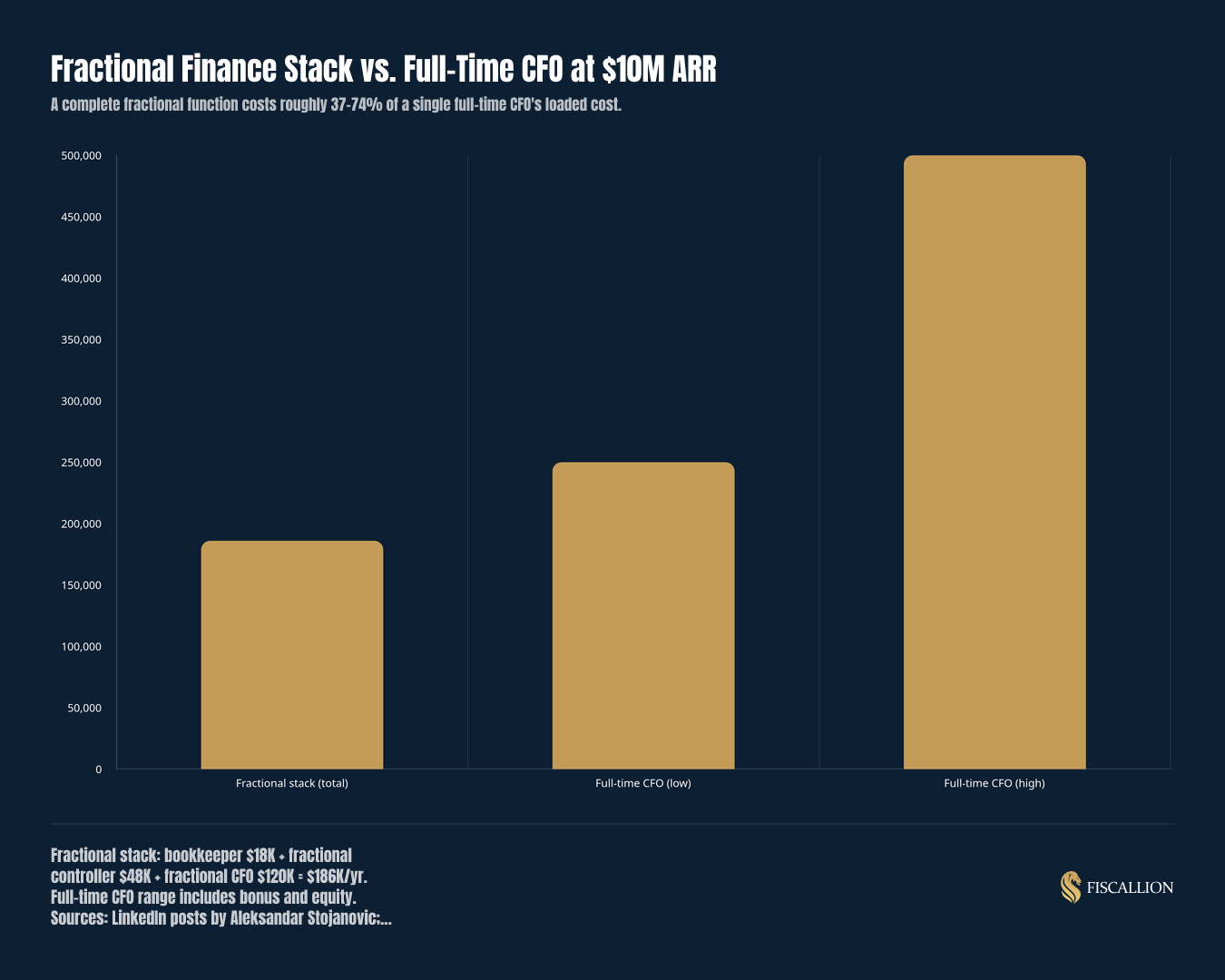
The math makes the case on its own. At $10M ARR, a fractional stack of a bookkeeper (roughly $1,500 a month), a fractional controller (roughly $4,000 a month), and a fractional CFO (roughly $10,000 a month) totals around $15,500 a month, or about $186,000 a year, for a complete finance function. Compare that to a single full-time CFO at $250,000 to $500,000 a year loaded, and the fractional stack costs well under half while giving you three distinct functions instead of one generalist stretched across all of them.
This is exactly the gap Fiscallion's accrual accounting service is built to close: the point where "the bookkeeper can't answer the questions the board is asking, but a full-time controller doesn't pencil out yet." That gap almost always opens between Series A and Series B, right when cash-basis books stop being defensible and a full accounting team is still a year or two away from making financial sense.
If your books are still cash-basis and your board or your next round diligence is asking questions your current setup cannot answer, explore Fiscallion's accrual accounting service for B2B SaaS. Every Fiscallion client works directly with Aleksandar Stojanovic at the CFO layer: senior-partner judgment on every engagement, not a handoff to an account manager or a junior delivery team.
When a SaaS startup needs both a controller and a CFO
Below Series B, a controller plus a fractional CFO typically covers both functions without overlap or gaps. The controller owns accuracy and compliance. The fractional CFO owns forward-looking strategy, and because the role is fractional, you are not paying for a full calendar of strategic work you do not yet generate.
The point where you need both roles as dedicated, full-time functions is Series B onward, specifically when FP&A and accounting start pulling in opposite directions inside one person's job description. If your controller (or the person acting as one) is also trying to build the board deck, run scenario models, and manage investor relations, one of those jobs is not getting done well. The close ships late, or the forecast is thin, or both.
The related mistake worth naming directly: a full-time CFO who is also doing controller-level close work is not "wearing two hats" efficiently. It is a $250,000-plus role spending real hours on $150,000 work, and neither the close nor the strategy gets the attention it needs.
"A CFO who also does controller work is doing two jobs and likely doing neither one well."
— Aleksandar Stojanovic, CEO & Founder at FiscallionSigns you've outgrown your current finance setup
You do not need to guess when it is time to move to the next level. The signals are concrete and observable, and each one points to a specific fix:
- Your monthly close takes more than 15 business days. This points to a controller gap, not a bookkeeping gap. Your books are accurate but slow, which usually means no one owns the close as a formal process.
- You cannot produce a cash flow forecast on request. This points to a CFO gap. Historical accuracy does not automatically translate into forward-looking modeling.
- Your board asks questions your finance function cannot answer. This is almost always a CFO gap, sometimes compounded by a controller gap if the underlying numbers themselves are shaky.
- ARR and recognized revenue tell different stories. This is a controller-level ASC 606 problem, and it is the kind of discrepancy that shows up as a painful adjustment during fundraising diligence or an eventual acquisition.
- Gross margin moves and nobody can explain why. This spans both controller (are the numbers right) and CFO (what does the movement mean for pricing or cost structure) territory.
Match the signal to the role that fixes it rather than assuming every finance problem needs a more senior hire. Sometimes the fix is a faster close process, not a CFO.
The cash-to-accrual transition as an inflection point
Most SaaS companies need to convert from cash-basis to accrual accounting somewhere between Series A and Series B, and this transition is precisely when the bookkeeper-to-controller upgrade stops being optional. Cash-basis books can survive early fundraising conversations, but they cannot survive a board that wants to see deferred revenue schedules, or an investor running real diligence on your recognized revenue versus your bookings.
A client at roughly $10M ARR came to Fiscallion with books still managed on a cash basis. Aleksandar helped restructure the financial data and prepare everything required for the transition to accrual accounting, including deferred revenue in the ledger and a monthly close that landed by day 10. The result was one set of numbers that held up under diligence, which is the actual test any accrual conversion needs to pass.
If this describes where your company sits right now, Fiscallion's accrual accounting service for B2B SaaS is built specifically for this transition, covering accrual bookkeeping, monthly close, ASC 606 revenue recognition for subscription, usage-based, and hybrid models, deferred revenue schedules, and monthly reporting built around SaaS metrics.
Cost benchmarks: what each role costs in 2026
Full-time compensation for these three roles is well documented. Using the Robert Half 2026 Salary Guide as the benchmark, a full-time CFO role starts at $195,500 to $321,750 base, a full-time Corporate Controller starts at $152,000 to $213,250 base, and the closest entry-level bookkeeping-adjacent title, Accounting Specialist, starts at $45,000 to $54,750. Once bonus and equity are loaded into a CFO's total package, the figure commonly lands between $250,000 and $500,000 or more for a growth-stage startup.
Fractional rates tell a different story, and they scale with company stage rather than jumping straight to a full-time salary. Fractional CFO engagements typically run $3,000 to $5,000 a month at pre-seed or seed, $4,000 to $10,000 a month during early growth, $10,000 to $15,000 a month once a company is scaling through the $10 to $75M ARR range, and $15,000 to $20,000 or more at enterprise scale.
Comparing a fractional stack against a single full-time hire makes the cost logic explicit. At $10M ARR, a complete fractional stack (bookkeeper, fractional controller, fractional CFO) runs roughly $186,000 a year. A single full-time CFO, loaded, runs $250,000 to $500,000 a year for one function instead of three. The fractional route is not a discount version of the same thing. It is three distinct capabilities delivered at a scale that matches what a $10M ARR company actually needs.
FAQ
What's the difference between a bookkeeper, a controller, and a CFO for a SaaS startup?
A bookkeeper records what already happened: transactions, reconciliations, accounts payable and receivable. A controller verifies that the numbers are accurate and compliant, owning the monthly close, GAAP statements, and revenue recognition rules like ASC 606. A CFO interprets what the numbers mean going forward, owning cash and runway strategy, fundraising, board reporting, and the trade-off decisions behind hiring, pricing, and capital allocation. The three roles differ by time horizon, not by generic seniority, and a SaaS company usually needs all three functions covered well before it needs all three as separate full-time hires.
Which finance role does a SaaS company actually need at each funding stage?
At pre-seed to seed ($0-$500K ARR), an outsourced bookkeeper plus an external CPA is enough. At seed to Series A ($500K-$5M ARR), the first real hire should be a controller or senior bookkeeper, paired with fractional CFO advisory for board reporting and the cash-to-accrual transition. At Series B ($5M-$15M ARR), you typically need a fractional or mid-market CFO, a controller, and a dedicated FP&A analyst, because FP&A and accounting separate into two distinct jobs around this point. At Series C ($15M-$50M ARR), the finance org grows to six to twelve people under a full-time CFO, with a dedicated Corporate Controller and VP of FP&A.
Is a CFO higher than a controller, and when does a SaaS startup need both?
A CFO sits above a controller in scope, but "higher" understates the actual difference: a CFO owns forward-looking strategy while a controller owns backward-looking accuracy, and both jobs are necessary at the same time once a company reaches meaningful complexity. A SaaS startup needs both as dedicated functions from Series B onward, specifically once FP&A work and accounting work start pulling in opposite directions inside one person's role, once an outside auditor enters the picture, or once multi-entity structure arrives. Below that stage, a controller paired with a fractional CFO typically covers both functions without either being under-resourced.
Can one outsourced accounting provider cover bookkeeping, controller, and CFO functions as my SaaS company scales?
An outsourced or fractional finance provider can run all three layers in parallel and scale the intensity of each as your company grows, rather than forcing you into three separate full-time hires spread across three separate years. That said, a founder should still expect senior-level accountability for the strategic layer specifically. Dashboards and accounting software can automate the recording layer, but the judgment behind runway decisions, pricing trade-offs, and board framing still needs a named, accountable person reviewing the model with you before it goes in front of your board. Every Fiscallion engagement works directly with Aleksandar Stojanovic at the CFO layer for exactly this reason: senior-partner judgment on the strategic layer, not a junior team executing a checklist.
Where this leaves you
The framework above is not a one-time decision. It is a map you should revisit at each funding milestone, because the trigger for your next finance hire is rarely a revenue number alone. It is the specific complexity that milestone brings: a board that wants answers, an auditor that wants auditable opening balances, or a cap table that finally justifies a full-time strategic hire.
If you are sitting at the point where your bookkeeper cannot answer what your board is asking, and a full-time controller still does not pencil out, that gap has a name and a fix. Fiscallion's accrual accounting service is built for exactly that stage of the journey, with Aleksandar working directly with you at the CFO layer throughout.