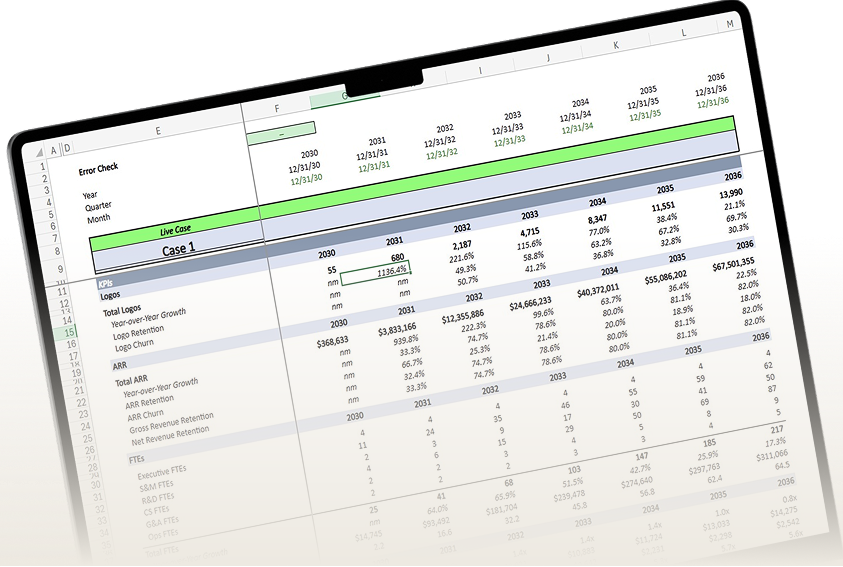


Board reporting software automates data collection, dashboards, and deck assembly. A fractional CFO owns the model, the assumptions, and the decisions those outputs are supposed to drive. At $5-100M ARR, the second layer is usually the bottleneck, not the first.
The decision in front of you is not "which tool." It's whether your board problem is a data problem or a judgment problem. Software fixes stale numbers and manual deck-building, typically for $250 to $5,000 a month. A fractional CFO fixes the absence of a point of view, typically for $3,500 to $20,000 a month depending on stage and provider. Most companies at this ARR range need both, layered correctly, not one instead of the other. This article gives you the comparison, the cost data, and a short diagnostic so you can tell which layer is actually broken before your next board meeting.
What we'll cover
- The two distinct layers of board reporting, and which one software actually solves
- A side-by-side comparison of board reporting software, a fractional CFO, and a full-time CFO
- A short diagnostic to identify your real bottleneck
- What software does better, and what it structurally cannot do
- What a fractional CFO adds, with the ownership model made explicit
- Full cost comparison across all three options, labeled by source
- The combination play, and when each option is enough on its own
- Common mistakes founders make when choosing between the two
The core concept: board reporting has two layers, not one
Every board reporting stack does two separate jobs, and conflating them is where most founders go wrong.
Layer 1 is data and presentation. Pulling numbers from your billing system, your CRM, and your accounting ledger into a coherent set of charts and slides. This is mechanical work: reconciliation, formatting, refreshing a deck every month. It is exactly what board reporting software is built to do. Mosaic, for example, is used to auto-generate the financial sections of board packages, including burn analysis, ARR waterfalls, headcount plans, and variance commentary, pulling from a library of more than 150 pre-built SaaS metrics.
Layer 2 is assumptions, trade-offs, and decisions. Why did net revenue retention drop three points. What happens to runway if you add three engineers. Whether the unit economics actually support the raise you're planning. This is judgment work, and it doesn't come out of a data pipeline no matter how clean the pipeline is.
The practitioner consensus on why board meetings fail points directly at layer 2. As Jim Cook, a former CFO at Mozilla and Orbital Insight, put it: "Boards don't meet to receive information. They meet to make decisions with it." Steve Retallick, Senior FP&A Director at Viasat, made the same point from a different angle: a 60-page board pack isn't thorough, it's unedited, because nobody asked what decision each page supports.
"Software can make layer 1 fast and clean. It cannot answer "what decision does this page support" for you."
— Aleksandar Stojanovic, CEO & Founder at FiscallionThat's a layer 2 problem, and it's the one that determines whether your board meeting produces a decision or a follow-up list.
Board reporting software vs fractional CFO vs full-time CFO: side by side
| Dimension | Board reporting software | Fractional CFO | Full-time CFO |
|---|---|---|---|
| What it produces | Dashboards, KPI tracking, auto-generated deck sections | Board-ready narrative, driver-based model, explicit recommendation | Same as fractional, plus daily operating presence |
| Who owns the assumptions | No one; the founder or finance team inputs them | The CFO, in partnership with the founder | The CFO, embedded in daily operations |
| "Why did NRR drop?" | Shows the trend line | Explains the driver and models the fix | Explains the driver and executes the fix in real time |
| Decision support | None built in; you still have to interpret the chart | Explicit recommendation and trade-off framing | Explicit recommendation, executed and owned |
| Typical monthly cost | $250-$5,000 | $3,500-$20,000 depending on stage | Roughly $350,000-$500,000 all-in per year at Series B |
| Implementation time | Days to weeks | Immediate to a few weeks | 3-6 months to ramp, plus recruiting time |
| Dependency risk | Vendor continuity risk (see Finmark below) | Depends on retainer scope and access | Low, but high fixed cost |
| Who owns the outcome | No one; it's a tool | The CFO, as senior partner on the engagement | The CFO, as a full-time executive |
On dependency risk: Finmark, a board-deck and forecasting tool, was acquired by BILL and its standalone product was shut down, with its site now redirecting to BILL's platform. Tools get sunset, repriced, or absorbed into larger platforms. A CFO relationship doesn't carry that kind of vendor risk, though it carries its own continuity questions around access and scope, which is why those terms matter in a retainer.
The bottleneck diagnostic: run this before you buy anything
Answer these honestly before deciding what to spend money on.
- Do your numbers reconcile across billing, CRM, and accounting without someone manually checking them each month?
- Can you explain any metric swing, in one sentence, without pulling up a spreadsheet?
- Does anyone explicitly own your forecast assumptions, or does the model just get updated?
- Do your board meetings end with a decision, or with a list of things to follow up on next quarter?
- If a board member asked "why did NRR drop three points," could you answer in the room, or would you need to get back to them?
If you're failing the first question, you have a data problem. Buy or upgrade software. If you're failing questions two through five, you have a judgment problem, and no amount of dashboard polish fixes it. That's a fractional CFO or full-time CFO problem, not a tooling problem.
What board reporting software genuinely does better
Give software credit where it's earned. Real-time sync across billing and accounting systems, a pre-built library of SaaS-specific metrics, and automated deck assembly are things a spreadsheet-and-CFO combination will always do slower by comparison. Causal, for example, offers a free tier and a $250 monthly Startup tier aimed at flexible modeling for seed to Series A companies. Runway and Cube sit in the $500 to $3,000 monthly range for similar purposes at the Series A stage.
None of this requires an hourly rate, and none of it needs you to schedule a call. That's a real advantage for a company with clean data and a founder who can own the model personally.
But there's a fit ceiling. As one CFO advisory source put it, Mosaic assumes someone will live in it daily: if your finance function is a part-time bookkeeper and an overloaded founder, the tool is overkill relative to who's actually going to use it. The same source estimates that roughly 40% of a typical Series A finance team's time goes to assembling data rather than analyzing it, which is exactly the problem software is built to solve, and exactly the ceiling past which it stops mattering.
What a fractional CFO adds that software structurally can't
A fractional CFO owns the assumptions behind the model, not just the model's output. That distinction shows up in three concrete ways.
Assumption ownership and trade-off modeling means someone is accountable for the driver-based logic connecting headcount, pricing, and runway, not just the chart that results from it. If you ask "what happens to runway if we add three engineers," a CFO builds that trade-off into the model and gives you a number with a recommendation attached. Software gives you a slider.
Board narrative and the explicit ask is the difference between a deck that reports history and one that frames a decision. A fractional CFO builds the pre-read, the shorter deck, and the explicit recommendation the board is actually being asked to approve, rather than forty slides of context with no ask attached.
"Independent judgment on your own numbers matters most during fundraising, when a founder's optimism about the raise needs a check from someone whose job is to say "your unit economics don't support this round at this valuation" before an investor does."
— Aleksandar Stojanovic, CEO & Founder at FiscallionEvery Fiscallion client works directly with Aleksandar at the CFO layer on this work. That is a deliberate structural choice: no handoff to a junior analyst after onboarding, no account manager between you and the person who owns your model. Fiscallion's own retainer includes a rolling 13-week cash flow model as a first deliverable, built to answer exactly the kind of driver-based question software can't answer on its own.
The pre-read, short deck, and explicit ask structure above is the same one shown in the client example below, where a 42-slide reporting deck was rebuilt as a 12-slide decision deck.
Cost comparison: software, fractional CFO, and full-time CFO
The numbers below span first-party pricing (labeled) and independent market data.
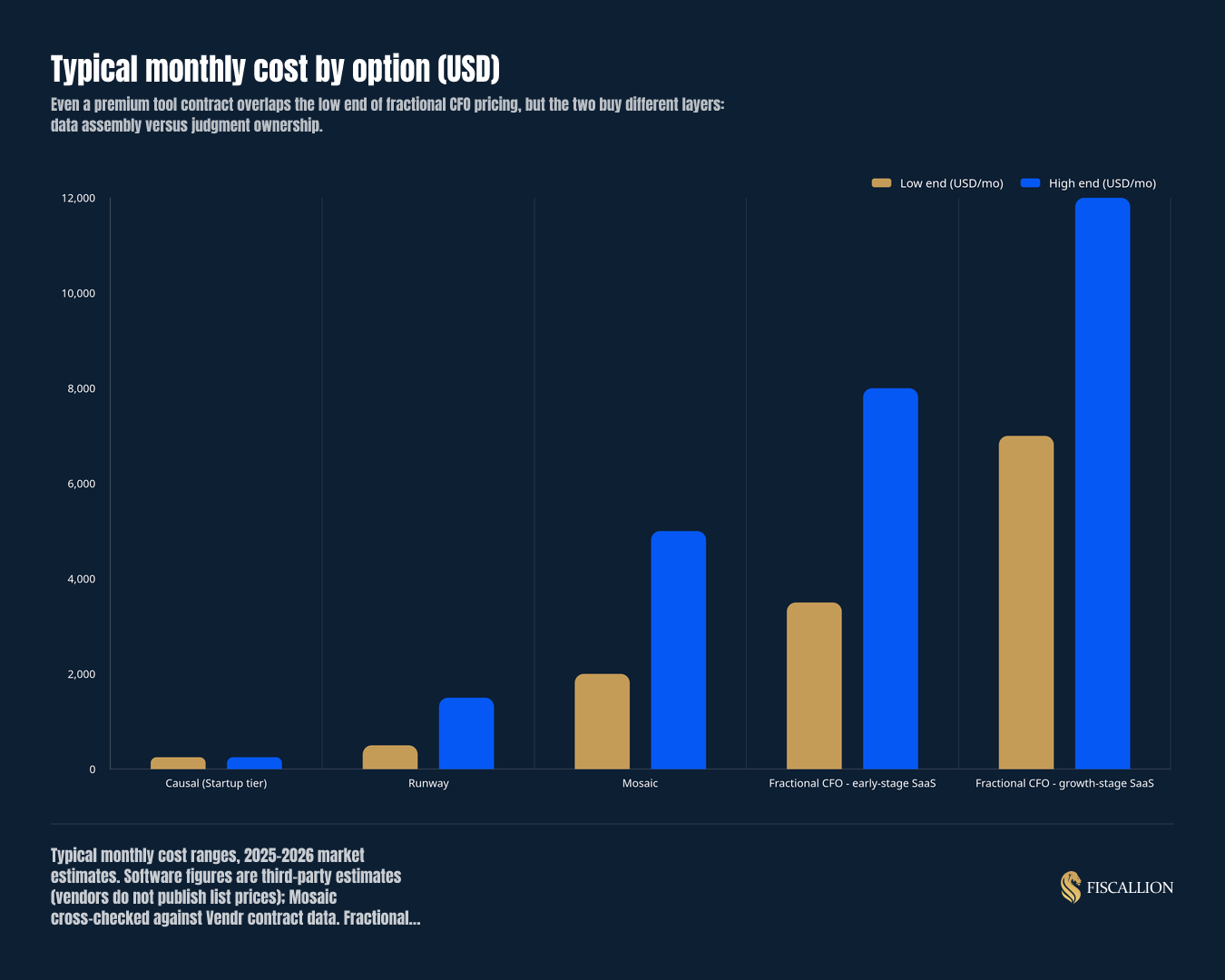
| Option | Typical monthly cost | Source type |
|---|---|---|
| Causal (Startup tier) | $250 | Third-party (vendor pricing) |
| Runway | $500-$1,500 | Third-party market estimate |
| Mosaic | $2,000-$5,000 | Third-party estimate; Vendr's contract data shows a median buyer paying about $24,000/year, roughly $2,000/mo, across 57 tracked purchases |
| Fractional CFO, early-stage SaaS | $3,500-$8,000 | First-party, Fiscallion pricing guide |
| Fractional CFO, Series A ($3-10M ARR) | $8,000-$15,000 | Third-party, Fractional Pulse dataset of 311 tracked listings |
| Fractional CFO, growth-stage SaaS | $7,000-$12,000 | First-party, Fiscallion pricing guide |
| Fractional CFO, Series B ($10-30M ARR) | $12,000-$20,000 | Third-party, Fractional Pulse |
| Full-time CFO, Series B, all-in | Roughly $350,000-$500,000/year | Third-party, CFO Advisors benchmark |
The ranges overlap for a reason: a Series A fractional CFO retainer and a mid-tier Mosaic contract can land in similar dollar territory, but they are not substitutes. One assembles data. One owns decisions. Most companies in the $5-100M ARR range don't need to choose one exclusively; they need to know which layer is currently broken and spend accordingly.
Compare reporting automation against senior CFO ownership directly for your board reporting stack through Fiscallion's financial modeling and board reporting service, where every engagement runs through Aleksandar as senior partner rather than a delivery team.
The combination play: when to stack, and when one option is enough
Software alone is enough when your data is already clean, a founder is willing and able to own the model personally, and the company is early enough that board meetings are still informal. This is rare past $10M ARR.
Software plus a fractional CFO is the right stack for most companies in the $5-100M ARR range. Software handles the data layer: real-time sync, pre-built metrics, deck automation. The CFO handles the judgment layer: assumption ownership, trade-off modeling, and the explicit ask in the boardroom. This is also the stack a fractional retainer is typically scoped to include, since board pack ownership for the finance sections and a rolling 13-week cash forecast are standard deliverables in most fractional CFO retainers at this stage.
A full-time CFO is the right call when the company needs daily executive presence, a permanent internal finance organization, or has grown complex enough to justify the fixed cost. Most companies don't need that hire until roughly $25M in revenue, and even past that threshold, a full-time hire takes three to six months to ramp against a much larger fixed cost than a fractional engagement.
Common mistakes and the better move
Mistake: buying a full data platform before you have anyone to interpret it. An $8M ARR company with a part-time bookkeeper buying a tool built to be lived in daily is spending on infrastructure nobody is staffed to use. Replacement move: fix the judgment layer first, or buy the cheaper tier of software and staff the interpretation separately.
Mistake: hiring a full-time CFO before the complexity justifies the cost. A full-time hire at $350,000 to $500,000 all-in, with three to six months to ramp, is a heavy commitment for a company that hasn't yet outgrown what a senior fractional relationship can cover. Replacement move: use a fractional CFO until daily executive presence is genuinely the constraint, not just a hiring instinct.
Mistake: assuming a dashboard is a decision. A clean chart showing NRR dropped three points is not the same as knowing why, or knowing what to do about it. Replacement move: treat every board metric as a question that needs an owner, not just a number that needs a home.
Frequently asked questions
Should I use board reporting software or hire a fractional CFO for my SaaS company?
Use software if your bottleneck is stale or scattered data and someone is available to interpret what it shows. Use a fractional CFO if your bottleneck is that board meetings end without decisions, or nobody owns the assumptions behind your forecast. Most companies at $5-100M ARR need both: software for the data layer, a fractional CFO for the judgment layer that turns that data into a recommendation your board can act on.
What does a fractional CFO add to SaaS board reporting that software can't?
A fractional CFO owns the assumptions behind your numbers, models the trade-offs between decisions like hiring versus runway, and builds the explicit ask your board is supposed to approve. Software can generate a chart showing a metric moved. It can't tell you why it moved, what to do next, or defend that recommendation independently in the room, which is why Fiscallion clients work directly with Aleksandar as senior partner rather than receiving a templated report.
If I already have a bookkeeper, do I still need a fractional CFO for board reporting?
Yes, because bookkeeping and CFO-level board reporting are different layers of work entirely. A bookkeeper closes your books and keeps the ledger accurate. A fractional CFO takes that reliable data and turns it into forecasts, scenario models, and the board narrative that answers "what do we do next." A fractional retainer is designed to sit alongside your existing bookkeeper, not replace them, since neither role is built to do the other's job.
How does the cost of board reporting software compare to a fractional CFO retainer for SaaS startups?
Board reporting software typically runs $250 to $5,000 a month, depending on the platform and tier. A fractional CFO retainer typically runs $3,500 to $20,000 a month depending on company stage, with early-stage engagements around $3,500-$8,000 and growth-stage or Series B engagements running $7,000-$20,000. The ranges can overlap, but they buy different things: software buys data assembly, a CFO retainer buys ownership of the assumptions and decisions built on top of that data.
The decision, restated
Software and a fractional CFO solve different problems, and the honest test is which one is actually broken right now: is your data unreliable, or is nobody owning the decision your board needs from you. Most companies at $5-100M ARR eventually need both, staged correctly rather than bought all at once.
If your board meetings keep ending in follow-ups instead of decisions, that's a judgment gap, not a dashboard gap, and it's worth comparing what reporting automation gives you against what senior CFO ownership adds through Fiscallion's financial modeling and board reporting service.