
Subscription analytics software calculates MRR, ARR, churn, net revenue retention (NRR) and cohort retention from your billing data, so finance can report recurring revenue without rebuilding it in a spreadsheet each month.
The best subscription analytics software is the one that matches your billing setup and calculates your metrics the way your board expects them defined. Features come second.
This comparison covers three tools with verified evidence: ChartMogul, Maxio and Baremetrics. You will get a stage-based path to a shortlist, a buyer scorecard, and the metric decisions to settle before any demo.
How these three tools were selected
Fiscallion does not sell subscription analytics software, so none of the tools below is ours to promote. The selection reflects what could be verified from vendor-published pages read on 2026-11-13, not hands-on testing.
Each tool was judged on five criteria:
- Billing-stack fit: which billing and accounting systems it connects to.
- Metric transparency: whether you can see and defend how MRR, NRR and churn are calculated.
- Revenue recognition scope: whether it covers ASC 606 or IFRS 15 work, or stays at the metrics layer.
- Pricing clarity: what is publicly disclosed and what depends on a quote.
- Security and implementation evidence: what the vendor publishes.
Pricing and claims below are vendor-published, and pricing can change. Confirm current terms on each vendor's page before you buy.
| Provider | Best for | Key features | Pricing |
|---|---|---|---|
| ChartMogul | Companies that want MRR, NRR and cohort reporting across one or several billing systems | Subscription metrics, multi-source billing view on Pro, two-way CRM sync, warehouse push, API and CSV exports | Free up to $10K MRR; Starter from $69/month monthly; Pro from $119/month monthly; Enterprise from $19,900/year |
| Maxio | Companies that need billing, collections and ASC 606 / IFRS 15 revenue recognition in one platform | Subscription management, recurring billing, dunning, revenue schedules, GL/ERP sync | Grow $599/month for up to $100K monthly billings; Scale is quote-based |
| Baremetrics | Companies with several payment and billing sources who also want payment recovery and cancellation insight | Subscription analytics, payment recovery, cancellation insights, forecasting, benchmarks, segmentation, API | Tier prices not confirmed in this article; check the live pricing page |
1. ChartMogul

ChartMogul pricing page, captured 2026-11-13.
ChartMogul is a subscription analytics platform built around billing-system data. It is the clearest fit when the job is board-ready MRR, NRR and cohort reporting.
Key features
- Billing sources: Stripe and Chargebee, with Paddle and Xero available through the partner SaaSync.
- Multi-system view: Pro combines multiple billing systems in one view, with up to 5 billing sources.
- Integrations and exports: two-way CRM sync and warehouse push on Pro; API, MCP and standard CSV exports on all plans.
- Security: SOC 2 Type II certified and GDPR compliant, per the vendor.
Pricing: ChartMogul's pricing page lists a Free plan at $0 up to $10K MRR. Starter is $69/month billed monthly or $57 on annual billing, with up to 3 team members and up to $10M ARR tracked. Pro is $119/month monthly or $99 annual, with unlimited team members.
Enterprise starts at $19,900 per year for companies over $10M ARR, on an annual contract. Annual billing saves 17%. A 14-day trial needs no credit card, and the Startup Program offers $50/month off any paid plan for 12 months.
Best for: finance leads who need metrics from one or more billing systems and want exports they control.
Pros
- Public pricing with clear plan limits.
- Open data access on every plan through API, MCP and CSV.
- Trial without a credit card.
Cons
- It sits on top of billing data. It is not a revenue recognition engine.
- Starter caps team members and billing sources, and ARR tracked at $10M. Above that, the listed route is Enterprise on an annual contract.
- The evidence reviewed here does not state Pro's ARR ceiling, so confirm it for your size.
2. Maxio
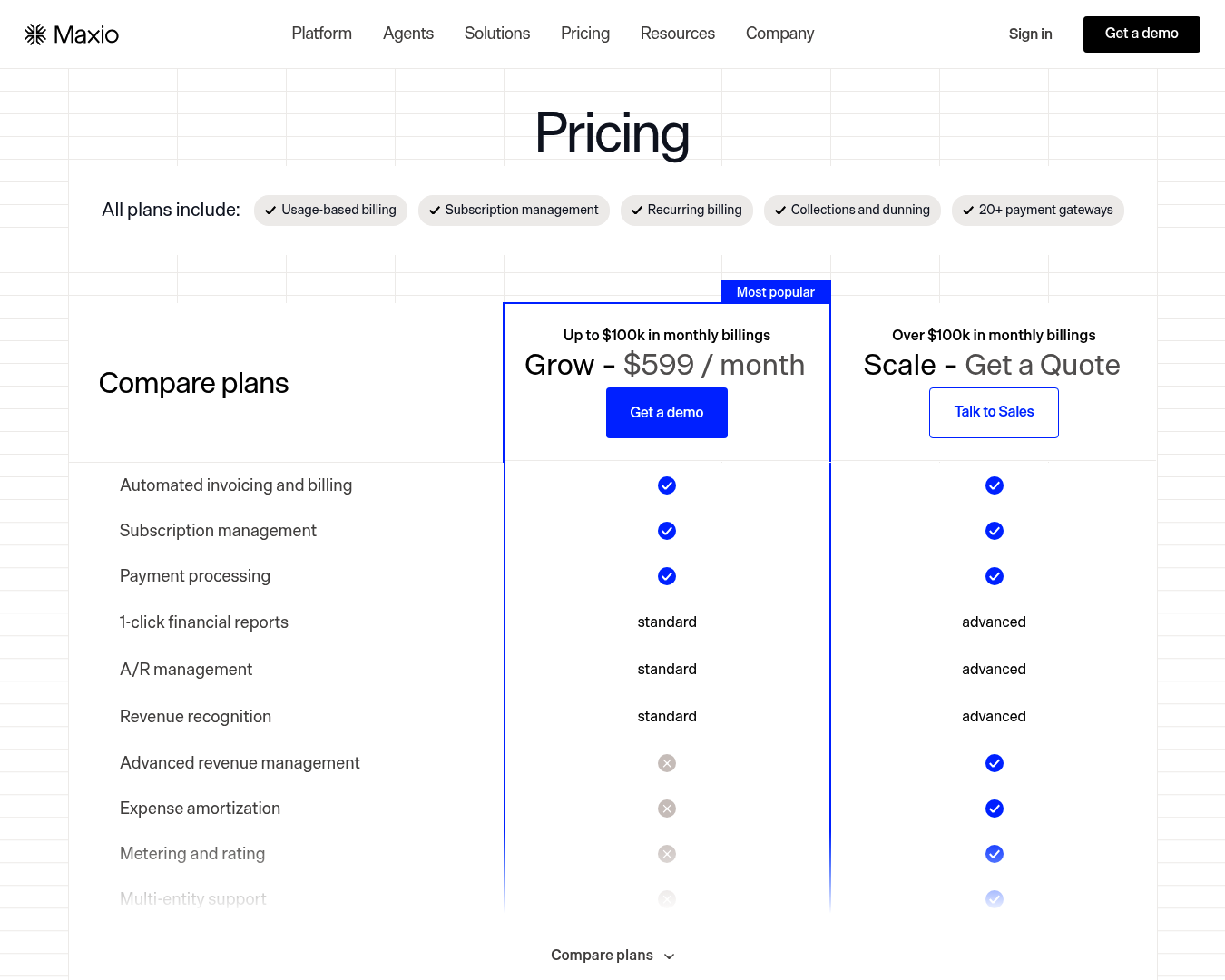
Maxio pricing page, captured 2026-11-13.
Maxio is closer to a billing and revenue operations platform than a pure analytics tool. It was formed from the combination of Chargify and SaaSOptics (merged April 2021, rebranded Maxio in May 2022) and is headquartered in Atlanta, Georgia.
Key features
- Billing core: usage-based billing, subscription management, recurring billing, collections and dunning, and 20+ payment gateways on all plans.
- Revenue recognition: automated ASC 606 and IFRS 15 positioning, revenue schedules, waterfall reports and journal entry consolidation. Standard on Grow, advanced on Scale.
- Accounting sync: GL and ERP sync with NetSuite, Sage Intacct and QuickBooks.
- Multi-entity: listed on Scale.
- Security: vendor-published SOC 1 and SOC 2 reports under SSAE 18, ISO 27001:2013 certification and PCI DSS Level 1.
Pricing: Grow is $599/month for up to $100K in monthly billings. Scale, above $100K monthly billings, is quote-based. Maxio states that pricing scales with billing volume rather than seat count.
Best for: companies where revenue recognition, collections and multi-entity reporting are part of the requirement, not just retention metrics.
Pros
- Revenue recognition and billing sit in the same system.
- Pricing does not depend on how many people need access.
- A Rapid Start Implementation program, with some customers live in as little as two weeks, according to the vendor's VERO example.
Cons
- It is a larger commitment than an analytics layer. If your billing system is staying put, you may be paying for scope you do not need.
- No traditional free trial.
- The vendor's results, such as a month-end close cut from 15 days to 5 days, are published customer testimonials and are not independently verified.
- This research did not verify the depth of Maxio's MRR, NRR and cohort reporting. Test it in a demo against your own definitions.
3. Baremetrics

Baremetrics pricing page, captured 2026-11-13.
Baremetrics combines subscription analytics with tools aimed at recovering and understanding lost revenue.
Key features
- Analytics and planning: Subscription Analytics, Financial Forecasting, Benchmarks, Segmentation and Trial Insights.
- Revenue protection: Payment Recovery and Cancellation Insights.
- Integrations: Stripe, Braintree, Recurly, Chargebee, Google Play, App Store Connect, Shopify Partners, Paddle, QuickBooks, Xero and PayPal.
- Access: Analytics API and MCP.
Pricing: tier prices were not confirmed in this research, so none are published here. Check Baremetrics' live pricing page. The vendor offers a free trial and an interactive demo.
Best for: companies selling through several payment channels, such as app stores or PayPal, that want recovery and cancellation tooling alongside metrics.
Pros
- The broadest integration list of the three, including app stores and Shopify Partners.
- Payment recovery and cancellation tooling in the same product.
- Free trial and interactive demo before you talk to anyone.
Cons
- Tier pricing was not verified here, so you cannot compare cost until you check the live page.
- No stage band is confirmed, so it is not placed in the stage path below.
- Like ChartMogul, it works from billing data and does not replace revenue recognition.
Which tool fits your stage
Start with two questions: how many billing systems feed revenue, and whether complex revenue recognition is a requirement. The path below uses only verified plan limits.

At $5-100M ARR you are well past the free tier, since $10K MRR is $120K ARR. Starter tracks up to $10M ARR, and above that ChartMogul lists Enterprise from $19,900 per year. Baremetrics is not placed on this path because its stage band was not confirmed.
Fix metric definitions before you pick a tool
"Software will calculate whatever definition you give it, including a contested one."
— Aleksandar Stojanovic, CEO & Founder at FiscallionIf sales and finance calculate CAC differently, a dashboard just formalizes the disagreement on a schedule.
Every metric needs one owner, one definition, one source system. That is the metric contract behind a reliable reporting cadence. Aleksandar Stojanovic puts the dashboard standard this way: "Every metric on the dashboard needs a definition, a trend line, a target, and a status indicator, so a director can scan it in seconds rather than asking what it means."
The named mistake is buying before defining. Teams that skip it spend the first months debating definitions instead of using the numbers.
NRR needs the most care. Definition ambiguity is one of the most common sources of friction in diligence conversations. Calculate NRR and gross revenue retention (GRR) on subscription MRR only, and disclose the methodology next to the number.
Settle these before any demo:
- MRR scope: whether usage, services, and one-time fees are in or out.
- Churn and contraction: how downgrades, pauses and failed payments are treated.
- NRR and GRR basis: subscription MRR only, with the method disclosed.
- Source of truth: which system wins when billing and the ledger disagree.
- Owner: the named person who signs off each metric.
The same logic applies to where a tool sits in your finance stack: a subscription analytics product is one layer, and it only works when the layers around it are sequenced deliberately.
Read NRR benchmarks by ARR band, not as one number
Once definitions are fixed, you need a reference point. ChartMogul's SaaS Retention Report was authored by Sid Jain, published 2023-11-01, and uses anonymized, aggregated data from over 2,100 SaaS businesses on the ChartMogul platform, calculated over calendar year 2022.
| ARR band | 75th percentile NRR | 90th percentile NRR |
|---|---|---|
| Under $300K | 79% | 98% |
| $300K-1M | 87% | 101% |
| $1-3M | 94% | 106% |
| $3-8M | 99% | 109% |
| $8-15M | 99% | 110% |
| $15-30M | 105% | 119% |
Source: ChartMogul SaaS Retention Report (Sid Jain), data year 2022, published 2023-11-01.

A company at the 75th percentile in a lower band is not failing. What counts as good NRR depends on stage.
The same report finds that businesses with NRR over 100% grow 43.6% per annum on average, versus 13.1% for those under 60%. It also finds that 35.1% of businesses in the $15-30M ARR range have NRR over 100%.
A separate 2024 ChartMogul update by Sofia Faustino, covering over 2,500 SaaS businesses and published 2024-09-03, found the median company with NRR at or above 100% grows 48% year-over-year. This is a different author and period, so treat it as a second data point.
Buyer scorecard for subscription analytics software
Use this scorecard in the demo. It is ungated, and every row is something you can verify.
| Criterion | What to verify | Red flag |
|---|---|---|
| Metric methodology | You can see how MRR, NRR, churn and contraction are calculated | The vendor cannot show the formula |
| Billing-source coverage | Every system that produces revenue connects | A source is "on the roadmap" |
| Ledger reconciliation | Tool totals tie to the accounting ledger, with differences explained | Nobody owns the gap |
| Revenue recognition scope | ASC 606 or IFRS 15 needs are named and mapped to a plan | You assume it is included |
| Data access | API and exports are available at your plan | Exports require a higher tier |
| Pricing basis | You know whether cost follows ARR, billing volume or seats | Cost jumps at a threshold you will reach this year |
| Security evidence | Certifications are listed and current | Reports are available only after signature |
| Named owner | One person is accountable for each metric | The tool is "owned by finance" |
"If a tool passes this scorecard but your definitions are still contested, the scorecard has not solved your problem. The tool will produce numbers that two executives interpret differently."
— Aleksandar Stojanovic, CEO & Founder at FiscallionFiscallion works above the ledger, as a fractional CFO and FP&A partner for B2B SaaS companies at $5-100M ARR. Every client works directly with Aleksandar Stojanovic at the CFO layer, with FP&A leadership experience gained through the growth of a SaaS company to €100M ARR. There is no account-manager or junior-team handoff.
Fiscallion does not build dashboards or BI tooling. Its financial modeling and board reporting service explicitly excludes them. The work is settling definitions, ownership and decision rules so the tool you choose reports numbers the board can act on.
Next step: Discuss the metric definitions and reporting requirements your finance team needs to resolve before selecting subscription analytics software, directly with Aleksandar.
FAQ
How do I evaluate which subscription analytics software fits my existing billing and accounting stack?
List every system that produces or records revenue: billing, payment processors, CRM and accounting. Then check each tool's connections against that list.
ChartMogul lists Stripe and Chargebee, with Paddle and Xero through SaaSync. Baremetrics lists a wider set that includes Recurly, Braintree, app stores and QuickBooks. Maxio syncs to NetSuite, Sage Intacct and QuickBooks.
Then ask whether the tool reads billing events rather than the ledger. If it does, you need a reconciliation step to the accounting system, and a named owner for the gap.
What metric definitions and reporting gaps should my finance team resolve before choosing a subscription analytics tool?
Resolve the scope of MRR, the treatment of churn and contraction, the NRR and GRR basis, the source of truth when systems disagree, and who signs off each metric. Each metric should have one owner, one definition and one source system.
Also decide how you will present these to the board. A board pack should frame decisions, not just report history, which requires definitions, ownership, cadence and decision rules.
Can subscription analytics software replace the reporting work my current accountant or bookkeeper handles?
No, because ledger accuracy and metric accountability are different jobs that need different owners. Bookkeepers and accountants own transactional accuracy: recording transactions, reconciling accounts and running the close.
Analytics software calculates metrics from billing data. Maxio's revenue recognition automation moves closer to accounting scope, but you still need accounting ownership of the close.
Fiscallion is not a bookkeeping firm and works alongside your accountant, using reliable accounting data for forecasts, scenarios and board decisions.
What should I expect during implementation when rolling out subscription analytics software to my finance team?
Expect the technical connection to be quicker than the definitions work. Maxio's vendor-published Rapid Start Implementation has some customers live in as little as two weeks, and ChartMogul offers a 14-day trial with no credit card.
The slower part is agreeing what each number means and reconciling it to the ledger. In Fiscallion's own board reporting work, the first pack in the new format typically ships in the second board cycle, depending on the state of current data and how quickly definitions are agreed.
Choose the definition first, then the tool
If you have one billing system and need clean retention reporting, ChartMogul is the shorter path. If revenue recognition and multi-entity needs drive the decision, Maxio is the more relevant fit. Baremetrics is worth a trial where payment recovery and several sources matter.
In every case, the tool is only as useful as the definitions behind it. Write the metric contracts first, then run the scorecard.