

Choosing an outsourced CFO is not primarily a hiring decision. It is a decision about what kind of finance judgment your board, your investors, and your own team can trust when cash gets tight or a round gets hard. Most $5-50M ARR SaaS companies overpay for reporting polish and underbuy decision quality, then wonder why the board deck still doesn't answer "what do we do next."
This article breaks down what "outsourced CFO services" actually cover, how the pricing models compare, how to evaluate a provider against your real problems (not the ones on their homepage), and where most founders get the buying decision wrong.
Key takeaways
- Outsourced CFO services range from bookkeeping-adjacent controller support to full strategic FP&A partnership. Know which one you're buying before you sign.
- The real buying criteria are decision cadence, assumptions ownership, and scenario modeling, not dashboard aesthetics or a fancier deck template.
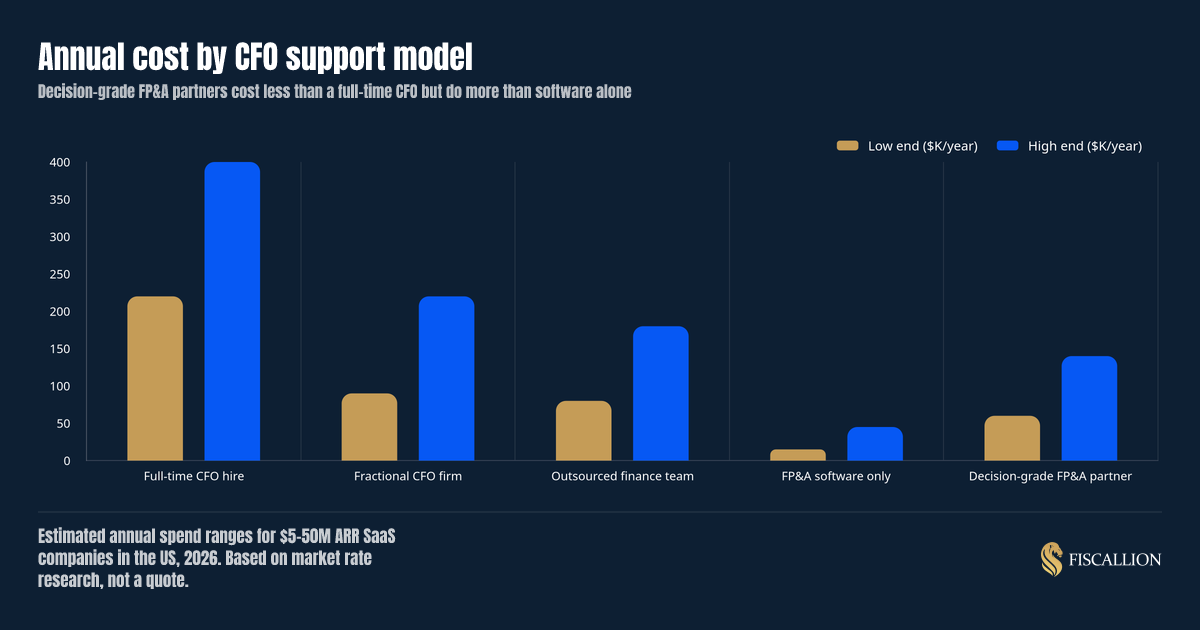
- A full-time CFO hire typically costs $220K-$400K loaded annually. Fractional CFO firms and outsourced finance teams run $80K-$220K. Decision-grade FP&A partners like Fiscallion typically land in the $60K-$140K range with faster time to value.
- Cash flow visibility and runway forecasting, not board deck formatting, are the top two reasons SaaS founders actually reach out for help.
- CAC/LTV should be evaluated as a cohort range, not a single number. If your provider hands you one blended figure, that's a red flag, not a deliverable.
- The best asset to walk away with is a scorecard you can use to compare three vendors in an afternoon, not another 45-minute sales call.
What we'll cover
- What "outsourced CFO services" actually means at the $5-50M ARR stage
- How to calculate the real cost of each model (not just the sticker price)
- How to interpret vendor claims and spot the gap between reporting and decision-making
- What to do next: a practical evaluation framework
- Common mistakes founders make when buying outsourced CFO help, and the better move
- A practical scorecard you can use this week
What outsourced CFO services actually cover
"Outsourced CFO" is used loosely enough that three different providers can mean three different things when they say it. That ambiguity is the first thing to fix before you spend a dollar.
At the $5-50M ARR stage, outsourced finance support generally falls into four categories:
| Model | What it typically includes | What it usually skips |
|---|---|---|
| Bookkeeping/controller firm | Monthly close, AP/AR, basic reporting | Forecasting, scenario modeling, board strategy |
| Fractional CFO firm | Board decks, some forecasting, investor prep | Deep cohort-level unit economics, weekly decision cadence |
| Boutique startup finance advisor | Fundraising narrative, cap table, investor relations | Ongoing operating cadence, headcount modeling discipline |
| Decision-grade FP&A partner (Fiscallion model) | Cash flow single source of truth, runway scenarios, CAC/LTV cohorts, headcount trade-off modeling, board narrative tied to decisions | Day-to-day bookkeeping (usually paired with a bookkeeper) |
Here's the distinction that matters most: most of these models are built to produce reports. A decision-grade FP&A partner is built to produce trade-offs your leadership team can act on this week. That difference shows up in every deliverable, from the board deck to the hiring plan.
If you already have a bookkeeper or a controller handling the close, what you're actually shopping for is the layer above that: someone who translates the close into cash, runway, and the next three decisions. That's a different service than what most "outsourced CFO" listings describe, and it's worth naming explicitly before you start taking sales calls.
How to calculate the real cost of each outsourced CFO model
Sticker price is the easy part. The harder number is cost per decision-ready output, and most founders never calculate it.
Start with total annual spend, then divide by what you actually get:
Step 1: Get the full loaded cost.
- Full-time CFO: base salary + bonus + equity + benefits + recruiting cost. This usually lands at $220K-$400K loaded for a first CFO hire at a $5-50M ARR SaaS company, before the six-to-nine months it takes to ramp.
- Fractional CFO firm: typically billed at $8K-$18K/month depending on hours and seniority, so $96K-$216K annually.
- Outsourced finance team (controller + FP&A analyst bundle): often $80K-$180K annually depending on scope.
- FP&A software alone (Cube, Mosaic, Finmark, Pry, etc.): $15K-$45K annually in licensing, but zero judgment included. Someone still has to build and own the model.
- Decision-grade FP&A partner: typically $60K-$140K annually, positioned between fractional CFO firms and software-only tools, but scoped to produce decisions, not just dashboards.
Here's how those ranges compare side by side.
Step 2: Divide by decision cadence.
Ask each vendor: how often do we get a runway scenario refresh, a hiring trade-off model, and a board narrative tied to a decision, not just a metrics recap? Weekly cadence beats monthly cadence for cash and runway. Monthly cadence is fine for board narrative. Quarterly is too slow for either.
Step 3: Add the ramp-up cost you're not pricing in.
A full-time CFO hire adds six to nine months of ramp time before they're producing independent judgment, plus a real risk of a bad hire costing you a year. Fractional firms and FP&A partners typically start producing usable output within two to four weeks because they've done this at other $5-50M ARR SaaS companies already.
How to interpret what you're actually buying
Cost comparisons only matter once you know what "good" looks like. Here's the interpretation lens that separates a real finance partner from a reporting vendor.
Good signal: they ask about your assumptions before they touch your numbers.
If the first conversation is about your churn assumption, your sales cycle length, or your gross margin trend by cohort, that's a provider who understands that forecasts fail because of hidden assumptions, not bad spreadsheets.
Red flag: they lead with dashboard screenshots.
A polished dashboard is not the same as a decision. If the sales pitch is mostly about visuals, ask directly: "Show me a board deck where a slide changed a board's vote." If they can't answer specifically, that's reporting, not FP&A judgment.
Good signal: CAC/LTV comes back as a cohort range with cohort breakdowns.
A single blended CAC/LTV number is close to useless at $5-50M ARR, where you likely have multiple go-to-market motions, contract lengths, and expansion patterns layered together. A decision-grade partner will show you CAC/LTV by cohort and acquisition channel, with a stated confidence range, not a false-precision decimal.
Red flag: the runway forecast has no explicit assumptions attached.
If you can't see the hiring plan, churn rate, and expense assumptions baked into a runway number, you can't stress-test it. And if you can't stress-test it, your board can't either, which means the number is decoration, not decision support.
Good signal: the board deck ends in a recommendation, not a recap.
Board reporting should answer "what do we do next," with two or three explicit trade-offs (hire now vs. wait a quarter, raise now vs. extend runway, cut CAC spend vs. protect growth rate). If the deck is all backward-looking metrics with no forward frame, you're paying for a status update.
To see where these gaps actually originate, it helps to look at what founders report as their real pain points when they first reach out for help, not what the marketing copy on most outsourced CFO sites assumes.

Cash flow visibility and runway forecasting outrank board deck polish by a wide margin. Most vendors are built to solve problem three (reporting) when the actual gap is problems one and two (visibility and forecasting confidence). That mismatch is the single most common reason founders churn through two or three finance vendors before finding one that fits.
What to do next: a founder's evaluation framework
Once you understand the categories and the cost structure, the buying process gets much shorter. Run this sequence before signing anything.
- Name your actual trigger. Are you dealing with metrics chaos, board pressure, fundraising prep, a cash-to-accrual transition, or the need to automate financial reporting? Each trigger points toward a different scope, and naming it prevents you from buying a generic package.
- Decide if you need a person, a system, or both. If you have no single source of truth across your billing system, your spreadsheet, and your CRM, you need a system fix first. No CFO, fractional or full-time, fixes fragmented data by showing up to more meetings.
- Ask for a sample board narrative, not a sample dashboard. Any vendor can show you charts. Ask to see how they've framed a real trade-off (a hiring freeze, a pricing change, a runway extension) for a board that had to vote on it.
- Price the model against decision cadence, not hours billed. A provider billing 10 hours a month sounds cheap until you realize none of those hours go toward a forward-looking scenario.
- Confirm assumptions ownership in the contract, not the pitch. Someone on your team or your vendor's team needs to be explicitly accountable for the churn rate, the CAC assumption, and the hiring plan baked into your model. If ownership is vague, revisit it before the model is even built.
- Run a 90-day pilot with a defined output, not an open-ended engagement. Ask for one deliverable: a 13-week cash flow model, a runway scenario set with three cases, or a board deck rebuild. Evaluate the output, then decide on scope.
This is close to the sequence we walk founders through directly. The FP&A framework for startups at the $5-50M ARR stage goes deeper into how to build the decision cadence itself, once you've picked the right partner model.
Common mistakes and the better move
Mistake: hiring a full-time CFO to fix a forecasting problem.
A full-time CFO adds cost, headcount, and reporting polish. It does not automatically fix fragile forecasts, unclear unit economics, or a board deck that recaps history instead of framing decisions. Most $5-50M ARR companies don't have a CFO-title problem. They have a decision-quality and FP&A framework problem.
Better move: Bring in a decision-grade FP&A partner first to fix cash visibility, forecasting confidence, and board narrative. Hire a full-time CFO later, once the volume of decisions and the complexity of the cap table genuinely justify a full-time seat, usually well past $50M ARR or ahead of a specific event like an IPO process.
Mistake: treating CAC/LTV as a single number everyone can argue about.
A blended CAC/LTV invites debate because it hides the variance between channels, segments, and cohorts. Debating one number wastes meetings that should be spent on trade-offs.
Better move: Insist on cohort-level CAC/LTV with explicit ranges and confidence bands. Use it to decide where to spend the next dollar of sales and marketing budget, not to win an argument in a board meeting.
Mistake: buying reporting when the real gap is cash flow visibility.
Founders often ask for "better reporting" or "cleaner metrics." The underlying problem is usually fragmented data across billing, CRM, spreadsheets, and someone's head.
Better move: Fix the single source of truth for cash first. Reporting quality improves automatically once the underlying data has one home and one owner.
Mistake: letting headcount decisions happen without a model.
Hiring plans built on gut feel and board pressure, rather than a model tying headcount to revenue milestones and runway, are one of the fastest ways to burn a fundraise's worth of runway in twelve months.
Better move: Require every headcount decision to run through a trade-off model that shows the runway impact, not just the org chart logic.
Mistake: signing a 12-month engagement before a pilot.
Long contracts lock you into a vendor before you've seen a single decision-ready output.
Better move: Negotiate a 90-day pilot with one clearly defined deliverable. Extend only after you've seen the work.
Practical asset: the outsourced CFO evaluation scorecard
Use this scorecard on your next three vendor calls. Score each provider 1-5 on every row, then compare totals.
| Evaluation criterion | What to ask | Score (1-5) |
|---|---|---|
| Cash flow single source of truth | "How do you reconcile billing, CRM, and spreadsheet data into one number?" | |
| Runway forecast rigor | "Show me the assumptions behind a runway number, and how you stress-test them." | |
| CAC/LTV methodology | "Do you give me a blended number or a cohort range with confidence bands?" | |
| Board narrative quality | "Show me a deck slide that changed a real board decision." | |
| Headcount trade-off modeling | "How do you tie a hiring plan to runway and revenue milestones?" | |
| Decision cadence | "What do we get weekly vs. monthly vs. quarterly?" | |
| Ramp time to usable output | "What's the first deliverable, and when do we see it?" | |
| Assumptions ownership | "Who owns the churn, CAC, and expense assumptions in the model, explicitly?" | |
| Total cost vs. decision output | "What's the annual cost divided by decision-ready deliverables per quarter?" |
A provider scoring high on cash visibility, runway rigor, and decision cadence, even with a lower score on brand recognition or logo count, is almost always the better buy for a $5-50M ARR SaaS company. A provider scoring high on dashboard aesthetics and low on assumptions ownership is a reporting vendor wearing a CFO title.
Conclusion
The best outsourced CFO service for a VC-backed SaaS startup is not the one with the most polished deck template or the biggest client logo wall. It's the one that gives your leadership team a single source of truth for cash, a runway forecast you can actually stress-test, and a board narrative that ends in a decision instead of a recap.
Most $5-50M ARR companies don't need a full-time CFO yet. They need decision-grade FP&A infrastructure: fragmented data resolved into one model, assumptions owned explicitly, and trade-offs framed across cash, hiring, pricing, and growth. That's the gap Fiscallion is built to close, without the cost and ramp time of a full-time hire or the reporting-only scope of a typical fractional CFO engagement.
If your forecasts still feel fragile, your board deck still doesn't answer "what do we do next," or your CAC/LTV number keeps getting debated instead of used, audit your metrics definitions and forecasting model before signing another 12-month engagement.