

Choosing an FP&A consulting agency is a decision about who owns your assumptions, not just who builds your model. Get this wrong and you end up with a nicer-looking spreadsheet and the same fragile forecast. Get it right and you walk into your next board meeting with a runway number you trust, a CAC/LTV range you can defend, and a hiring plan tied to cash, not headcount targets someone set a year ago.
This article breaks down what actually differentiates FP&A consulting agencies for startups, the engagement models on the market, what each one costs, and the specific evaluation criteria that matter more than a polished deck or a big-name client list.
Key takeaways
- Most $5-50M ARR SaaS companies do not have a CFO problem. They have a decision-quality and FP&A problem: fragmented data, implicit assumptions, and no repeatable cadence for turning activity into cash and runway decisions.
- Fractional CFO firms, outsourced finance teams, and boutique SaaS FP&A consultants differ mainly in scope, cadence, and who actually owns the model versus who just reviews it.
- Price ranges from roughly $3,000 to $35,000+ per month depending on model and scope. Price alone tells you almost nothing about decision quality.
- The right partner treats CAC/LTV as a cohort range, not a single number, and builds board materials that frame trade-offs instead of only reporting history.
- Vet agencies on assumptions ownership, SaaS-specific experience, and decision cadence, not on the length of their client logo wall.
Article structure
This piece covers the core engagement models available, how to calculate the true cost of each one, how to interpret vendor claims and case studies, a step-by-step evaluation process, the mistakes that lead founders to hire the wrong partner, and a practical vetting checklist you can use in your next round of calls.
Why this decision matters more than it looks
Founders usually start this search after a trigger event: a board member asked a question nobody could answer cleanly, a fundraise is six months out, or the finance stack (QuickBooks, a spreadsheet, a BI tool, and three people's mental models) stopped producing one consistent number for cash.
The instinct is to search for "FP&A consulting agencies" or "fractional CFO near me" and start taking calls. That is reasonable, but it optimizes for the wrong variable. You are not hiring someone to make your reporting look better. You are hiring someone to own a small number of hard assumptions (churn, CAC payback, gross margin trajectory, hiring pace) and turn them into a forecast you can defend under pressure.
That distinction changes who you should be evaluating and how.
The core engagement models, defined
Before comparing vendors, get clear on the category differences. These get blurred in sales conversations on purpose.
| Model | What it actually is | Best fit | Typical monthly cost |
|---|---|---|---|
| Boutique SaaS FP&A consultant | A specialist (often a former startup CFO or FP&A lead) who owns your model and forecast cadence directly | Companies that need decision-grade FP&A without full-time headcount | $3,000 - $8,000 |
| Fractional CFO firm | A part-time CFO, usually generalist, handling board relations, some modeling, and strategic advisory | Companies mid-fundraise or needing investor-facing gravitas | $6,000 - $15,000 |
| Outsourced finance team | A staffed team (bookkeeper, controller, analyst) handling accounting plus some FP&A | Companies converting from cash to accrual accounting or needing close/controller support | $8,000 - $20,000 |
| Full-time CFO hire | An employee, usually senior, with salary plus equity | Companies at scale needing daily executive presence and full ownership of the finance org | $20,000 - $40,000+ (loaded) |
| Fiscallion FP&A partner | A dedicated FP&A partner model built specifically for $5-50M ARR SaaS, focused on decision cadence over reporting polish | Companies with metrics chaos, fragile forecasts, or board pressure who need CFO-level judgment without building a finance org | $3,000 - $6,000 |
The chart below shows how these models compare on typical monthly spend. The gap between a dedicated FP&A partner and a full-time CFO hire is the gap most $5-50M ARR companies are trying to close without overpaying for it.

Note that "fractional CFO" and "FP&A consultant" get used interchangeably in marketing copy, but they are not the same service. A fractional CFO often spends more time on board relations, fundraising narrative, and executive presence. An FP&A consultant spends more time inside the model: cohort analysis, scenario building, and the assumptions behind your runway number. You may need both. You rarely need to pay full-time-CFO rates for either.
How to calculate the real cost of each option
The sticker price on a proposal is never the full cost. Calculate total cost of ownership before comparing quotes.
- Base monthly retainer. What the agency or firm quotes you directly.
- Ramp-up cost. Weeks of low-value output while the partner learns your business, cohorts, and contract terms. Multiply your current forecasting pain (in hours per week from your team) by the ramp period.
- Tooling overlap. Some agencies require you to adopt their preferred stack (a specific FP&A platform, a specific BI tool) on top of what you already pay for. Add that license cost.
- Opportunity cost of a wrong number. This is the one founders skip. If a partner's forecast is wrong by 15% on runway, and that changes a hiring decision or a fundraise timeline, the cost is not the retainer. It is the decision made on bad information.
- Founder time cost. A partner who needs constant hand-holding to interpret their own outputs is not saving you time. If you are still the one translating the model into a decision, you have not actually bought FP&A capacity.
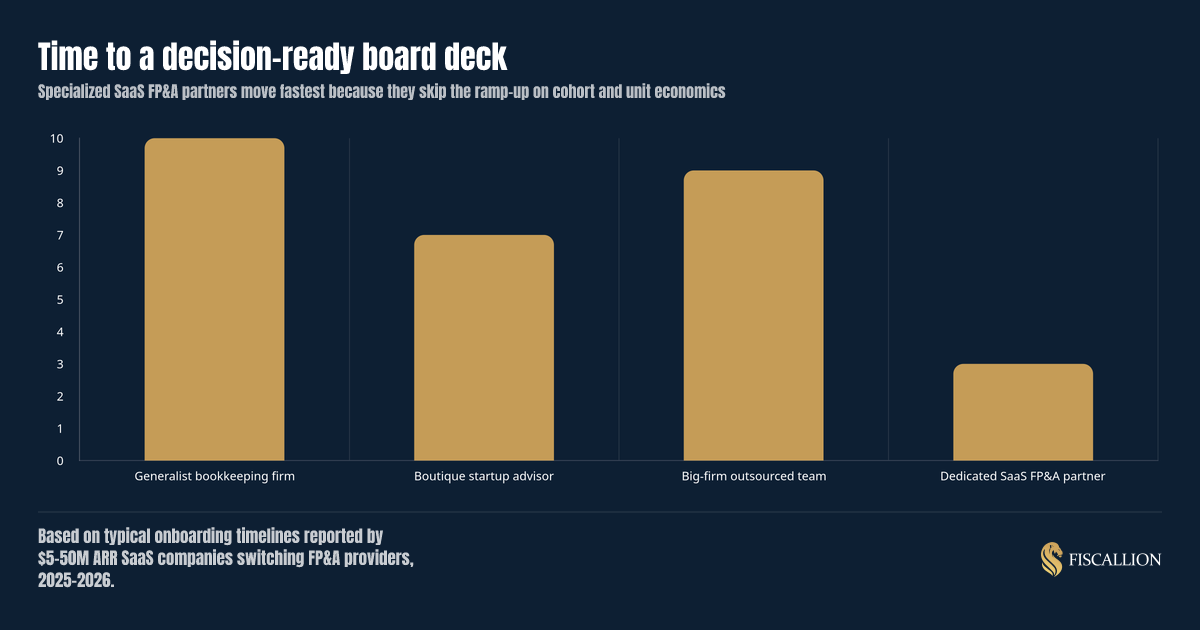
Add these together and compare apples to apples. A $4,000/month partner who ramps in two weeks and hands you a decision-ready board narrative is often cheaper in real terms than a $12,000/month firm that takes two months to get oriented and still leaves you to interpret the numbers.
The chart below illustrates why ramp time matters as much as the monthly rate. A slow start delays your first usable board deck, which is often the actual deadline driving the search.
How to interpret vendor claims and case studies
Most agency websites lead with logos and generic language: "strategic," "data-driven," "efficient." None of that tells you whether they will change how you make decisions. Interpret what you are shown using three filters.
Filter one: does their case study name a decision, not just a metric.
"We improved forecast accuracy by 20%" is a metric claim. "We identified that the sales team's ramp assumption was overstating pipeline conversion by 8 points, which changed the hiring plan for Q3" is a decision claim. You want the second kind. It shows the firm connects numbers to trade-offs.
Filter two: do they treat unit economics as a range, not a single figure.
Ask directly how they calculate CAC and LTV. If the answer is a single blended number across all customer segments, that is a red flag. CAC/LTV should be presented as a cohort range (by acquisition channel, by plan tier, by signup quarter) because a single number hides which segments are actually profitable. This is one of the most common sources of unproductive debate in board meetings, and it is fixable with the right cohort structure.
Filter three: ask what happens when the forecast is wrong.
Every forecast will be wrong at some point. Ask how the firm handles a miss. A firm that has a defined process for re-forecasting, communicating the miss to the board, and adjusting assumptions is more mature than one that treats the model as a one-time deliverable.
What to do next: a step-by-step evaluation process
Use this sequence before signing with any FP&A consulting agency.
- Name your trigger event. Are you preparing for a board meeting, a fundraise, a cash-to-accrual transition, or trying to fix chronic metrics chaos? Different triggers call for different scope, and naming it prevents scope creep in the proposal.
- Write down your three hardest assumptions. Usually churn, CAC payback period, and hiring pace. Ask every candidate firm how they would validate and stress-test those three specifically, not generically.
- Request a sample board page, not a sample deck. A full sample deck can be templated. A single page walking through a specific trade-off (for example, "should we hire two more AEs this quarter given current CAC payback") shows you their actual thinking.
- Confirm who owns the model after onboarding. Some firms build the model and hand it off with limited support. Others own it as a living forecast updated monthly. Get this in writing.
- Check SaaS-specific experience, not just startup experience. SaaS unit economics (net revenue retention, cohort LTV, CAC payback by channel) differ meaningfully from ecommerce or services businesses. A generalist advisor without SaaS reps will re-learn concepts you already understand.
- Pilot before committing to a long contract. A 60 to 90-day engagement with a clear deliverable (a validated runway model, one board cycle) is a reasonable test before a 12-month retainer.
Common mistakes and the better move
Mistake: hiring a full-time CFO before you have decision infrastructure.
A full-time CFO adds cost and reporting polish, but if your forecasting, unit economics, and capital allocation discipline are not fixed, you now have a more expensive version of the same problem. The better move: fix the FP&A framework first with a dedicated partner, then decide if you need a full-time executive once the company has outgrown fractional support, typically past $50M ARR or ahead of a Series D.
Mistake: treating CAC/LTV as a single number to win an argument.
Founders and board members often debate one blended CAC/LTV figure as if it settles the question of whether growth spend is working. It never does, because it hides channel and cohort variance. The better move: insist on a cohort range broken out by acquisition channel and plan tier, and use that range to make the specific trade-off (which channel to cut, which to fund further), not to win a debate.
Mistake: choosing a partner based on how polished the deck looks.
A beautiful board deck that does not answer "what do we do next" is reporting, not FP&A. The better move: evaluate on whether the materials frame a trade-off with a recommendation, not just a history of what happened last quarter. This is the same standard we hold ourselves to in every Fiscallion engagement, and it's the difference explored in more depth in our breakdown of a decision-grade FP&A framework for $5-50M ARR.
Mistake: assuming outsourced finance teams and FP&A consultants solve the same problem.
Outsourced finance teams are often strongest at bookkeeping, close processes, and controller-level accuracy, particularly useful during a cash-to-accrual transition. They are not always built for forward-looking scenario modeling and board narrative. The better move: separate the accounting hygiene problem from the forecasting and decision-cadence problem, and staff each with the right specialist.
Mistake: no clear decision cadence after the engagement starts.
Some engagements produce a great initial model and then go quiet until the next board deck is due. Runway and unit economics assumptions drift monthly, especially with new pricing, new hires, or new channels added. The better move: agree on a monthly or bi-weekly cadence where the partner flags assumption drift before it shows up as a surprise in the board deck.
How to interpret pricing signals in proposals
When you get proposals back, three signals tell you more than the number on the page.
- Scope creep clauses. A proposal with vague deliverables ("ongoing strategic support") is harder to hold accountable than one with named deliverables ("monthly board deck, quarterly reforecast, weekly cash position update").
- Who does the actual work. Some fractional CFO firms sell you time with a senior partner in the sales call, then staff the account with a junior analyst. Ask specifically who will be in your monthly working session.
- Onboarding data requirements. A firm that asks only for your P&L and a headcount list is underestimating the work. A firm that asks for cohort-level revenue data, contract terms, and channel-level CAC data from day one is signaling they intend to build a real model, not a template.
Practical asset: a vetting checklist for your next call
Use this checklist on your first call with any FP&A consulting agency, fractional CFO firm, or outsourced finance team.
- Do they name a specific decision from a past client engagement, not just a metric improvement?
- Do they present CAC/LTV as a cohort range, broken out by channel and plan tier?
- Can they show a sample board page focused on a trade-off, not a templated deck?
- Is there a named cadence (weekly, bi-weekly, monthly) for flagging assumption drift?
- Do they have direct SaaS experience with net revenue retention and cohort LTV, not just general startup finance?
- Is the total cost of ownership (retainer, ramp time, tooling, founder time) clear before you sign?
- Is there a defined pilot period (60 to 90 days) before a long-term commitment?
- Do they clarify who owns the model long-term: them, you, or a shared cadence?
If a firm cannot answer most of these directly and specifically, that is useful information before you sign anything.
Conclusion
The best FP&A consulting agencies for startups are not the ones with the longest client list or the most polished onboarding deck. They are the ones who will own your hardest assumptions, treat unit economics as a range rather than a talking point, and build board materials that answer what to do next, not just what happened last month.
Most $5-50M ARR SaaS companies searching for this kind of help do not actually need a full-time CFO. They need decision-grade FP&A: fragmented cash visibility resolved into one source of truth, a runway forecast built on assumptions you can defend, and a cadence that catches drift before it becomes a board surprise.
If your current setup cannot answer what you do next with the numbers you already have, the fix usually is not another dashboard. It is a rebuilt forecasting model and a clear decision cadence. Audit your metrics definitions and forecasting model before your next board cycle, and get in front of the gap while it is still cheap to close.