
A SaaS financial forecast needs a full rebuild, not another update, when its structure no longer matches how the business operates: the drivers, the revenue architecture, or the core assumptions have drifted from reality. An update fixes numbers. A rebuild fixes the machine that produces them.
That distinction is where most founders get stuck. You extend the same spreadsheet another quarter, swap in new actuals, and the output still doesn't answer the question your board is asking. The problem isn't that the numbers are old. It's that the model was never built to handle the business you run today.
This article gives you a trigger list instead of a calendar rule. You'll see when a roll-forward is enough, when a re-forecast is the right call, and when the correct move is a full rebuild. You'll also get a rebuild trigger table, a 30-minute audit sequence you can run before your next board meeting, and the mistakes that keep founders reporting against a model nobody trusts.
What you'll learn
- The three levels of forecast maintenance, and why confusing them wastes time or hides risk
- A trigger table mapping specific business changes to the correct response: update, re-forecast, or rebuild
- A 30-minute audit sequence to diagnose your current model before your next planning cycle
- What a rebuild actually involves, and how often SaaS companies should expect to do one
- Common mistakes that keep finance teams reporting against a forecast nobody believes
Three levels of forecast maintenance, and why founders confuse them
Most founders treat forecast maintenance as one activity: "update the model." It isn't. There are three distinct levels, and each fixes a different problem.
Rolling forward means adding a new month or quarter to the same structure, with the same drivers and the same assumptions. Nothing about the architecture changes. This is maintenance, not analysis.
Re-forecasting means replacing stale assumptions with current actuals inside the existing structure. Your churn assumption was 3%, actuals came in at 4.5%, so you update the input and let the model recalculate. The architecture is sound; the inputs were out of date.
Rebuilding means the architecture itself is wrong. The revenue model changed, the go-to-market motion shifted, or the cost structure no longer resembles what the model assumes. No amount of input-swapping fixes that, because the machine is calculating the wrong thing correctly.
Here's the distinction that trips people up: a stale forecast is a cadence problem. A broken forecast is an architecture problem. You solve the first by re-forecasting more often. You solve the second only by rebuilding.
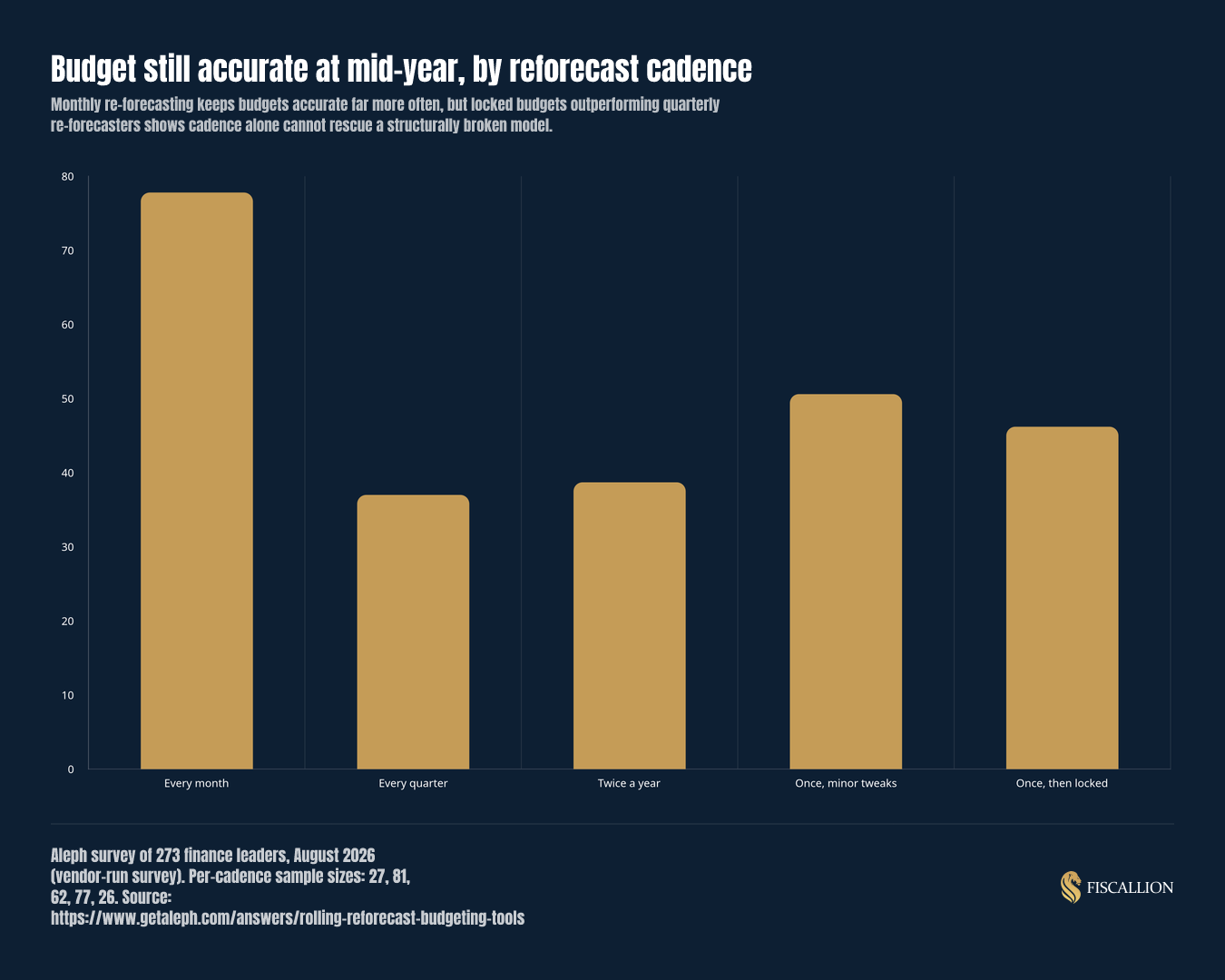
Data from a 2026 survey of finance leaders by Aleph makes this concrete. Among teams that reforecast monthly, 77.8% said their budget was still accurate at mid-year. Among quarterly reforecasters, only 37.0% said the same, barely better than teams that locked their budget once and never touched it again (46.2%). That non-monotonic result matters: if cadence alone fixed forecasts, more frequent reforecasting would always win. It didn't. A survey of finance leaders on reforecast cadence shows that some quarterly reforecasters are patching a broken model more often, not fixing it faster.
| Reforecast cadence | Share reporting budget still accurate at mid-year |
|---|---|
| Every month | 77.8% (n=27) |
| Every quarter | 37.0% (n=81) |
| Twice a year | 38.7% (n=62) |
| Once, with minor tweaks | 50.6% (n=77) |
| Once, then locked | 46.2% (n=26) |
Source: Aleph survey of 273 finance leaders, August 2026. Vendor-run survey; presented as directional evidence, not an independent benchmark.
There's a corollary failure mode on the other end: rebuilding from scratch every month.
"If your team is tearing the model apart monthly instead of refreshing actuals against stable drivers, you don't have a forecasting cadence problem. You have a structural one, and rebuilding constantly is a symptom, not a solution."
— Aleksandar Stojanovic, CEO & Founder at FiscallionThe rebuild trigger table: what changed determines the response
Instead of asking "is it time to update the forecast," ask what specifically changed. Each trigger below points to a different correct response.
| Trigger | What it looks like | Correct response |
|---|---|---|
| Unit economics drift | CAC, LTV, or payback period moves 20-30% from what the model assumes | Rebuild |
| Repeated plan-vs-actual gaps | Roughly 20% variance for three consecutive months | Rebuild |
| Revenue model or GTM change | New monetization stream, or shift from self-serve to enterprise sales | Rebuild |
| Structural cost change | Contractor-to-FTE conversion, or outsourced function brought in-house | Rebuild |
| Accounting-method transition | Moving from cash to accrual basis | Rebuild |
| Fundraising prep | Preparing a data room or board deck for a raise | Re-forecast (rebuild if structure is already broken) |
| Funding event closed | New capital changes runway and hiring plans | Re-forecast |
| Normal actuals drift, no structural change | Monthly numbers vary but assumptions still hold | Roll forward |
The unit-economics and GTM triggers come from practitioner guidance on financial model rebuild triggers, which frames the core issue well: investors expect models to be responsive to how the business actually runs, not just arithmetically accurate. Reporting against a model that no longer reflects your GTM motion signals you don't understand your own metrics, whether or not the spreadsheet still balances.
The repeated-divergence trigger has a specific threshold worth naming, even though it comes from a single practitioner source rather than an industry standard: a systematic plan-versus-actual gap near 20% repeating for three consecutive months is treated as a hard signal that planning assumptions have collapsed. Below that, a roughly 10% deviation corridor is considered healthy for a working model. Point edits stop working once you're consistently outside that corridor.
The accounting-method trigger is one Fiscallion sees directly. A cash-to-accrual transition doesn't just change bookkeeping mechanics. It requires re-baselining revenue recognition, gross margin, and runway calculations, because the model's core financial logic has to change, not just its inputs.
A 30-minute audit to tell you which one you need
Before you commit to a rebuild or assume an update will hold, run a short audit. This sequence, adapted from a published 60-minute SaaS forecast audit framework, can be compressed to about 30 minutes if you already know your model.
- Pull the outputs. Look at your current runway, CAC, and gross margin outputs. Do they match what your team believes to be true right now, independent of the model?
- Open the assumptions tab. Find every hardcoded input. Note the date each one was last touched.
- Test for assumption decay. Are inputs frozen from a prior stage of the business, before your last pricing change, GTM shift, or hiring wave?
- Check for structural blind spots. Is CAC fully burdened with all sales and marketing cost, or just ad spend? Does headcount ramp tie to actual hire dates, or a flat assumption? Does cash flow account for collection timing, or just booked revenue?
- Check for operational disconnects. Does the model reflect how your team actually runs the business today, or how it ran it a year ago?
If step 3 turns up several assumptions untouched since a prior operating reality, or step 4 surfaces a structural blind spot, you're looking at a rebuild, not an update.
What a forecast rebuild actually involves
A rebuild isn't a bigger version of an update. It resets the model's foundation in three specific ways.
Re-anchor drivers to actual run-rates. Every driver, from sales cycle length to net revenue retention, gets reset against what's actually happening in the business right now, not what was assumed at the last planning cycle.
Rebuild the cash bridge with a downside case. A rebuild isn't complete without a scenario that stresses the plan. If churn moves 2 points worse than base case, or a renewal slips a quarter, does the runway number still hold?
Reset named assumptions with owners. Every forecast rests on inputs someone chose, whether they admit it or not. During a rebuild, each material assumption gets a name attached to it: who owns this number, and what would change their mind about it. Approved headcount, in-process headcount, and modeled headcount can diverge by 10-15% in a fast-growing company, and each version produces a different burn forecast. A rebuild forces you to pick one and name who's accountable for it.
This is close to how Aleksandar Stojanovic, Fiscallion's founder, has described a mid-year re-forecast sequence directly: when a team is materially off plan, the fix isn't another patch, it's re-anchoring the model's drivers and rebuilding the cash bridge before the next board cycle.
How often to rebuild versus roll forward
The cadence question and the rebuild question are separate, and conflating them is where most founders go wrong.
For roll-forward and re-forecasting, reforecast cadence guidance points to quarterly as the minimum standard for most businesses, with monthly reforecasting suited to fast-growth SaaS companies. A monthly reforecast with decent FP&A tooling takes something like 1-2 days; the same cycle in raw spreadsheets can run 1-2 weeks.
For rebuilds, cadence isn't the right frame at all. You rebuild on triggers, not on a schedule. Rolling forecasts versus annual budgets guidance is direct about the failure mode to avoid: rebuilding the model every month. Build once, refresh actuals, adjust drivers, re-run. If any single refresh step takes more than half a day, that's a signal you have a model problem, not a process problem, and the fix is a rebuild, not a faster update habit. Rolling forecasts extending 12-18 months tend to win when growth exceeds roughly 25% annually; an annual budget with one or two re-forecasts during the year is defensible when nothing material has changed.
The same logic applies to when not to touch the model. Weekly tweaks when nothing material has shifted are busywork rather than analysis. Update after a funding event closes, after a revenue-model change, before a fundraise, and when actuals diverge significantly from projections. A quarterly refresh, absent any of those triggers, is reasonable practice.
What to do next: run the rebuild diagnostic before your next board cycle
If your audit surfaced assumption decay, a structural blind spot, or a repeated plan-versus-actual gap near 20%, don't schedule another update cycle. Run a forecast-rebuild diagnostic against the explicit trigger criteria above: unit-economics drift, GTM or revenue-model change, structural cost change, an accounting-method transition, or three consecutive months of material variance.
Every Fiscallion engagement works directly with Aleksandar Stojanovic at the CFO layer.
"There's no account-manager handoff and no junior team doing the modeling while a senior partner reviews it later. The person rebuilding your driver-based model, stress-testing your cash bridge, and naming your assumptions is the same person who presents the result to your board."
— Aleksandar Stojanovic, CEO & Founder at FiscallionIf you want a second opinion on whether your current model needs a rebuild or just a re-forecast, the financial modeling and board reporting service page describes how Fiscallion builds and maintains scenario-based forecasts, cash-burn tracking, and board-ready decks for SaaS companies from $5M to $100M ARR.
Common mistakes and the better move
Mistake: reporting against a dead budget. If your board deck compares actuals to a plan built on assumptions everyone knows are wrong, you're not reporting, you're performing. Replacement move: name the assumption that broke, and bring a re-forecast or rebuild recommendation to the same meeting where you flag the gap.
Mistake: rebuilding from scratch every month. This looks like rigor. It's actually a sign the model was never built with stable, named drivers in the first place. Replacement move: build once with a driver-based structure, then refresh actuals and adjust inputs. If a refresh takes longer than half a day, that's your signal to rebuild properly, once.
Mistake: weekly assumption tinkering when nothing material changed. Constant small edits create the illusion of precision without improving decision quality. Replacement move: set a re-forecast cadence (monthly for fast-growth SaaS, quarterly at minimum) and reserve mid-cycle edits for genuine triggers.
Mistake: confusing a stale forecast with a broken one. Treating an architecture problem as a cadence problem means you reforecast more often against a model that's still calculating the wrong thing. Replacement move: run the 30-minute audit above before deciding whether to re-forecast or rebuild.
Mistake: using a locked budget purely to explain variance after the fact. A budget that only exists to show how wrong you were isn't useful for decisions. Replacement move: treat the variance itself as a trigger check, not just a reporting line, and connect it to the next action, not just the last quarter's explanation.
Trigger-criteria scorecard
Use this scorecard directly. Score your current forecast against each row; three or more "yes" answers point to a rebuild rather than an update.
| Trigger check | Yes / No |
|---|---|
| Has CAC, LTV, or payback moved 20-30% from what the model assumes? | |
| Have you had roughly 20% plan-vs-actual variance for three straight months? | |
| Has your revenue model or go-to-market motion changed since the model was built? | |
| Has a cost structure shifted materially (contractor to FTE, outsourced to in-house)? | |
| Are you transitioning from cash to accrual accounting? | |
| Have any input assumptions gone untouched since a prior stage of the business? | |
| Does CAC exclude meaningful sales or marketing cost categories? | |
| Does headcount in the model diverge from approved or in-process headcount by more than 10%? |
FAQ
What are the clearest signs our current SaaS financial forecast needs a full rebuild instead of a quick update?
The clearest signs are structural, not numerical. If CAC, LTV, or payback has moved 20-30% from what the model assumes, or if you've had roughly 20% plan-versus-actual variance for three consecutive months, patching inputs won't fix it. Other hard signals include a revenue-model or go-to-market change, a structural cost shift like moving from contractors to full-time staff, and a cash-to-accrual accounting transition. If your 30-minute audit turns up hardcoded assumptions frozen from an earlier stage of the business, or CAC that excludes real cost categories, that's architecture failure, not staleness, and it calls for a rebuild.
How often should a SaaS company rebuild its financial forecast versus just rolling forward the existing model?
Rebuild on triggers, not on a calendar. Rolling forward and re-forecasting follow a cadence: quarterly is the minimum standard for most businesses, monthly is appropriate for fast-growth SaaS companies. Rebuilds are different. You rebuild when one of the specific triggers above occurs: unit-economics drift, a GTM or revenue-model change, a structural cost shift, an accounting transition, or a repeated plan-versus-actual gap near 20%. Rebuilding every month regardless of what changed is itself a failure mode. It signals the model was never built with a stable, driver-based structure to begin with.
If we already have an internal bookkeeper or fractional CFO, when does it still make sense to bring in outside help to rebuild our forecast?
A bookkeeper works below the forecast layer entirely; they maintain the ledger, not the model that turns ledger data into runway, scenarios, and board-ready decisions. Bringing in help there isn't about replacing them, it's about adding a layer they don't cover. A fractional CFO already engaged with your business may have broad financial oversight but not deep SaaS-specific modeling experience, or may not have the dedicated hours available for a one-time rebuild on top of ongoing responsibilities. The honest way to evaluate this is by scope and capacity, not by assuming either role is insufficient. If your existing finance support doesn't include hands-on SaaS forecast architecture, or doesn't have room in their calendar for a focused rebuild before a board meeting or raise, that's when outside modeling depth is the right addition, working alongside what you already have rather than replacing it.
What should we expect during a forecast rebuild engagement, and how long does the process typically take?
Expect three concrete steps: re-anchoring every driver to actual run-rates, rebuilding the cash bridge with a downside case, and naming every material assumption with an accountable owner. There's no single published industry standard for how long a rebuild engagement takes, and it depends heavily on how broken the existing model is. As a rough anchor, a first-time model build in raw spreadsheets is commonly a multi-week undertaking, while a healthy, driver-based model should refresh in days, not weeks, once rebuilt properly. If any single refresh step in your current process takes longer than half a day, that's a sign the underlying architecture, not the update cadence, needs the work.
The decision that actually matters
The question isn't "when did we last update the forecast." It's "does the forecast's structure still match how we run the business." A stale model gets fixed by reforecasting more often. A broken one only gets fixed by rebuilding it, and no amount of monthly patching will substitute for that decision.
Run the audit, score your forecast against the trigger scorecard, and if three or more triggers are true, treat that as your answer. The forecast-rebuild diagnostic exists for exactly that moment, before the board meeting where you'd otherwise be reporting against a model nobody in the room believes anymore.