

Most founders ask the wrong question. They ask "do we need a CFO yet," when the real question is narrower and more urgent: what decisions are you making right now without the financial analysis that would make them defensible?
That reframing changes the timeline entirely. You do not wait for an ARR number to feel "ready" for FP&A. You act on specific signals: a board deck that produces confusion instead of confirmation, a headcount plan built on targets instead of financial capacity, a fundraising model rebuilt from scratch because nothing was maintained between rounds. If any of those describe this quarter, you are already past the point where FP&A would have helped.
This article gives you the trigger framework: the seven operational signals that mean it is time, a rough ARR and headcount map for sequencing finance hires, and a clear answer on how an FP&A agency fits alongside the bookkeeper and CPA you already have.
What you'll learn
- Why "when" is a harder question than "who," and why most founders hire the wrong altitude of finance help too early
- The seven trigger moments that signal you need FP&A now, not eventually
- A rough ARR and headcount map for sequencing bookkeeper, controller, fractional CFO, and full-time CFO
- What an FP&A agency adds beyond your existing bookkeeper and CPA
- Whether to structure the engagement as a project or a retainer, and how it works with your current QuickBooks and billing stack
Why "when" is harder to answer than "who"
Founders default to hiring by job title. Bookkeeper, controller, CFO, FP&A analyst — each gets pitched as "finance help" without a clear description of what altitude of work it actually covers.
That confusion has a structure to it. There are three layers, and they answer different questions:
A bookkeeper tells you what happened last month. A CPA makes sure what happened is compliant and tax-correct. FP&A tells you what to do about it, and builds the model that shows the trade-offs of each option.
The mistake most founders make is hiring one layer expecting it to do the job of another. A clean forecast built on misclassified data still gives you the wrong answer, and a controller who is excellent at closing the books will not build you a runway scenario with defensible assumptions, because that is not the job they were hired for.
FP&A does not replace bookkeeping or accounting. It sits on top of them, and it only works well when the layers underneath are accurate. If your books are a mess, the first fix is not an FP&A agency. It is getting the recording layer right, then adding the forward-looking layer once there is something reliable to build on.
The seven trigger moments that mean it's time
These are the operational signals to watch for, not a revenue threshold. Rank them by how much pain they cause your specific business, but treat any one of them as a serious signal.
1. Cash flow visibility collapses
You get three different cash numbers from three different people in the same week. Sales has a pipeline view, Finance has a bank balance, RevOps has a dashboard, and none of them reconcile. There is no single source of truth, and every conversation starts with "whose number is right."
2. Runway forecasting feels fragile
Someone asks "what's our real runway" and you cannot answer in one sentence with a confidence range. You have a number, but it assumes flat churn, flat hiring, and no macro shocks, and everyone in the room knows it is fragile the moment it is questioned.
3. Board reporting doesn't answer "what do we do next"
Your board decks show what happened last quarter accurately. They do not frame the decision the board is actually there to help you make. Meetings end with follow-up requests instead of decisions, because the deck reported history instead of choices.
4. Unit economics get debated instead of used
CAC and LTV are tracked, reported, and argued about every board meeting, but the debate never changes what the team does next quarter. A single blended CAC number gets treated as gospel when it should be a range across cohorts and channels, and the lack of a decision rule means every meeting re-litigates the same question.
5. Hiring decisions happen without a model
Headcount gets approved because "we hit the ARR target that unlocks three more AEs," not because someone modeled the fully burdened cost against the cash position and the payback period on that specific role. Financial capacity analysis is what is supposed to check the target-based plan, and if it doesn't exist, the plan is really a hope.
6. The cash-to-accrual transition breaks confidence
If you are switching from cash-basis to accrual accounting, plan on 60 to 90 days where the old view of the business is gone and the new one hasn't earned trust yet. Every metric downstream of revenue becomes a question instead of an answer during that window, and without a framework to bridge the two views, founders lose confidence in their own numbers at exactly the moment investors expect the opposite.
7. Fundraising prep exposes the gap
You rebuild the model from scratch for every raise because nothing was maintained in between. Diligence questions expose that the finance function has been reactive, and the scramble to produce a defensible model under a deadline is the most expensive way to discover you needed this six months earlier.
The signal to watch for is a monthly review that produces surprise rather than confirmation. If the numbers regularly surprise you instead of confirming what you expected, the forecasting layer isn't doing its job, whether or not anyone has named that problem yet.
The ARR and headcount map: a rough guide, not a rule
Revenue stage correlates with when FP&A becomes necessary, but it is a correlation, not a trigger in itself. Two companies at the same ARR can be in very different positions depending on headcount complexity, fundraising timeline, and how clean the underlying books are. Use this table as a starting point, then check it against the seven triggers above.
A full-time CFO hired before $10M ARR without a working FP&A foundation tends to spend their first year fixing data hygiene problems instead of doing strategic FP&A work, which is an expensive way to discover the books weren't ready for that hire.
Fractional CFO support is Fiscallion's core service — a strong choice when a company needs senior judgment plus hands-on FP&A ownership. A typical engagement is priced in the $5,000 to $15,000 per month range, a fraction of the cost of a full-time hire, whose base salary alone runs from $250,000 to $400,000 for an experienced CFO, before equity.
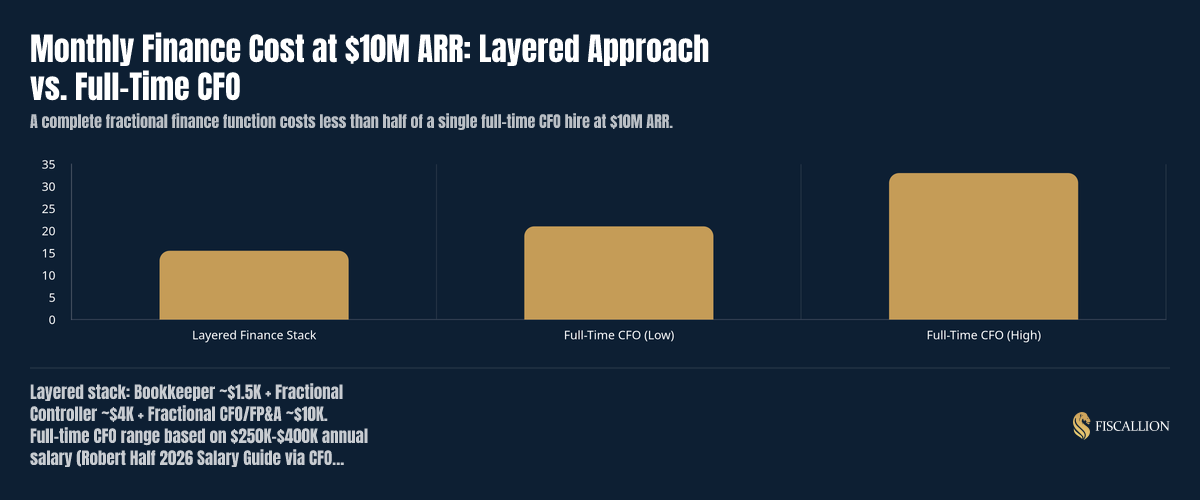
The headcount signal matters as much as the revenue number. When your one internal finance hire is drowning in monthly close and accounts payable work and has zero bandwidth left for the model, you have already outgrown what that role can deliver, regardless of your ARR. Three specific signs you've outgrown a bookkeeper-only setup: monthly close takes more than 15 business days, you cannot produce a cash flow forecast on demand, or your board is asking questions your finance function cannot answer.
What an FP&A agency adds beyond your bookkeeper and CPA
Your bookkeeper and CPA are essential, and an FP&A agency is not a replacement for either. It is a different layer that depends on the first two being accurate.
Your bookkeeper handles the recording layer: transactions, reconciliations, and making sure the raw data is correct. Your CPA handles compliance and tax, including whether your revenue recognition follows ASC 606 and whether your filings are defensible if you're audited or acquired.
An FP&A agency handles a third layer neither of them is built to cover: forward-looking models, scenario planning, and a decision cadence that turns your numbers into choices. It owns the assumptions behind your forecast, not just the historical record behind your statements.
Concretely, that means an FP&A agency will:
- Build and maintain a cash-linked forecast model that updates as actuals come in, not a static spreadsheet built once for a board meeting
- Define the metrics everyone in the company uses consistently, so Sales, Finance, and the board are looking at the same numbers
- Run a decision cadence that matches how fast the business actually needs to decide, rather than a generic monthly check-in
- Frame trade-offs for hiring, pricing, and growth spend as ranges and scenarios, not single point estimates
The most expensive sequencing mistake is not hiring FP&A too late. It is hiring the wrong level of finance help for the problem you actually have, which usually means bringing in strategic judgment before the underlying data can support it, or leaving strategic judgment out entirely while the bookkeeping layer gets more and more attention.
One-time project or ongoing retainer: match the model to your problem
Both engagement models exist, and the right choice depends on what triggered the need.
A project engagement fits a scoped, time-boxed problem: rebuilding a model from scratch ahead of a raise, producing a board pack for a specific meeting, or building a cash forecast for a diligence process. These typically run six to twelve weeks with a defined deliverable and end date.
A retainer engagement fits ongoing decision support: rolling forecasts, a monthly board reporting rhythm, and a standing decision cadence that doesn't reset every quarter. This is the standard model for founders who have moved past a single trigger event into continuous operating complexity.
Retainer pricing in the market runs across tiers based on scope, from core packages in the $2,000 to $3,500 per month range up to board-level engagements at $8,000 to $12,000 or more, depending on complexity and reporting cadence. Hourly billing is uncommon in serious FP&A work, because it penalizes efficiency and adds friction to exactly the strategic conversations that matter most.
Expect the first 30 to 60 days of any engagement to be diagnostic: auditing your metric definitions, reconciling data sources, and building the cash-linked model that everything else depends on. Real operating impact, meaning a decision cadence the team actually relies on, tends to show up in months three through six, not week one.
At Fiscallion, every client works directly with Aleksandar Stojanovic at the CFO layer, whether the engagement is a scoped project or an ongoing retainer. There is no account manager layer between you and the person making the judgment calls on your model.
Book an FP&A model review with Aleksandar
If any of the seven triggers above sound familiar, the fastest way to find out what your specific model needs is to look at it directly with someone who brings FP&A leadership experience gained through scaling a SaaS company to €100M ARR. Book an FP&A model review with Aleksandar and walk through your current forecast, board reporting, or hiring model together.
Can an FP&A agency work with your existing QuickBooks and billing setup?
Yes, and this is a common point of hesitation that shouldn't be. A competent FP&A agency builds the forecasting layer on top of your existing stack. It does not require you to migrate your general ledger or replace your billing system first.
What matters more than tool choice is data hygiene. QuickBooks paired with Stripe is the most common stack for SaaS companies in the $5 to $15M ARR range, and it works fine as a foundation, provided the revenue data flowing into it is structured correctly.
The strain shows up around revenue recognition, not the tools themselves. Manual reconciliation between Stripe and QuickBooks becomes untenable around $10 to $15M ARR, and QuickBooks Online Plus cannot automatically handle deferred revenue the way QuickBooks Online Advanced can with native recognition scheduling. That gap is real, but it's a signal for a targeted fix, not a reason to delay engaging FP&A support.
The scale of the underlying problem is larger than most founders assume: 41% of SaaS companies under $10M ARR lack a compliant revenue recognition process, according to Bessemer's State of the Cloud research. An FP&A agency's job in that situation is to build the forward-looking model on the cleanest available version of your data, and flag where the underlying data needs a fix, not to force a tool migration before doing any strategic work.
The cost of waiting
Decisions made without FP&A support don't disappear. They still get made, just through intuition instead of a model, and the financial consequences compound quietly until a board meeting or a fundraise forces them into the open.
Capital misallocated through a bad hiring decision or an underpriced plan does not correct itself on its own. It shows up later as a shorter runway, a harder fundraising conversation, or a board that has lost confidence in the numbers.
The instinct to delay usually gets framed as a resource decision, something you'll invest in once you can "afford it." That framing treats FP&A as a cost center rather than what it actually is: a decision-quality investment that determines whether your capital, hiring, and pricing choices are defensible when someone finally asks you to defend them.
Frequently asked questions
We already have a bookkeeper and a CPA — what does an FP&A agency add that they don't cover?
Your bookkeeper and CPA cover the backward-looking layers of finance: accurate transaction records and compliant financial statements. Neither role is built to own forward-looking assumptions.
An FP&A agency adds the forecasting layer: a cash-linked model that updates with actuals, scenario planning for hiring and pricing decisions, and a decision cadence that turns your numbers into choices instead of just a historical record. It depends on your bookkeeper and CPA doing their jobs well, but it does a different job entirely. If your books are inaccurate, fix that first; a forecast built on bad data gives you a confident wrong answer, which is worse than no answer at all.
At what ARR or headcount stage does it make sense to bring in an FP&A agency versus keeping forecasts in-house?
There is no single revenue number that triggers this decision, but the consensus across founders and finance operators lands in a similar range. Below roughly $2M ARR, a bookkeeper and CPA are usually sufficient, with FP&A support only needed on a project basis for a specific raise. Between $2M and $5M ARR, a controller becomes critical and fractional FP&A support starts paying off if you're raising or facing board pressure.
The most common inflection point sits in the $5M to $15M ARR range, where decision complexity outpaces what an internal team can absorb, and one avoidable hiring or pricing mistake can cost more than a year of an FP&A retainer. The headcount signal matters just as much: if your one internal finance hire is buried in monthly close and has no time left for modeling, you've outgrown a bookkeeper-only setup regardless of your specific ARR number.
Is an FP&A agency engagement a one-time project or an ongoing monthly retainer?
Both models exist and fit different problems. A project engagement, typically six to twelve weeks, fits a scoped need like rebuilding a fundraising model, producing a board pack, or preparing a cash forecast for diligence. A monthly retainer fits ongoing decision support: rolling forecasts, a standing board reporting rhythm, and a decision cadence that persists across quarters instead of resetting.
Retainer-based work is the standard model for founders who need continuous support rather than a single deliverable. Expect the first 30 to 60 days of either model to be diagnostic, auditing your metric definitions and building the underlying model, with the real operating impact showing up over the following few months.
Can an FP&A agency work with our existing QuickBooks and billing setup, or do we need to migrate to new tools first?
You don't need to migrate tools before starting. A competent FP&A agency builds the forecasting layer on top of your existing stack, most commonly QuickBooks paired with a billing tool like Stripe, which remains the standard setup for SaaS companies through roughly $15M ARR.
What matters more than the specific tools is data hygiene, particularly around revenue recognition. Manual reconciliation between billing and accounting systems tends to break down as you approach $10M to $15M ARR, and a meaningful share of SaaS companies under $10M ARR lack a fully compliant revenue recognition process. An FP&A agency's role is to build a defensible model on your current stack and flag specific data fixes as they come up, not to require a system migration as a prerequisite for strategic work.
We already have finance tools and AI dashboards — do we still need a fractional CFO partner?
Your AI tools can surface patterns and automate reporting, but they cannot own the assumptions behind your forecast, pressure-test a hiring plan against your cash position, or stand behind the model when a board member challenges it. A fractional CFO partner brings the accountability layer that no tool provides on its own — the person who decides which outputs should change your decision and which are noise. The tools are inputs; the partner is the layer that turns those inputs into decisions someone actually stands behind.
The decision, not the deck
The question was never whether your company is "big enough" for FP&A. It's whether the decisions you're making this quarter, on cash, hiring, pricing, or the next raise, can survive being asked to show their assumptions.
If a board question, a hiring plan, or a fundraising deck would make you uncomfortable under real scrutiny right now, that discomfort is the trigger. Waiting for a revenue milestone to feel "ready" just means making more decisions on intuition in the meantime, and those decisions compound whether or not anyone is tracking them.