

Your financial model is the first piece of finance infrastructure that breaks, and it usually breaks quietly. The signal isn't company size - it's whether your model can survive being asked to show its assumptions. If it can't answer a scenario question without a rebuild, if three people in your company would give you three different cash numbers this week, or if your board deck reports history instead of framing a decision, the model has already failed. This article walks through the specific signs, who should own the model versus who shouldn't, the full-time-versus-partner decision, and exactly what to prepare before you bring in outside help.
Why the financial model is the first thing that breaks
A financial model is not a spreadsheet you check once a quarter. It's the artifact that forces you to state, in numbers, how your business actually works: what drives revenue, what drives cost, and what happens to cash when either one moves.
"When that artifact is missing or unreliable, decisions don't stop happening. They just stop being analytical."
— Aleksandar Stojanovic, CEO & Founder at FiscallionHiring gets approved because "we hit our ARR target," not because the model showed you could afford the headcount against your cash position. Pricing gets debated in Slack instead of tested against a margin scenario.
The question worth asking isn't "are we big enough to need outside help." It's narrower and more useful: can your model answer a hard question right now, or does someone have to rebuild it first. That distinction is what the rest of this article is built around.
What follows answers four questions in sequence: the specific signs your model has outgrown internal capacity, whether your accountant or bookkeeper can be the one to fix it, whether the right move is a full-time hire or an outside partner, and what to have ready before that engagement starts.
Signs your SaaS financial model needs outside help
These are not vague maturity signals. Each one is a specific failure mode you can check against your own model this week.
Your model can't answer a scenario question without a rebuild. If a board member asks "what happens to runway if churn hits 8% instead of 5%," and the honest answer is "give us a few days," the model isn't a decision tool. It's a static report dressed up as one.
Cash flow visibility has collapsed into competing numbers. When your bookkeeper, your ops lead, and your bank balance each imply a different cash position in the same week, you don't have a cash problem yet. You have a single source of truth problem, and it will become a cash problem the first time you act on the wrong number. Inflection CFO frames this precisely: cash forecasting becomes guesswork the moment you can't answer runway questions past 30 days or model the cash impact of a new hire.
You can't state your runway in one sentence with a confidence range. "About a year, give or take" is not a runway number. It's an admission that the model hasn't been stress-tested against committed spend. GroundworkCFO documents a real case where a founder believed they had 14 months of runway; once committed hires, software renewals, and churn were accounted for, the real number was 8.5 months.
Board reporting narrates the past instead of framing the next decision. If your board meetings end with "let's follow up on that" instead of a decision made in the room, the deck is doing history, not analysis.
CAC and LTV get re-debated every quarter instead of driving action. If your unit economics are calculated but nobody can explain why they moved, or what to do differently next quarter because of it, the numbers exist but aren't being used.
Headcount decisions get approved on growth targets, not modeled capacity. Approving a hiring plan because "we need to hit the number" skips the step where you check whether cash and margin can actually absorb it.
The model gets rebuilt from scratch every fundraise. If nothing survives between rounds, you're not maintaining a model, you're producing a one-time artifact for investors and letting it die afterward.
CRV ties some of this to revenue stage: fractional support is generally appropriate at $1-3M ARR, financial decisions start outpacing founder or part-time capacity around $8M ARR (which tends to coincide with Series B prep), and $15-20M ARR is the outer edge of running without dedicated finance leadership of some kind. But CRV is careful to note that revenue is a proxy, not the trigger. The real triggers are fundraising timelines that need six to twelve months of clean, defensible numbers, business model complexity (marketplaces and fintech-adjacent models need finance sooner), and growth rate, since faster growth compresses how much runway you have to fix a broken model before it matters.
Can your accountant or bookkeeper build your SaaS financial model?
This is the question founders ask most often, and the honest answer is: usually no, not because of skill, but because of orientation.
Finance work sits in three layers that answer different questions:
| Layer | Role | Question it answers | Orientation |
|---|---|---|---|
| Recording | Bookkeeper | What happened, transaction by transaction | Backward-looking |
| Reporting | Accountant / controller | Is the historical record accurate and compliant | Backward-looking |
| Strategy | FP&A / CFO partner | What should happen next, and what does it cost | Forward-looking |
Ramp's breakdown of FP&A versus accounting makes the distinction cleanly: accounting is past-oriented, rules-driven, and built for precision against a known standard. FP&A is future-oriented, built on rolling forecasts, scenario models, and analytical judgment about what hasn't happened yet. Those are different skills, not different levels of the same skill.
City Shift Finance puts it more directly: asking a controller or accountant to also produce forward-looking analysis "rarely works, not because of capability but because the two functions require different orientations." A controller who closes your books flawlessly every month may have no practice building a defensible churn scenario, because that has never been their job.
There's also a stack-order problem. GetAFractional describes the correct sequence as records, then reporting, then forecast, then decision. If your books are unreconciled or you don't know your last closed month, hiring someone to build a forecast on top of that is building on sand. Fix the layer underneath before adding a layer on top.
This also explains why boards and investors push back on accountant-built models. BlackpeakCFO notes that accountants produce GAAP-compliant statements, while investors expect SaaS-specific models with MRR waterfalls, cohort-based retention, unit economics like LTV:CAC and CAC payback, and a bottom-up three-year projection. Series A investors typically look for at least a 3:1 LTV:CAC ratio and CAC payback under 18 months. Those aren't accounting outputs. They're FP&A outputs, built by someone whose job is to model forward, not close backward.
None of this means your accountant or bookkeeper is dispensable. They're the foundation the model sits on. It means the model itself, the forward-looking, scenario-driven layer, needs an owner whose job is specifically that.
Full-time finance hire vs outside financial modeling partner
Once you've established that the model needs a dedicated forward-looking owner, the next decision is whether that owner should be a full-time hire or an outside partner. This is where most founders either overcorrect (hire too senior, too early) or under-invest (leave the gap open too long).
The cost gap is larger than most founders expect. At roughly $10M ARR, a complete fractional finance stack, bookkeeper, fractional controller, and fractional CFO combined, runs in the range of $15,500 per month, or about $186,000 per year. A full-time CFO at growth stage typically costs $250,000 to $500,000 or more all-in once salary, bonus, and equity are included, and takes three to six months to ramp before delivering full value. Inflection CFO puts fractional CFO retainers in the $8,000-$15,000 per month range and full-time cost around $150,000-$250,000 all-in, with the fractional model generally holding up to roughly $20M ARR before complexity outgrows it.
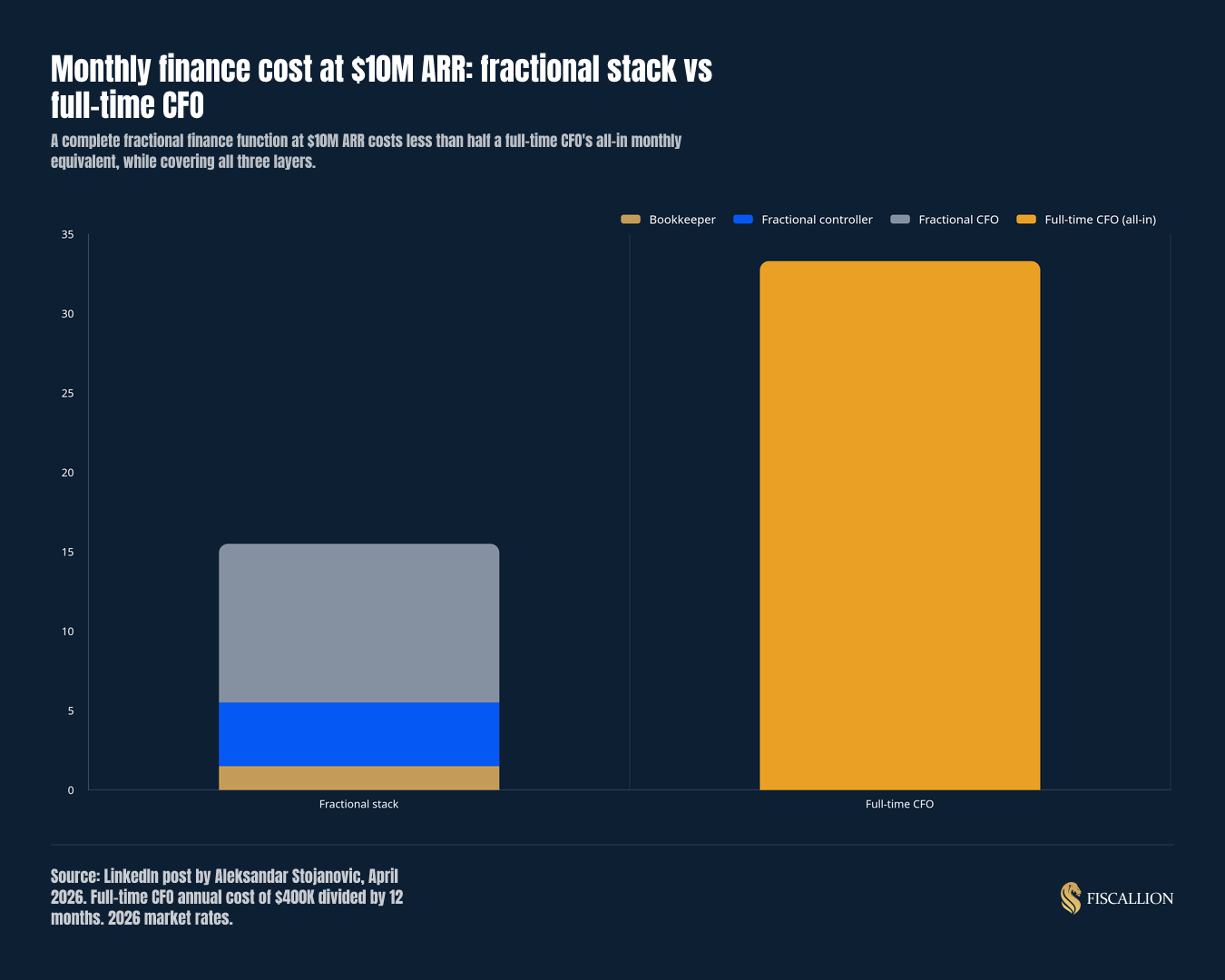
Full-time is premature below a threshold most companies haven't hit yet.CFO Advisors suggests fractional CFO plus controller is usually the right call through the $2-8M ARR range, with a shift toward full-time VP Finance or CFO becoming common past $8M ARR as complexity increases. But "common" isn't universal, and hiring a full-time CFO before the company has the daily workload to justify it means that expensive hire spends a meaningful share of their time on work a controller should be doing.
Three specific conditions signal you've actually outgrown fractional support, rather than just grown revenue:
- Financial decisions requiring CFO-level judgment are happening daily, not monthly (active M&A, complex capital structure)
- Your finance team has grown to 10 or more people who need day-to-day management
- The sheer complexity and workload of the finance function requires a full-time executive presence, not periodic strategic input
"Before those conditions exist, a full-time CFO hire tends to add reporting polish without fixing the underlying decision-quality problem, because the problem was never "we don't have someone senior enough." It was "we don't have a model and a cadence.""
— Aleksandar Stojanovic, CEO & Founder at FiscallionThe sequencing mistake compounds the cost problem. Hiring a person before building the system means a new full-time CFO spends their first several months fixing data hygiene and building the model from scratch, work an outside partner would have already done. You end up paying full-time compensation for what is, functionally, still an infrastructure-building phase.
What an outside financial modeling partner delivers instead is specific: a cash-linked model tied to your actual accounting data, metric definitions that stop the board-meeting arguments about what CAC means, a recurring decision cadence instead of ad hoc reporting, and scenarios framed as trade-offs rather than a single static forecast.
This is the core of how Fiscallion works. Every engagement is led directly by Aleksandar Stojanovic at the CFO layer, not handed to an account manager or a junior analyst team. You get senior FP&A judgment on the model itself, plus the hands-on ownership to keep it maintained between board meetings and fundraising cycles, without carrying full-time CFO compensation before the workload justifies it.
What to prepare before bringing in outside help
The single biggest lever you control in how fast an outside partner becomes useful is how organized your inputs are on day one. You don't need it perfect. You need it available.
Financial documents. Gather your profit and loss statement, balance sheet, and cash flow statement, ideally 12 to 24 months of history. Include any existing forecasts or budgets, even informal ones. Greyt's preparation checklist is explicit that this doesn't need to be polished; it needs to exist somewhere accessible.
System access. Have your accounting software, bank and credit card access, and payroll platform ready to grant. A partner can't build a cash-linked model without seeing the actual cash movement.
Business context. Pull together your chart of accounts, any existing investor reports or board decks, debt or equity agreements, and a simple picture of how your finance function is currently structured, even if that structure is "just me and a bookkeeper."
Priorities, stated explicitly. Define the top two or three financial priorities for the next six to twelve months. That might be improving cash visibility, preparing for a fundraise, or building forecasting capability from a standing start. A partner working against a stated priority moves faster than one working against a vague request for "better reporting."
An honest list of decisions you can't confidently make today. This is the most useful preparation step and the one founders skip. Write down the specific decisions currently blocked by financial uncertainty, whether you can afford a hire, whether a price increase holds margin, how long your runway actually is. That list becomes the actual scope of the engagement.
You don't need everything perfect before you start. As Greyt puts it, the more organized you are going in, the less time gets spent on discovery and the sooner the model starts producing decisions instead of questions.
Take the financial-model readiness diagnostic
If two or more of the signs above sound familiar, the fastest way to find out exactly where the gap is isn't to guess. It's to run your model against a structured readiness check.
Fiscallion offers an open financial-model readiness diagnostic built to identify precisely where your current model breaks down, whether that's cash visibility, scenario capability, board-ready framing, or unit economics you can actually explain. It's built to answer one question: where specifically does your model need outside support, and where doesn't it.
If you want to see how this connects to ongoing reporting and board cadence rather than a one-time fix, explore Fiscallion's KPI dashboards and reporting service.
Frequently asked questions
What are the signs my SaaS company needs outside help with its financial model?
The clearest signs are a model that can't answer a scenario question without being rebuilt, cash numbers that differ depending on who you ask, an inability to state runway in one sentence with a confidence range, board decks that report history instead of framing a decision, unit economics that get debated but not used, headcount decisions approved without checking modeled cash capacity, and a model that gets rebuilt from scratch at every fundraise instead of being maintained. Any single one of these is worth addressing. Two or more happening at once usually means the model has already stopped functioning as a decision tool.
Can my existing accountant or bookkeeper build and maintain my SaaS financial model?
Generally, no, and this isn't a capability gap so much as an orientation gap. Bookkeepers and accountants are backward-looking by design: their job is to record and report what already happened accurately and in compliance with accounting standards. A financial model is forward-looking: it requires building scenarios, defending assumptions about what hasn't happened yet, and updating projections as conditions change. Those are genuinely different skill sets. Your accountant or bookkeeper remains essential as the foundation the model sits on, since a forecast built on inaccurate underlying data will be wrong no matter who builds it. But the forward-looking model itself typically needs an owner whose specific job is FP&A, not a bolt-on task for someone already doing a different job.
Is it better to hire a full-time finance hire or work with an outside financial modeling partner?
It depends on whether your financial complexity and daily workload have actually outgrown fractional support, not on your revenue alone. A full-time CFO makes sense when financial decisions requiring CFO-level judgment are happening daily, when your finance team has grown large enough to need full-time management, or when overall complexity requires a permanent executive presence. Below that threshold, a full-time hire at typical growth-stage compensation often ends up doing infrastructure-building work that an outside partner would have already completed, while costing several times more than a fractional arrangement covering the same ground. The right comparison isn't "cheaper versus better." It's whether your current workload justifies a permanent, full-time seat, or whether senior judgment applied on a fractional basis solves the actual problem you have right now.
What should I have prepared before bringing in outside help for my SaaS financial model?
Have your profit and loss statement, balance sheet, and cash flow statement ready, ideally with 12 to 24 months of history and any existing forecasts, even informal ones. Prepare to grant access to your accounting software, banking, and payroll systems. Pull together context like your chart of accounts, existing board decks or investor reports, and any debt or equity agreements. Most importantly, write down your top two or three financial priorities for the next six to twelve months and an honest list of decisions you currently can't make confidently because of financial uncertainty. None of this needs to be polished. The goal is availability, not perfection, since the more organized your inputs, the less time gets spent on discovery before the model starts producing usable answers.
The decision that actually matters
The question was never whether your company is big enough to deserve outside financial help. It's whether your current model can survive being asked a hard question, and whether the person maintaining it is oriented toward the past or the future.
Get the layers right, recording, reporting, and strategy, owned by the right people in the right sequence, and the full-time-versus-partner decision becomes much easier to make on its own merits.