A startup cash investment policy is a short written document that sets where company cash may sit, in which instruments, at what maturities, who approves changes, and how often the board reviews it. Adopt one before idle cash moves anywhere.
The decision in front of you is simple: who is allowed to move cash out of the operating account, and under what rules? Without a written answer, that decision gets made ad hoc, usually under pressure.
This article gives you an open template you can copy, edit and put in front of your board. It covers governance. It does not recommend specific funds, providers or yields.
What this template covers
- The definition and the board's role: what the policy is and why the board approves it.
- Bucket sizing: how to split cash by the date you need it.
- The policy text: liquidity buckets, permitted instruments, maturities, approvals and monitoring, written so you can paste them.
- A worked example: two illustrative allocations, labeled as vendor guidance.
- Common mistakes: the failure patterns and the replacement move for each.
Why the board approves the policy before you invest
Andreessen Horowitz states the governance point directly in its guide to founder cash management: "As a best practice, you should draft a simple investment policy and have your Board approve it before you move forward with implementing a broader investment strategy."
"That sequence matters. The policy is not a yield strategy. It is a constraint that exists so a single person cannot take a risk the board never agreed to."
— Aleksandar Stojanovic, CEO & Founder at FiscallionThe a16z crypto team also published a treasury management guide that sets the priority order for the policy: capital preservation, liquidity, and income, in that order. Write that order into the first paragraph of your policy. Every later rule should be testable against it.
Where the policy sits matters too. It lives above the ledger. Your accountant records balances; the policy decides what is allowed to happen to them. Treasury software manages where cash sits and who can move it, while forecasting models where cash will be. The policy is the governance layer that tells both what the limits are.
How to size the buckets: start with the date you need the cash
Operating cash versus strategic cash is the cleanest starting split. a16z defines operating cash as everything needed to run the business for the next 12 months, such as salaries, rent and interest payments, and says it belongs in a deposit account. Strategic cash is money you do not need for a longer period, and it can go into a yielding account such as a money market fund.
The a16z crypto guide goes further on coverage. It says teams should hold at least 12 months, ideally 18 months, of operating expenses in a basic cash account, meaning a bank deposit or money market account. Excess cash can then move to incremental-yield instruments.
To size your buckets, work through these steps:
- Calculate monthly net cash burn from your forecast, not from last quarter's bank statements.
- Multiply by the number of months of coverage the board wants in the operating bucket. Pick a number and write it into the policy.
- Subtract that amount from total cash. What remains is the candidate for the short-term and strategic buckets.
- If the remainder is zero or negative, stop. All cash stays in deposit accounts and the policy is a short document.
- Only where runway exceeds 12 to 18 months does a16z suggest considering a laddered portfolio of 6-12 month instruments, such as U.S. Treasuries, bonds or commercial paper, for near-term expenses.

Founders should also keep a daily view of liquid cash. a16z notes that accounts receivable is not cash until it is received, so do not count it toward a bucket.
The bucket table
Mercury, which sells banking and treasury products, describes a three-bucket framework. Treat it as vendor guidance, not independent evidence. It is a useful structure for the policy because each bucket is defined by when the cash is needed.
| Bucket | Purpose | Mercury's suggested home |
|---|---|---|
| Liquid | Cash for the next 3-6 months | FDIC-insured checking using sweep networks |
| Short-term | Cash needed within 3-12 months | U.S. Treasury bills, government money market funds, short-duration Treasury ladders |
| Strategic | Excess capital beyond 12 months of forecasted needs | 1-3 year laddered Treasuries, agency securities, diversified mutual funds |
Mercury also gives a stage pattern: early-stage companies typically keep 6-12 months of burn liquid, while growth-stage companies often operate with 3-6 months of liquid cash and place larger balances in laddered Treasuries and money market funds.
Note the tension with a16z. a16z draws the operating line at 12 months and recommends 12-18 months in basic cash. Mercury's liquid bucket is shorter. Your board has to choose, and the policy should state the chosen number, not a range.
The policy template, section by section
Copy the text below into your board folder. Replace the bracketed fields with the numbers your board agrees on. The fields are blank on purpose: the right figures depend on your burn, your runway and your risk tolerance.
1. Purpose and priorities
- Purpose: To govern how [Company] holds, invests and monitors its cash.
- Priority order: Capital preservation first, liquidity second, income third. Where two rules conflict, the higher priority wins.
- Scope: All cash and cash equivalents held in any bank, brokerage or fund account in the company's name.
2. Liquidity buckets
| Bucket | Coverage rule (board sets) | Permitted holdings |
|---|---|---|
| Operating | [__] months of forecast operating expenses | Bank deposit accounts, money market accounts |
| Short-term | Cash forecast to be needed after the operating period, within [__] months | Instruments listed in section 3 with maturity inside the limit in section 4 |
| Strategic | Cash beyond all forecast needs through [__] months | Instruments listed in section 3 with maturity inside the limit in section 4 |
Rule: if forecast burn rises or runway shortens, the Finance Lead moves cash back toward the operating bucket first and reports the move at the next review.
3. Permitted instruments
| Category | Permitted? | Condition |
|---|---|---|
| Bank deposit accounts | Yes | Bank approved by the board; exposure limit per institution of [__] |
| Money market accounts and funds | Yes | Government or prime as the board specifies |
| U.S. Treasury bills and notes | Yes | Within the maturity limits in section 4 |
| Investment-grade fixed income | Strategic bucket only | Rated BBB or higher; diversified across maturities, credit quality, sectors and issuers |
| Commercial paper and bonds | Only if runway exceeds [__] months | Board pre-approval required |
| Equities, crypto, private securities, derivatives | No | Not permitted under this policy |
The BBB-or-higher rating floor and the diversification dimensions come from the a16z crypto guide, which describes them as the typical approach for traditional companies investing excess cash. Name the categories, not the providers. A provider change should never require a policy rewrite.
Check protection at the account level. FDIC coverage for eligible corporate deposits generally combines the corporation’s deposits at each insured bank, up to $250,000. SIPC protects missing customer cash and securities at a failed member brokerage, subject to a $500,000 limit including up to $250,000 for cash. SIPC does not protect against investment losses. A money market deposit account and a money market mutual fund are different products; establish which one you hold before recording its protection.
4. Maturities and liquidity coverage
- Operating bucket: no maturity. Funds available same day.
- Short-term bucket: maximum single-instrument maturity of [__] months.
- Strategic bucket: maximum single-instrument maturity of [__] months; laddered so a portion matures on a regular schedule.
- Coverage floor: operating bucket never falls below [__] months of forecast operating expenses without written notice to the board.
For the underlying principle, a16z says the fundamental tenet of managing liquidity as a startup is that timing and maturity matter. Match every instrument's maturity to a date in your forecast, not to a yield.
5. Approvals
| Action | Authority |
|---|---|
| Adopt or amend this policy | Board |
| Add a new instrument category or institution | Board |
| Move cash between buckets within policy limits | Finance Lead, reported at next review |
| Open or close accounts, add signers | CEO plus [second approver] |
| Any exception to a limit | Board chair in writing, ratified at next meeting |
State who drafts the policy (the CFO or finance lead), who owns it day to day, and who reviews exceptions. Frame the approval as a board choice: the board is not endorsing a market view, it is setting the boundaries inside which management has discretion.
6. Monitoring and review
| Cadence | Activity | Owner |
|---|---|---|
| Weekly | Review cash position and near-term inflows and outflows | Finance Lead |
| Monthly | Reconcile bucket balances against policy limits; log any breach | Finance Lead |
| Quarterly | Board review of bucket balances, exceptions and policy fit | CEO and Finance Lead |
| On a trigger | Re-review after a financing, a major forecast change or a bank event | Board |
This cadence connects to your forecast. A short-horizon direct model tracks operational liquidity, and a longer-horizon indirect model informs runway and capital allocation. Each assumption in those models should have a named owner. The same applies here: every limit in the policy needs one person accountable for it.
Alex Stojanovic’s finance-cadence post shows how recurring checks support operating decisions. Use that ownership discipline here: identify who checks each cash limit and who brings an exception to the board.
A worked illustration with vendor numbers
Mercury’s cash-management guide provides the two examples below. They illustrate a vendor’s framework, rather than observed market averages or allocation targets for your company.
| Company | Total cash | Monthly burn | Liquid | Short-term | Strategic |
|---|---|---|---|---|---|
| Early-stage | $500K | About $50K | $300K | $200K | $0 |
| Growth-stage | $5M | About $300K | $1.8M | $2.2M | $1.0M |
The pattern is the useful part. The early-stage company has nothing in the strategic bucket because it has nothing beyond its forecast needs. The growth-stage company holds a strategic balance only because its forecast shows cash it will not need soon.
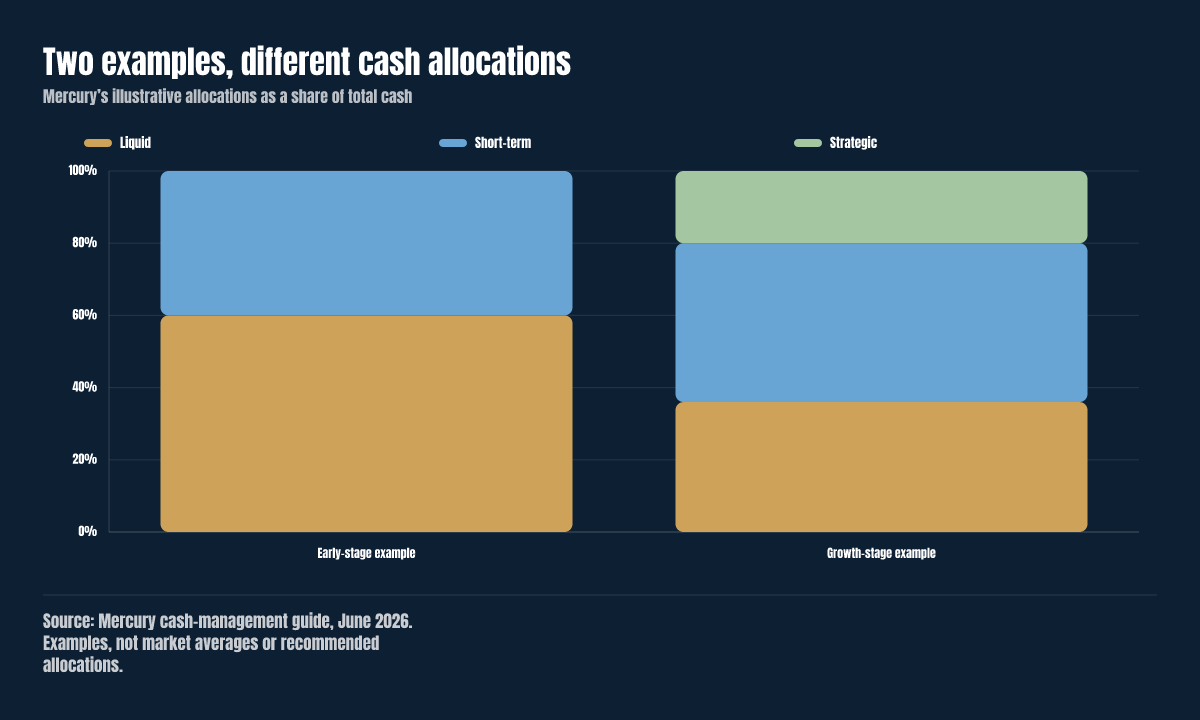
The chart converts the example amounts into percentages of each company’s total cash. The table above retains the dollar amounts and burn assumptions.
How to interpret the policy against your runway
Treat the policy as a test of your forecast. If you cannot say how many months of operating expenses sit in the operating bucket today, your cash visibility is the problem, not your instrument list.
Historical context: Silicon Valley Bank’s State of the Markets H1 2025 report says the typical Series B company that raised capital in 2024 increased its burn by 8% year over year. That is a dated finding for fundraising companies, not a current benchmark for all startups. Your policy should move cash toward near-term needs whenever your own forecast burn rises.
Use this reading guide:
- Strategic bucket empty: correct if forecast needs absorb all cash. Do not invest to fill it.
- Operating bucket below the floor: a breach. Report it, then move cash back.
- Large strategic balance and short runway: your forecast and your allocation disagree. Fix the forecast assumption or the allocation before the next board meeting.
What to do next
Move in this order:
- Pull your latest monthly net burn and your cash by account.
- Choose the operating coverage number with your board chair, using the a16z 12-18 month rule and your own risk tolerance as the starting point.
- Fill the bracketed fields in the template and strip any instrument category you would not explain to your board.
- Send the draft with the board pack and put approval on the agenda as a decision, not an update.
- Schedule the weekly, monthly and quarterly reviews now, with a named owner for each.
Copy the template above into your board folder and fill in the bracketed fields. It is open, readable in full here, and requires no form or email gate. If you want a senior finance partner to build the underlying cash model and board pack that the policy depends on, see how Fiscallion approaches financial modeling and board reporting.
Common mistakes and replacement moves
| Mistake | Replacement move |
|---|---|
| No written policy until a bank event forces one | Adopt the one-page policy while cash is calm, and review it quarterly |
| One bucket for all cash | Split by the date the cash is needed: operating, short-term, strategic |
| Choosing instruments by yield | Apply the priority order: preservation, liquidity, income |
| Set-and-forget approval | Add a quarterly board review and trigger-based re-review |
| No named owner for limits | Assign one accountable person to each limit and each forecast assumption |
| Naming providers inside the policy | Name categories and criteria, and keep providers in an approved list the board can change |
The most common error is the second one. A single pool of cash makes every withdrawal look the same, so a payroll run and a long-dated holding compete for the same dollars.
Who owns the policy: your finance lead, with senior CFO judgment
"A policy only works if someone owns it between board meetings. That person reconciles bucket balances, logs breaches and brings exceptions to the board before they become surprises."
— Aleksandar Stojanovic, CEO & Founder at FiscallionIf you do not have a full-time CFO, a fractional CFO can hold that role: model ownership, board preparation and the judgment on trade-offs between runway and yield. Each Fiscallion client works directly with Aleksandar Stojanovic at the CFO layer, with senior-partner ownership on every engagement, not a handoff to an account manager or junior team. Fiscallion works above the ledger and is not a bookkeeping firm, so your existing accountant keeps the books while the policy and forecast sit with the CFO layer.
A full-time CFO becomes the better fit when you need daily executive presence and a permanent internal finance organization.
FAQ
What liquidity buckets should a startup divide its cash reserves into?
Use three buckets defined by when you need the cash: operating, short-term and strategic. a16z separates operating cash, needed over the next 12 months, from strategic cash held longer. Mercury's vendor framework uses liquid (next 3-6 months), short-term (3-12 months) and strategic (beyond 12 months of forecast needs). Have the board set the exact coverage numbers and write them into the policy.
Which financial instruments are appropriate for a startup cash investment policy?
The permitted list should be short and named by category. Deposit accounts and money market accounts suit operating cash. Treasury bills and laddered Treasuries fit the short-term and strategic buckets. The a16z crypto guide describes investment-grade fixed income rated BBB or higher, diversified across maturities, credit quality, sectors and issuers, as the typical approach for excess cash. List what is permitted and everything else is excluded. This article does not recommend specific products.
How often should a board review and update the startup cash investment policy?
Review it quarterly with the board pack, and re-review it after a financing, a major forecast change or a bank event. The sources in this article do not prescribe a review frequency, so treat this as a recommended cadence, not a benchmark. Between meetings, run a weekly cash review and a monthly check of bucket balances against policy limits.
Can we adopt a cash investment policy if we already work with a bookkeeper or fractional CFO?
Yes. The policy is a governance layer and does not replace either role. Your bookkeeper keeps the ledger accurate. A fractional CFO can draft the policy, own the forecast it depends on and prepare the board approval. The board still approves it and owns the risk limits.
Keep institution concentration and payment continuity in a separate bank cash-access contingency plan. An approved investment policy sets the limits; the contingency plan tests whether operating payments can still run.
The decision to take to your next board meeting
Put one question on the agenda: do we approve a written policy that defines buckets, instruments, maturities, approvers and review cadence? If the answer is yes, every later cash move has a rule to test against. If the answer is no, you are choosing ad hoc decisions on purpose.
Start with the operating bucket. Once the board agrees on how many months of expenses must stay in basic cash, the rest of the template follows from your forecast.