
Outsourced board reporting is an engagement where a senior finance partner outside your company owns the driver-based model, the forecast cycle, and the recurring board pack, turning your closed books into a decision-ready document instead of a historical recap.
You're reading this because your board deck currently takes days to build, gets debated on definitions before it gets debated on decisions, or arrives too late for anyone to act on it. That's a buy-versus-build decision, and it has a concrete answer.
Outsourced board reporting services for SaaS companies typically include four things: a board-ready pack built around a fixed metric set, a build timeline of roughly 6 to 10 weeks, a monthly-to-quarterly reforecast cadence, and a cost structure that runs a fraction of a full-time hire. Here's what that actually looks like, and how to tell a strong provider from a weak one.
What you'll learn
- What belongs in a board-ready SaaS reporting package, and what stays in the appendix
- How outsourced board reporting differs from what your bookkeeper or accountant already delivers
- What the engagement looks like from scoping through steady-state cadence, with realistic timelines
- How to evaluate providers, including when a full-time CFO or a bookkeeping-only provider is actually the better fit
Reporting is not the problem. Your decision system is
Most boards don't stall because the numbers are wrong. They stall because nobody agreed in advance what "good" looks like, who owns which number, or what the board is actually being asked to decide.
A deck is a presentation artifact. A board pack is a decision document. An investor update is a relationship-maintenance tool. Treating all three as the same thing is why board meetings turn into definition debates instead of decisions.
A founder I work with used to spend three days building a 42-slide board deck before every meeting, most of it narrative padding around numbers nobody had pre-agreed on. The fix wasn't a better template. It was a five-number pre-read, a tighter deck, and a metric set with the same definitions every quarter, as detailed in a related post on Fiscallion's LinkedIn.
The bookkeeper-versus-CFO distinction: "Bookkeeping records what happened. A CFO decides what happens next. The two functions work together, but they are different jobs," as StartupCFO frames it. Outsourced board reporting sits on the CFO side of that line. It doesn't replace your bookkeeper or accountant. It uses their closed books as the input to a forward-looking model.
What a board-ready package includes
Boards don't need more slides. They need a consistent, minimal set of numbers that answers "are we on plan, and what do we do next."
The consensus across SaaS-specific benchmarking sources and Fiscallion's own delivery model converges on a short list, with everything else moved to appendix.
| Metric or section | Question it answers |
|---|---|
| ARR bridge (new, expansion, contraction, churn) | Where did growth or loss actually come from this period? |
| NRR and GRR | Is the existing customer base expanding or eroding? |
| CAC payback | How long until new customer spend is recovered? |
| Burn multiple and runway | How efficiently is cash being converted into growth, and how long do we have? |
| Gross margin | Is the unit economics trend improving or degrading? |
| Rule of 40 | Is growth plus profitability tracking to a healthy combined threshold? |
| Pipeline coverage | Is there enough pipeline to hit the next quarter's plan? |
| Performance vs. plan with variance explained | Where did we miss, and why? |
| Updated forecast | What does the plan look like now, not three months ago? |
| Two or three decisions needed from the board | What is the board actually being asked to weigh in on? |
This list matches independent research on what boards expect to see. Fairview's analysis of board deck metrics cites the Bessemer CFO Playbook's guidance to lead with NRR, show four-plus quarters of trend, and keep the metric definitions consistent meeting over meeting. Separately, PMGuru's review of growth-stage board reporting found that boards actually read five numbers: revenue versus plan, burn, pipeline, NRR, and runway, packaged into 10 to 12 slides with bad news stated up front and one explicit ask per meeting.
How outsourced board reporting differs from your bookkeeper or accountant
Your bookkeeper closes the books. Your accountant files taxes and keeps you compliant. Neither function is built to answer "what should we do about the burn multiple next quarter," and that's not a criticism of either role. It's a scope difference.
"Fiscallion's own positioning states it directly: accounting looks backward, FP&A looks forward. The work layers insight on top of closed financials, translating ledger data into forward-looking strategy rather than historical record-keeping."
— Aleksandar Stojanovic, CEO & Founder at FiscallionExternal sources back this up with the same distinction in different words. CFOmatrix puts it as "a bookkeeper records the past; a CFO shapes the future." CFO Advisors draws the same line: "unlike bookkeeping or accounting services, which record what already happened, CFO advisory work is forward-looking." The same source flags that firms like Pilot and Kruze are accounting services, not CFO firms, which is a useful category check when you're evaluating vendors that market themselves loosely as "financial support for startups."
In practice, this means your existing bookkeeper keeps doing their job unchanged. An outsourced board reporting partner sits on top of that output, builds the driver-based model, and owns the forecast, the variance analysis, and the board pack as one connected system rather than three disconnected deliverables.
What the engagement looks like, start to steady state
"A board reporting engagement has a predictable shape. Knowing the phases in advance helps you set expectations with your board about when the new format lands."
— Aleksandar Stojanovic, CEO & Founder at Fiscallion| Phase | What happens | Typical output |
|---|---|---|
| Scoping | Definitions get agreed: what counts as ARR, expansion, churn; what "on plan" means | A written metric dictionary, agreed once, reused every meeting |
| Model build (roughly 6-10 weeks) | Driver-based operating model built, 13-week cash flow constructed, metric definitions finalized | Working model plus first board pack |
| First board pack | The new format ships on the current board cycle | Board pack with ARR bridge, NRR/GRR, CAC payback, burn multiple, runway, variance, forecast, and the ask |
| Steady state | Monthly reforecast for cash and near-term revenue; quarterly reforecast for the full plan | Pack shipped roughly 7 days ahead of each meeting, questions pre-answered |
Fiscallion's own service scopes this at a one-time model build from $9,000 over 6 to 10 weeks, followed by ongoing forecasting and board reporting from $3,500 a month, fixed-fee and scoped in writing, for B2B SaaS companies between $5M and $50M ARR.
For context on deliverables you should expect from any serious provider at this stage, StartupCFO's overview of fractional CFO work lists the same core set: a 13-week cash flow forecast, a driver-based operating model, a board pack with financials and budget-versus-actuals variance commentary, KPIs, narrative, investor updates, and fundraising materials when needed.
What it costs relative to other options
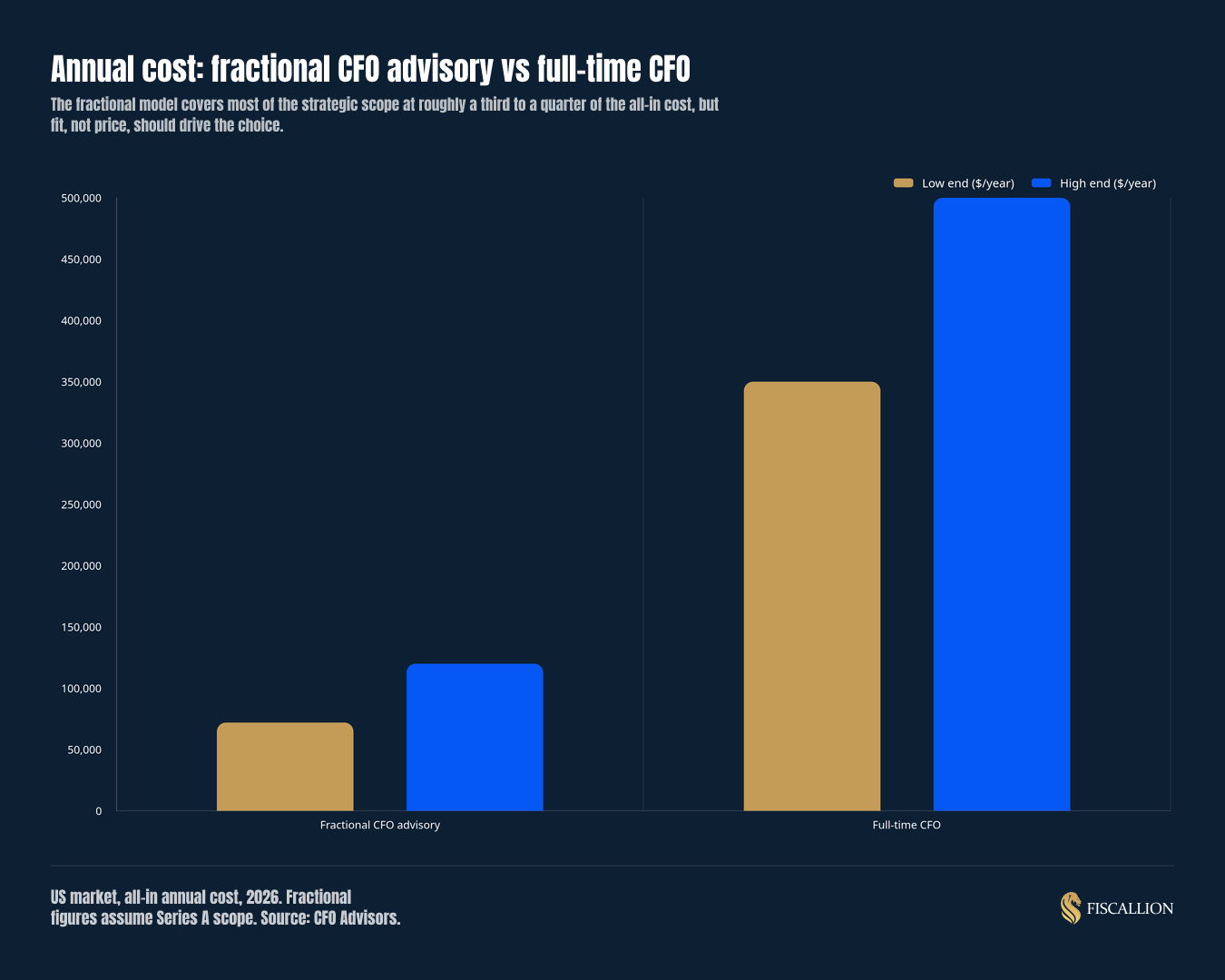
Market pricing for fractional CFO-level support varies by company stage. CFO Advisors' 2026 benchmarking puts monthly retainers at roughly $3,500 to $6,000 for seed-stage companies, $6,000 to $10,000 for Series A, $8,000 to $15,000 for Series B, and $12,000 to $25,000 for Series C and beyond. A full-time CFO hire, by comparison, runs $350,000 to $500,000 or more all-in per year, with a 3 to 6 month ramp before they're fully productive, versus a 2 to 4 week ramp for a fractional engagement.
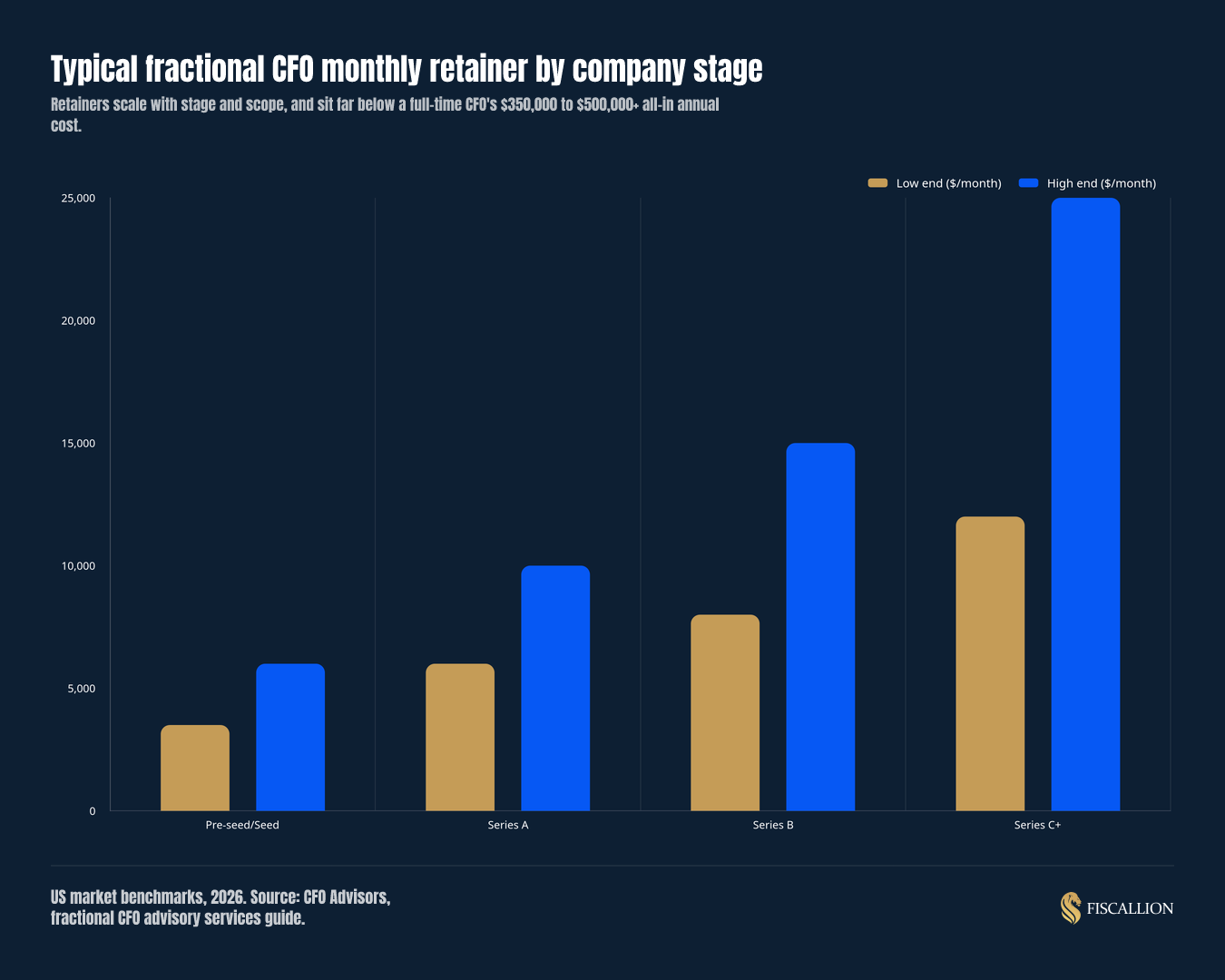
That gap is the reason most companies between $5M and $50M ARR default to fractional or outsourced support rather than a full-time hire. It's not that a full-time CFO is the wrong choice; it's that the cost and ramp only pay off once finance complexity is itself a full-time job. CFO Advisors places that inflection point at roughly $10-15M ARR with multiple revenue lines or international operations.
Scope a board reporting cadence for your company directly with Fiscallion's financial modeling and board reporting service. Bring your last board deck to the first conversation; it's the fastest way to show a provider where the current format is breaking down.
How to evaluate providers
Not every provider marketed as "outsourced CFO" or "board reporting services" delivers the same scope. Use this checklist before signing anything.
- Model ownership and handover documentation. Ask who owns the model after the engagement ends, and whether you get documentation your internal finance lead can run day to day. A provider that keeps the model as a black box has misaligned incentives.
- A single metric dictionary. The provider should commit definitions to writing once and reuse them every meeting. If NRR gets redefined quarter to quarter, the board pack is not decision-grade.
- Cadence discipline. Monthly reforecast for cash and near-term revenue, quarterly reforecast for the full plan, and the pack delivered days ahead of the meeting, not the night before.
- Senior-partner access, not a junior handoff. Ask specifically who you'll be working with day to day and whether that person changes. At Fiscallion, every client works directly with Aleksandar Stojanovic at the CFO layer; there's no account manager or junior delivery team involved.
- Fixed-fee scoping in writing. Open-ended hourly billing on board reporting work makes cost unpredictable exactly when you need budget certainty most.
- Fair scope match. If your finance complexity has grown past what a part-time engagement can absorb, a full-time CFO or Head of Finance is the more honest answer. If your books aren't yet reliable enough to model, a bookkeeping or accounting service needs to close that gap first.
Common mistakes and replacement moves
Mistake: treating the deck as the reporting system. A deck is a presentation layer. If the underlying model and metric definitions aren't consistent, a polished deck just hides the problem better.
Replacement move: build the model and metric dictionary first, then let the deck follow from it.
Mistake: letting metric definitions drift. If ARR, NRR, or burn multiple get calculated differently each quarter, board members spend the meeting reconciling numbers instead of deciding.
Replacement move: agree definitions once, write them down, and reuse them every cycle.
Mistake: burying cash in an appendix. Runway and burn multiple are core decision inputs, not supporting detail.
Replacement move: put cash and runway on the first page, not the last.
Mistake: modeling a single runway scenario. A single-line runway number implies false precision and hides the trade-offs a board actually needs to weigh.
Replacement move: present a range tied to explicit assumptions about growth and spend, not one point estimate.
Mistake: reporting vanity metrics. Total signups or gross bookings look good but don't tell a board whether the business is healthy.
Replacement move: anchor the pack to the metrics in the table above, all of which tie directly to cash, growth quality, or efficiency.
Saasmentic's review of board reporting practices corroborates this operating set: ARR movement, NRR, pipeline coverage, burn and runway, CAC payback, and cash efficiency, held together by metric-dictionary discipline.
Frequently asked questions
How is outsourced board reporting different from what my existing bookkeeper or accountant already provides?
Your bookkeeper and accountant record what already happened and keep you compliant. Outsourced board reporting is forward-looking: it takes closed books as an input and builds a driver-based model, a rolling forecast, and a board pack that frames trade-offs and decisions. Neither role replaces the other. Fiscallion's positioning states this directly: accounting looks backward, FP&A looks forward, and the work layers insight on top of the ledger rather than duplicating it.
What financial metrics and SaaS KPIs should be included in a board-ready reporting package?
At minimum: an ARR bridge showing new, expansion, contraction, and churn; NRR and GRR; CAC payback; burn multiple and runway; gross margin; Rule of 40; pipeline coverage; performance versus plan with variance explained; the updated forecast; and the two or three decisions the board needs to weigh in on. Independent benchmarking from Fairview and PMGuru corroborates this same short list, with the emphasis on leading with NRR and keeping definitions consistent across meetings rather than expanding the metric count.
How quickly can an outsourced board reporting provider get our first reporting cycle ready?
Expect roughly 6 to 10 weeks from scoping to the first board pack on the new format, depending on how clean your existing data is and how fast metric definitions get agreed between you and the provider. That's distinct from ramp time on a fractional engagement generally, which industry benchmarking puts at 2 to 4 weeks, versus 3 to 6 months to fully ramp a full-time CFO hire. Fiscallion's own model-build phase runs 6 to 10 weeks starting from $9,000, after which the first pack ships on your current board cycle.
What does the ongoing working relationship look like with an outsourced board reporting partner?
Once the model is built, expect a monthly reforecast covering cash and near-term revenue, a quarterly reforecast of the full plan, and the board pack delivered roughly 7 days ahead of each meeting with likely questions pre-answered. Fiscallion also hands over full documentation so your internal finance lead can run the model day to day between cycles, and pricing stays fixed-fee and scoped in writing rather than open-ended hourly billing. Every engagement runs through direct work with Aleksandar Stojanovic at the CFO layer, not a delegated account team.
The decision in front of you
If your board deck takes days to assemble and still gets debated on definitions instead of decisions, the fix isn't a better template. It's a provider who owns the model, the forecast, and the pack as one system, and who ships it early enough for the board to actually act on it.
That's a scoping conversation, not a lengthy sales process. Scope a board reporting cadence with Fiscallion and bring your last board deck; it's the fastest way to see exactly where the current format is costing you decisions.