
The decision is not "outsource or hire." It is whether your current close, revenue recognition, and reporting cadence match the complexity of your business right now, or whether you are paying strategic-hire money for clerical output, or worse, paying nothing for controller-level judgment you desperately need before your next board meeting.
Most SaaS founders reach this question at a predictable moment: the bookkeeper cannot answer what the board is asking, but a full-time controller does not pencil out yet. That gap is real, it is measurable, and it has a defensible answer once you separate the four layers of finance work from the one hiring decision you think you are making.
This article gives you the cost math, the coverage comparison, and the stage-based triggers to make that call with confidence, not guesswork.
What "controller" actually means in a SaaS context
Founders tend to collapse finance into a single hire: "we need a controller" or "we need a CFO." In practice, SaaS finance work breaks into four distinct layers, and confusing them is why so many hiring decisions go wrong.
The layers, per a widely cited breakdown from G2 CFO's finance team framework, are:
- Bookkeeping — transaction recording, bank and card reconciliations, AP/AR processing.
- Controller-level accounting — close ownership, GAAP compliance, financial statement preparation, revenue recognition mechanics.
- Strategic finance / FP&A — financial models, scenario analysis, SaaS metric definitions, forecasting.
- CFO-level leadership — investor relations, capital allocation, board strategy, trade-off decisions.
Each layer has a different cost basis and a different skill set. A generalist controller hire who is strong at close mechanics is not automatically strong at ASC 606 judgment calls or board narrative. When you hire one person and expect all four layers, you either overpay for commodity work or underpay for judgment work, and usually both happen at once.
The practical fix is to price each layer separately before you decide who does it.
The true cost of an in-house controller
The salary line on a job posting is not the cost of the hire. Fully-loaded cost includes payroll taxes, benefits, tools, recruiting, onboarding ramp time, and management overhead.
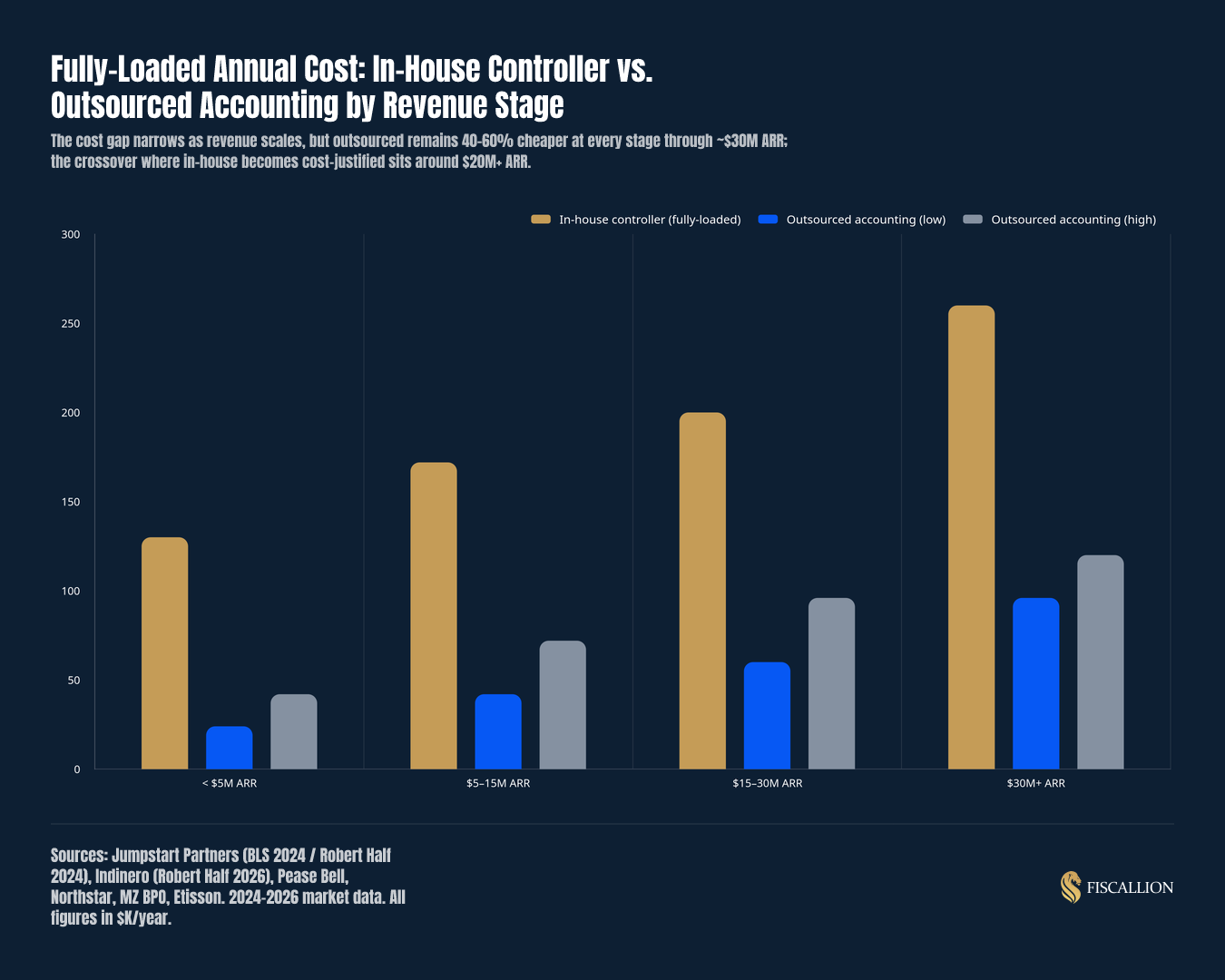
Base controller salaries range from roughly $85K-$120K at smaller companies to $150K-$220K at larger ones, according to the Robert Half 2026 Salary Guide, which puts the controller base range at $118.75K-$213.25K. Apply a fully-loaded multiplier of 1.40-1.55x once you add payroll taxes, benefits, and overhead, and the same source lands the fully-loaded range at $170K-$310K per year.
BLS employer compensation data confirms the scale of that load: benefits made up 29.7% of total private-industry compensation as of March 2024, and more recent BLS figures put benefits at roughly 43% on top of base wages. That is not a rounding error. It is a third to a half of the salary number, added back on top of it.
Two more costs rarely make it into the hiring plan:
- Ramp time. A new controller typically needs three to six months before they are producing reliable, judgment-grade output. You pay full salary during that window for partial productivity.
- Turnover and bad-hire risk. Average tenure in accounting and finance roles runs under three years at smaller companies, with a turnover rate near 17.4%, and SHRM's 2024 benchmarking data puts the cost of a bad hire at 2.5x-3.5x annual salary once you count recruiting, ramp, and the cost of the mistakes made along the way.
Put together, a fully-loaded in-house controller runs $130K-$310K per year, depending on company size and market, before you have accounted for the fact that controller roles are currently the hardest finance position to fill. Personiv's 2025 CFO Pulse Survey found 21% of CFOs name controller as their hardest role to fill, with 87% reporting a finance talent shortage and nearly half saying open roles take at least 60 days to close.
What outsourced accounting actually costs
Outsourced and fractional controller services run $2,000-$8,000 per month, or roughly $24K-$96K per year, according to Etisson's 2026 pricing guide and a separate April 2024 analysis from Pease Bell. The range breaks into rough tiers:
| Tier | Monthly cost | What it typically covers |
|---|---|---|
| Core controller | $2,500-$5,000/month | Monthly close, reconciliations, standard reporting |
| Advanced | $5,000-$8,000/month | Complex revenue recognition, multi-entity, higher transaction volume |
That maps to a documented 40-60% cost savings versus a full-time hire, per both Pease Bell and a separate comparison from MZ BPO. Fiscallion's own pricing sits inside this band: ongoing accounting starts at $2,500/month, rising to $4,000/month for usage-based, hybrid, or multi-entity revenue models, with historical clean-up and accrual conversion starting at $4,000 as a one-time project, billed at a fixed monthly fee rather than by the hour.
"Most SaaS founders hit the same point: the bookkeeper can't answer the questions the board is asking, but a full-time controller doesn't pencil out yet."
— Aleksandar Stojanovic, CEO & Founder at FiscallionCoverage comparison: what each model actually delivers
Cost only matters relative to coverage. Here is where the two models diverge in practice.
| Coverage area | In-house controller | Outsourced accounting |
|---|---|---|
| Monthly close ownership | Yes, daily presence | Yes, typically closed by a fixed day-of-month target |
| ASC 606 revenue recognition | Depends on individual's experience | Built into specialized SaaS providers |
| Deferred revenue schedules | Maintained if controller has capacity | Maintained inside the ledger by design |
| Daily bookkeeping / AP-AR | Yes | Sometimes retained in-house, sometimes included |
| Board-ready SaaS metrics | Depends on skill set | Built into reporting deliverables |
| Tax filing | Sometimes, if controller has tax background | No, stays with a dedicated tax specialist |
| On-site, same-day presence | Yes | No, though response windows can be defined by SLA |
| Backstop during absence | No, single point of failure | Yes, team-based coverage |
The single point of failure risk is easy to underweight until it happens. With one in-house accountant, the close stops when they are on vacation, sick, or gone, and institutional knowledge leaves with them. Indinero's analysis notes the average cost per hire runs near $4,129 per SHRM data, a cost you pay again every time that single point of failure turns into a resignation.
There is also a control benefit to outsourcing that founders rarely credit: segregation of duties. The Association of Certified Fraud Examiners found that a lack of internal controls was the most common weakness in occupational fraud cases, present in 32% of them, with a median loss of $145,000 per case. A single in-house bookkeeper or controller recording, approving, and reconciling the same transactions is a control gap. A team-based outsourced model splits those functions by design.
Compare coverage against your current stage before you decide
Before choosing a model, map your close timeline, transaction complexity, and growth trajectory against the ranges above. That comparison, not a generic "outsource until X ARR" rule, is what should drive the decision.
If you want a structured way to run that comparison, walking through Fiscallion's Accrual Accounting for B2B SaaS service is the fastest way to see where your current setup has gaps and where it does not. Every engagement is scoped and run directly with Aleksandar Stojanovic at the CFO layer, not handed off to an account manager or junior delivery team.
SaaS-specific complexity: why specialization matters more here than in other industries
Revenue recognition is where generalist controllers most often get SaaS accounting wrong. ASC 606 requires a five-step model to recognize revenue, and deferred revenue is typically the largest liability on a SaaS balance sheet.
Six years after ASC 606 took effect, companies are still struggling with it. Cohen & Company's January 2025 analysis found that even mature SaaS companies still have trouble distinguishing implementation services from core subscription revenue and determining whether professional services count as distinct performance obligations.
There is also a newer wrinkle most in-house hires have not encountered before: the KPMG 2025 Handbook notes that incremental costs to obtain a customer contract, including sales commissions and related fringe benefits, must now be capitalized as contract cost assets when the expected amortization period exceeds twelve months, a requirement KPMG describes as "new to most software entities."
Add usage-based and hybrid contract structures, which are increasingly common as SaaS pricing models diversify, and you have a technical accounting surface area that a generalist hire, however capable, has often never touched.
"This is the specific argument for specialization: not that in-house talent is weak, but that SaaS revenue mechanics are a narrow, evolving discipline that most controller candidates have not been tested on."
— Aleksandar Stojanovic, CEO & Founder at FiscallionWhen outsourced accounting makes more sense
Certain signals point clearly toward an outsourced model:
- You are under $5M ARR with straightforward revenue mechanics.
- You are scaling quickly and cannot afford a multi-month hiring and ramp cycle.
- You are heading into a fundraise and need board-ready numbers on a fixed timeline.
- You are mid cash-to-accrual transition and need GAAP-compliant books built correctly the first time.
- Your current setup has a single point of failure and no backstop.
- You need ASC 606 or usage-based revenue recognition expertise you cannot justify hiring full-time.
A useful breakeven heuristic from Pegacorn Group's hire-vs-outsource framework is the 30-hours-per-week threshold: outsource until the function consistently generates more than 30 hours per week of work requiring institutional knowledge, then hire. Below that line, a full-time salary is paying for capacity you are not using.
When an in-house controller makes more sense
The signals reverse as complexity and volume increase:
- Monthly close consistently takes more than seven business days.
- Your outsourced controller relationship is already approaching 25+ hours per week of work.
- You are preparing for your first audit.
- You have multi-entity, multi-currency, or international consolidation requirements.
- ASC 606 judgment calls are now a recurring, not occasional, part of your close.
- You have crossed roughly $5M-$10M ARR with a clear trajectory toward $20M+ within 24 months.
Per Shay CPA's scaling framework, these signals cluster most heavily once companies pass roughly $20M ARR, which is also where transaction volume and complexity typically justify a dedicated internal hire and, eventually, a small internal team.
There is a cost to waiting too long as well. Pegacorn's analysis notes that hiring too late produces its own cleanup bill: uncoded transactions, unresolved reconciling items, and missed technical accounting positions that take months and outside help to fix. The goal is not to delay the in-house hire indefinitely. It is to make it when the workload actually justifies it.
The hybrid model most companies actually run at $5-20M ARR
Few companies make a clean binary switch. The most common pattern between $5M and $20M ARR is a hybrid split, and it typically takes one of three shapes:
- In-house AP/AR clerk, outsourced close. A junior internal hire handles day-to-day transaction entry while an outsourced partner owns the GAAP close, revenue recognition, and reporting.
- In-house controller, outsourced specialist support. A generalist controller owns policy and process while an outsourced firm handles technical accounting, tax coordination, or audit-season surge capacity.
- Fully outsourced accounting plus fractional CFO. An outsourced provider owns the books end to end, with a fractional CFO layered on top for forecasting, board narrative, and strategic trade-offs.
Fiscallion's model typically follows the first pattern: it usually replaces the existing bookkeeper for the accounting function itself, while some clients keep an internal person for day-to-day administrative tasks. Tax stays with a dedicated tax specialist in every case; Fiscallion's job is to keep the books in a state where that tax provider's work is straightforward, not to file returns.
Frequently asked questions
What are the disadvantages of outsourced accounting for SaaS companies?
The most cited disadvantages, per K38 Consulting's 2025 outsourcing analysis and a related March 2025 breakdown from Excelevate, are: less direct day-to-day control over financial operations; communication delays, particularly with providers operating across large time zone gaps; integration friction with your existing tech stack; unclear or expanding pricing, where a $2K/month contract quietly grows as services are added; data security and confidentiality concerns tied to sharing financial systems access; and a context gap, where an external team will not absorb company-specific nuance without deliberate investment in documentation and onboarding.
None of these are disqualifying on their own, but they are reasons to vet a provider's scope, pricing structure, and communication cadence before signing, rather than after the first surprise invoice.
Can an outsourced accounting provider fully replace an in-house controller for a SaaS company?
Not fully, and not indefinitely, once you scale past a certain point. Most evidence, including analysis from Indinero and Pegacorn Group, suggests the outsourced model covers the full controller function well up to roughly $20M ARR. Beyond that, transaction volume, multi-entity complexity, and the need for daily, on-the-ground institutional knowledge typically make an in-house hire necessary.
That said, "fully replace" is the wrong frame even for companies that do hire in-house. Many companies that bring a controller on staff still retain an outsourced partner for tax coordination, technical accounting judgment calls, or audit-season surge capacity, because those needs are episodic rather than daily.
How does outsourced accounting work alongside my existing bookkeeper or CFO?
The arrangement depends on what you already have in place, but three patterns cover most cases: your in-house bookkeeper or AP clerk keeps handling daily transactions while the outsourced firm owns the GAAP close and technical accounting; your in-house controller keeps ownership of policy and process while the outsourced partner executes the close and specialist work; or you run fully outsourced accounting with a fractional CFO layered on top for forecasting and board strategy.
The variable that matters most is scope clarity. Vague boundaries between what the internal person owns and what the outsourced partner owns are the most common source of friction in these arrangements, according to Shay CPA's scaling guidance. Fiscallion typically replaces the bookkeeping and accounting function outright, while tax stays with a dedicated specialist and any existing fractional CFO relationship can sit above the accounting layer without overlap.
When does it make more sense to choose outsourced accounting over hiring an in-house controller for SaaS?
Choose outsourced when you are under roughly $20M ARR, your close does not yet require more than 30 hours per week of dedicated institutional-knowledge work, and you are facing a specific trigger: a fundraise, a cash-to-accrual conversion, board pressure for numbers your current bookkeeper cannot produce, or metrics chaos where nobody can agree on the SaaS numbers in the deck.
Outsourced also makes sense when the risk you are trying to solve is a single point of failure, not a capacity shortfall. If your concern is "what happens if our one finance person leaves," a team-based outsourced model solves that directly. If your concern is genuine capacity, and the workload has already crossed the 30-hours-per-week threshold with a clear trajectory past $20M ARR, that is the signal to start planning the in-house hire instead.
The decision is about matching coverage to complexity, not picking a side
There is no universally correct answer between outsourced accounting and an in-house controller. There is only the answer that matches your current transaction volume, revenue recognition complexity, and growth trajectory, priced honestly against what each option actually costs once benefits, ramp time, and turnover risk are included.
Founders who get this wrong usually make the same mistake in either direction: hiring a full-time controller for work that does not yet require 30 hours a week of institutional judgment, or staying on a generalist outsourced arrangement past the point where multi-entity complexity and daily presence genuinely require someone in the building. Get the coverage-to-complexity match right, and the cost question mostly answers itself.
If you want to compare your current setup against both models directly, Fiscallion's Accrual Accounting for B2B SaaS service page is the place to walk through it, working directly with Aleksandar Stojanovic rather than a junior delivery team.