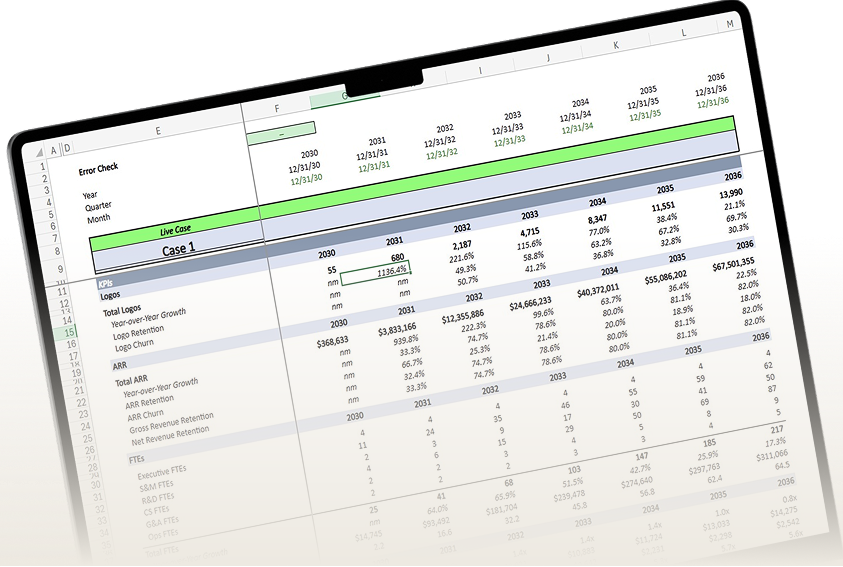

A fundraising model built by a financial modeling agency typically survives past the raise: it comes with documented assumptions, SaaS metric definitions, and a handoff so your team can run it independently. A model from a freelance modeler is usually faster and cheaper up front, but it often arrives as a single file, with no continuity, and legal ownership that defaults to the freelancer unless you specified otherwise in writing. The right choice depends on whether you're solving for one fundraising event or building infrastructure that also feeds board reporting, headcount planning, and the next raise.
You are reading this because the model from your last round is either stale, was built by someone who left, or never existed in a form your board would trust. That is not a modeling problem. It's a decision about who owns your numbers going forward.
What you'll learn in this comparison
- The real difference between a freelance modeler, a boutique firm, and a financial modeling agency for fundraising work
- What a fundraising-ready model actually requires beyond a spreadsheet
- Honest cost and timeline comparisons, including what an in-house hire costs by contrast
- Who legally owns the model after the engagement ends, and why that matters
- A four-question framework to decide which option fits your stage
The three options on the table, and what each one is actually built for
When you search for help with a fundraising model, you'll run into three distinct categories of provider, not one continuum of "cheaper to more expensive."
A freelance modeler is typically a single contractor working project by project. They build a file, deliver it, and move to the next client. Cost for a one-off model generally runs $500 to $3,000 depending on complexity, with hourly rates in the $75-$250 range.
A boutique firm sits between freelance and agency. Pricing for custom investor-ready models with revisions and support runs $800 to $5,000+, while Big 4 or investment-bank-adjacent shops charge $10,000-$50,000+ for the same category of deliverable.
An embedded FP&A agency works on retainer, builds the model as one piece of an ongoing system, and stays attached to it through the close-to-forecast cycle, board reporting, and the next scenario question. This is where Fiscallion operates: fundraising models are one output of a broader forecasting and reporting engagement, not the entire scope.
The comparison that matters is not "who is cheapest" but "what does each option deliver for a fundraising process specifically." A freelancer can absolutely produce a clean three-statement model. What's less certain is whether that model holds up when an investor asks you to flex a hiring assumption live in the room, or whether anyone will touch it again after the term sheet.
What a fundraising-ready model actually requires
Investors evaluating a Series A through Series C SaaS company are not grading your spreadsheet aesthetics. They're testing whether your assumptions hold together under pressure.
A fundraising-ready model needs:
- A driver-based operating model where revenue, headcount, and cash are linked, not hardcoded
- A rolling 13-week cash flow view that ties near-term burn to the annual plan
- Scenario analysis that flexes headcount, pricing, and churn assumptions together, not in isolation
- SaaS metrics defined once and used consistently across the model, the board pack, and investor updates
- A board-ready output, not just a raw file
A generalist freelancer will typically deliver the first item and stop there. According to Finro Financial Consulting's analysis of startup financial models, general freelancers often lack the domain expertise SaaS fundraising requires, frequently rely on generic templates, and offer limited iteration once the initial file is delivered. The same analysis notes that DIY founder models commonly contain hardcoded formulas, unrealistic churn assumptions, and no real link between revenue and cash, which is precisely what breaks under a term sheet negotiation.
An agency-built model is designed to survive live questioning. If an investor asks what happens to runway if you delay two senior hires, the model should answer that in the room, not require a follow-up email three days later.
The SaaS metrics gap that decides fundraising credibility
Most fundraising conversations stall on the same handful of numbers. If your model does not define them consistently, every board or investor conversation becomes a debate about definitions instead of decisions.
The metrics that consistently break fundraising decisions when they're missing or inconsistent:
| Metric | Why it matters in fundraising | Common freelancer gap |
|---|---|---|
| Net cash runway | Investors size the round against this first | Often calculated once, not stress-tested |
| CAC by segment/channel | Blended CAC hides which channels actually work | Usually reported as one blended number |
| CAC payback period | Signals capital efficiency to investors | Frequently omitted entirely |
| LTV | Feeds unit economics defensibility | Modeled as a single figure, not a cohort range |
| NRR | Core SaaS health signal at Series B and beyond | Sometimes conflated with gross retention |
| MRR/ARR | Baseline growth metric | Usually present, but not reconciled to billing data |
| Pipeline coverage | Tests whether the growth plan is achievable | Rarely modeled as a driver at all |
| Headcount vs. plan | Ties burn to actual hiring decisions | Treated as a fixed input, not a lever |
A financial modeling agency built around SaaS fundraising work builds around all eight with shared definitions that carry through to the board pack, because the same numbers get scrutinized in diligence that get presented at the board table.
"A generalist freelancer usually surfaces two or three of these well."
— Aleksandar Stojanovic, CEO & Founder at FiscallionSpeed to a fundraising-ready model, compared honestly
Founders often assume speed favors the freelancer by default. That's only true for a narrow definition of "done."
For a single, standalone model, a freelancer or boutique shop can move fast. Basic three-statement models typically take one to two weeks, while detailed SaaS metrics or fundraising-ready models generally take two to four weeks, with rush delivery available at a premium. Pricing across that range runs roughly $2,000 to $15,000 per project, with fundraising-ready investor models specifically landing around $5,000-$12,000.
An agency engagement runs on a different clock because it's not building a single file. A model build combined with a first board pack typically takes 6-10 weeks, but ongoing forecasting and reporting begin within the first few weeks of the engagement, well before the full build is complete.
Compare both against the alternative most founders don't fully cost out: hiring in-house. Sourcing, interviewing, and closing a mid-level FP&A analyst typically takes 6-12 weeks, plus another 4-8 weeks of ramp time before that person is fully productive. That's a 3-6 month runway before you have a usable model, which is longer than either the freelance or agency path, and it assumes the hire works out.
The honest cost math, by stage and by intent
Cost comparisons in this category get dishonest fast because people compare a one-time freelance fee to an annualized retainer without naming the difference in scope.
Here's the comparison stated plainly:
| Option | Typical cost | What you get |
|---|---|---|
| Freelance modeler | $500-$3,000 one-time (Excel Business Resource); $2,000-$12,000 for a fundraising-ready build (Knex) | A single deliverable file, typically no ongoing support |
| Boutique firm | $800-$5,000+ for custom builds; $10,000-$50,000+ for Big 4/bank-adjacent work (Excel Business Resource) | A more polished build, variable ongoing involvement |
| Financial modeling agency (Fiscallion) | Model build from $9,000 over 6-10 weeks; ongoing forecasting and reporting from $3,500/month | A model plus the system that keeps it current: board packs, variance analysis, scenario updates |
| In-house FP&A analyst | $110,000-$185,000/year fully loaded (Fiscallion / FinanceResolver) | A dedicated employee, plus hiring risk and ramp time |
The freelancer is the cheaper option for exactly one scenario: a single fundraising event, a clean and simple business model, and no expectation that the file gets touched again after the raise closes. If that's your situation, paying $500-$3,000 for a one-off model is a reasonable trade.
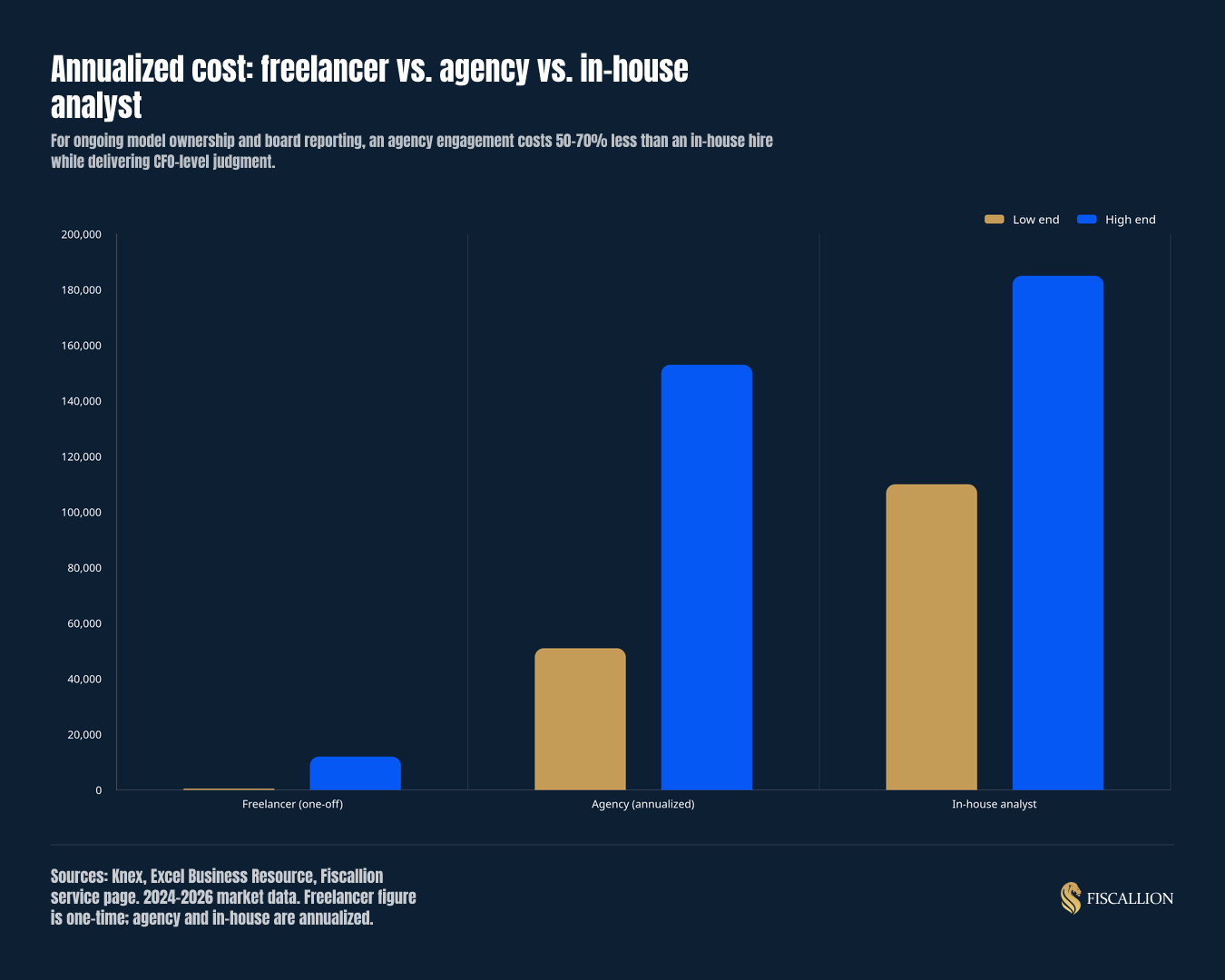
The math changes the moment the model needs to survive past the raise, feed monthly board reporting, or answer headcount and pricing trade-off questions in real time. At that point, an agency engagement running $9,000 to build plus $3,500 or more per month costs meaningfully less annualized than a $110,000-$185,000 in-house hire, while still providing continuous senior judgment rather than a one-time deliverable. This is not an argument that the agency path is automatically superior. It's an argument that comparing a one-time freelance fee against an annualized retainer without naming the difference in scope produces the wrong decision.
Talk to Fiscallion about your fundraising model
If you're weighing whether your fundraising model needs to survive past the raise, review fundraising-model ownership and reporting fit through Fiscallion's financial modeling and board reporting service. Every engagement is scoped and owned directly by Aleksandar Stojanovic at the CFO layer, not handed to a junior analyst after the sales call.
Model ownership is the question most founders skip
Here is the part almost nobody asks before they sign a freelance contract: who legally owns the model when it's done?
In the United States, the default legal rule is that independent contractors own the intellectual property they create unless a written agreement explicitly assigns that IP to the company that hired them. The "work made for hire" doctrine, which would otherwise resolve this automatically, covers only narrow, specific categories of work and generally does not apply to most consulting or freelance deliverables, including financial models.
In practice, this means a freelance modeler you hired for a single project may retain legal ownership of the model itself unless your contract said otherwise.
"Most founders never think to ask, because the conversation is framed around price and turnaround time, not IP."
— Aleksandar Stojanovic, CEO & Founder at FiscallionA financial modeling agency should resolve this explicitly, in writing, before the engagement starts. Fiscallion's approach is stated directly: the model gets built, then handed over with documentation so your team can run it day to day. The objective is a model your finance lead can update independently, not a permanent dependency on the agency for every scenario question.
Before you engage any provider, freelance or agency, put this question in writing: who owns the file, and what documentation comes with it when the engagement ends?
Working alongside your existing accountant or bookkeeper
A common hesitation is assuming that bringing in a modeling agency means replacing or duplicating whatever your bookkeeper or accountant already does.
It doesn't, and it shouldn't. FP&A work sits above the ledger. An FP&A agency doesn't replace your bookkeeper or controller, it sits on top of the accounting function and translates what's already being recorded into decisions about runway, hiring, and pricing. Your bookkeeper or accountant continues to own the ledger, the close, and compliance. The financial modeling agency takes that clean accounting data as an input and turns it into a forward-looking model, board pack, and fundraising deliverable.
If a provider proposes replacing your existing bookkeeping relationship as part of a fundraising modeling engagement, that's worth questioning. The two functions are complementary, not competing.
Red flags that apply no matter which option you're considering
Regardless of whether you go freelance, boutique, or agency, the same warning signs predict a bad outcome. A LinkedIn post from finance professional Tariq Baha lays out four to watch for when hiring anyone to build a financial model:
- No prior experience building models for businesses like yours
- Forecasts that stay high-level and disconnected from actual business drivers
- Assumptions that feel arbitrary, with no clear method for how they were derived
- A model that looks clean on the surface but breaks the moment you run a scenario or "what if" question through it
Add one more that matters specifically for agency engagements: proposals that create a permanent dependency for routine updates, where you can never run the model without paying for another round of consulting. A model that reports numbers without ever recommending what to do next is a red flag regardless of the provider's size or price point.
Test any provider, freelance or agency, by asking them to walk through a scenario live before you sign anything. If the model can't answer a headcount or pricing trade-off question in the room, it will not survive an investor meeting either.
A four-question framework to decide
Use these four questions to decide which option actually fits your situation, rather than defaulting to whichever provider you found first.
- What decision are you making in the next 90 days? If it's purely "close this round," a freelancer covering a single deliverable may be enough. If it's "close this round and then run the company against a plan," you need something built to persist.
- Do you need 10 hours a month of model maintenance, or 40? Light, occasional updates favor a freelancer or boutique arrangement. Ongoing monthly forecasting, board packs, and variance analysis favor a retained agency relationship.
- Does the provider own the model, or just present it? Ask directly whether you'll receive a documented, editable model your team can run independently, or a static output you'll need to pay again to modify.
- Can they show cohort-level CAC and LTV, or only a blended ratio? A provider who can only produce a single blended unit economics number hasn't built the SaaS metric depth a fundraising process actually requires.
Answer these honestly before you sign anything, and the right provider usually becomes obvious.
Frequently asked questions
What does a financial modeling agency offer over a freelance modeler for investor-grade fundraising models?
A financial modeling agency typically offers deeper FP&A judgment, a consistent SaaS metrics framework across the model and board pack, ongoing maintenance rather than a one-time file, scenario modeling tied directly to headcount and pricing decisions, and a documented handoff so the model survives past the raise. A freelance modeler generally delivers a single file faster and cheaper, but usually without continuity, without SaaS-specific metric depth beyond the basics, and often without a written IP assignment that guarantees you own what you paid for.
Who owns the fundraising financial model after the engagement ends?
The default legal position in the United States is that independent contractors, including freelance modelers, own the intellectual property they create unless a written agreement explicitly assigns it to you. This means a freelance-built model may legally remain the freelancer's property unless your contract stated otherwise. A financial modeling agency should address this directly: Fiscallion builds the model, documents it, and hands it over so your team can operate it independently, rather than creating a dependency on the agency for every future update.
Can a financial modeling agency work alongside my existing accountant or bookkeeper?
Yes. FP&A and financial modeling work sits on top of the accounting function rather than replacing it. Your bookkeeper or accountant continues to own the ledger, the monthly close, and compliance. The financial modeling agency uses that accounting data as an input to build forecasts, scenario models, and board-ready reporting. If a provider suggests taking over bookkeeping as part of a modeling engagement, treat that as a scope mismatch rather than a value add.
How quickly can an agency deliver a fundraising-ready model versus a freelance modeler?
A freelance modeler can typically deliver a one-off fundraising model in one to four weeks, depending on complexity, since the scope is limited to a single file. An agency engagement generally takes 6-10 weeks to deliver a full model build along with the first board pack, because the build integrates with ongoing forecasting and reporting rather than standing alone, though monthly forecasting work often begins within the first few weeks. Both options are meaningfully faster than hiring in-house, which typically takes three to six months from decision to a usable, fully ramped model given standard recruiting and onboarding timelines.
The decision that actually matters
The choice between a financial modeling agency and a freelance modeler is not about which one builds a better-looking spreadsheet. It's about whether you're solving for a single fundraising event or building something that keeps working after the round closes, feeds your board reporting cadence, and answers the next hiring or pricing question without starting from scratch.
If your model only needs to survive one term sheet, a freelancer covering that narrow scope is a defensible choice. If you need the model to become the operating system behind your board meetings, your runway planning, and your next raise, that's a different scope entirely, and it's worth evaluating providers against that standard rather than against price alone.