
Cash accounting records revenue when money hits your bank account. Accrual accounting records it when you have actually earned it. For most businesses that distinction is a technicality. For a SaaS company that collects annual contracts upfront, it is the difference between books that describe your business and books that mislead you.
Take a $24,000 annual contract collected in January. Under cash accounting, January shows $24,000 in revenue and every other month of the year shows zero. Under accrual accounting, each month shows $2,000 in recognized revenue, with the remaining balance sitting on the balance sheet as deferred revenue and declining by $2,000 a month until the contract is fully delivered. One method makes your business look like a January boom followed by eleven flat months. The other shows what actually happened: a customer paying steadily for a service delivered steadily. This is confirmed in Stripe's comparison of cash and accrual methods and in Growthy's analysis of accrual versus cash basis for SaaS startups.
This article walks through the core mechanical difference between the two methods, the three triggers that force a switch, how deferred revenue actually works under current accounting standards, and what typically breaks during the transition. It closes with an open readiness checklist you can use to assess where your company stands right now.
What you'll learn
- The core mechanical difference between cash and accrual accounting, and why SaaS revenue specifically breaks the cash method
- The three triggers, investor, tax, and operational, that force a switch from cash to accrual
- How deferred revenue works under ASC 606, with a worked example
- Which accounting standards govern SaaS revenue recognition and why they still trip up mature companies
- What breaks during the cash-to-accrual transition and how to prevent it
- A readiness checklist you can use before starting the conversion
Cash vs accrual: the core difference for SaaS
Cash basis accounting records revenue when cash arrives and expenses when cash leaves. It is simple, it matches your bank balance, and it is legal for many small businesses under IRS Publication 538.
Accrual basis accounting records revenue when it is earned and expenses when they are incurred, regardless of when cash actually moves. This is the method required for GAAP-compliant financial reporting and the one investors expect to see.
For most businesses, the gap between the two methods is small and timing-related. A retailer that sells a product and gets paid the same week will report roughly the same numbers either way. SaaS breaks this assumption in three specific ways:
- Annual prepaid contracts. A customer pays for twelve months of service in one transaction. Cash accounting books all of it immediately; accrual spreads it across the service period.
- Multi-element bundles. A single contract might include platform access, onboarding, and support, each delivered on a different timeline and each requiring its own recognition schedule.
- Usage-based and hybrid pricing. Revenue tied to consumption complicates a straightforward monthly recognition model and adds another layer that cash accounting cannot represent at all.
Here is the difference laid out side by side.
| Dimension | Cash basis | Accrual basis |
|---|---|---|
| Revenue timing | Recorded when cash is received | Recorded when the service is delivered |
| Expense timing | Recorded when cash is paid | Recorded when the cost is incurred |
| Deferred revenue | Not tracked as a distinct liability | Tracked as a balance sheet liability, released as obligations are met |
| SaaS metric compatibility | Breaks MRR, ARR, LTV:CAC | Required for standard SaaS metrics |
| Investor and diligence readiness | Requires reconstruction before diligence | Expected baseline for institutional review |
| Legal basis for use | Available to entities under the IRS Section 448(c) gross receipts threshold, and to S corps regardless of size | Required for public companies and most private companies above the threshold |
"Cash-basis books describe your bank account, not your business."
— Aleksandar Stojanovic, CEO & Founder at Fiscallion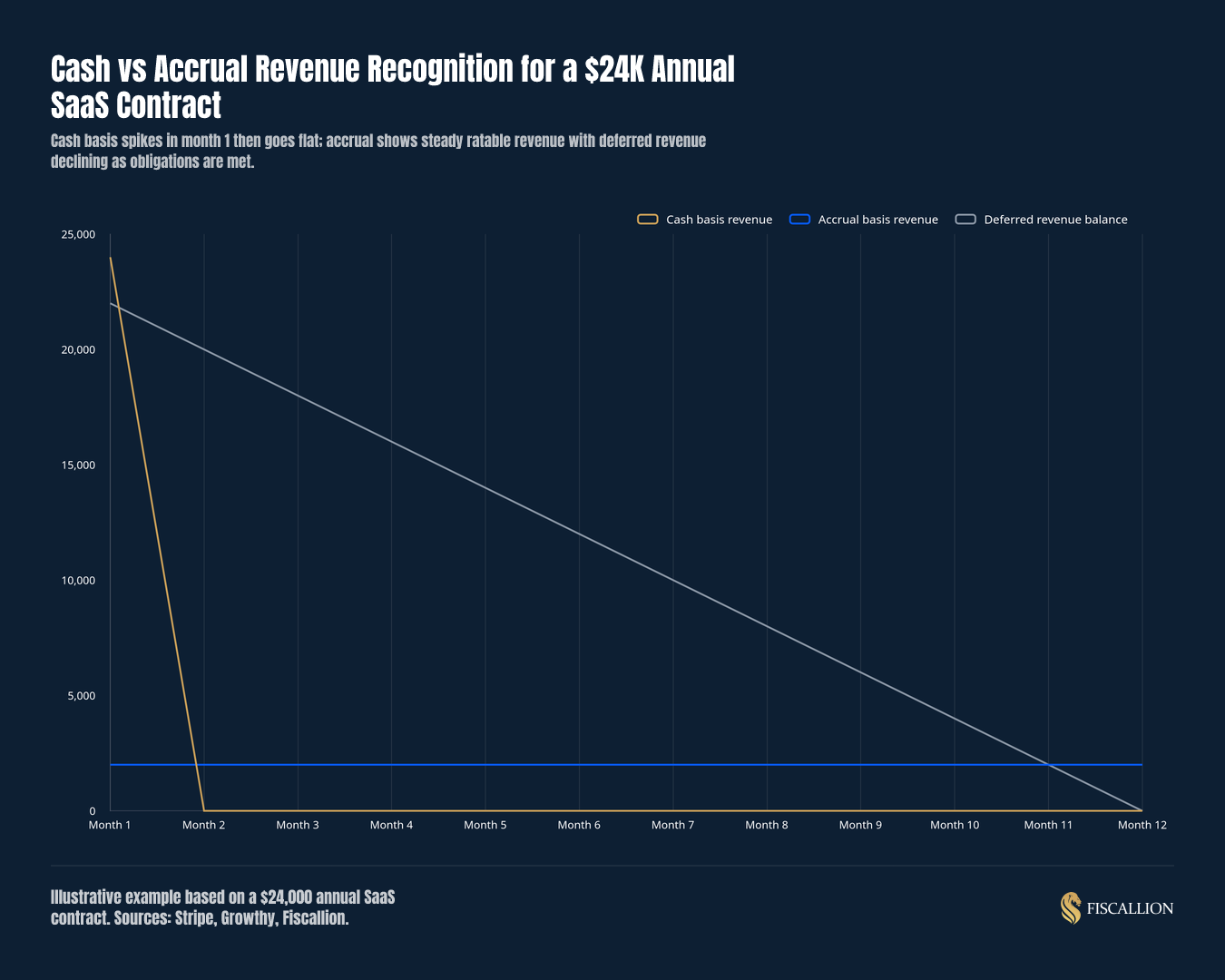
Cash basis spikes in month 1 then goes flat; accrual shows steady ratable revenue with deferred revenue declining as obligations are met. Illustrative example based on a $24,000 annual SaaS contract. Sources: Stripe, Growthy, Fiscallion.
When should a SaaS company switch from cash to accrual accounting?
Three separate triggers push a SaaS company off cash accounting. Any one of them is usually sufficient on its own.
Trigger one: investors and diligence. Institutional investors and most sophisticated angels require accrual-basis GAAP financials for due diligence. Cash-basis records force a reconstruction that delays deals and raises questions about financial discipline. Private equity firms treat cash-based accounting as a warning sign and apply valuation discounts of 10 to 15 percent when they encounter it. One documented case involved a revenue restatement that reduced pre-money valuation by 20 percent. VCs need accrual numbers because standard SaaS metrics, ARR, MRR, LTV:CAC, magic number, simply do not compute correctly on cash-basis books.
Trigger two: the IRS gross receipts threshold. Under Section 448 of the Internal Revenue Code, C corporations and partnerships with a C corporation partner must use the accrual method once average annual gross receipts over the prior three tax years exceed a threshold that adjusts for inflation. For tax year 2025 that threshold is $31 million; for 2026 it rises to $32 million. Cross it and you are required to file IRS Form 3115 and calculate a Section 481(a) adjustment, a cumulative recalculation of taxable income that can be spread over up to four years. S corporations, sole proprietorships, and single-member LLCs taxed as disregarded entities are not covered by Section 448(a) and can technically remain on cash accounting regardless of size, though investors will still expect accrual reporting in practice.
Trigger three: operational complexity. Even without an investor or tax deadline, cash-basis books eventually stop being usable for decisions. Once deferred revenue, multi-element contracts, and usage-based pricing are part of your business, cash accounting cannot represent what is actually happening well enough to plan hiring, pricing, or runway against it.
In practice, most SaaS companies convert somewhere between Series A and Series B, when investor scrutiny and revenue complexity arrive at roughly the same time. For a deeper treatment of the conversion process itself, see cash to accrual for SaaS businesses.
How accrual accounting handles deferred revenue for SaaS subscriptions
Deferred revenue is a liability, not income. When a customer pays $24,000 upfront for an annual contract, that cash does not become revenue on your income statement all at once. It sits on the balance sheet as deferred revenue and moves to recognized revenue only as you deliver the service.
Under ASC 606, the current revenue recognition standard, this is more precise than it used to be. The standard requires companies to decompose multi-element contracts into distinct performance obligations and recognize revenue for each one separately, with its own allocated price and recognition timeline. Under the prior standard, ASC 605, one contract price generally meant one recognition schedule. Under ASC 606, a contract that bundles platform access, onboarding, and support may require three separate schedules, each tracked in its own sub-ledger for auditability.
This is where a deferred revenue rollforward becomes necessary rather than optional. A rollforward tracks how much revenue has been recognized, how much remains deferred, and how that balance moves month over month. Faster-growing SaaS companies tend to have wider gaps between cash collected and revenue recognized, which means a larger and more consequential deferred revenue balance to manage.
Applied to the $24,000 example: month one collects $24,000 in cash, recognizes $2,000 in revenue, and books $22,000 as deferred revenue. Each subsequent month recognizes another $2,000 and reduces the deferred revenue balance by the same amount, reaching zero by month twelve. That mechanical bridge from cash collected to revenue recognized is exactly what a rollforward document is built to show, and it is the single artifact that makes an accrual P&L legible to a board or an investor.
What accounting standards apply to SaaS revenue recognition?
Two standards do most of the work.
ASC 606, Revenue from Contracts with Customers, is the primary standard, issued jointly by FASB and IASB. It uses a five-step model: identify the contract, identify performance obligations, determine the transaction price, allocate the price across obligations, and recognize revenue as each obligation is satisfied. It became effective for public companies in 2018 and private companies in 2019.
ASC 340-40, Costs to Obtain or Fulfill a Contract, governs how sales commissions are treated. Under this standard, incremental costs to obtain a customer contract, including commissions and related fringe benefits like 401(k) match and payroll taxes, must be capitalized as contract cost assets if the expected amortization period exceeds twelve months. KPMG describes this requirement as something "new to most software entities", and it moves a meaningful cost line from the income statement to the balance sheet, changing reported margin without changing the underlying business.
PwC identifies eight distinct issue areas where software and SaaS companies specifically struggle with ASC 606 application: identifying the contract, identifying performance obligations, determining transaction price, allocating transaction price, contract modifications, principal versus agent determinations, costs to obtain a contract, and the actual recognition of revenue. Even six years after adoption, SaaS companies still struggle with distinguishing implementation services from core subscription revenue and determining whether professional services count as a distinct performance obligation or get bundled into the subscription itself.
For what it is worth, FASB completed a post-implementation review of ASC 606 in November 2024 and did not identify any matters requiring immediate standard-setting action. The standard is settled. The difficulty is not that the rules keep changing; it is that applying them correctly to a specific SaaS contract structure takes judgment every time.
What breaks during the transition (and how to prevent it)
The conversion from cash to accrual is not a bookkeeping cleanup. It is a structural change to how your P&L reads, and two things typically break in a predictable order.
Revenue breaks first. As cash collected and revenue recognized diverge, the top-line P&L number drops relative to what the cash-basis version showed, even though nothing about the business has changed. Founders who see this without context often stall hiring decisions or panic about growth that has not actually slowed.
Gross margin breaks second. Prepaid contract costs get amortized and sales commissions get capitalized under ASC 340-40, both of which move expenses off the income statement and onto the balance sheet. A 5 to 10 point margin swing during this window is common and does not reflect a change in unit economics. It reflects the business being measured correctly for the first time. A company reporting 68 percent gross margin under cash accounting might show 61 percent under accrual for exactly this reason, not because anything regressed.
The technical accounting side, establishing ASC 606 policy, identifying deferred revenue and unbilled receivables, restating historical periods, is manageable with the right process. The harder part is operational: reconfiguring the close process, retraining whoever owns the books, and communicating the margin shift to a board that has not seen it coming.
Three reference points make the transition survivable rather than disruptive: a clean opening balance sheet that establishes where deferred revenue, accrued liabilities, and prepaid expenses stand on day one; a one-page MRR-to-revenue bridge that shows the board exactly how cash collected maps to revenue recognized; and a 60-day parallel read that runs both methods side by side before the cash-basis books are retired. Most SaaS companies complete the core conversion within 60 to 90 days, and the framework built during that window, the rollforward, the bridge, the opening balance sheet, becomes permanent infrastructure rather than a one-time project.
The cash-to-accrual readiness checklist
Use this checklist to assess where your company actually stands before starting a conversion. It is meant to be worked through directly, not filled out and filed away.
- Revenue recognition policy documented. Do you have a written policy describing how revenue is recognized for each contract type you sell, not just a general statement that you "follow ASC 606"?
- Deferred revenue tracked in the ledger, not a spreadsheet. Is deferred revenue a live account in your accounting system with sub-ledgers by performance obligation type, or is it reconstructed manually each month?
- Sales commission capitalization policy in place. Have you determined whether commissions need to be capitalized under ASC 340-40 based on your amortization period, and do you have a process for tracking it?
- Form 3115 assessed or filed. If you are approaching or past the IRS Section 448 gross receipts threshold, have you evaluated the Section 481(a) adjustment and filing requirement?
- Opening balance sheet calculated. Do you have a clean, dated starting point for deferred revenue, accrued liabilities, and prepaid expenses before the new method goes live?
- MRR-to-revenue bridge built. Can you show, on one page, how monthly recurring revenue collected maps to revenue recognized under accrual?
- 60-day parallel read planned. Do you have a window where both methods run side by side so you can validate the new numbers before retiring the old ones?
- Board communication plan for margin distortion. Have you prepared your board for the likely 5 to 10 point margin swing so it reads as a measurement change, not a performance problem?
Work through this list honestly. If more than two or three items are unresolved, the conversion is going to surface problems mid-process rather than before it starts. Every Fiscallion client works directly with Aleksandar Stojanovic at the CFO layer on exactly this kind of transition, which means the judgment calls on performance obligations, commission capitalization, and board framing get made by someone who has done this before, not handed off to a junior team.
If you want a second set of eyes on where your company stands, explore Fiscallion's Accrual Accounting for B2B SaaS service.
Frequently asked questions
When should a SaaS company switch from cash to accrual accounting?
Three triggers typically force the switch, and any one of them is usually enough on its own. The first is investor pressure: institutional investors and most sophisticated angels require accrual-basis GAAP financials for due diligence, and cash-based books can trigger valuation discounts of 10 to 15 percent during PE review. The second is the IRS Section 448 gross receipts threshold: C corporations and partnerships with a C corporation partner must use accrual accounting once average annual gross receipts over the prior three years exceed the inflation-adjusted threshold, $32 million for tax year 2026. S corporations and disregarded entities are exempt from this requirement regardless of size, though investors will still expect accrual reporting. The third trigger is operational: once deferred revenue, multi-element contracts, and usage-based pricing make up a meaningful share of your business, cash-basis books stop being usable for planning decisions. In practice, most SaaS companies convert somewhere between Series A and Series B, when the investor and operational triggers tend to arrive close together.
How does accrual accounting handle deferred revenue for SaaS subscriptions?
Deferred revenue is a balance sheet liability, not income. When a customer pays upfront for a subscription, that cash is booked as deferred revenue and released to the income statement only as the service is delivered. Under ASC 606, multi-element contracts must be decomposed into distinct performance obligations, each with its own allocated price and recognition schedule, a change from the prior standard where one contract price generally meant one schedule. A deferred revenue rollforward, a document tracking recognized revenue, remaining deferred balance, and month-over-month movement, is the practical tool that makes this legible. For a $24,000 annual contract collected in month one, accrual accounting recognizes $2,000 in revenue that month, books $22,000 as deferred revenue, and recognizes another $2,000 each subsequent month until the deferred balance reaches zero in month twelve.
What accounting standards apply to SaaS revenue recognition?
The primary standard is ASC 606, Revenue from Contracts with Customers, issued jointly by FASB and IASB, using a five-step model to identify the contract, identify performance obligations, determine the transaction price, allocate that price across obligations, and recognize revenue as each obligation is satisfied. A second standard, ASC 340-40, governs costs to obtain a contract and requires sales commissions to be capitalized rather than expensed immediately if their amortization period exceeds twelve months. PwC identifies eight distinct issue areas where SaaS companies specifically struggle with ASC 606, including distinguishing implementation services from core subscriptions and determining whether professional services are a distinct performance obligation. FASB completed a post-implementation review of the standard in November 2024 and found no matters requiring immediate changes, so the rules are stable; the difficulty is applying them correctly to each specific contract structure.
The decision this comes down to
"Cash accounting is not wrong, it is simply describing a different question than the one a growing SaaS company needs answered. It tells you what happened to your bank account. Accrual accounting tells you what happened to your business."
— Aleksandar Stojanovic, CEO & Founder at FiscallionThe switch is not optional once investors, the IRS threshold, or your own contract complexity force the question, and waiting until the deadline arrives tends to produce a rushed conversion instead of a deliberate one. Work through the readiness checklist above now, while you still have the time to do it properly, rather than during the week before a due diligence request lands.