
Revenue recognition is not a bank-statement fact. It is a policy decision, and if you have not written that policy down, someone is making it ad hoc every close.
That gap shows up at the worst possible moments: a board asks why revenue does not match cash collected, a diligence team flags implementation fees booked upfront, or your auditor asks for a deferred revenue rollforward you have never produced. A SaaS revenue recognition policy is the document that prevents all three. Below is a full template, built on ASC 606, that you can adapt directly.
What a revenue recognition policy actually is
A revenue recognition policy is not a legal contract and it is not your billing system's configuration.
"It is the written judgment layer that sits between your contracts, your billing data, and your general ledger."
— Aleksandar Stojanovic, CEO & Founder at FiscallionYour billing system tells you when cash was invoiced or collected. Your policy tells your finance team, your auditor, and your board when that cash becomes revenue on the P&L. Without a written policy, that translation happens differently every quarter, based on whoever closes the books.
This matters because recognition timing distorts revenue, margin, and runway in ways that are easy to miss until a board member or investor asks a pointed question. A prepaid annual contract collected in January is not $120,000 of January revenue. It is $10,000 of revenue recognized monthly over the contract term, with the remaining balance sitting on your balance sheet as a liability.
The chart below illustrates this for a single $120,000 annual prepaid subscription.
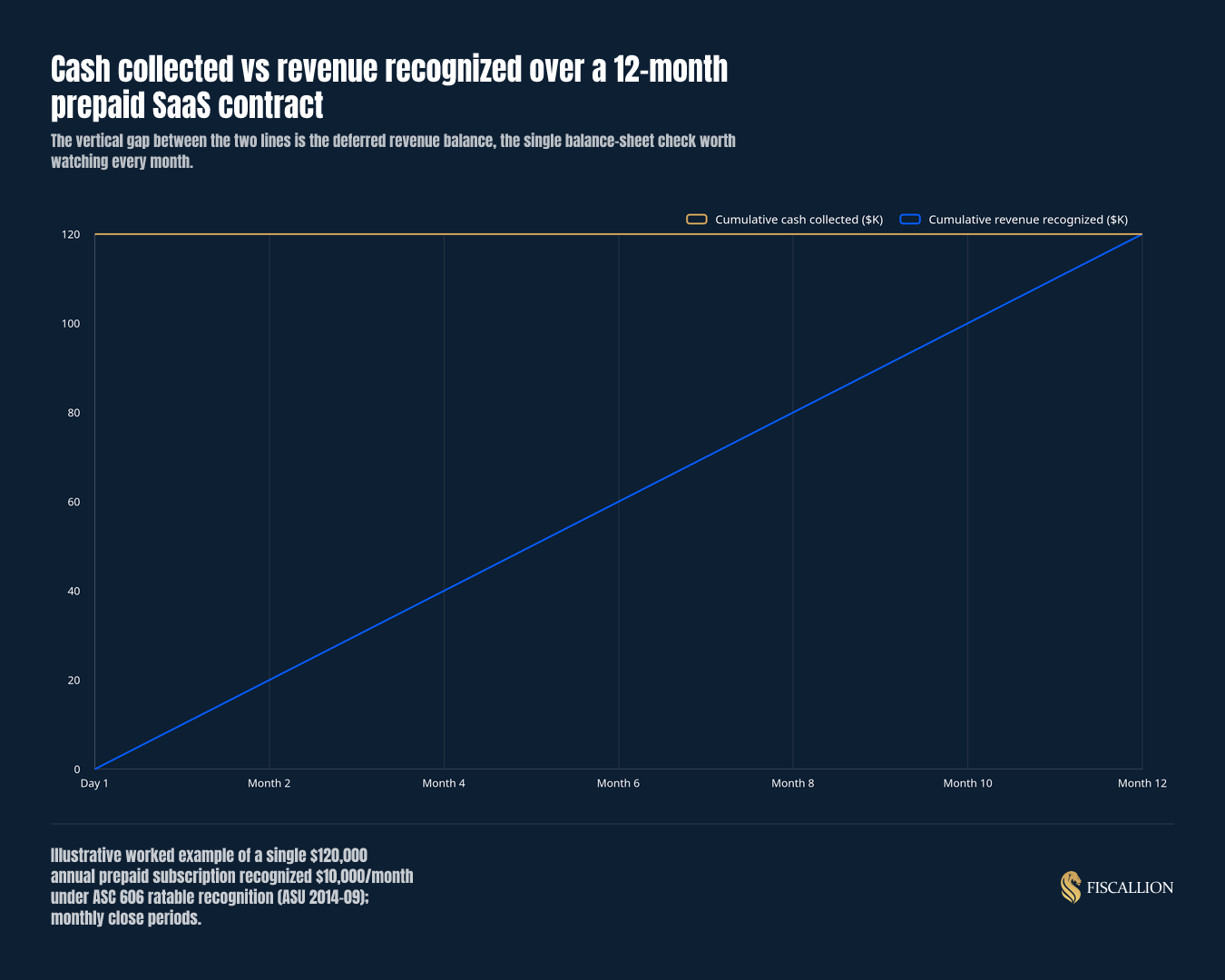
The vertical gap between the two lines at any point in time is your deferred revenue balance. That gap is the single balance-sheet check worth watching every month, because it tells you how much cash you have already collected that you have not yet earned the right to call revenue.
The governing framework: ASC 606 and its five steps
Every SaaS revenue recognition policy should open by naming its governing standard. For US-based B2B SaaS companies, that standard is Topic 606, introduced by ASU 2014-09, which requires recognizing revenue to depict the transfer of promised goods or services in an amount that reflects the consideration the entity expects to be entitled to.
ASC 606 applies through five sequential steps:
- Identify the contract with a customer.
- Identify the performance obligations in the contract.
- Determine the transaction price.
- Allocate the transaction price to the performance obligations.
- Recognize revenue when (or as) each performance obligation is satisfied.
Topic 606 became mandatory for public companies in annual periods beginning after December 15, 2017, and for private companies a year later, per RSM's technology industry summary. If your company has not formalized a written policy since then, you are not alone, but that also means your judgment calls have likely never been documented or tested.
The template, section by section
Below is the structure Fiscallion uses when building a SaaS revenue recognition policy for a client. It is organized to mirror the five-step ASC 606 model, plus the operational sections (deferred revenue, contract costs, disclosures, governance) that make the policy usable by your accounting team, not just your auditor.
Section 1: Scope and framework
State which standard governs the policy (ASC 606 for US GAAP filers), which entities and revenue streams it covers (subscription, usage-based, implementation, professional services, hardware if applicable), and the effective date of the policy itself.
Section 2: Contract identification and modification policy
Define what constitutes a contract for accounting purposes, which is not always the same as your signed order form. This section should specify:
- The criteria for combining multiple contracts signed close in time with the same customer into a single accounting contract.
- Your treatment of contract modifications: whether a change is accounted for as a separate contract, a prospective modification, or a cumulative catch-up adjustment.
- The trigger point for when a renewal or expansion order becomes its own contract versus an amendment to an existing one.
Section 3: Performance obligation catalog
This is where most SaaS companies run into recurring judgment problems. A performance obligation exists when a promised good or service is distinct, and SaaS entities must judge distinctness across subscriptions, implementation, training, support, and hybrid offerings, as detailed in BDO's guidance on identifying performance obligations in software.
Your catalog should list every typical offering (platform access, onboarding/implementation, premium support, training, professional services) and state whether each is distinct or bundled with the core subscription. This is not a one-time exercise. A Cohen & Company analysis from January 2025 found that SaaS companies still struggle to distinguish implementation services from core subscriptions, six years after ASC 606 adoption. Name this explicitly in your policy as a judgment area requiring quarterly review, not a solved problem.
Section 4: Transaction price and variable consideration
Document how you determine the transaction price, including:
- Fixed subscription fees versus variable, usage-based, or consumption-based fees.
- Your constraint policy for variable consideration, meaning how you estimate and cap revenue when the ultimate amount is uncertain.
- Treatment of prepaid usage credits, including your breakage policy (the portion of prepaid credits customers are not expected to redeem).
Section 5: Allocation and standalone selling price
When a contract bundles multiple performance obligations, you must allocate the transaction price based on standalone selling price (SSP). Document your SSP estimation hierarchy: observable standalone prices first, then adjusted market assessment, then expected cost plus margin, and finally a residual approach when other methods are not available. KPMG's Revenue for Software and SaaS Handbook covers this allocation step along with contract modifications and contract costs in detail.
Section 6: Recognition patterns
State the default recognition pattern for each obligation type:
| Obligation type | Typical recognition pattern | Basis |
|---|---|---|
| SaaS subscription access | Ratably, over the service period | Customer receives benefit continuously (over time) |
| Perpetual or term software license | Point in time, at delivery | Functional IP delivered upfront under US GAAP |
| Implementation/onboarding (distinct) | Over the service period or point in time, based on nature | Depends on distinctness test outcome |
| Usage-based fees | As usage occurs | Variable consideration recognized as earned |
| Support and maintenance | Ratably, over the support period | Stand-ready obligation |
Note that under US GAAP, software IP is classified as functional versus symbolic, with software typically treated as functional and recognized at a point in time, while IFRS instead asks whether the customer has a right to use or a right to access the IP. ASC 606 also bars recognizing license renewal revenue before the renewal period begins, per Deloitte's DART comparison of US GAAP and IFRS. If you operate under both frameworks, this distinction belongs explicitly in your policy.
Section 7: Deferred revenue and contract liabilities
This is the section your board and your auditor will look at first. It should specify:
- The mechanics of your deferred revenue rollforward: opening balance, additions from new billings, reductions from revenue recognized, and closing balance.
- How unbilled receivables (revenue recognized but not yet invoiced) are tracked and reconciled.
- How you calculate and report remaining performance obligations (RPO), sometimes called backlog.
- Which cost types qualify (base commission, and associated fringe such as 401(k) match and payroll taxes, if the amortization period exceeds twelve months).
- Your amortization period policy, typically tied to expected customer life.
- Your impairment review cadence.
Section 9: Disclosures checklist
Your policy should map directly to what your financial statements need to disclose. At minimum, per RSM's disclosure summary, that includes:
- Disaggregated revenue by category (subscription, usage, services).
- Contract balances: opening and closing contract assets, contract liabilities, and receivables, with a rollforward of changes.
- Remaining performance obligations (RPO), noting available practical expedients, such as relief for contracts of one year or less, per KPMG's IFRS Institute comparison.
- Significant judgments made in applying the standard, including distinctness determinations and SSP methodology.
Section 10: Governance
Name who owns the policy (typically your controller or fractional CFO), how often judgment areas are reviewed (quarterly is standard practice for growth-stage SaaS), and what evidence trail supports each judgment call for audit purposes.
How to interpret the policy once it exists
A written policy is only useful if it changes how you read your financials. Once it is in place, three things should become visible that were not before:
- Your MRR-to-GAAP-revenue bridge should reconcile cleanly, month over month.
- Your deferred revenue balance should move predictably with new bookings and recognized revenue, not as an unexplained plug.
- Your gross margin and runway model should stop shifting every time someone reclassifies an implementation fee.
If any of these three things is still unstable after you write the policy, the problem is not the document. It is inconsistent application, which points back to the governance section above.
What to do next
Do not treat this as a one-time compliance exercise. Build a quarterly review into your close calendar where your controller or CFO revisits the performance obligation catalog and the SSP allocation methodology against any new contract types signed that quarter.
New pricing structures, new bundles, and new usage-based add-ons all introduce fresh judgment calls that your existing policy may not cover. A policy that was accurate at $10M ARR often needs revision by $30M ARR, once your product and packaging have evolved.
Common mistakes and what to do instead
Mistake: treating implementation fees as automatically distinct (or automatically bundled). Both defaults are wrong without a documented distinctness test. Run the test explicitly, every time your offering catalog changes, and document the outcome.
Mistake: recognizing annual prepaid revenue upfront because cash was collected upfront. Cash timing and revenue timing are governed by different rules. Recognize ratably over the service period and let the deferred revenue balance carry the difference.
Mistake: skipping the deferred revenue rollforward until an auditor asks for it. Build the rollforward into your monthly close from the start. Reconstructing it retroactively for a full fiscal year is a materially larger task than maintaining it monthly.
Mistake: expensing sales commissions as paid. Under ASC 340-40, incremental commission costs tied to obtaining a contract should be capitalized and amortized, not expensed immediately, if the benefit period exceeds a year.
Get the practical asset
This template is published in full above. Use it as your working draft: fill in your own performance obligation catalog, your SSP hierarchy, and your commission amortization policy, then route it through your accountant or fractional CFO for review before your next audit or diligence cycle.
If you want a senior finance leader to build this policy alongside your existing accounting team rather than write it alone, Fiscallion's accrual accounting service for B2B SaaS covers ASC 606 revenue recognition, month-end close, and subscription, usage-based, and AI revenue models. Every Fiscallion client works directly with Aleksandar Stojanovic at the CFO layer: senior partner on every engagement, never a junior-team handoff.
Frequently asked questions
What should a SaaS revenue recognition policy template include?
At minimum, it should include a scope statement naming the governing standard (ASC 606 for US GAAP filers), a contract identification and modification policy, a performance obligation catalog covering subscriptions, implementation, and support, a transaction price and variable consideration policy, an SSP allocation methodology, recognition patterns by obligation type, deferred revenue rollforward mechanics, contract cost capitalization rules under ASC 340-40, a disclosures checklist, and a governance section naming who owns and reviews the policy. Each of these maps to a section in the template above.
How do you handle deferred revenue and contract liabilities in a SaaS revenue recognition policy?
Document the rollforward mechanics explicitly: opening balance, additions from new billings, reductions as revenue is recognized, and the closing balance each period. This rollforward is what reconciles cash collected against revenue recognized, and it is typically the first document an auditor or diligence team requests. Pair it with tracking for unbilled receivables and remaining performance obligations (RPO), since all three together give a complete picture of contract liabilities per RSM's disclosure guidance.
Does a SaaS revenue recognition policy need to follow ASC 606 or IFRS 15?
If your company reports under US GAAP, your policy should be built on ASC 606. If you report under IFRS, the equivalent standard is IFRS 15. The two are substantially converged, since they came from the same joint FASB/IASB project and share the same five-step model, but the FASB's official comparison notes real differences: the collectibility threshold differs ("probable" under US GAAP versus "more likely than not" under IFRS), IFRS requires reversal of contract-cost impairments where US GAAP prohibits it, and interim disclosure scope and effective dates differ. If you operate under both frameworks, or are preparing for a cross-border transaction, your policy needs a section naming which standard governs and flagging where the two would produce different answers.
Can I use a free SaaS revenue recognition policy template for my startup's financial statements?
The structure in this article is free to use, and a documented policy is far better than no policy at all. But a template only works if the judgment calls inside it (which performance obligations are distinct, how you estimate standalone selling price, how you set your commission amortization period) are applied consistently and defensibly to your actual contracts. That application is where most SaaS companies get into trouble, not the template structure itself. If you are heading into an audit, a fundraise, or a diligence process, it is worth having a controller or fractional CFO stress-test your completed policy against your real contract population before you rely on it in your financial statements.
The policy is an FP&A artifact, not a compliance chore
A revenue recognition policy is not paperwork you produce once for an auditor and file away. It is the document that lets your MRR-to-revenue bridge, your margin analysis, and your runway model actually be trusted by your board and your investors.
Get the structure right once, review it quarterly as your contracts evolve, and you stop debating revenue timing every close. You start using it to make decisions instead.