
Outsourced budgeting services for SaaS companies are an outsourced FP&A engagement in which an external CFO-level partner owns your annual budget build - driver-based revenue and cost models, scenario cases, and the reforecast cadence - while your bookkeeper or controller keeps owning the ledger.
That distinction is the whole decision. You are not choosing whether to have a budget. You already have one, and it is probably last year's number with a growth percentage bolted on. You are choosing who owns the judgment behind it: an internal hire you have not made yet, a spreadsheet exercise that goes stale by March, or a partner who has done this build before and will still own it in July when the numbers stop matching the plan.
By the end of this guide you will know what a complete outsourced budgeting engagement delivers, how it sits next to the bookkeeper or controller you already have, the trigger points that mean it is time to bring one in, and why the process cannot stop at the January board deck.
| What it covers | What it does not cover | Who owns it |
|---|---|---|
| Driver-based annual budget, scenario cases, reforecast cadence, board pack | Bookkeeping, reconciliations, revenue-recognition execution | CFO-layer partner owns the model; your bookkeeper or controller owns the ledger |
| Runway modeling, cash bridge, headcount and cost model | Payroll processing, AP/AR, month-end close | CFO-layer partner builds and interprets; finance ops executes the transactions behind it |
| Budget-vs-actual variance analysis, trade-off framing for the board | Tax filings, audit prep, GAAP-to-cash mechanics | CFO-layer partner reports the "so what"; your accountant certifies the numbers underneath |
What outsourced budgeting services actually include (and what they don't)
A complete engagement is not a spreadsheet handed over in January. It is a set of connected deliverables that get maintained through the year.
At minimum, expect:
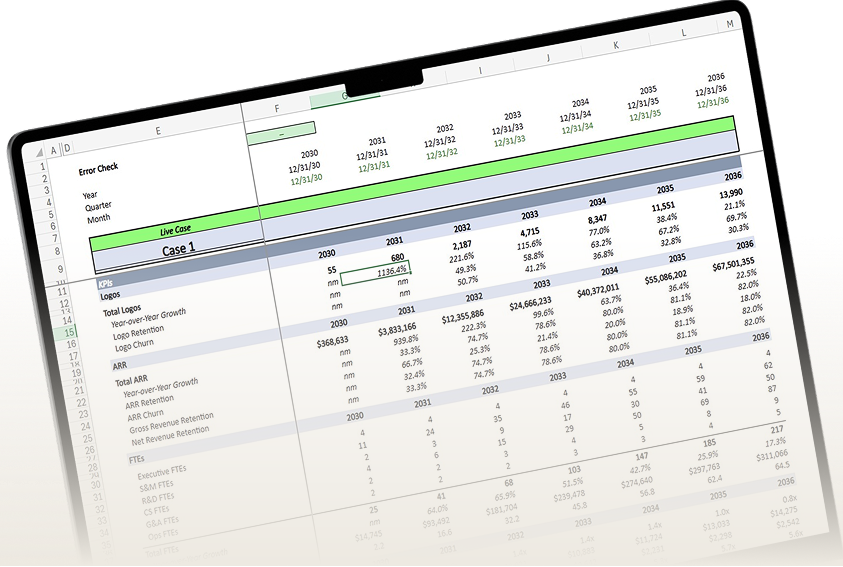
- Driver-based annual budget - an ARR waterfall built from beginning ARR, plus new bookings, plus expansion, minus churn, not a flat growth assumption applied to last year's total.
- Headcount and cost model - hiring plans tied to the revenue triggers that justify them, not a headcount list built in isolation from the pipeline.
- Cash bridge and runway model - how the budget translates into burn and months of runway under each scenario.
- Base, upside, and downside scenarios with trigger points - for example, "hire two SDRs once pipeline hits X," rather than three static cases that never get revisited.
- Budget-vs-actual variance reporting - a recurring cadence, not a one-time comparison.
- Board-ready forecast decks - packaged for a trade-off conversation, not a metrics recap.
What it explicitly does not include: bookkeeping, reconciliations, or revenue-recognition execution. Outsourced budgeting is work performed above the ledger, using accounting data as an input rather than replacing the function that produces it.
The mechanics behind the revenue build matter here: an ARR waterfall approach that separates new, expansion, and churn gives you a budget you can actually defend line by line, instead of one growth percentage that hides three different assumptions.
How it works alongside your bookkeeper or controller
The layer separation is the practical reason this model works. Your bookkeeper or controller is responsible for the ledger being accurate: transactions coded correctly, accounts reconciled, statements closed on time. An outsourced budgeting partner is responsible for what the numbers mean once they are accurate.
Those are different skill sets and different time allocations.
"A CFO who is also wrestling with reconciliations is not doing CFO work - every hour spent on the ledger is an hour not spent on the scenario model, the hiring trade-off, or the board narrative."
— Aleksandar Stojanovic, CEO & Founder at FiscallionThis also means sequencing matters. If your books are not reliable yet, an outsourced budgeting engagement will build a forecast on a shaky foundation. Clean records come first; strategic judgment layers on top of that, not instead of it.
For some companies, the right ownership structure is different: an in-house controller with strong FP&A instincts, or a full-time CFO once the workload and daily executive presence justify the role. Outsourced budgeting is the right fit when you need senior judgment and hands-on model ownership without the fixed cost or ramp time of a full-time finance hire.
The annual planning timeline an outsourced partner runs
Annual planning should be built backward from your board approval date, not forward from January 1. For a December fiscal year end, that typically means:
| Timing | Activity |
|---|---|
| Mid-August | Kickoff: agree growth and spending envelopes before templates go out |
| Late September | Department input window closes |
| October | Iteration and scenario building - expect three to five budget versions |
| 5-7 business days before the board meeting | Board pack finalized and distributed |
This sequencing comes from Aleph's annual budgeting process guide, which also found that in its 2026 survey of 250 finance leaders, over-optimistic projections were the most-cited reason a first budget draft missed. Agreeing the envelope before the templates go out - rather than after department heads have already anchored on a number - is the direct fix for that failure mode.
Budget vs. reforecast vs. rolling forecast, why the engagement doesn't end in January
An annual budget sets spending limits once a year and stays static for that period. A reforecast is an update triggered by changed conditions - some companies run it quarterly, others as needed. A rolling forecast continuously extends the planning window, usually by month or quarter, regardless of whether conditions changed. These are three different mechanisms, and Drivetrain's breakdown of budget reforecasting is useful for understanding when each applies.
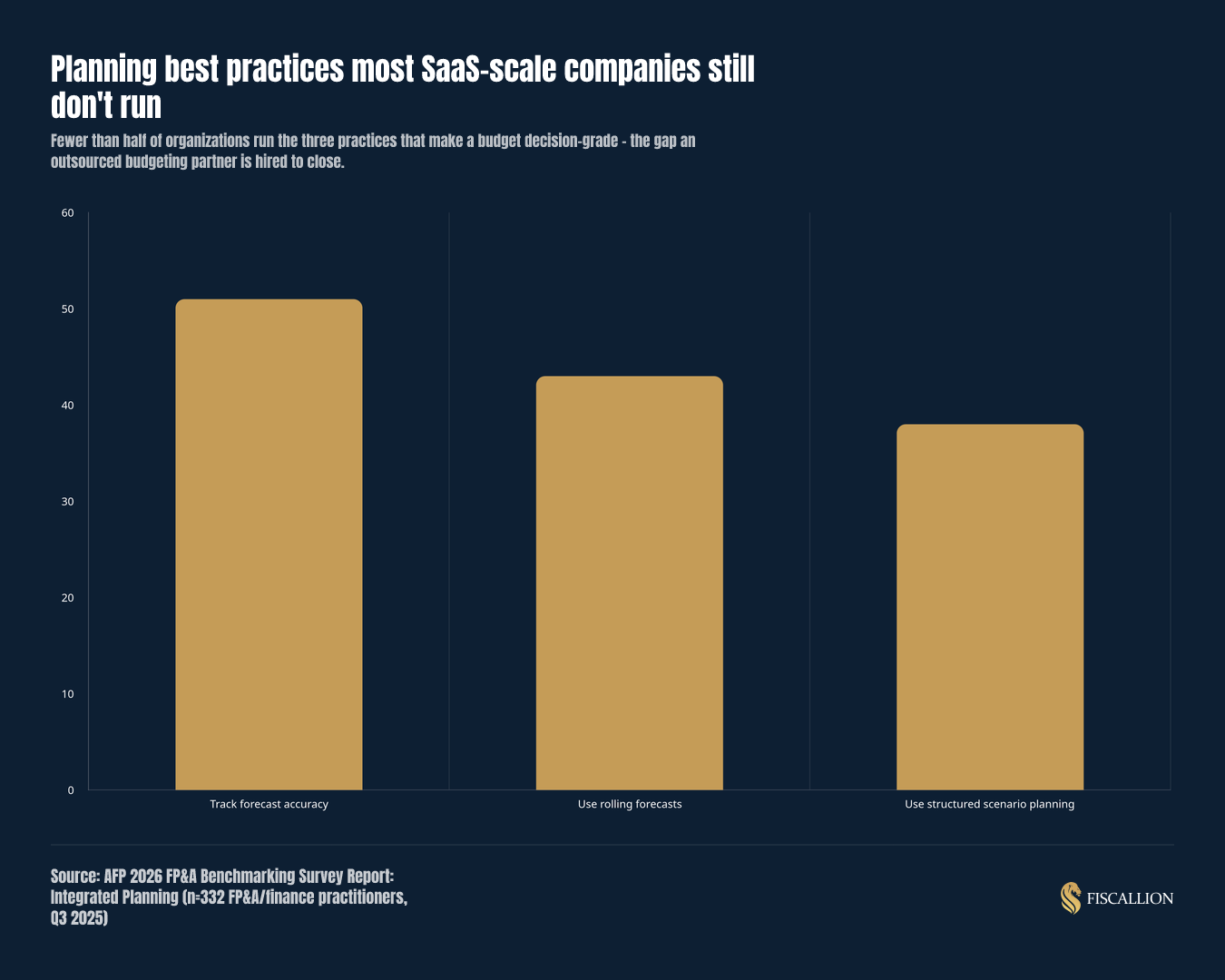
Most companies never get past the first one. In AFP's 2026 FP&A Benchmarking Survey of 332 finance practitioners, only 43% of organizations use rolling forecasts and only 38% use structured scenario planning.
"Most budgets are set once and then quietly ignored as the year diverges from plan."
— Aleksandar Stojanovic, CEO & Founder at FiscallionThat same survey found the average annual budget takes 8.7 weeks to produce and that figure has not improved in three years, while only 51% of organizations even track forecast accuracy against the plan they built. If the process is that slow and unmeasured, the resulting budget cannot answer "what do we do next" by the time your board asks.
Outsourced budgeting services for SaaS companies earn their fee by keeping the model alive after the kickoff meeting, running the mid-year reforecast, re-anchoring drivers against actuals, rebuilding the cash bridge and downside case, and resetting targets - not filing the January deck and disappearing until next year.
When to engage, trigger points for $5-100M ARR companies
The right moment to bring in an outsourced budgeting partner is usually marked by one of these signals:
- Your board expects trade-off framing instead of a metrics recap, and your current deck cannot deliver that.
- You are heading into a fundraise and need a defensible model, not a spreadsheet built the week before the data room opens.
- Hiring decisions are happening without a model connecting headcount to revenue triggers.
- Metrics chaos: three tools, two spreadsheets, and no single source of truth for cash or ARR.
- You are moving from cash to accrual accounting and need the budget rebuilt on the new basis.
This window tends to open around $5M to $30M ARR, Series A through Series C, the stage where board-level accountability outpaces what an internal team without dedicated FP&A capacity can produce. The sequencing still holds: clean records first, then strategic judgment layered on top.
Outsourced partner vs. full-time hire vs. DIY spreadsheets, choose by scope, not price
Each option fits a different operating need. None of them is a weaker version of the others; they differ in scope, ownership, access, and cost structure.
| Option | Scope | Ownership | Senior judgment | Cost structure |
|---|---|---|---|---|
| Outsourced budgeting partner | Full annual planning cycle, scenarios, reforecasts, board decks | External CFO-layer owner, works with your existing bookkeeper/controller | Consistent, senior-level throughout the engagement | Retainer, scaled to engagement scope |
| Full-time CFO hire | Daily executive presence, builds and runs an internal finance org | Internal, full-time | Senior, but ramp time and hiring risk apply | Fixed salary plus equity, highest ongoing cost |
| DIY spreadsheets | Whatever the founder or ops lead has time to build | Internal, often part-time and reactive | Varies, no dedicated senior ownership | Lowest direct cost, highest hidden cost in decision quality |
A full-time CFO is the right call when the company has enough complexity and daily workload to justify a permanent internal finance leader. DIY spreadsheets work until the board starts asking questions the spreadsheet was not built to answer. Outsourced budgeting sits between those two: senior judgment and model ownership, without the fixed cost or ramp time of a full-time hire.
What this looks like with Fiscallion
Fiscallion's outsourced FP&A service line covers KPI-driven budget planning, driver-based forecasting, startup runway modeling, strategic scenario planning, cash-burn tracking, and board-ready forecast decks - the same deliverable set outlined above, built for SaaS, marketplace, and tech-enabled businesses from Seed through Series D.
Every Fiscallion client works directly with Aleksandar Stojanovic at the CFO layer. That is senior-partner ownership on every engagement, not a rotating account manager or a junior analyst handing off your model between meetings. Aleksandar's FP&A leadership experience gained through the growth of a SaaS company to €100M ARR shapes how the budget gets built: as a decision framework the board can act on, not a compliance document.
Fiscallion is not a bookkeeping firm. The engagement works above the ledger - your bookkeeper or controller keeps the books accurate, and the budgeting work turns that accuracy into a forecast, a set of scenarios, and a reporting cadence your board can use.
If you are ready to scope this for your company, the next step is a direct conversation about annual planning and budget ownership.
Common mistakes and replacement moves
- Mistake: Budget equals last year plus a growth percentage. Replacement: a driver-based build using the ARR waterfall - beginning ARR plus new, plus expansion, minus churn.
- Mistake: An over-optimistic first draft that misses by a wide margin. Replacement: agree the growth and spending envelope before templates go out to department heads.
- Mistake: Reporting against a budget that stopped reflecting reality by Q2. Replacement: a scheduled reforecast, not an ad hoc one triggered only when things go badly wrong.
- Mistake: Scenario planning as theater - three cases built once and never revisited. Replacement: trigger-point-linked scenarios, where a hiring or spending decision is explicitly tied to a metric threshold.
FAQ
How do outsourced budgeting services work alongside our existing SaaS bookkeeper or controller?
They work above the ledger, not in place of it. Your bookkeeper or controller keeps owning transaction accuracy, reconciliations, and close; the outsourced budgeting partner uses that accounting data as the input to the annual budget, scenarios, and reforecasts. The two functions need to be reliable in sequence - clean books first, then the strategic model built on top of them - and a well-run engagement will flag if the underlying records are not solid enough yet to support planning decisions.
What deliverables are included in an outsourced SaaS annual planning engagement?
A complete engagement delivers a driver-based annual budget built from an ARR waterfall, a headcount and cost model tied to revenue triggers, a cash bridge and runway model, base/upside/downside scenarios with explicit trigger points, recurring budget-vs-actual variance reporting, and board-ready forecast decks. Deliverables are what separate a real engagement from a title - if a proposal does not name these artifacts and a cadence for producing them, it is not a full annual planning engagement.
When should we start engaging an outsourced budgeting partner for SaaS annual planning?
Start planning backward from your board approval date, which for a December fiscal year end typically means kickoff in mid-August. As for engaging a partner at all, the trigger points are board pressure for trade-off framing instead of a metrics recap, fundraising prep, hiring decisions without a model, metrics chaos across tools, or a cash-to-accrual accounting transition. This window most commonly opens between $5M and $30M ARR, Series A through Series C, once board accountability outpaces what an internal team without dedicated FP&A capacity can produce.
Does outsourced budgeting cover scenario modeling and reforecasting, or just the initial annual budget?
A properly scoped engagement covers both. The initial annual budget is only the starting artifact; the ongoing value comes from the reforecast cadence and scenario updates that keep the plan connected to actuals as the year unfolds. Given that only 43% of organizations run rolling forecasts and 38% run structured scenario planning according to AFP's 2026 benchmarking survey, this is precisely the gap most in-house processes leave open, and it is the part of the engagement that should not be treated as optional or separately billed after the fact.
An outsourced budgeting engagement is a decision about who owns the judgment behind your numbers, not just who builds the spreadsheet. The companies that get value from it treat the annual budget as a living framework: reforecast on a schedule, scenarios tied to real trigger points, and a board deck built to support a decision rather than recap a month.
If your budget process still runs on last year's number plus a growth assumption, or your board meetings still feel like a metrics recap instead of a trade-off conversation, scope annual planning and budget ownership directly with Aleksandar before your next planning cycle starts.