
Outsourced accounting for a B2B SaaS company typically runs from $1,500 to $8,000 a month depending on revenue recognition complexity, transaction volume, and whether the retainer includes controller-level review. The number that matters more than the sticker price is what the retainer actually covers: accrual close, ASC 606 revenue recognition, and deferred revenue schedules kept inside the ledger rather than a side spreadsheet.
You are reading this because a number is due diligence, a board question, or a messy close forced the pricing question into the open. This article answers it directly, then explains why the cheapest quote is rarely the right buy once your revenue model has any usage-based, hybrid, or multi-element complexity.
What outsourced accounting actually costs for a B2B SaaS company
Pricing for outsourced accounting sits in three broad tiers, and SaaS companies land toward the top of each one because revenue recognition work adds hours a simple flat-subscription business never generates.
At the low end, bookkeeping-only service, meaning transaction coding and basic reconciliations without a full GAAP close, runs $800 to $1,500 a month. Full-service accounting that adds month-end close, financial statements, and variance analysis moves to $1,500 to $2,500 a month. Comprehensive finance operations, which layers in payroll, AP/AR management, and fractional CFO advisory on top of the close, runs $2,500 to $4,500 a month.
Revenue stage shifts these ranges further. Companies with $5M to $20M in revenue that need multi-entity consolidation and investor-grade reporting typically pay $3,000 to $8,000 a month, not the lower bookkeeping-tier price. SaaS companies specifically, once deferred revenue schedules and usage-based recognition enter the picture, sit at the high end of that range, often $5,000 to $10,000 a month, because a controller billing around $150 an hour adds real cost for every extra hour the revenue model demands.
Fiscallion's own pricing reflects this split. Ongoing accounting starts at $2,500 a month for straightforward subscription revenue, and moves to $4,000 a month once usage-based, hybrid, or multi-entity revenue is in play. Historical clean-up and accrual conversion are scoped as a separate one-time project starting at $4,000, billed as a fixed fee rather than by the hour, so you are never paying a monthly retainer while the foundation underneath it is still being rebuilt. Full details are on the accrual accounting for B2B SaaS service page.
| Service tier | Monthly range | What it typically covers |
|---|---|---|
| Bookkeeping only | $800-$1,500 | Transaction coding, basic reconciliation, no GAAP close |
| Full-service accounting | $1,500-$3,500 | Bookkeeping plus month-end close and financial statements |
| Comprehensive / SaaS-specific | $2,500-$8,000+ | Accrual close, ASC 606, deferred revenue, controller review, SaaS metrics reporting |
A quoted monthly fee only tells part of the story until you know which scope tier it sits in.
In-house vs. outsourced: the real math
The comparison founders actually need is not one outsourced quote against another. It's outsourced against the fully-loaded cost of building the function internally.
A single in-house staff accountant, fully loaded with benefits and overhead, runs $100,000 to $150,000 a year. Add a controller and that combination climbs to $250,000 to $350,000 a year before any strategic finance leadership is added. A full internal stack, bookkeeper plus controller plus CFO, runs $350,000 to $550,000 a year.
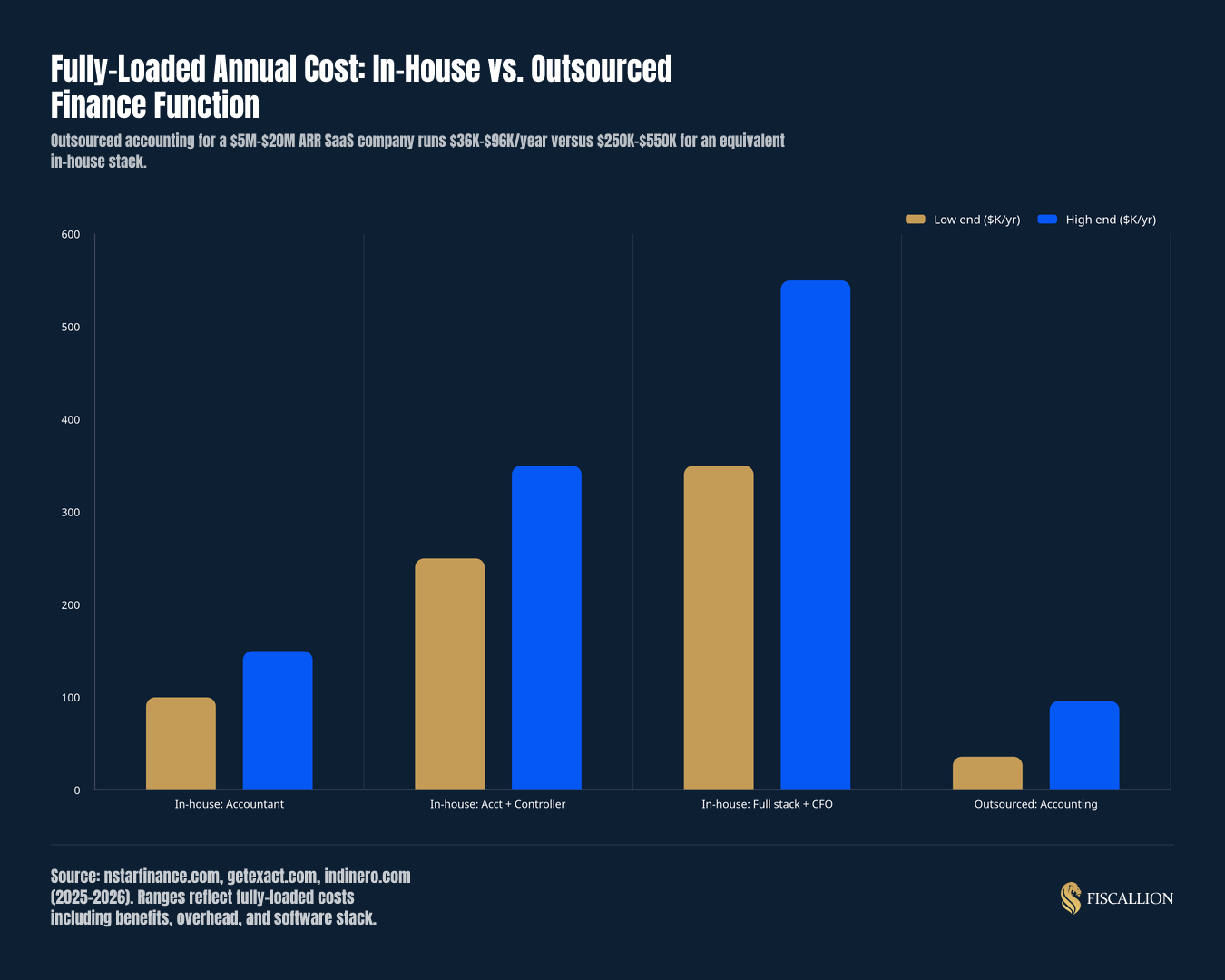
Against that, outsourced accounting for a $5M to $20M ARR company runs $36,000 to $96,000 a year for the accounting function alone. It reflects the difference between paying for one function you need continuously and paying for a full-time salary, benefits load, and severance risk on a role that, below a certain scale, does not need daily in-house presence.
Fully-loaded salary math also hides costs founders forget to model. Benefits and legally required payroll costs add roughly 43% on top of base wages, which is why a defensible multiplier on a quoted salary is closer to 1.45x than 1.0x. Add a software stack, which runs $6,000 to $18,000 a year on top of headcount, and the true cost of in-house accounting is consistently higher than the base salary number suggests.
None of this means in-house is the wrong answer at every stage. Companies above roughly $20M ARR usually have enough transaction volume and complexity to justify a permanent internal team, and a hybrid model, day-to-day AP/AR in-house with GAAP close and technical accounting outsourced, is common in the $5M to $20M range. The decision is about workload and complexity, not about outsourcing being inherently cheaper or in-house being inherently more capable.
"The gap is not marginal."
— Aleksandar Stojanovic, CEO & Founder at FiscallionWhat's included in an outsourced accounting retainer for SaaS
A price without a scope definition is not a comparable number. Here is the standard the reference point should be built against.
A SaaS-grade outsourced accounting retainer should include:
- Accrual bookkeeping and monthly close, not cash-basis records
- ASC 606 revenue recognition for subscription, usage-based, and hybrid contracts
- Deferred revenue schedules maintained inside the ledger, not in a parallel spreadsheet
- Bank, card, and payment processor reconciliation
- A monthly reporting package built around SaaS metrics, not generic financial statements
- Payables and receivables support
- Historical clean-up and accrual conversion, scoped separately when books need rebuilding
Commodity bookkeeping, by contrast, is built for simple, flat-subscription businesses and priced accordingly. It typically stops at transaction coding and skips GAAP close, revenue recognition, and deferred revenue tracking entirely. If your revenue model really is that simple, the cheaper option is genuinely the better buy.
What most generalist providers miss, and what a SaaS-specialist retainer should always include: deferred revenue schedules kept inside the books rather than reconciled by hand each month, payroll broken out by department (COGS, sales and marketing, R&D, G&A) so gross margin reporting is accurate, and a close that lands on a predictable day every month rather than drifting later as volume grows.
"The mismatch only shows up once usage-based pricing, multi-element contracts, or multi-entity structure enter the picture and the bookkeeping-tier provider cannot keep up."
— Aleksandar Stojanovic, CEO & Founder at FiscallionWhat drives the price: complexity, not headcount
Three factors set the price of an outsourced accounting retainer, and none of them is company size on its own.
Transaction volume matters, but it's a secondary driver. Operational complexity matters more: multi-entity structures, multi-state payroll and tax exposure, and usage-based revenue all add hours regardless of how many invoices you send. Service scope is the third and largest lever: bookkeeping-only pricing assumes no GAAP close and no revenue recognition work, while controller-level and CFO-advisory scope assumes both.
For a SaaS company specifically, the complexity driver is almost always revenue recognition in SaaS. ASC 606 requires significant judgment calls on performance obligations and transaction price allocation, and sales commissions must be capitalized when the expected amortization period runs beyond twelve months, per KPMG's 2025 Handbook. Even years after ASC 606 took effect, SaaS companies still struggle to distinguish implementation services from core subscriptions and to determine whether professional services count as a distinct performance obligation, according to Cohen & Company's 2025 analysis.
This is why SaaS companies pay more than a services business of similar revenue. The expertise required is specialist accounting judgment, not generalist bookkeeping throughput.
Review your scope and pricing directly
The clearest way to compare pricing is against a defined scope, not a headline number. Fiscallion's accrual accounting for B2B SaaS service page lays out exactly what's included at each tier, along with what a historical clean-up project costs before ongoing work begins. Every engagement runs directly with Aleksandar at the CFO layer: a senior partner on the account, not a handoff to a junior delivery team.
Book a growth call through that page to walk through where your books stand today, what a clean accrual close would cost at your revenue and complexity level, and what a realistic transition timeline looks like.
Can outsourced accounting work alongside your existing bookkeeper?
Yes, and both common arrangements work.
In most engagements, the outsourced accounting provider replaces the bookkeeper for the accounting function itself: the close, reconciliation, and revenue recognition all move to the outsourced team. Some clients instead keep an internal person for day-to-day administrative work, invoice entry, expense processing, while the outsourced provider owns the close, reconciliation, and revenue recognition on top of that. Both models function well; the choice depends on whether the internal person's time is better spent on admin throughput or whether that role should be eliminated entirely.
One boundary stays fixed regardless of the model: tax preparation and filing remain with a tax specialist. A SaaS-focused outsourced accounting provider keeps the books in a state where your tax provider's work is straightforward, and coordinates directly with them at year end, but does not file returns itself.
How long does it take to transition to outsourced accounting for a SaaS company?
The process runs through a scoping call, a review of the current books, then onboarding into the first close. The exact timeline depends heavily on how clean the existing books already are.
If historical clean-up and accrual conversion are needed, expect that to be scoped and completed as a separate project before ongoing monthly work begins, so you're not paying a full retainer while the foundation is still being rebuilt. For the specific cash-to-accrual conversion, the transition itself typically takes 60 to 90 days from kickoff to a stable accrual close, based on Fiscallion's experience running these conversions.
Companies changing accounting methods for tax purposes also need to file IRS Form 3115 and calculate a Section 481(a) adjustment, which the IRS allows to be spread over up to four years. This is a procedural step your outsourced provider should flag early, not something discovered after the fact.
The practical milestone to watch for is not the calendar date but the deliverable: a clean opening balance sheet, a one-page bridge reconciling MRR to recognized revenue, and a close that lands on a predictable day each month. If clean-up is required, expect the first board pack on the new accrual format to ship roughly one to two board cycles in, not immediately.
The trigger moments: when to move from bookkeeping to outsourced accounting
Cash-basis books stop working for most SaaS companies somewhere around Series A. The mismatch between cash collected and revenue actually earned becomes large enough that board members, investors, and even the founder start drawing the wrong conclusions from the numbers.
Watch for these signals specifically:
- The board asks questions your current bookkeeper can't answer
- ARR and recognized revenue tell noticeably different stories month to month
- Deferred revenue lives in a spreadsheet next to the ledger instead of inside it
- The close consistently lands three or more weeks after month-end
- Fundraising is approaching and the books are not diligence-ready
Most SaaS companies need to complete this conversion somewhere between Series A and Series B, before the gap between cash and accrual reporting becomes a fundraising liability. Companies with twelve or more months of clean, ASC 606-compliant financials move through due diligence noticeably faster than those scrambling to clean up books at the last minute, a scramble that can cost tens of thousands of dollars and consume weeks exactly when time matters most.
The real decision at this stage is not whether to outsource the function. It's whether to outsource to a provider who understands SaaS revenue recognition specifically, or to a generalist who will need to learn ASC 606 complexity on your books.
How to evaluate an outsourced accounting provider for SaaS
Use this checklist when comparing quotes, because the price alone will not tell you what you're buying:
- Do they handle ASC 606 for usage-based and hybrid contracts specifically, not just flat subscriptions?
- Are deferred revenue schedules maintained inside the ledger, or tracked in a separate spreadsheet?
- What day does the close finish? Day 5 to 10 signals discipline; day 20 or later signals a formality rather than a working close.
- Is payroll broken out by department (COGS, sales and marketing, R&D, G&A) for accurate gross margin reporting?
- Does the monthly reporting package include SaaS-specific metrics, not just a generic profit and loss statement?
- Do they coordinate directly with your tax provider at year end?
- Is the fee fixed and predictable, or hourly and variable?
A provider that answers all seven clearly is pricing for SaaS complexity. A provider that hedges on ASC 606 or reporting scope is likely pricing a generalist bookkeeping retainer with a SaaS label attached.
Frequently asked questions
What does outsourced accounting cost for a B2B SaaS company?
Expect $1,500 to $3,500 a month for full-service accounting on straightforward subscription revenue, and $3,000 to $8,000 a month once usage-based pricing, deferred revenue complexity, or multi-entity structure enters the picture. Fiscallion's own retainers start at $2,500 a month for straightforward SaaS revenue and move to $4,000 a month for usage-based, hybrid, or multi-entity revenue, with historical clean-up scoped separately as a one-time project starting at $4,000. The number to compare is not the monthly fee in isolation but the fee against the defined scope: whether ASC 606 revenue recognition, deferred revenue schedules, and controller-level review are actually included.
What's included in an outsourced accounting retainer for SaaS?
A SaaS-grade retainer should include accrual bookkeeping and monthly close, ASC 606 revenue recognition for subscription and usage-based contracts, deferred revenue schedules maintained inside the ledger, bank and payment processor reconciliation, a monthly reporting package built around SaaS metrics, and payables and receivables support. Historical clean-up and accrual conversion, when needed, are typically scoped and priced as a separate one-time project before ongoing monthly work begins. Tax preparation and filing are not included; those stay with a dedicated tax specialist, with the accounting provider keeping books in a state that makes tax work straightforward.
Can outsourced accounting work alongside my existing bookkeeper?
Yes. The most common arrangement has the outsourced provider take over the accounting function entirely, close, reconciliation, and revenue recognition, replacing the bookkeeper's role. Some clients instead keep an internal person for day-to-day administrative tasks while the outsourced provider owns the close and revenue recognition work on top. Both arrangements function well in practice; the right choice depends on how the internal person's time is best used. In either model, tax preparation and filing remain with your tax provider, with the accounting team coordinating at year end rather than filing returns itself.
How long does it take to transition to outsourced accounting for a SaaS company?
The process typically runs through a scoping call, a review of current books, and onboarding into the first close, with the exact timeline depending on how much historical clean-up is needed. A cash-to-accrual conversion specifically tends to take 60 to 90 days from kickoff to a stable accrual close. If your books need significant clean-up, that work is scoped and completed as a separate project before ongoing monthly service begins, so you're not paying a full retainer while the foundation is still being rebuilt. Expect the first board-ready pack in the new format within roughly one to two board cycles once clean-up is complete.
The decision that actually matters
Pricing outsourced accounting in isolation misses the point. The real comparison is fully-loaded in-house cost against outsourced cost at a matched scope, and the real risk is buying commodity bookkeeping for a revenue model that has outgrown it.
If your revenue model is genuinely simple, flat subscriptions with no usage-based or multi-entity complexity, the lower-cost bookkeeping option is the right buy. If ASC 606 judgment calls, deferred revenue schedules, and diligence-ready books are part of your reality, price against that scope specifically, and expect to pay for the specialist judgment it requires.