
A fractional CFO agency and an independent CFO consultant solve the same category of problem through different structures: one gives you bench depth and coverage, the other gives you a direct, uninterrupted relationship with a single senior operator. Neither is inherently better. The right choice depends on your decision problem, your existing accounting setup, and whether you need continuity of coverage or continuity of context.
You are not really asking "agency or independent." You are asking which structure will get you decision-grade forecasting, credible board materials, and CAC/LTV numbers you can act on, without paying partner rates for junior execution.
The question behind the question
Most founders arrive at this decision already exhausted by a different one: cash flow visibility, runway confidence, or a board deck that reports history without recommending a next move. "Fractional CFO" gets used as a catch-all label, but it covers everything from ten hours a month of month-end review to a near-full-time finance leader running your model, your board pack, and your fundraising data room.
That range is the problem. Fractional CFO monthly retainers span roughly $3,000 to $12,000 on the low-to-mid end, with fundraise-intensive engagements running well past $10,000 a month, and those figures describe strategic finance work only. Bookkeeping, invoicing, bill pay, and reconciliations get billed separately in almost every credible engagement. If a provider quotes you a single number that supposedly covers everything, ask what is excluded before you ask what is included.
Before comparing delivery models, it helps to separate what each one actually is, because "agency" and "independent" get used loosely enough to obscure real differences in scope, ownership, and risk.
What each model actually is (and isn't)
A fractional CFO agency is a firm, not a person. You sign with the firm, and the firm assigns a CFO, sometimes with a supporting bench of controllers, bookkeepers, or FP&A analysts under the same roof. If your assigned CFO is unavailable, a colleague can typically step in. You are paying for organizational continuity.
An independent CFO consultant is a solo operator. You sign with the person who does the work. There is no bench, no backup, and no handoff. Three delivery models show up consistently across the market:
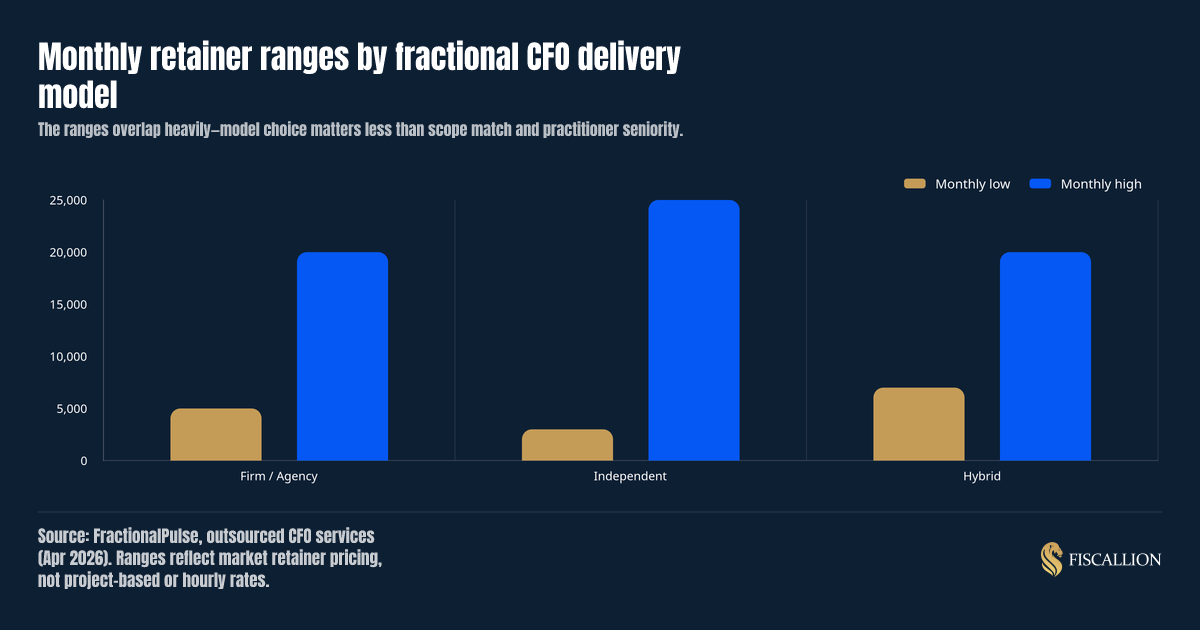
| Delivery model | Typical monthly retainer | Continuity if your CFO is unavailable | Who you contract with |
|---|---|---|---|
| Firm / agency | $5,000–$20,000 | Yes, colleague coverage | The firm |
| Independent consultant | $3,000–$25,000 | No, unless separately arranged | The individual |
| Hybrid (independent + support team) | $7,000–$20,000 | Partial, via the individual's own team | The individual |
Source: FractionalPulse, outsourced CFO services, published April 2026.
Notice that the independent range is the widest one. It stretches lower than the agency floor, because solo operators carry less overhead, and higher than the agency ceiling, because the most senior independent operators price at a premium for direct access. Model choice does not predict price. Scope and seniority do.
It also helps to separate a fractional CFO from a project-based CFO consultant. A fractional CFO holds ongoing responsibility for financial outcomes: the forecast, the board narrative, the cash position, over time. A consultant is typically engaged for a defined deliverable, like a valuation model or a due-diligence package, and then exits. As one industry comparison puts it, "a fractional CFO is an ongoing leadership role... a CFO consultant is a project-based engagement... one leads from within; the other advises from the outside." Consultants often charge a higher hourly or project rate precisely because the engagement is narrow and finite.
There is also a distinct sub-category worth naming directly: the FP&A-focused advisory partner. This model does not run your monthly close or manage bookkeeping. It owns rolling forecasts, scenario modeling, CAC/LTV as cohort ranges, and a decision cadence with the CEO, and it is designed to pair with your existing accounting team rather than replace any part of it. Fiscallion operates in this category. Every Fiscallion client works directly with Aleksandar Stojanovic at the CFO layer, senior-partner ownership on every engagement, not a hand-off to an account manager or a junior delivery team.
Cost comparison: do agencies cost more than independent consultants?
Not reliably. What drives price is scope and seniority, not whether the provider is a firm or a solo operator. Source: FractionalPulse.
A useful outsourced CFO tiering breaks the market by scope rather than delivery model. Tier 1, accounting-led work, runs $1,500 to $5,000 a month and covers financial ops, basic cash flow, and budget-versus-actuals, with no board-level strategy. Tier 2, advisory work, runs $5,000 to $12,000 a month for financial modeling, board deck preparation, and fundraising data rooms, typically serving $2M to $15M ARR companies. Tier 3, operational work, runs $12,000 to $25,000 a month for direct team management, revenue recognition under ASC 606, and multi-entity consolidation, serving $10M to $50M ARR companies. Source: FractionalPulse, outsourced CFO tiers.
The gut-check that cuts through most sales conversations is the effective hourly rate. If a quoted retainer, divided by expected hours, lands meaningfully below $250 an hour, you are very likely paying for a junior team member wearing a senior title. That threshold applies whether the provider is an agency or an independent.
Full-time cost is the other side of this comparison. A full-time CFO's fully loaded first-year cost runs $300,000 to $600,000, once you add base salary of $250,000 to $350,000, benefits and payroll taxes at 25 to 35 percent, recruiting fees of $30,000 to $80,000, and equity. Source: GetExact, fractional CFO salary, published March 2026. A fractional engagement at $36,000 to $144,000 a year represents a substantial reduction against that baseline, though the comparison only holds if the fractional scope actually covers the decisions you need made.
A useful way to size this in practice is to price the complete finance stack rather than a single hire. At roughly $10M ARR, a bookkeeper at $1,500 a month, a fractional controller at $4,000 a month, and a fractional CFO at $10,000 a month totals about $15,500 a month, or $186,000 a year, still less than half a full-time CFO's all-in cost. Source: Aleksandar Stojanovic, LinkedIn, April 2026.
Key differences that actually matter
Once you strip out the cost overlap, four real differences remain, and they cut in opposite directions depending on the model.
Bench depth favors the agency. A firm can put a colleague in front of your board if your assigned CFO is sick, traveling, or leaves the engagement. That colleague may also answer industry-specific questions your primary CFO has not encountered. This is the clearest structural advantage of the agency model.
Key-person risk favors the independent, until it doesn't. With an independent consultant, "the person you meet is the person who does the work, every month, this is the only model where that is guaranteed."
"Context compounds: the same person who built your forecast defends it to your board and refines it after every close, with nothing lost in handover."
— Aleksandar Stojanovic, CEO & Founder at FiscallionThe trade-off is real: "client capacity is limited, there is no built-in bench cover." Source: ScaleWithCFO, choosing a fractional CFO, published June 2026.
Who actually does the work is not guaranteed by either label. Agencies carry a specific risk here: "the person who sells the engagement is not the person who does the work," and quality depends almost entirely on who you are matched with rather than on the firm. Some boutiques keep the partner close to the numbers for the life of the engagement. Others cascade work down after the first month, and you keep paying partner rates for associate execution. The ScaleWithCFO source is blunt about the fix: "ask who builds your board pack in month four, not month one."
Bundled scope favors the agency, clean handoff favors the independent. Firms often offer supporting layers, controllers, bookkeepers, FP&A analysts, under the same roof, which can simplify vendor management if you need those layers. If you already have a reliable bookkeeper or controller, an independent consultant's narrower scope avoids paying for redundant capacity.
Sector specialization outweighs the model you pick
Here is the variable that matters more than agency versus independent: does the person actually know SaaS.
"A CFO who has lived inside your revenue model has seen your metrics and your investor questions dozens of times. A generalist, regardless of delivery model, works it out on your budget."
— Aleksandar Stojanovic, CEO & Founder at FiscallionThe test is concrete and takes five minutes in an interview. Ask any candidate how they would rebuild your MRR schedule, how annual contracts should flow through deferred income, and what actually belongs in the monthly board pack. Source: ScaleWithCFO.
For a company at $5-100M ARR, this test matters more than firm size. A generalist independent with SaaS depth will outperform an agency CFO who is relearning your revenue recognition rules on your dime, and the reverse is equally true.
Working alongside your existing accountant or bookkeeper
Neither model, done well, replaces your existing accounting function. "We work alongside your existing accounting team, fractional controller, and accounting manager, not around them," is how one accounting firm frames the layered structure, noting that "CFOs analyze financial data to guide business decisions while controllers manage internal financial controls and compliance." Source: Massey and Company CPA, published July 2026.
This shows up as a recognizable pattern at the $5M to $10M ARR stage. As one fractional operator describes it, "most of the time we just layer on top where the controller keeps owning the accounting and we come in for the modeling, the board materials, and the raise prep." Bookkeeper, controller, FP&A, and CFO are four different jobs, and most teams have covered the first one or two and assumed that was the entire function. Source: Will Sprague, LinkedIn, July 2026.
The practical distinction between agency and independent here is bundling, not capability. An agency can offer the controller and bookkeeper layer inside the same contract, which can simplify vendor relationships if those layers are missing. An independent consultant typically expects you to already have reliable accounting in place and will build on top of it rather than provide it.
The risk runs in both directions if this coordination fails. A standalone advisor operating in a silo can hand you recommendations that are "misaligned or non-integrated with existing accounting, tax, payroll, HR, and operations teams," and the downstream cleanup can become expensive. Source: Advysor, LinkedIn, May 2026. This is not an argument against independents specifically. It is an argument for confirming, before you sign, exactly how the provider intends to coordinate with your existing bookkeeper or controller.
What working relationship should you actually expect
This is where the label starts to matter less than the practical rhythm you will experience month to month.
With an agency, expect a sales conversation with a senior partner, followed by an assigned CFO who may or may not be the person you spoke to. Coverage is the upside: if your CFO is unavailable, someone else can step in. The risk is delegation drift, where work quietly cascades to less senior staff after the relationship settles in.
With an independent consultant, expect direct access to the person doing the work, a shorter communication loop, and no substitution risk, because there is no one to substitute. The trade-off is capacity: if that person is unavailable, there is no built-in cover unless you have negotiated it separately.
The test that cuts through both models is behavioral, not structural. After roughly ninety days with a fractional CFO, "can you point to a decision you made differently because of them? If the answer is no, you do not have a CFO. You have a contractor with a fancy title." Warning signs include "beautiful decks, no decisions changed," "lots of analysis, no recommendations," and a CFO who "waits for you to ask instead of flagging what you missed." Source: Tobias Herrmann, LinkedIn, April 2026.
That test also exposes a broader market quality problem worth naming plainly: the market is genuinely uneven. Some providers charge premium rates while outsourcing execution and taking far longer than necessary to close books that should move quickly. The counterpoint matters equally: the strong operators, agency or independent, "are finding margin improvements through pricing tweaks, preventing cash flow disasters, and building forecasts you can actually operate against." Source: CJ Gustafson, LinkedIn, August 2025. The ninety-day decision test is how you tell which group you hired.
When to choose which model
Use the decision problem, not the label, as your filter.
- Choose an agency when you need integrated layers, CFO plus controller plus bookkeeping under one roof, coverage for continuity during travel or turnover, or breadth across functions beyond FP&A.
- Choose an independent consultant when you need senior judgment applied directly to the work, deep SaaS specialization without a handoff, and you already have reliable accounting in place.
- Choose an FP&A-focused advisory partner, Fiscallion's category, when the actual problem is forecasting confidence, CAC/LTV numbers nobody trusts, or board materials that report history without framing a next decision, rather than a compliance or bookkeeping gap.
Trigger moments tend to make the choice obvious in practice: metrics chaos across disconnected spreadsheets and tools, board pressure to explain a burn trend, fundraising prep that exposes thin unit economics, or a cash-to-accrual accounting transition that your current bookkeeper was never scoped to lead.
Selection process: questions to ask before signing
Ask these six questions of any provider, agency or independent, before you sign anything:
- Who actually does the work month to month?
- What happens when you are away, is there cover, and what does it cost?
- How is pricing structured, and what falls outside the retainer?
- Can I see a redacted sample board pack from a comparable-stage client?
- How many clients does this person or team run at once?
- What sector do most of your clients come from?
Source: ScaleWithCFO.
Get the answers in writing before you commit to a long contract. A defined cadence, monthly board packages, a specific forecast update schedule, decision-review sessions, protects you from vague scope creep in either direction, and it gives you a concrete basis for the ninety-day decision test described above.
Common mistakes and the better move
Mistake: hiring based on a sample deck alone. A polished board deck template tells you nothing about who will actually build your deck in month four. Ask for a redacted deck from an active, comparable-stage engagement, and ask who built it.
Mistake: treating "fractional CFO" as one category. You now know it spans three delivery models and at least three scope tiers. Specify the tier and model you need before you start evaluating vendors, not after.
Mistake: comparing retainer cost to full-time base salary only. A full-time CFO's fully loaded first-year cost includes benefits, payroll taxes, recruiting fees, and equity on top of base. Compare fully loaded numbers on both sides.
Mistake: signing a twelve-month contract without a defined cadence. Lock in deliverables, meeting frequency, and forecast update intervals in writing before signing anything longer than a quarter.
Mistake: assuming the title implies strategic ownership. Neither "fractional CFO" nor "agency" guarantees decision-grade FP&A. Run the ninety-day decision test regardless of which model you choose.
Mistake: hiring a full-time CFO before diagnosing the actual problem. If your gap is forecasting confidence or board framing rather than daily executive presence and a permanent internal finance organization, a full-time hire is likely oversized for the problem you actually have.
Frequently asked questions
Should I choose a fractional CFO agency or an independent consultant for my SaaS company?
Base the decision on your specific gap, not a general preference for one structure. If you need integrated layers under one contract, coverage during turnover or travel, or breadth across compliance and controllership alongside FP&A, an agency's bench depth is the stronger fit. If your team already has reliable bookkeeping and controllership and the gap is decision-grade forecasting, board framing, or unit economics you can actually act on, an independent operator, or an FP&A-focused advisory partner like Fiscallion, gives you direct senior judgment without paying for layers you do not need. Sector specialization in SaaS should outweigh the model choice either way: a generalist in either structure will cost you time relearning your revenue model.
Do fractional CFO agencies cost more than hiring an independent CFO consultant?
Not reliably. Published retainer ranges show firms at $5,000 to $20,000 a month and independents at $3,000 to $25,000 a month, a wider band on both ends, according to FractionalPulse. Price is driven by scope and seniority far more than by delivery model. The more useful comparison is the effective hourly rate: if a quote lands meaningfully below $250 an hour for genuine strategic FP&A work, you are likely paying for junior execution regardless of whether the provider is a firm or a solo operator.
Can a fractional CFO agency work alongside my existing accountant or bookkeeper?
Yes, and this is the expected structure, not an exception. Fractional CFOs, agency or independent, typically layer on top of your existing bookkeeper or controller rather than replacing them, handling modeling, board materials, and forecasting while your existing team continues owning the books and compliance. Confirm the coordination model explicitly before signing: ask how the provider will interface with your current accounting team, who owns which deliverable, and how discrepancies get resolved, since a provider operating in a silo can produce recommendations that are misaligned with your accounting or tax reality.
What working relationship should I expect from a CFO agency versus a solo consultant?
With an agency, expect a sales conversation with a senior figure followed by an assigned CFO who may not be the same person, with the benefit of bench coverage if that person becomes unavailable. With an independent consultant, expect direct, uninterrupted access to the person doing the work, with no substitution but also no handoff loss. In both cases, apply a ninety-day test: can you point to a specific decision you made differently because of this person's input? If every deliverable is polished analysis with no recommendation attached, you are paying for a contractor, not a CFO, regardless of the model.
The decision is about scope, not the label
Neither a fractional CFO agency nor an independent consultant is universally the better choice. The agency buys you bench depth and coverage. The independent buys you uninterrupted context and direct senior access. What actually determines value is whether the scope matches your real problem and whether the person doing the work has run SaaS metrics before.
For most companies in the $5M to $100M ARR range, the actual gap is not the org chart. It is decision-grade FP&A: forecasts you can operate against, CAC/LTV treated as a cohort range instead of a debated single number, and board materials that frame trade-offs instead of reporting history. If that is your gap, compare delivery models and discuss senior-partner fit through Fiscallion's fractional CFO service, where every engagement runs directly with Aleksandar Stojanovic at the CFO layer.