
A fractional CFO proposal that leads with credentials instead of diagnosis gets filed and forgotten. A Series A or B founder does not need to read another biography. They need to see that someone understands why cash flow visibility is broken, why the board keeps asking questions the deck cannot answer, and what fixing that is actually worth.
This article gives you the structure a proposal from a fractional CFO agency should follow, the fee ranges you should expect to see at your stage, and the questions to ask before you sign anything. It also covers how the engagement fits alongside a controller or bookkeeper you already have, because most proposal failures trace back to unclear boundaries between those roles.
What you'll learn
- The six components every serious fractional CFO proposal must contain
- How to read a phased 30/60/90-day deliverable plan and what should be in each phase
- Retainer pricing ranges by stage and what actually drives the spread
- How a fractional CFO, a controller, and a bookkeeper divide the work without overlap
- How fast onboarding should happen after a Series A or Series B round closes
Why most fractional CFO proposals get rejected
Most rejected proposals share the same three defects. First, they open with the provider's résumé and client logos instead of the company's problem. Second, they quote a monthly retainer with no stated connection to what that spend is worth to the business. Third, they describe the engagement in vague language that could mean anything from bookkeeping cleanup to board deck design.
The alternative structure works because it starts somewhere else entirely: the client's broken financial engine. A proposal built around diagnosis first names the specific gap, quantifies what closing it is worth in dollars, and only then presents the retainer as the obvious way to capture that value.
"The retainer stops looking like a cost and starts looking like the cheapest path to an answer you don't currently have."
— Aleksandar Stojanovic, CEO & Founder at FiscallionOne distinction gets missed often enough that it is worth stating plainly. A proposal is a non-binding document meant to win the engagement. An engagement letter is the binding contract signed after you accept. If a provider is fuzzy about which document you are looking at, that fuzziness usually shows up again later in how they define scope.
The six components every fractional CFO proposal should contain
A proposal missing any of these six elements is incomplete, regardless of how polished the deck looks.
| Component | What it should specify |
|---|---|
| Client and provider identification | Legal entity names, primary contacts, and who signs |
| Scope of services and deliverables | Exactly what work is included, in plain language, not categories |
| Fee structure and billing terms | Monthly retainer amount, invoicing cadence, expense handling |
| Engagement period and timelines | Start date, initial term, renewal or notice terms |
| Client responsibilities and required access | Systems, data, and people the CFO needs and by when |
| Confidentiality and legal protections | NDA terms, data handling, liability boundaries |
This list comes from how proposal structure standards are typically built for CFO engagements, and it maps closely to how a standard scope of work document should be organized for any fractional finance role.
Section by section: the diagnosis-first proposal structure
The economic roadmap replaces the résumé
Instead of opening with track record, a strong proposal opens with a table connecting the problem to a dollar figure. The format is consistent across well-built CFO proposals: problem, business impact, annual value of the fix, and the CFO's specific role in delivering it.
| Problem | Business impact | Annual value of fix | CFO's role |
|---|---|---|---|
| No 13-week cash forecast | Board and investors ask questions leadership cannot answer confidently | Faster fundraise decisions, fewer surprise cash crunches | Build and maintain rolling cash forecast |
| Headcount plan lives in three spreadsheets | Hiring decisions made without a burn-rate check | Avoids over-hiring against a runway that isn't real | Own single headcount plan tied to burn model |
| CAC/LTV debated as single numbers | Pricing and growth trade-offs stall in every leadership meeting | Faster, evidence-based growth decisions | Build cohort-based unit economics view |
Notice what this table does not do. It does not compare the retainer to a full-time CFO's salary. It compares the retainer to the cost of not having the answer.
The engagement boundary: what is in scope and what is not
Ambiguous scope is where most fractional CFO relationships sour. A clear proposal separates what is always included from what is usually excluded.
Work that belongs in almost every fractional CFO scope: cash management, financial forecasting, fundraising readiness, cap table oversight, and investor reporting. Work that often gets added depending on the engagement: pricing strategy, cost structure analysis, unit economics, and board reporting. Work that should almost never be in scope: day-to-day accounts payable, payroll processing, and bookkeeping data entry, according to how the fractional CFO operating model is typically defined.
If a proposal is silent on exclusions, ask directly. Vague scope is how a $10,000 monthly retainer quietly becomes bookkeeping cleanup at strategic-advisory rates.
Phased deliverables: what the first 90 days should look like
A credible proposal breaks the engagement into three phases rather than promising undefined ongoing value from day one. The phased deliverable structure that shows up consistently across CFO service proposals looks like this:
- Phase 1, days 1-30: foundation and visibility. Financial statement audit, a 12-month cash flow projection, a concentration analysis on customers and vendors, and a written health assessment.
- Phase 2, days 31-60: execution and stabilization. Implementation of the top action items from phase one, renegotiation of banking terms if needed, and a 24-month plan.
- Phase 3, days 61-90: optimization and transition planning. A quarterly board package, a refined forecast, and a clear roadmap for what comes next.
If a proposal skips straight to "ongoing strategic support" without naming what happens in each of the first three months, push back and ask for specifics.
Fee structure and retainer tiers by stage
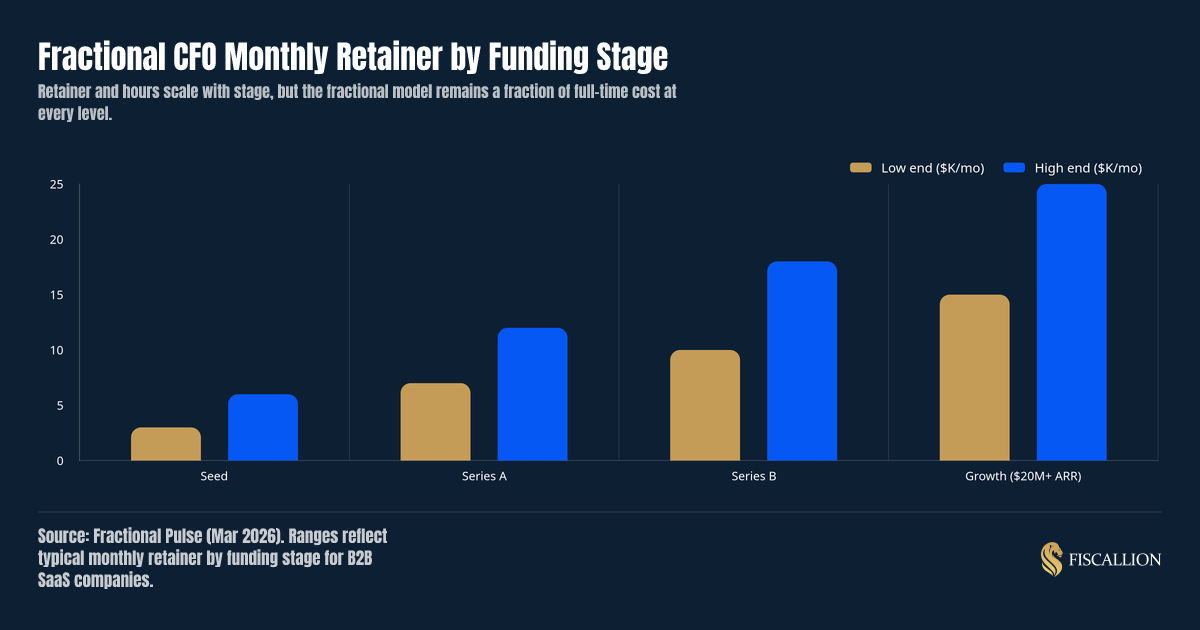
Retainer pricing scales with company stage, board cadence, fundraise activity, and reporting complexity. Ranges reported across the fractional CFO market for 2026 look like this.
| Stage | Typical monthly retainer | Typical hours/month |
|---|---|---|
| Seed | $3,000-$6,000 | 10-15 |
| Series A (embedded) | $5,000-$18,000 | Varies with scope |
| Series A (full-scope, active fundraise) | $15,000-$25,000 | Varies with scope |
| Series B ($5-20M ARR) | $10,000-$18,000 | 20-30 |
| Growth stage ($20M+ ARR) | $15,000-$25,000 | 25-40 |
These figures come from Fractional Pulse's 2026 pricing analysis, CFO Advisors' Series A pricing benchmarks, and Pegacorn Group's cost breakdown.
Four variables drive the spread within each range: board reporting cadence, whether you are actively fundraising, the complexity of your entity structure, and reporting complexity such as multi-product revenue recognition or R&D capitalization, per Pegacorn Group's analysis.
What no tier includes, regardless of price: bookkeeping or transactional accounting, full-time presence, a fix for bad underlying financial data, or a guaranteed fundraise outcome. As Pegacorn Group puts it, "a CFO can identify the gaps and structure the cleanup, but the cleanup itself is bookkeeping work."
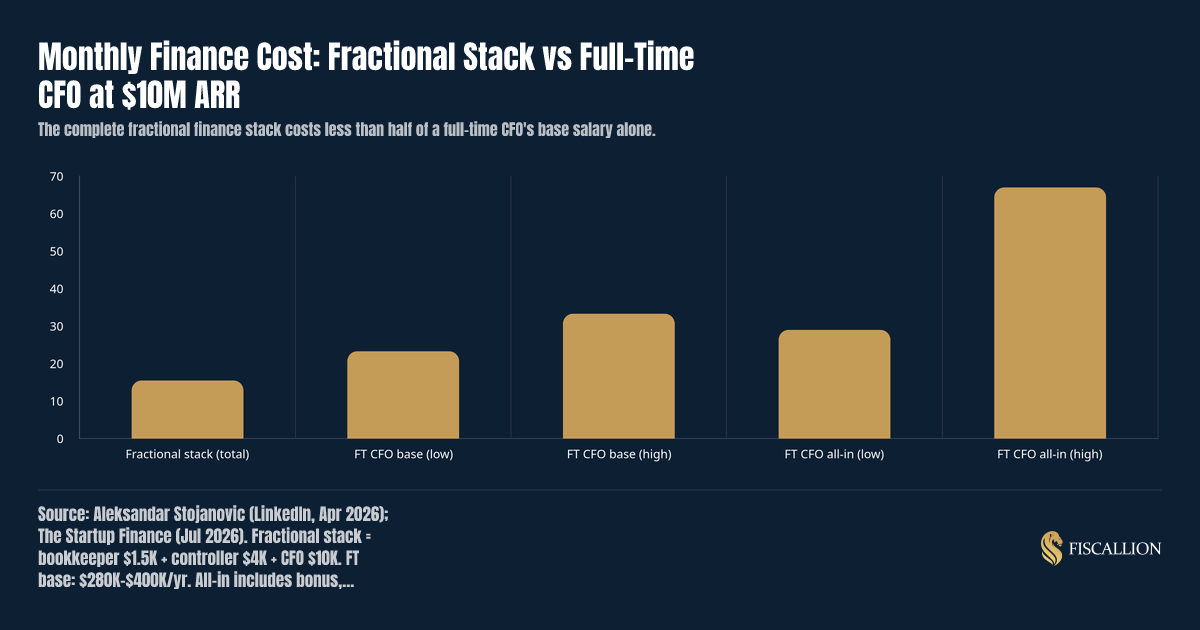
Compare that to full-time cost. A full-time CFO's base salary runs $280,000-$380,000 per year, or roughly $23,000-$32,000 per month, with all-in cost including bonus, benefits, equity, and recruiting fees reaching $350,000-$800,000 annually. Fractional engagements typically save 60-80% of that all-in figure, according to The Startup Finance. That comparison should never be used to argue the fractional model is simply "cheaper." It is a different scope, delivered by a senior partner rather than a permanent internal hire, and the right fit depends on whether your company needs daily executive presence or targeted strategic FP&A ownership.
Client responsibilities and required access
The proposal should list exactly what it needs from you and by when. That typically means system access to your accounting platform and billing tools, a single internal point person, and agreed turnaround times for data requests. A proposal that skips this section usually means the provider hasn't thought through onboarding, which is a preview of how the engagement will run.
Terms, change orders, and termination
Look for a defined initial term, a notice period for termination (30 days is common), a stated process for handling scope changes without renegotiating the whole contract, and confidentiality terms covering your financial data. These are unglamorous details, but they are exactly where disputes happen six months in if they are not written down now.
What a fractional CFO retainer covers for a post-raise SaaS company
A retainer built for a company that just closed a Series A or B typically spans eight modules: cash flow and liquidity planning, budgeting and forecasting, KPI dashboards and board-ready reporting, fundraising and diligence prep, systems and integrations, profitability and cost analysis, controls and tax strategy coordination, and support for strategic transactions. This module set is consistent with how fractional CFO service packages are structured at this stage.
Cadence matters as much as scope. A working engagement typically includes weekly or biweekly check-ins with the CEO running 30-45 minutes, a monthly review with the leadership team lasting one to two hours, ad-hoc sessions for major decisions, and quarterly strategic planning. As Inflection CFO notes, "engagements fail when cadence becomes monthly-only. That's just reporting, not decision support."
That distinction is worth sitting with. A monthly board deck tells you what happened. A weekly cadence with your CFO is where the actual decisions get made, before they show up in a deck three weeks later. This is also where board reporting frameworks that treat gross margin, net revenue retention, CAC payback, and cash runway as tier-one metrics earn their keep, because those numbers need to be current when a decision is on the table, not restated after the fact.
How a fractional CFO works alongside your controller or bookkeeper
The most common objection to a fractional CFO proposal is some version of: "We already have someone doing our books, why do we need this too?" The answer lies in a three-layer model that most founders have never had explained to them clearly.
Layer one is the bookkeeper. They record what happened. Typical cost is $500-$2,000 per month, needed from day one, and most companies should stop running this function solo once they cross $2 million ARR.
Layer two is the controller. They make the records reliable and on time. Fractional controller cost typically runs $3,000-$8,000 per month, needed from roughly $3-5 million ARR, and critical the moment your monthly close takes seven or more days.
Layer three is the fractional CFO. They turn the numbers into decisions. Cost typically runs $8,000-$20,000 per month, needed from $3 million ARR if you are actively raising, or $7 million ARR if you are not. This layer becomes critical the moment a founder cannot confidently answer "what's our real runway" in a board meeting. These layer definitions and cost ranges come from Aleksandar Stojanovic's breakdown of the finance stack and align with how Rubric Financial maps bookkeeping-to-CFO growth stages.
These layers are cumulative, not substitutes for one another. Rubric Financial states this directly: "A CFO hired onto unreliable books spends the first six months doing controller work at CFO rates. Fix the layer below before buying the layer above."
"A fractional CFO who has to fix unreliable books before doing any strategic work is not doing CFO work, they are doing controller work at CFO rates."
— Aleksandar Stojanovic, CEO & Founder at FiscallionIn practice, a fractional CFO integrates with an existing team through one of three models, as described by CFO Engine:
- Supervisory: the CFO directly manages the finance team, spending two to three days a week embedded, typically when there is no controller in place.
- Collaborative: the CFO works alongside an existing controller, spending one to two days a week, with clear division of who owns reporting mechanics versus strategic interpretation.
- Project-based: the CFO leads specific initiatives, such as a fundraise or a model rebuild, without ongoing weekly presence.
The math at a representative stage makes the layering concrete. At $10 million ARR, a company running a bookkeeper at $1,500 per month, a fractional controller at $4,000 per month, and a fractional CFO at $10,000 per month spends roughly $15,500 per month total, according to Aleksandar Stojanovic's LinkedIn analysis. That is less than half the base salary of a full-time CFO alone, before benefits, equity, and recruiting costs are added.
How quickly can a fractional CFO be onboarded after a Series A or B round?
Speed is one of the clearest advantages a fractional model has over a full-time search. A fractional CFO can typically be engaged and productive within one to four weeks, compared with three to six months for a full-time executive search, based on onboarding timelines reported by Burkland Associates and StartupCFO.ai.
The first 30 days should follow a defined sequence, not an open-ended ramp-up period. According to Consult EFC's first-30-days framework:
- Days 1-7: cash visibility and quick protection. Six specific numbers get pulled: bank balances, weekly burn, top 20 accounts receivable, top 20 accounts payable, payroll timing, and tax liabilities.
- Days 8-14: fixing reporting so decisions stop relying on guesswork.
- Days 15-21: practical financial controls.
- Days 22-30: clear priorities and a documented 90-day plan.
There is also a sequencing question worth raising before you sign a proposal at all: should you be hiring a fractional CFO right now, or a controller, or both? A common post-raise mistake is bringing in senior CFO-level support the week the round closes, when the work the round actually funded sits at the controller and fractional-CFO layer for the first 12 to 18 months. As Bryan Johnson frames the sequencing: "Stop hiring the senior CFO the week after the Series A closes. The work the round actually funded sits at the controller and fractional CFO layer for the first 12 to 18 months. That is roughly $150K of controller plus $7K/month of fractional CFO oversight, and it gets you to month 12 with a clean diligence package and a real Series B story. The senior CFO comes in around month 14 or 15."
This is exactly the kind of judgment call a proposal should address directly rather than assume. Every Fiscallion engagement starts with this sequencing conversation, and every client works directly with Aleksandar Stojanovic at the CFO layer to figure out which layer of finance work they actually need right now, not a generic package sold regardless of fit.
Common mistakes and the better move
Mistake: accepting a proposal that quotes a number with no connection to value. Ask for the economic roadmap table. If a provider cannot connect the retainer to a specific dollar impact, they have not done the diagnosis work yet.
Mistake: treating "fractional CFO" and "bookkeeping cleanup" as the same service. They are different layers. If your books take more than a week to close, you likely need a controller first, or alongside, not instead of a CFO.
Mistake: agreeing to monthly-only cadence. A single monthly meeting is reporting, not decision support. Push for weekly or biweekly touchpoints if you are actively managing runway, fundraising, or scaling headcount.
Mistake: hiring a full-time senior CFO immediately after closing a round. In many cases, the work funded by that round sits at the controller and fractional CFO layer for the first year or more. A senior full-time hire before that groundwork is done often means paying CFO rates for controller-level work.
The proposal template you can adapt
Use this structure as a working checklist when reviewing or requesting a proposal from any fractional CFO agency.
- Client and provider identification: [Company name], [ARR and stage], [Primary contact], [Provider legal entity and CFO name]
- Diagnosis statement: The specific financial visibility, forecasting, or reporting gap identified, stated in one paragraph, no jargon
- Economic roadmap table: Problem / business impact / annual value of fix / CFO's role, populated with your actual numbers
- Scope of services: Explicit list of what is included (cash management, forecasting, board reporting, fundraising support) and explicit exclusions (bookkeeping, payroll, tax filing)
- Phased deliverables: Days 1-30, 31-60, 61-90, each with named deliverables, not vague categories
- Fee structure: Monthly retainer amount, invoicing terms, expense policy, initial term length
- Cadence: Weekly/biweekly check-in schedule, monthly review format, quarterly planning sessions
- Client responsibilities: Named point of contact, system access needed, data turnaround expectations
- Terms: Notice period, change order process, confidentiality terms
Fill in each line with your company's specifics before you compare providers. A proposal that cannot populate this structure with real detail is not ready to sign.
Frequently asked questions
What should a fractional CFO proposal include for a Series A or B SaaS company?
A complete proposal should include six components: client and provider identification, a clearly defined scope of services with named deliverables, a fee structure with billing terms, an engagement period with timelines, client responsibilities and required access, and confidentiality and legal protections. Beyond those baseline components, the strongest proposals for Series A/B companies open with an economic roadmap connecting your specific financial visibility gaps to a dollar value, then break the first 90 days into three named phases: foundation and visibility, execution and stabilization, and optimization and transition planning. If a proposal skips the diagnosis and jumps straight to a retainer number, ask for the missing analysis before you sign.
How does a fractional CFO engagement work alongside our existing controller or bookkeeper?
The relationship works through a layered model rather than overlap. A bookkeeper records transactions, a controller ensures those records are reliable and delivered on time, and a fractional CFO uses those reliable numbers to build forecasts, run scenarios, and support board and investor decisions. These layers are cumulative: a fractional CFO working with unreliable books ends up doing controller-level cleanup at CFO rates, which is a poor use of both the retainer and the CFO's time. Depending on whether you already have a controller, the CFO typically integrates through a supervisory model (managing the finance function directly, common when there is no controller), a collaborative model (working alongside an existing controller with clearly split responsibilities), or a project-based model (leading a specific initiative like a fundraise without ongoing weekly presence). At a representative $10 million ARR company, running all three layers, bookkeeper, controller, and fractional CFO, typically costs less than half of a full-time CFO's base salary alone.
What does a fractional CFO retainer typically cover for a post-raise SaaS company?
A post-raise retainer typically covers eight modules: cash flow and liquidity planning, budgeting and forecasting, KPI dashboards and board-ready reporting, fundraising and diligence preparation, systems and integrations, profitability and cost analysis, controls and tax strategy coordination, and support for strategic transactions. It should not include day-to-day accounts payable processing, payroll administration, or bookkeeping data entry, since those belong to the layers below the CFO. Monthly retainer pricing at the Series A/B stage typically falls between $5,000 and $25,000 depending on board cadence, active fundraise status, entity complexity, and reporting complexity, and the engagement should include a defined weekly or biweekly cadence with the CEO in addition to monthly and quarterly reviews. If your engagement is monthly-only, it is functioning as reporting rather than as decision support, and that gap should be addressed directly with the provider.
How quickly can a fractional CFO agency be onboarded after a Series A or Series B round closes?
A fractional CFO can typically be engaged and operational within one to four weeks, compared with three to six months for a full-time executive search and hire. The first week should focus on establishing cash visibility: pulling bank balances, weekly burn, top receivables and payables, payroll timing, and tax liabilities. The following three weeks typically address fixing reporting gaps, putting practical controls in place, and producing a documented 90-day plan with clear priorities and owners. One sequencing point matters here: bringing in a senior full-time CFO the week a round closes is often premature, since the work funded by that round usually sits at the controller and fractional CFO layer for the first 12 to 18 months. Getting the fractional layer engaged quickly, before deciding whether a full-time hire is warranted later, tends to produce a cleaner diligence package heading into the next round.
Get a proposal built for your stage, not a template
A generic proposal template tells you what a good engagement should look like. It does not tell you whether you need a controller, a fractional CFO, or both right now, or what your specific cash flow and forecasting gaps are actually costing you.
If you want that assessed directly rather than guessed at from a template, scope a fractional CFO engagement with Fiscallion and discuss proposal fit with Aleksandar Stojanovic directly. Every engagement is scoped and led at the CFO layer, not handed off to a junior team after the first call.