
The question "who's the best fractional CFO consultant" is the wrong first question. The right first question is what decision you're actually stuck on: cash visibility, runway confidence, board reporting, unit economics, or headcount planning. Fractional CFO consultants, outsourced finance teams, boutique SaaS FP&A advisors, and finance software platforms all solve different slices of that problem, and most founders shop for a title before they define the job. Get the job definition right first, and the vendor selection gets a lot easier - and a lot cheaper.
This piece breaks down what fractional CFO consultants actually do at the $5-50M ARR stage, what the market charges, how to evaluate a candidate or firm against your specific decision gaps, and where a fractional hire is not actually the fix.
Key takeaways
- A fractional CFO is a job description, not a guarantee of decision quality. Scope the engagement to the specific gap: cash visibility, runway forecasting, board reporting, unit economics, or headcount modeling.
- Market rates for fractional CFO consultants run from roughly $2,000/month at pre-seed to $25,000/month for full-scope strategic work at Series B and beyond, with the spread driven almost entirely by hours committed and whether the work is strategic or operational.
- A fully loaded full-time CFO at a $5-15M ARR company typically costs $500,000-$800,000 annually versus $87,000-$167,000 for a fractional alternative covering the same strategic scope, based on 2025-2026 market benchmarks.
- Most $5-50M ARR SaaS companies don't have a CFO problem. They have a decision-quality and FP&A problem: fragmented data, implicit assumptions, and no repeatable cadence for turning activity into cash, runway, and trade-offs.
- Score any fractional CFO candidate or firm against five criteria: SaaS-specific modeling experience, assumptions transparency, board-deck philosophy, cadence discipline, and whether they treat CAC/LTV as a range or a single misleading number.
What we'll cover
This article walks through the core concept of what a fractional CFO consultant is supposed to deliver, how to calculate the real cost and time commitment for your stage, how to interpret vendor proposals and rate cards, what to do next with a structured evaluation process, the most common hiring mistakes, and a practical scorecard you can use in your next vendor conversation.
The real job: decision quality, not a fancier deck
A fractional CFO consultant should change what decisions you can make with confidence. Not the design of your board deck. Not the polish of your dashboards. The decisions.
At $5-50M ARR, the decisions that matter are consistent across almost every SaaS company we work with: how much runway do you actually have under three growth scenarios, what happens to margin if you change pricing, which of the next five hires pays for itself within 12 months, and what should the board actually decide at the next meeting versus just be informed of.
If a fractional CFO candidate can't walk you through how they'd model those five decisions in the first conversation, you're evaluating a reporting vendor, not a strategic finance partner. That distinction matters because reporting and strategy get priced and staffed very differently, and conflating them is where budgets get wasted.
This is also where the category gets confusing. Fractional CFO firms, outsourced bookkeeping and controller services, boutique SaaS FP&A consultants, and finance platforms like Cube, Mosaic, Finmark, or Pry all get pitched as "finance help." They are not interchangeable. A controller keeps your books clean. A software platform gives you a place to see numbers. Neither one owns the judgment call about whether you can afford the sales hire you're debating in Tuesday's leadership meeting. For a deeper breakdown of what the SaaS CFO role actually covers at each stage, see our guide on CFO responsibilities and when the function becomes full-time.
How to calculate what you actually need to pay
Cost is a function of two variables: hours committed per month and whether the work is strategic or operational. Everything else, including the sticker rate per hour, is noise on top of that.
Use this sequence to size your own budget before you take a call with any provider.
- List the decisions you need finance judgment on this quarter. Runway scenario planning, a pricing change, a hiring plan, a board deck, fundraise prep. Count them.
- Estimate hours per decision. A single board deck cycle with commentary runs 15-25 hours. A full runway model rebuild runs 20-40 hours. Ongoing monthly close support runs 10-20 hours depending on transaction complexity.
- Add a strategic multiplier if you're mid-fundraise. Fundraise prep, due diligence support, and investor Q&A materials typically add 30-50% more hours during the active window.
- Match total hours to the market rate bands below, not the other way around. Don't let a provider's package define your scope; let your scope define the package you buy.
Here is what the market actually charges by stage, based on aggregated 2025-2026 fractional CFO pricing data. For a deeper breakdown including hourly rates and project-based fees, see our complete fractional CFO cost guide.
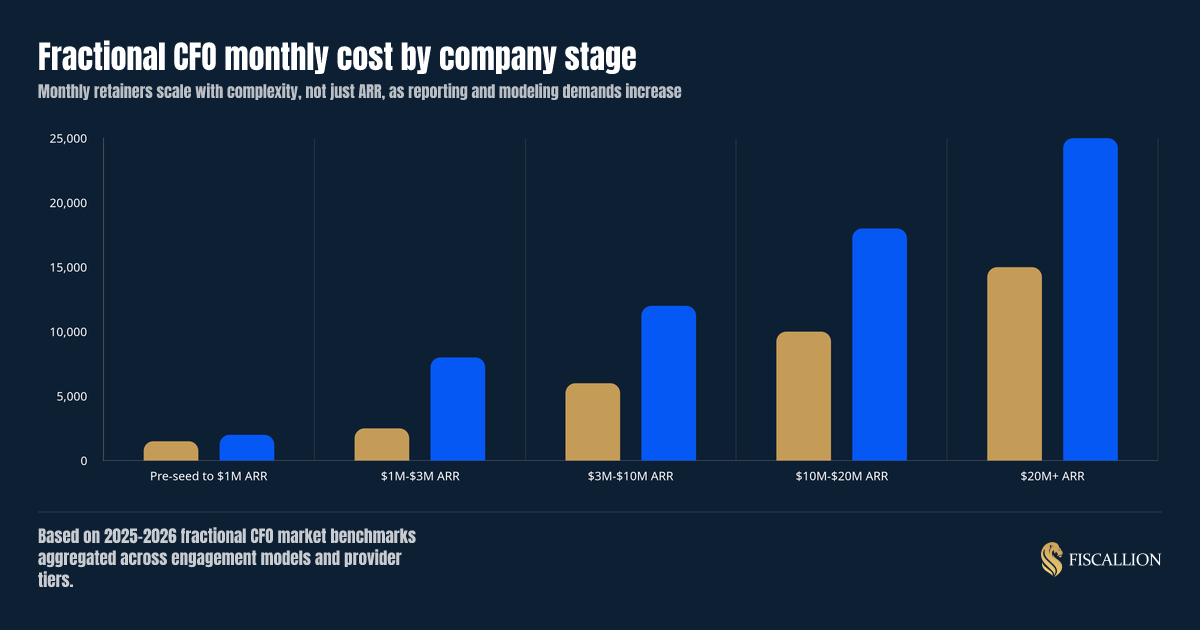
| Company stage | Typical monthly hours | Monthly retainer range | What's usually included |
|---|---|---|---|
| Pre-seed to $1M ARR | 5-10 hrs | $1,500-$2,000 | Cap table setup, basic model review, light advisory |
| $1M-$3M ARR | 10-15 hrs | $2,500-$8,000 | Board pack, monthly cadence, cohort-level metrics review |
| $3M-$10M ARR | 15-25 hrs | $6,000-$12,000 | Investor-grade model, fundraising readiness, department planning support |
| $10M-$20M ARR | 20-35 hrs | $10,000-$18,000 | Weekly ops cadence, board deck ownership, unit economics governance |
| $20M+ ARR | 30-50 hrs | $15,000-$25,000 | Full-scope strategic finance, capital structure, finance hire sourcing |
Compare that against the fully loaded cost of a full-time CFO hire at the same revenue bands, and the gap is the actual business case for going fractional in the first place.
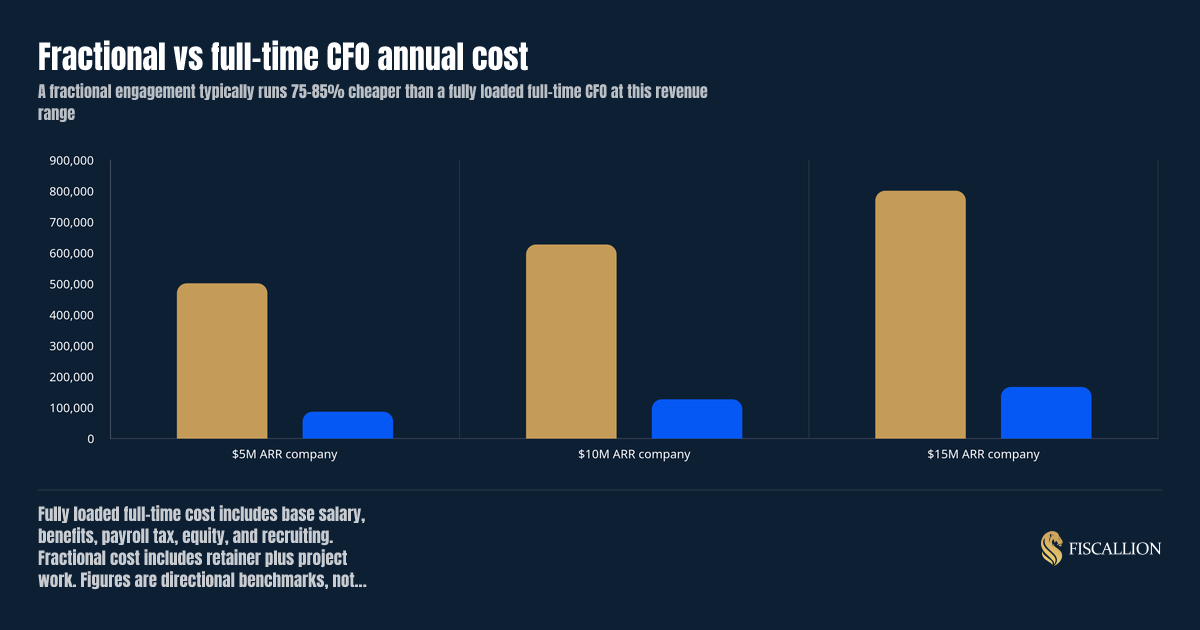
A fully loaded full-time CFO, once you add base salary, benefits, payroll tax, equity, and recruiting cost, runs $500,000-$800,000 a year for a $5-15M ARR SaaS company. A fractional engagement covering the same strategic scope lands at $87,000-$167,000. That's not a small discount. It's an 75-85% cost reduction for most of the decision-grade output a board actually needs. Industry benchmarks from Go Fractional place the average fractional CFO hourly rate at $177, with the 25th-75th percentile band running $125-$210 per hour - consistent with the retainer ranges above.
How to interpret a proposal or rate card
A rate card tells you almost nothing about output quality. Two firms quoting the same $12,000/month retainer can deliver completely different value depending on three things: who does the actual work, how assumptions get documented, and what the board deck looks like at the end.
Who does the work. Some fractional CFO firms use leverage: a senior partner scopes the engagement, then junior analysts do the modeling and a partner reviews it before it reaches you. That's not automatically bad, but you should know which model you're buying. If board-facing judgment calls are being made by someone with two years of experience and a senior review layer, ask directly.
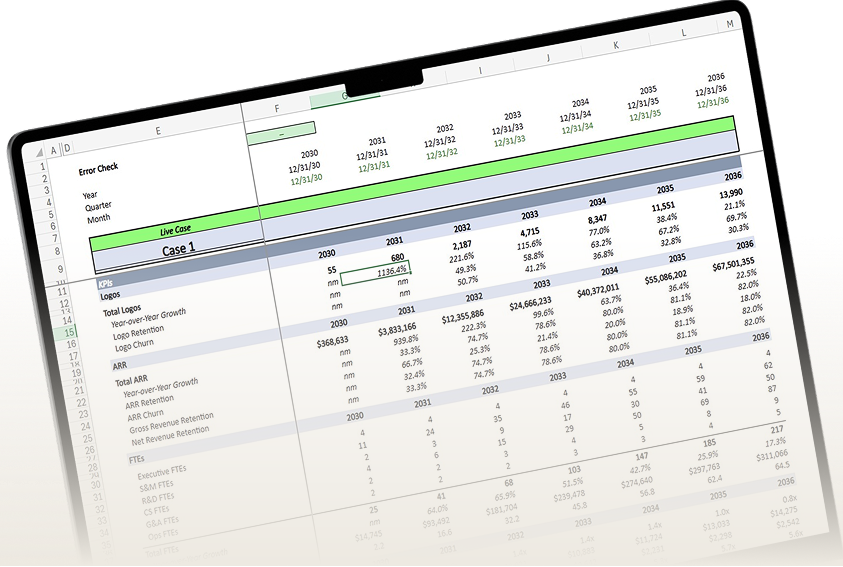
How assumptions get documented. Ask to see a sample model, not a sample deck. If growth rate, churn, and CAC payback assumptions are buried in unlabeled cells with no sensitivity range, that model will break the first time someone other than the person who built it needs to update it. A decision-grade model shows its assumptions, dates them, and assigns an owner to each one.
What the board deck argues for. Pull a sample board package. Does it end with a recommendation and a trade-off, or does it end with a chart? A deck that says "here's what happened last month" is a reporting artifact. A deck that says "here are three paths for the next two quarters and the cash implication of each" is a decision tool. Fiscallion's position on this is direct: board decks and investor updates should frame choices, not just report history, and if a fractional CFO's sample materials don't do that, the retainer price is buying you polish, not judgment.
What to do next: a five-point scoring framework
Score any candidate, firm, or internal hire against these five criteria before you sign anything. Use a simple 1-5 scale per row and total it.
| Criterion | What to ask | Red flag answer |
|---|---|---|
| SaaS-specific modeling experience | "Walk me through how you'd model deferred revenue and NRR for a company like mine." | Generic answers that don't distinguish bookings from recognized revenue |
| Assumptions transparency | "Show me a model where I can see every input assumption and who owns it." | Locked cells, no visible assumption log, "trust the output" |
| Board-deck philosophy | "Show me a sample board deck. What did it recommend?" | Charts with no recommendation, no trade-off framing |
| Cadence discipline | "What's the monthly rhythm, and what happens if a number is late?" | Vague or ad hoc reporting schedule |
| CAC/LTV treatment | "Do you report CAC/LTV as one number or a cohort range?" | A single blended LTV:CAC ratio presented as fact |
That last row matters more than founders usually expect. A single blended CAC/LTV number gets debated in every board meeting because everyone knows it's hiding cohort variance. Fiscallion treats CAC and LTV as a range tied to cohorts, not a headline ratio, because a single number invites the wrong argument: whether the number is right, instead of what to do about the segments driving it up or down. For the full calculation methods and benchmark ranges, our SaaS unit economics guide breaks down CAC, LTV, payback period, and the Rule of 40 with worked examples.
Run this scorecard against every option on the table, including the internal hire alternative: a full-time CFO, a Head of Finance, a controller, or an FP&A analyst. In a lot of cases, the scorecard reveals that what you actually need isn't a person at all. It's a decision cadence and a model that doesn't fall apart when your fundraiser asks a follow-up question.
Common mistakes and the better move
Mistake: hiring for the title instead of the gap. Founders often bring in a fractional CFO because a board member suggested it, not because a specific decision is stuck. The better move: name the decision first (runway confidence, pricing margin, hiring ROI), then find the person or firm whose sample work addresses exactly that decision.
Mistake: treating bookkeeping providers as CFO-equivalent. Firms that keep clean books and run payroll are valuable, but they are not the same category as strategic FP&A. Correct books are not the same as a fundable financial narrative. The better move: separate the two budgets. Pay for clean recordkeeping on one line and strategic judgment on another, and don't expect one vendor's rate card to cover both unless they're explicit about doing so.
Mistake: accepting a single blended CAC/LTV or NRR number in every board update. A single ratio invites debate about whether the number is right instead of what to do about it. The better move: insist on cohort-level unit economics with an explicit range, and make every board conversation about the trade-off, not the arithmetic.
Mistake: hiring a full-time CFO before $10-20M ARR because it "feels more serious."Jason Lemkin's rough rule of thumb, echoed across most SaaS operator commentary, puts a real full-time CFO need closer to $20M ARR, with a VP of Finance or controller filling the gap below that. OnlyCFO's analysis on SaaStr reaches the same conclusion: most companies at $2M-$20M ARR need a VP of Finance, not a true CFO, and hiring the title too early means paying for strategic capacity the business doesn't yet have the complexity to use. Similarly, Christoph Janz at Point Nine notes that a great CFO near $5-10M ARR can almost pay for themselves through better pricing and cash management - but that's a VP-level operator doing strategic work, not a ceremonial title hire. The better move: match the hire level to complexity, not to fundraising optics, and revisit the decision every time ARR crosses a meaningful threshold.
Mistake: buying a dashboard tool and calling it FP&A. Platforms like Cube, Mosaic, Finmark, or Pry give you a place to see numbers pulled from your stack. They don't own the judgment calls about what those numbers mean for your next hire or your next board meeting. The better move: pair any software layer with a person or process accountable for the assumptions behind the numbers, not just the visualization of them. For a structured approach to building that decision cadence, our FP&A framework for startups walks through the model, cadence, and assumptions ownership that dashboard tools don't provide.
Mistake: skipping the reference check on model quality. Founders check references on personality and responsiveness. They rarely ask a reference to open an actual model. The better move: ask a reference client to screen-share a real financial model from the engagement, not a sanitized sample, and check whether the assumptions are current and owned.
The category landscape, honestly assessed
Every option in this space solves a real problem for someone. None of them solve every problem for everyone.
| Option | Best fit | What it doesn't fix |
|---|---|---|
| Fractional CFO firm (hourly or retainer) | Board reporting, fundraising readiness, ad hoc strategic advice | Ongoing decision cadence between engagements; depends heavily on individual practitioner |
| Outsourced finance / bookkeeping team | Clean books, payroll, compliance | Strategic modeling, board narrative, trade-off framing |
| Boutique SaaS FP&A consultant | Deep unit economics work, one-time model builds | Ongoing operating cadence unless retained continuously |
| Finance software platform (Cube, Mosaic, Finmark, Pry) | Centralizing data, building live dashboards | Owning the judgment behind the assumptions and the board narrative |
| Full-time CFO hire | Companies at $20M+ ARR with real organizational complexity | Cost efficiency below that threshold; risk of overpaying for underused capacity |
| Fiscallion CFO / FP&A partnership | Decision-grade cash, runway, and trade-off modeling on a fixed cadence, without building a finance org | Day-to-day bookkeeping and payroll execution, which stays with your existing ops or accounting provider |
The pattern across most $5-50M ARR SaaS companies we talk to isn't a missing title. It's fragmented data across tools, people, and decks, implicit assumptions nobody owns, and no repeatable cadence for turning activity into cash, runway, and a next move. A fractional CFO consultant can fix that, but only if the engagement is scoped around decision cadence and assumptions ownership, not just monthly reporting output. If you're preparing for a raise, the same principle applies to Series B funding requirements - the model and metrics need to survive diligence, not just look clean in a deck.
A practical asset: the vendor evaluation call script
Use this script structure on your first call with any fractional CFO consultant, firm, or internal candidate. It surfaces the answers the scorecard above needs in under 30 minutes.
- "Walk me through your last board deck for a company at our stage. What did it recommend, and what happened after?"
- "Show me a live model, not a template. Where are the assumptions, and who owns each one?"
- "How do you handle CAC and LTV when the number looks different across cohorts?"
- "What's your monthly cadence, and what's the escalation path if a number is late or wrong?"
- "If our runway forecast and our board deck disagreed with each other, whose job is it to reconcile that, and how fast?"
That last question is the one most vendors fumble. A decision-grade finance function has one source of truth for cash, runway, and the model behind the board deck. If the answer involves reconciling three spreadsheets after the fact, you've found the actual problem the engagement needs to solve before anything else.
Conclusion
The best fractional CFO consultant for your company is the one whose sample work already answers your hardest live decision, not the one with the strongest brand or the lowest hourly rate. Price the engagement against the specific decisions you're stuck on, score every candidate against SaaS-specific modeling depth, assumptions transparency, board-deck philosophy, cadence discipline, and CAC/LTV treatment, and don't default to a full-time hire before the complexity of your business actually justifies it.
Most companies in the $5-50M ARR range don't need more consultants or more dashboards. They need one place where cash, runway, and trade-offs get modeled with owned assumptions and a fixed decision cadence. Audit your metrics definitions and forecasting model before your next board cycle, and you'll know within a week whether the gap is a vendor problem or a framework problem.