

Annual planning for SaaS is the 8 to 12 week process of setting next fiscal year's revenue targets, headcount plan, and spending envelope, started by working backward from the board approval date rather than forward from today's calendar.
Most founders get this wrong in a predictable way: they wait for a natural-feeling moment, usually October or November, and then compress the entire process into a scramble before board packs are due. The fix is not to start earlier for its own sake. It is to anchor the calendar to a fixed date, work backward through the steps that must happen before it, and treat the plan as a cadence rather than a one-time document.
This matters because the timing decision drives everything downstream: how much time functional leaders get to build real numbers, whether the plan is built on stale forecasts or recent actuals, and whether your board sees a defensible set of trade-offs or a rushed draft full of placeholder assumptions.
What you'll learn
- The four anchor dates that should set your planning calendar, not the other way around
- A realistic week-by-week timeline for a lean SaaS finance function
- What has to be true about your data and reporting before you kick off
- The mistakes that turn a planning cycle into a burnout exercise with no better plan at the end
Start from the board date, not the calendar
The single decision rule that fixes most annual planning timing problems: identify your board approval meeting first, then build backward.
Four dates anchor the calendar, in this order:
- Board approval meeting - usually the last regular board meeting before the new fiscal year begins.
- Board pack deadline - typically 5 to 7 business days before the meeting, since materials need to circulate before directors review them.
- Executive sign-off window - at least two weeks with a consolidated draft in hand, so the CEO, CFO, and function leads can stress-test the plan before it goes to the board.
- Last clean actuals - the most recent closed month you want the plan to build on, since a plan anchored to two-month-old numbers is already behind reality.
Working backward from these four dates, for a company with a December 31 fiscal year end, kickoff typically lands in the second or third week of August. A June 30 fiscal year end pushes kickoff to February, and a March 31 fiscal year end pushes it to November.
That backward-build logic holds regardless of your specific fiscal year end. The board date is fixed. Everything else is scheduled in reverse from it.
What a realistic planning calendar looks like
Enterprise finance teams often run a full 12-week cycle with dedicated planning staff. A lean SaaS finance function, where the CEO or a single finance owner is doing this alongside everything else, needs the same sequence compressed to fit real capacity.
The standard recommendation across FP&A practitioners is an 8 to 12 week cycle from kickoff to board approval, with roughly this structure:
| Week | Phase | What happens |
|---|---|---|
| 0 | Finance prep | Pull actuals, current-year forecast, headcount roster, and draft top-down assumptions |
| 1-2 | Targets and assumptions | CEO and CFO set the revenue target, margin floor, and headcount envelope |
| 3-6 | Department input | Function leads build hiring and spending plans against the envelope |
| 7-9 | Consolidation | Finance reconciles department plans into one model, flags gaps against the target |
| 10-11 | Leadership review | Executive team stress-tests trade-offs, adjusts assumptions, finalizes scenarios |
| 12 | Board approval | Final numbers presented, approved, and cascaded to owners |
| +1-2 | Buffer | Reserved for revision cycles, since most plans need more than one pass |
This structure follows the phased approach documented by Grove FP, adapted here for a smaller finance function running one connected model instead of a department-by-department enterprise build.
Actual cycle times vary. The 2026 AFP FP&A Benchmarking Survey of 332 finance professionals across 54 countries puts the average budgeting cycle at 8.7 weeks, while top performers in APQC data complete the process in 28 days or less. Your company's realistic number depends on headcount complexity, number of departments, and how many revisions your board typically requires.
For a company that does not need a full enterprise cycle, one connected model linking targets, hiring plan, budget, and runway can replace the 12-week department-by-department build. Board approval happens once, followed by a monthly variance check rather than a second full cycle.
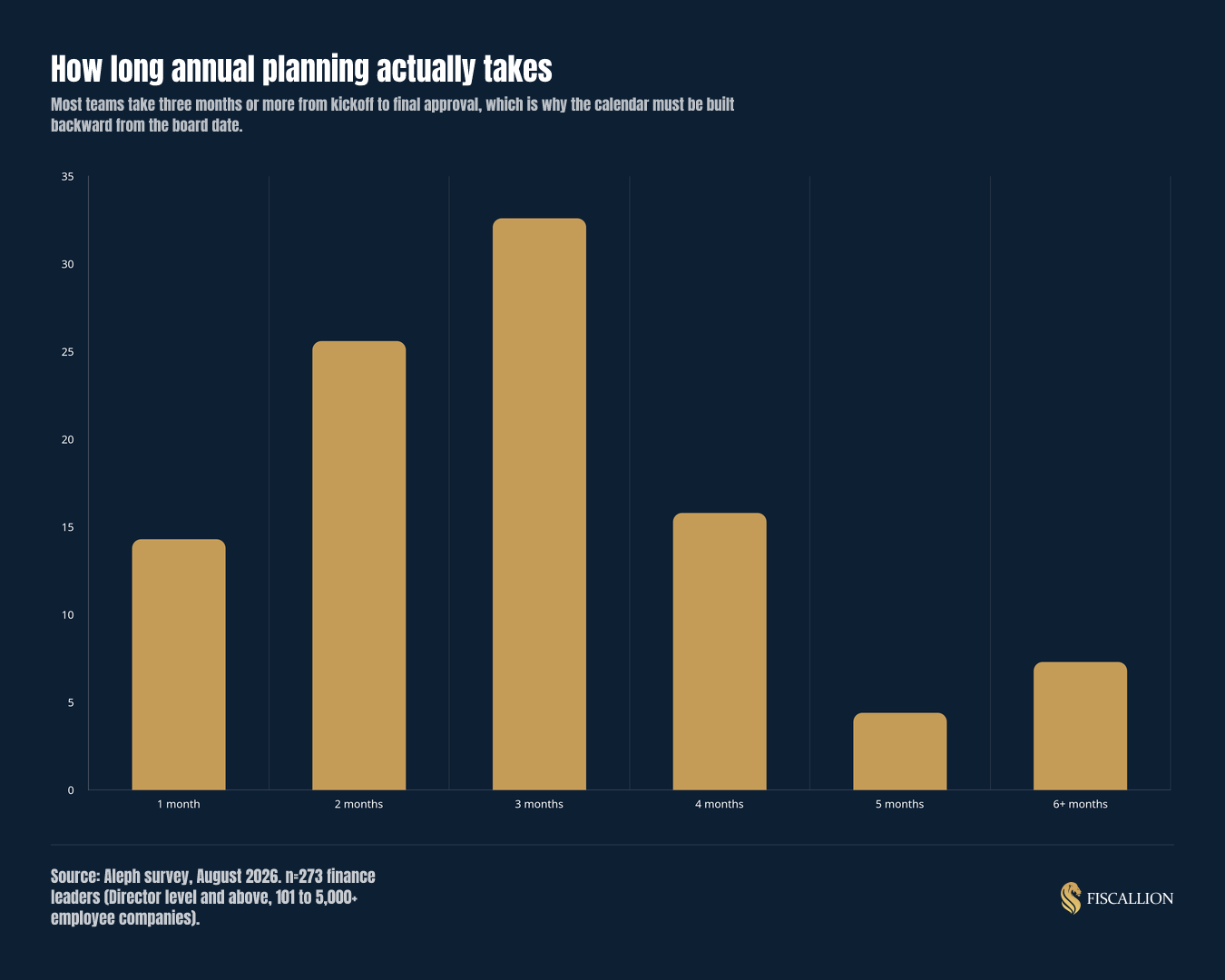
How long annual planning actually takes
Survey data from finance leaders confirms most teams take longer than they expect. Aleph's August 2026 survey of 273 finance leaders (Director level and above, at companies with 101 to 5,000+ employees) found:
| Cycle length (kickoff to final approval) | Share of finance leaders |
|---|---|
| 1 month | 14.3% |
| 2 months | 25.6% |
| 3 months | 32.6% |
| 4 months | 15.8% |
| 5 months | 4.4% |
| 6+ months | 7.3% |
Just over 60% of teams take three months or more from kickoff to final approval, and 78% need three or more revisions before the plan is locked. This is the practical case for building the calendar backward from a fixed board date instead of guessing how long the process will take once you start.
Why starting earlier can make the plan worse
The instinct to start planning as early as possible is understandable but often counterproductive.
Building a plan too early forces it to rest on a current-year forecast that will be stale by the time the plan goes live. If you kick off in June for a January 1 fiscal year and base your targets on a forecast for the remaining six months of the current year, that forecast will almost certainly be wrong by the time the new plan takes effect.
"You end up planning against a number you already know is inaccurate."
— Aleksandar Stojanovic, CEO & Founder at FiscallionAPQC data on process speed points to a related, counterintuitive finding: one practice associated with faster planning cycles is starting later, close enough to fiscal year end that the plan is built on actual results rather than a forecast. Starting later, within the bounds of the 8 to 12 week window, produces a plan grounded in what actually happened rather than what you guessed would happen months earlier.
The other failure mode at the opposite extreme, starting too late, is well documented too. Fairview's guidance on annual operating plans recommends starting 4 to 6 months before the new fiscal year begins, warning that October starts for a January 1 fiscal year "produce rushed plans full of placeholder assumptions." The lesson is not "earlier is always better" or "later is always better." It is that the window is bounded on both sides, and the board date should tell you where in that window to land.
The inputs that must be ready before kickoff
Planning fails less often because of timing and more often because the inputs were not ready when the clock started. Before you schedule kickoff, confirm you have:
| Input | Why it matters |
|---|---|
| 12-18 months of actuals by department or cost center | Gives function leads a real baseline instead of guesswork |
| Current-year forecast | Shows the gap between plan and current trajectory |
| Fully loaded headcount roster | Prevents underestimating the true cost of each role, including benefits and taxes |
| Major contracts and commitments | Surfaces fixed costs that constrain the spending envelope |
| A named assumption set | Headcount cost inflation, benefits load, revenue growth range, and FX, agreed before functional teams start building |
| A RACI or defined ownership map | Assigns who owns which number, so consolidation does not become a debate about authorship |
This pre-work, sometimes called Week 0 finance prep, determines whether weeks 1 through 12 run smoothly or turn into repeated rework.
One input deserves particular attention: headcount. Fiscallion's board-reporting framework recommends a single owned headcount plan with three explicit columns, approved, in-process, and modeled roles, because these three views can diverge by 10 to 15% in a fast-growing company. If your planning process starts without that single source of truth, the headcount line in your annual plan will be a negotiation rather than a number.
The sequence matters as much as the inputs. Fairview's build sequence recommends setting the executive frame, revenue target, margin floor, and headcount envelope, before any functional plan is built. Starting with department-level templates before the executive frame exists is one of the most common reasons a first draft gets rejected and the cycle burns an extra two to three weeks.
Readiness diagnostic: is your reporting mature enough to plan on?
"Annual planning does not fix broken reporting. It amplifies whatever is already true about your numbers."
— Aleksandar Stojanovic, CEO & Founder at FiscallionIf your monthly reporting is inconsistent, the annual plan built on top of it inherits that inconsistency at a larger scale.
Use this diagnostic before you commit to a kickoff date:
Signals you're ready:
- Metrics have single, agreed definitions across finance, sales, and the board deck
- Headcount has one owned plan, not three competing spreadsheets
- Every material assumption in your model has a named owner
- Monthly close happens on a predictable schedule, with actuals available within a known number of business days
Signals planning will amplify the chaos:
- Metrics get debated in the board meeting instead of used to make decisions
- Multiple versions of "burn rate" circulate depending on who pulled the number
- Assumptions live in someone's head rather than in the model
- Close takes long enough, or is unpredictable enough, that "last clean actuals" is a moving target
This diagnostic draws on the same board-reporting framework that governs Fiscallion's ongoing engagements: definitions, ownership, cadence, and decision rules. If you are seeing more items from the second list than the first, the fix is not to delay planning indefinitely. It is to spend the two to three weeks before kickoff closing those gaps, since they will cost you more time mid-cycle if left unaddressed.
Common mistakes and replacement moves
Mistake: starting with templates instead of the executive frame.
Replacement: set the revenue target, margin floor, and headcount envelope with the CEO and CFO first. Hand functional leaders a bounded problem, not a blank spreadsheet.
Mistake: treating the annual plan as the only view that matters.
Replacement: the annual number hides monthly cash timing. A plan that looks fine on an annual basis can still produce a cash crunch in a specific quarter if renewal timing or seasonal spend is not modeled month by month. This is the same problem addressed in Fiscallion's startup budget template guide, which covers the planning-versus-reporting layer split in more depth.
Mistake: locking the plan with no reforecast trigger.
Roughly two-thirds of companies revise their annual plan mid-year, yet fewer than 20% have a pre-defined trigger for when a revision is warranted, according to McKinsey research cited by Rework. Replacement: define upfront what variance level or event triggers a reforecast, rather than deciding mid-year in a panic.
Mistake: running a full enterprise-style cycle when your company does not need one.
Replacement: if you are a single-digit-to-low-double-digit finance function, one connected model linking targets, hiring plan, budget, and runway, approved once and monitored monthly, does the job that a 12-week department-by-department cycle was designed to solve at a larger scale.
What to do next
Fiscallion's fractional CFO engagements begin with a structured diagnostic that reviews your current data, rebuilds or validates the model, sets a reporting cadence, and builds scenario planning into the process, the same groundwork this guide walks through. Every client works directly with Aleksandar Stojanovic at the CFO layer: senior-partner ownership on every engagement, not a handoff to an account manager or junior team.
To help you set your own calendar, use an annual-planning readiness calendar and owner checklist: work backward from your board date using the four anchor points above, confirm each input in the readiness table is in place, and assign a named owner to every assumption before functional teams start building. That sequence alone resolves most of the timing mistakes covered in this guide. If you want a second set of eyes on your model, cadence, or board-reporting structure before you lock next year's plan, see how Fiscallion's financial modeling and board reporting service supports that groundwork.
FAQ
How early should a SaaS founder start annual planning if revenue is seasonal or tied to renewal cycles?
Anchor your calendar to the board date first, then adjust for your renewal and seasonality pattern within that window. B2B SaaS seasonality tends to follow customer budget cycles rather than consumer seasons: Q4 often brings a spend flush as enterprise buyers use remaining budget, and Q1 carries a churn bump as buyers reassess their stack after the new fiscal year starts. One analysis of over $2 billion in subscription revenue found July to be the industry's highest-churn month, with churn intent roughly 47% above May baselines, citing ProfitWell data. If a large share of your renewals land in a specific quarter, build your reforecast cadence around that pattern rather than treating the annual plan as a single static document. Kickoff timing itself should still follow the backward-from-board-date rule; renewal seasonality affects how often you revisit the plan, not when you start building it.
What financial inputs should be ready before we kick off annual planning for our SaaS company?
Before scheduling kickoff, confirm you have 12 to 18 months of actuals by department or cost center, a current-year forecast, a fully loaded headcount roster, a list of major contracts and commitments, a named set of assumptions covering headcount cost inflation, benefits load, and revenue growth range, and a clear owner for each of those inputs. Missing any one of these does not make planning impossible, but it does mean the first two to three weeks of your cycle will be spent gathering data that should have been ready before the clock started. The inputs table earlier in this guide lays out the full checklist.
Should we involve our existing bookkeeper or accountant in the annual planning process, or bring in outside help?
Your bookkeeper or accountant should stay exactly where they are: closing the books and producing accurate historical actuals. Annual planning sits above that layer. It requires setting forward-looking assumptions, modeling scenarios, and making trade-off recommendations on headcount, pricing, and runway, work that is distinct from bookkeeping and typically outside a bookkeeper's scope. Fiscallion is not a bookkeeping firm and does not replace your existing accountant; it works above the ledger, turning reliable accounting data into the forecast and planning layer your board and executive team need. Fiscallion's fractional CFO engagements start with a structured diagnostic, reviewing your current data and model, before building the planning cadence, and every engagement is owned directly by Aleksandar Stojanovic at the CFO layer rather than handed to a junior team.
How do we know if our current SaaS metrics and reporting are mature enough to support annual planning?
Run the readiness diagnostic earlier in this guide before committing to a kickoff date. If your metrics have single agreed definitions, your headcount plan has one owner instead of three competing spreadsheets, every assumption in your model has a named owner, and your monthly close happens on a predictable schedule, your reporting is mature enough to plan on. If you are instead debating basic numbers in board meetings, seeing multiple versions of burn rate depending on who pulled it, or missing a fixed close date, planning will surface and amplify those gaps rather than fix them. Spend the two to three weeks before kickoff closing the biggest gaps rather than starting the cycle on an unstable base.