
A board member asks why the forecast missed by 20%, and nobody in the room can point to the assumption that broke. That moment, more than any generic pitch about "financial clarity," is why founders start searching for outside FP&A help.
What does an FP&A agency do for SaaS companies? In practical terms: it owns your forecasting model, translates your metrics into board-ready decisions, and runs a monthly cadence that turns raw billing and usage data into a cash and runway number you can defend under pressure. It is not bookkeeping, and it is not a dashboard subscription. It is judgment, applied on a schedule, to a small number of assumptions that determine whether your next six months of hiring, pricing, and spending decisions are grounded in reality or in hope.
Every Fiscallion engagement runs through the same person at the top: you work directly with Aleksandar Stojanovic at the CFO layer, not with a rotating analyst pool. His perspective draws on FP&A leadership experience gained through the growth of a SaaS company to €100M ARR, which is the operating pattern recognition behind the scope, pricing, and evaluation framework in this article.
This article breaks down the actual scope of work, how these engagements get priced, how to tell a real FP&A partner from a reporting vendor with a nicer template, and the specific mistakes that cost founders a wasted year and a second vendor search.
Key takeaways
- An FP&A agency for SaaS companies owns your forecasting model, monthly reporting cadence, and the assumptions behind cash, runway, and unit economics, not just the slides that present them.
- Pricing varies by model and scope, from execution-focused FP&A support through fractional CFO leadership to a full-time hire; see the pricing comparison below before assuming a higher retainer automatically buys more value.
- The deliverable that actually matters is a driver-based model your team can interrogate, not a static report; ask any candidate agency to show you a live model, not a polished case-study artifact.
- CAC, LTV, and runway should come back as ranges tied to cohorts, not single numbers presented with false precision.
- Most $5-100M ARR companies do not have a "need a CFO" problem. They have a decision-quality and FP&A infrastructure problem, and a full-time hire does not automatically fix that.
- The right test for any engagement is decision cadence: does the monthly cycle end with a named decision and owner, or just an updated chart.
What an FP&A agency actually does for a SaaS company
Strip away the marketing language and an FP&A agency does four things, in this order of importance: it owns the model, it runs the cadence, it interprets the output, and it prepares the board narrative.
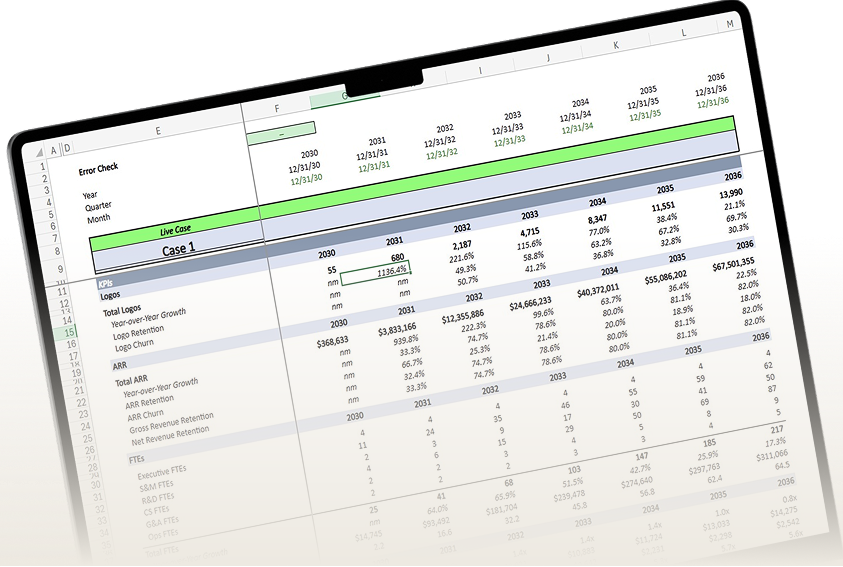
Owning the model means someone outside your team is responsible for maintaining a driver-based forecast, built from pipeline, churn, headcount, and pricing assumptions, rather than "last month plus a growth rate." That model has to survive contact with a board member's question. If the agency can't walk you through why a specific line moved, they are reporting the model, not owning it.
Running the cadence is the operating rhythm: a weekly cash check, a monthly metrics review, and a quarterly plan refresh, each with a fixed agenda and a defined output. Without the cadence, a financial model is just a document that goes stale within weeks of the last raise or the last close.
Interpreting the output is where most vendors fall short. Anyone can generate a chart showing net revenue retention at 108%. The job is explaining why it moved, which cohort drove it, and what to do next quarter.
Finally, board narrative work means the agency helps translate the model into a deck that frames trade-offs rather than reciting history. A board that spends 90 minutes clarifying what ARR means is a board that never got to discuss whether you should enter a new segment.
This is the same distinction Fiscallion draws in its own service scope: FP&A looks forward while accounting looks backward, layering forecasting, scenario modeling, and decision-ready reporting on top of the ledger data your bookkeeper or controller already produces. An FP&A agency does not replace your accounting function. It sits on top of it and turns the output into a forecast, a cash position, and a recommendation.
How FP&A engagements are scoped and priced
Before comparing vendors, get clear on what you're actually buying. The category blurs on purpose in sales conversations, so the labels ("virtual CFO," "fractional CFO," "FP&A partner," "outsourced finance team") tell you less than the scope of deliverables underneath them.
Need help choosing the right finance model?Book a working session with Aleksandarto map the ownership, cadence, and CFO coverage your company actually needs.
Kruze Consulting's startup CFO cost benchmark places fractional CFO retainers at $8,000-$16,000 per month and earlier-stage full-time CFO compensation at $250,000-$400,000 before equity.
Price alone doesn't signal decision quality, and it doesn't tell you which model fits either. An execution-focused SaaS FP&A partner and fractional CFO leadership can look similar on a monthly invoice, but they buy different things: one buys hands-on modeling and reporting execution, the other buys senior ownership of the assumptions and the judgment to defend them in front of a board. When a company needs both senior judgment and hands-on FP&A ownership in the same relationship, especially through fundraising, board scrutiny, or a step-change in the business, fractional CFO leadership is usually the stronger fit, even though it costs more per month than a narrower execution engagement.
Comparing a fractional CFO's monthly retainer to a full-time hire's annual compensation also requires separating cash from equity. Carta's compensation data reports salary and equity separately for exactly this reason, and any fair comparison across engagement models should too. Whichever model you choose, ask what fraction of the retainer goes toward assumption ownership versus reporting polish; most sales calls won't volunteer that breakdown unless you ask directly.
How to interpret what you're being sold
Read past the deliverables list and ask three interpretation questions before you sign anything.
Who owns the assumptions, not just the spreadsheet? A vendor that updates your model with actuals every month is doing data entry. A partner who tells you why churn assumptions need to change based on cohort decay curves is doing FP&A. Ask directly: "If my Q3 forecast misses, whose job is it to explain the driver?"
Is CAC/LTV presented as a range or a single number? A single blended CAC:LTV ratio hides more than it reveals. If a vendor hands you one clean 3.2:1 figure without a cohort breakdown by acquisition channel and vintage, ask what's hiding underneath it. A good partner treats CAC:LTV as a range tied to specific customer cohorts, because a good vs. bad ratio depends entirely on which segment you're looking at.
Does the board deck recommend a decision, or recite one? A deck that reports "NRR is 108%" is reporting. A deck that reports "NRR dropped to 108% because of two enterprise downgrades on the legacy pricing plan, here's the migration timeline" is decision-ready.
This LinkedIn post captures the shift in practice, from a 42-slide reporting exercise to a 12-slide deck built around one real decision:
What to do next: matching the engagement to your decision problem
Not every company at $5-100M ARR needs the same engagement. Match the model to the symptom, not the label on the website.
- If your board and investor updates keep re-explaining the same numbers, you need cadence and board narrative work before you need more headcount. Start with a scoped FP&A engagement that rebuilds the pre-read and the monthly metrics review.
- If your cash position lives in three spreadsheets that don't agree, you need a rolling 13-week cash model before you touch anything else. That is a systems and cadence problem, not a hiring problem.
- If CAC and LTV get debated in every meeting but never change a decision, the issue is not the ratio. It's the absence of a decision rule tied to the ratio: what specific spend or channel change happens when the number crosses a threshold.
- If you are converting from cash to accrual accounting, prioritize an outsourced finance team or FP&A partner who has run that transition before; in our experience, the first few months after cutover are where founder confidence in the numbers breaks down, not the mechanics of the switch itself.
- If you're heading into a raise within six months, weight your evaluation toward fundraising narrative experience and investor Q&A readiness, on top of the base FP&A scope; this is often where fractional CFO leadership earns its higher retainer, since fundraising conversations benefit from senior, direct engagement with your board and investors.
Common mistakes and the better move
Mistake: hiring a full-time CFO before you've fixed the forecast. A full-time hire adds cost, reporting polish, and org-building capacity. It does not automatically fix a fragile forecasting model or unowned assumptions. Replacement move: fix the FP&A layer first with a fractional or agency partner, then decide if the volume of work justifies a full-time seat.
Mistake: evaluating agencies on the polish of their sample board deck. A clean template tells you about design skill, not model ownership. Replacement move: ask to see a live, working model during the discovery call, not a case study screenshot.
Mistake: treating CAC:LTV as a single reportable number. A blended ratio gets debated in every board meeting and changes nothing. Replacement move: require cohort-level CAC:LTV bands tied to a specific spend decision, updated quarterly.
Mistake: month-to-month engagements with no defined cadence commitment. Without a fixed weekly and monthly rhythm, a finance partner becomes reactive, answering questions instead of running a system. Replacement move: set a 90-day minimum and a written cadence (weekly cash check, monthly metrics review, quarterly plan refresh) before the first invoice.
Mistake: assuming price signals quality. A higher-priced retainer that never touches your forecasting assumptions is worse value than a lower-priced partner who rebuilds your model in the first 30 days, regardless of which engagement model you're comparing. Replacement move: score on decision cadence and assumptions ownership first, budget second.
The pattern behind most of these mistakes is the same: founders search for a title (CFO, controller, FP&A analyst) when the actual gap is a repeatable decision process. That gap shows up constantly in companies making the cash and runway conversation harder than it needs to be:
A practical asset: the FP&A agency evaluation scorecard
Run any candidate agency through this scorecard during your discovery call. Score each item 0 (not present), 1 (partially present), or 2 (clearly present).
A score below 10 out of 16 usually means you're buying reporting polish, not FP&A judgment. Above 13, you're likely looking at a partner who will change how decisions get made, not just how they get presented.
Frequently asked questions
What is SaaS FP&A?
SaaS FP&A is the operating layer between raw financial and usage data and the decisions that data is supposed to inform. At companies in the $5-100M ARR range, it covers driver-based forecasting, monthly and quarterly reporting, board packs, metric definitions (ARR, NRR, CAC, LTV, burn multiple), cash and runway management, and scenario modeling for hiring, pricing, and fundraising decisions. It differs from general accounting or bookkeeping because it looks forward. Accounting tells you what happened last month; SaaS FP&A tells you what's likely to happen next quarter and what to do about it. Most companies in this ARR range have pieces of this working (a spreadsheet forecast, a metrics dashboard, a board deck template) but few have all of it operating on one consistent cadence with one owner for the underlying assumptions.
Will FP&A be replaced by AI?
No. If you're weighing whether an FP&A partner is worth it once you already have accounting software, a reporting dashboard, or an AI copilot in your stack, the honest answer is that the tools change what the partner spends time on, not whether you need one. AI is already good at the mechanical layer of FP&A: pulling actuals from your CRM, ERP, and billing system, generating a first-draft variance narrative, and assembling a base-case forecast from historical patterns. What it doesn't do is decide which assumptions are wrong, interpret why a metric moved in the context of your specific business and cohorts, or make the trade-off recommendation a board or CEO actually needs. Tools accelerate data assembly and first drafts; a partner owns the assumptions, applies judgment to company-specific drivers, and is accountable for the recommendation that follows. For a SaaS company evaluating an FP&A agency, this matters practically: ask whether the partner uses automation to compress the mechanical work so more time goes toward judgment calls, or whether they're just producing prettier automated reports with the same gaps underneath.
What is included in an FP&A or fractional CFO retainer, and what is billed separately?
Most recurring retainers, whether structured as execution-focused FP&A support or fractional CFO leadership, cover the same core: ongoing ownership of the forecasting model, a fixed reporting cadence (typically a weekly cash check and a monthly metrics review), board and management reporting, and an agreed amount of advisory access for day-to-day questions. What's usually scoped and billed separately is project-shaped work that has a defined start and end rather than a recurring rhythm: a fundraising transaction, a cash-to-accrual conversion, diligence support for a raise or acquisition, a system or ERP implementation, or an extensive historical cleanup of books that were never properly reconciled. Where exactly that line sits varies by provider and by the complexity of the work involved, so the actual proposal and statement of work, not a general industry rule, is what controls what's included and what triggers an additional fee.
Will Fiscallion work with our existing accountant or bookkeeper?
Yes. Fiscallion isn't a replacement for your accountant or bookkeeper, and the two roles aren't interchangeable. Accounting closes the books each month and reconciles the historical numbers; that's the system of record. Fiscallion works alongside that team, takes the reliable actuals once they're closed, and converts them into forward-looking forecasts, scenario models, cash and runway views, and the specific decisions those numbers should drive. If your bookkeeper or accountant isn't closing the books on a reliable monthly cadence, that's usually the first gap to fix, since a forecast is only as good as the actuals underneath it, but the fix is coordination with your existing team, not replacing them.
Conclusion
An FP&A agency or fractional CFO earns its retainer by owning the assumptions behind your cash, runway, and unit economics, and by running a cadence that turns those assumptions into a decision every month, not by producing a cleaner-looking board deck. Scope and assumption ownership are the real differentiators between engagement models; price follows from those, not the other way around. Before you sign with any provider, or decide your current one isn't working, get specific about what layer of work you're actually buying versus what layer is still missing.
If your metrics definitions and forecasting model haven't been stress-tested against a real board question in the last quarter, that's the gap worth closing first. Book a working session with Aleksandar to walk through your current model and figure out which engagement — execution-focused FP&A support, fractional CFO leadership, an outsourced finance team, or a full-time hire — actually fits where you are.