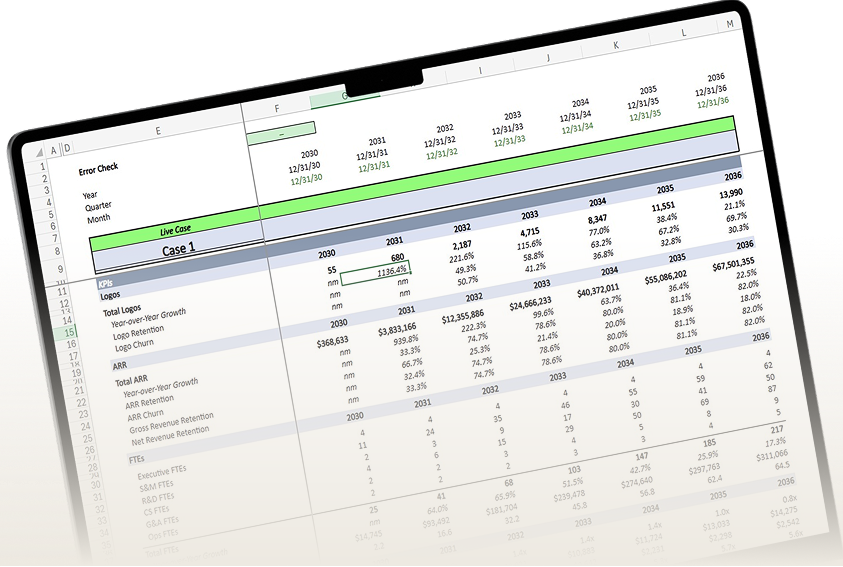


A SaaS department budget input template is a pre-structured form each department head completes during annual planning: headcount by role and start date, operating expenses by category, and written assumptions, pre-populated by finance and mapped to the chart of accounts so inputs consolidate into the P&L without rework.
You can collect department budgets one of two ways. You send ten owners a blank spreadsheet and rebuild the totals by hand for three weeks, chasing missing rows and guessing at what a number means. Or you send one structured template, pre-populated with actuals, and the numbers roll up the day the input window closes.
This post shows you how to build the second version. You will get the exact sections the template needs, a step-by-step collection cadence you can run this planning cycle, guidance on what non-finance department heads should and should not touch, and a straight answer on when Excel stops being enough.
Why the input template is the quality gate of the whole budget
Most finance teams treat the input template as a formality: get numbers in, worry about quality later. That is backwards.
The data backs this up. In the FP&A Trends 2026 survey of 475 finance professionals, 47% of FP&A effort goes to data collection and validation versus 32% on actual insight generation. That is not a systems problem. It is a template and process problem, and it is fixable before the input window even opens.
The same survey asked what blocks planning and forecasting. The answer is not tooling.
| Barrier to planning and forecasting | Share of respondents citing it |
|---|---|
| Processes | 43% |
| Data | 37% |
| Systems | 16% |
| Other | 4% |
Source: FP&A Trends 2026 Survey, 475 respondents.
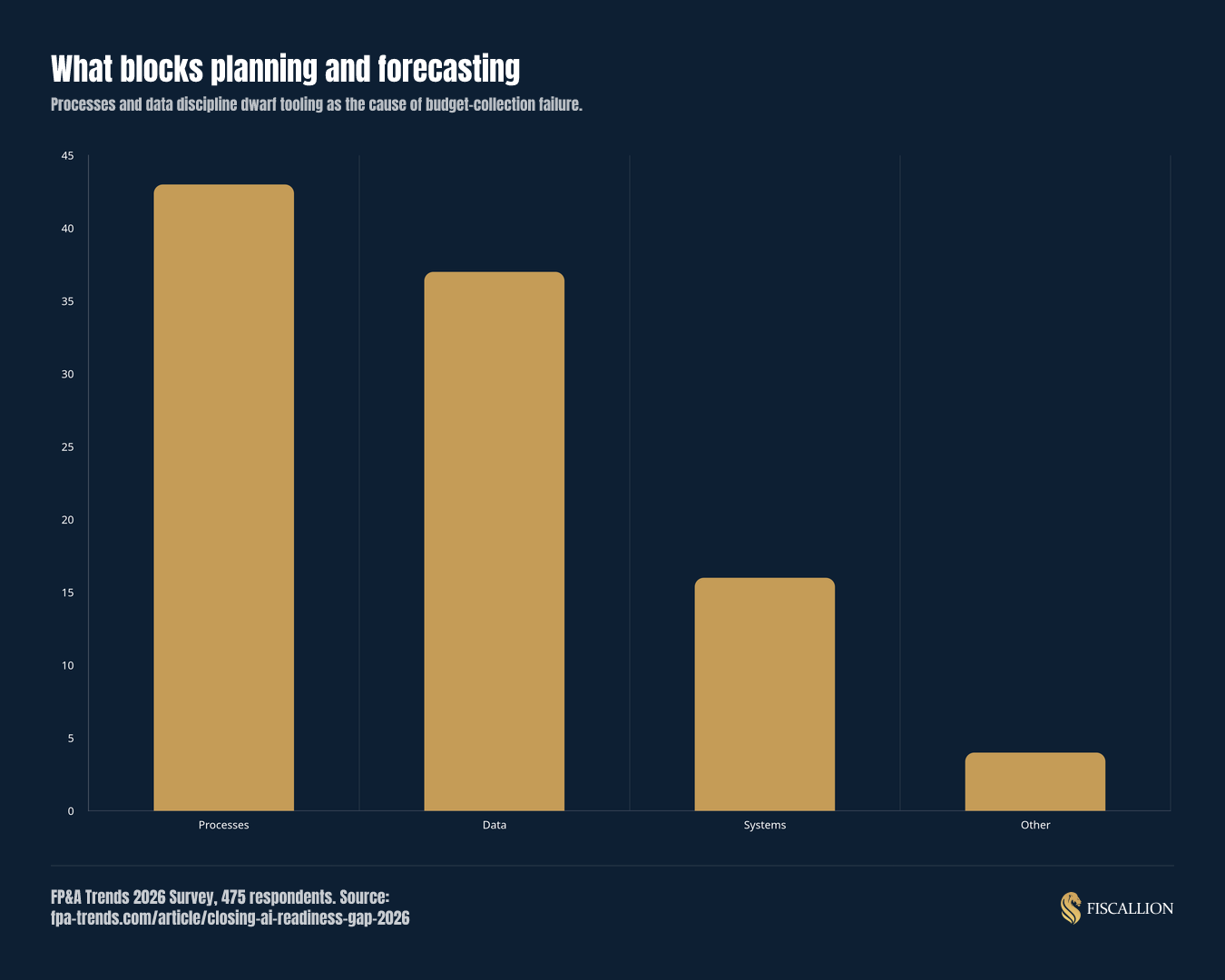
Processes and data discipline, the exact things a well-designed input template fixes, account for 80% of the friction. Systems account for 16%. If you are shopping for a new planning tool before you have fixed your template, you are solving the smaller problem first.
The execution disconnect shows up downstream too. The AFP's 2026 FP&A Benchmarking Survey of 332 practitioners found budgets align at the top, with 63% strategic alignment at upper management, but that alignment breaks down in execution: only 47% report consistent planning variables across business units, and only 62% of business units say they actually value the budget. When department heads do not trust the process, they stop putting real effort into their inputs, and the whole exercise degrades into a compliance task.
"The template is where the budget either gets fixed or gets broken, before a single dollar of that spend hits a board deck."
— Aleksandar Stojanovic, CEO & Founder at FiscallionWhat the template must include
A department budget input template has four required sections, and finance should own most of the structure before it ever reaches a department head.
Grove FP lays out a structure worth copying almost exactly: headcount, OpEx by category, CapEx above a set threshold, and revenue where a department has direct revenue responsibility. The design pre-populates twelve months of prior-year actuals plus the current budget in monthly columns, uses data validation to stop bad entries at the source, and requires an assumption-notes column so every material number has a stated reason behind it.
Here is how that maps for a SaaS department template:
| Section | Department owner fills in | Finance pre-populates or controls |
|---|---|---|
| Headcount | New hires, planned start dates, role changes | Current headcount, salary bands, employer tax and benefits load |
| OpEx by category | Software/tools, travel, marketing/events, professional services, contractors, training, other (with description) | Prior-year actuals, current run-rate, category list mapped to the chart of accounts |
| CapEx | Business case for anything above the set threshold | Threshold definition, approval routing |
| Revenue (if applicable) | Pipeline or bookings assumptions for revenue-owning teams | Top-line growth range, per-function envelope |
| Assumptions/notes | Written justification for every material number | Notes column structure, required-field validation |
| Roll-up rows | Nothing, this is read-only | Formulas that map every line to a P&L position |
For headcount specifically, you have two input approaches, and the choice matters. A detailed model asks for per-employee rows including planned hires by name or requisition, while an aggregate model asks for headcount count times average salary. Bojan Radojicic's budgeting guide notes that every department template begins with an analysis and payroll budget, and every line item must map to a pre-defined position in the P&L so consolidation is formula-driven, not a manual re-entry exercise.
For SaaS specifically, do not skip contractor spend and software/tools as their own line categories. Mostly Metrics' planning template treats headcount phasing, contractor treatment, and software budgeting as separate collection categories because they behave differently in a cash forecast than standard OpEx, and lumping them together hides where money actually goes.
How to run the collection: a step-by-step cadence
Building the right template solves half the problem. Running a disorganized collection process around a well-built template still produces a mess. Work backward from your board pack deadline and run these steps in order.
- Lock the chart of accounts and cost-center list first. Nothing goes out to department heads until this is fixed. Changing account structure mid-collection forces every owner to redo their work.
- Hand down assumptions instead of asking for them. Headcount cost inflation, benefits load, and the company's revenue growth range are finance decisions, not department head guesses. Aleph's process guide is explicit that this is the step teams skip, and the single largest cause of a wasted first draft.
- Agree the top-down envelope before any template goes out. A rough revenue range and a per-function spending envelope give department heads a target to plan against, instead of a blank check.
- Pre-populate actuals and run-rate. Every owner should open the template and see their own current-year numbers already there, not a blank grid.
- Give one template per owner, scoped to their cost centers only. Nobody should see or edit line items outside their department.
- Run a 30-minute live briefing per owner instead of written instructions. A short conversation surfaces confusion that a memo will not.
- Close the input window after two weeks, no extensions. An open-ended window does not produce better inputs, it produces slower ones.
- Consolidate against the P&L mapping and expect three to five versions. Nobody's first draft is final, and the template should make revision easy, not painful.
This cadence is built for a finance team of two to five people managing eight to fifteen budget owners around a December year-end, per Aleph's guide, but the sequence holds at smaller and larger scale: structure first, assumptions handed down, then a short closed window.
How non-finance department heads use it
Department heads should never touch formulas. They edit input cells only, and everything else, including roll-up rows and category mappings, stays locked.
What they should see: their prior-year actuals and current budget sitting beside blank columns for the new plan, so every new number has context instead of appearing in isolation. Monthly columns matter here specifically because hiring start dates and event timing shift cash needs within the year even when the annual total looks identical.
The single most important habit to enforce is the assumption-notes column. Every material number needs a stated reason. This mirrors the discipline Fiscallion applies to board reporting: a forecast is only as trustworthy as the named assumption behind it.
"A sales headcount number without a stated ramp assumption is a guess wearing a spreadsheet's clothing."
— Aleksandar Stojanovic, CEO & Founder at FiscallionWhat a completed input template tells you
Once inputs come back, read them for coherence before you read them for the total. Does the sales headcount plan support the revenue envelope you handed down, or does it assume a rep productivity ramp nobody actually validated? Capacity has to exist before revenue assumptions get credit for it, the same check that applies to a full SaaS financial model.
Look for where the first draft will miss: departments that filled in totals without touching the assumption column, categories that do not map cleanly to a chart of accounts line, and any headcount request with no start date attached. Each of these is a signal the template did its job by surfacing a gap, not evidence the department head did something wrong.
Vena's 2026 FP&A Impact Report, surveying 431 finance professionals with Benchmarkit, found that 52% of finance leaders say revenue forecasts differ from actuals by more than 6%, and only 34% fully integrate operational drivers like headcount into their forecasting models. A department input template that ties headcount timing to revenue and cost assumptions is a direct fix for that integration gap.
Excel or a dedicated planning tool
Master the template discipline before you shop for software. Datarails, citing FP&A Trends' 2024 survey, reports that 52% of finance professionals still use spreadsheets as part of their planning process, and Excel's real limits show up not in the math but in the overhead: version control, data consolidation, and error checking that surface gradually as headcount and complexity grow.
Excel is the right call when your version control and consolidation overhead is still small: a handful of departments, a single finance owner, manageable manual pulls from your ERP and HRIS. You have outgrown it when you are manually reconciling five versions of the same tab, chasing owners for the "latest" file, or losing an afternoon to a broken formula reference nobody can trace.
If you are shopping for a tool for the current season, spreadsheet-native platforms and budgeting-first mid-market platforms are the realistic middle step for a $5-100M ARR company; full planning suites are typically a later decision once complexity justifies the implementation lift, per Aleph's process guide (note this is a vendor's own framing of the market, not an independent ranking).
Remember what the FP&A Trends barrier data showed: systems account for only 16% of what blocks planning. Fix the process and the template first. The tool is a secondary decision, not the one that determines whether this year's budget actually rolls up.
Keep the department input template open and usable by non-finance owners
The template above is designed to be run as written, not locked behind a form. If you want a second opinion on your chart-of-accounts mapping or your assumption structure before you send it to department heads, Fiscallion's financial modeling and board reporting service is built for exactly this kind of review. Every Fiscallion client works directly with Aleksandar Stojanovic at the CFO layer, senior partner on every engagement, not a junior handoff.
Common mistakes and replacement moves
- Mistake: asking department heads "what do you need next year?" with no envelope. Replacement: hand down a driver-based envelope tied to the company's revenue range, so owners plan against a target instead of writing a wish list.
- Mistake: skipping the chart-of-accounts mapping before templates go out. Replacement: lock the mapping first, because if input does not equal output, the budget effectively dies the first time finance tries to close a month against it.
- Mistake: asking department heads for cost-inflation and benefits assumptions they cannot reasonably estimate. Replacement: finance hands these down as fixed inputs, freeing owners to focus on what they actually know: headcount timing and category spend.
- Mistake: leaving the input window open indefinitely "until everyone submits." Replacement: a two-week closed window with a scheduled follow-up, which produces faster and comparably accurate inputs.
- Mistake: accepting a number with no notes column entry. Replacement: require a stated assumption for every material line before the input is considered complete.
- Mistake: budgeting headcount as a flat annual number with no start date. Replacement: capture the month a hire starts, because timing changes the cash forecast even when the annual total is unchanged.
Frequently asked questions
What should a SaaS department budget input template include?
At minimum, four sections: headcount by role with start dates, operating expenses broken into categories relevant to how the department actually spends (software/tools, travel, marketing/events, professional services, contractors, training, and other), CapEx above a defined threshold with a business case, and revenue assumptions for any department with direct revenue responsibility. Every material number needs an assumption-notes entry, and every line needs to map to a position in the chart of accounts so the roll-up is formula-driven rather than manually rebuilt.
How do non-finance department heads use a budget input template during annual planning?
They see their prior-year actuals and current-year run-rate pre-populated next to blank columns for the new plan, so they are adjusting from a known baseline instead of starting from zero. They edit input cells only, never formulas or roll-up rows. Their main job is filling in headcount timing, category spend for their team, and a written assumption behind every number that materially changes from the current run-rate. A short live briefing before they start, rather than a written instruction memo, resolves most confusion before it turns into a bad first draft.
Should you build your department budget input template in Excel or a dedicated planning tool?
Start with the template discipline regardless of the tool, since process and data account for the large majority of planning failures, not the software you use. Excel works fine while your department count, version control needs, and consolidation overhead stay manageable. You have outgrown it when you are reconciling multiple file versions by hand, manually pulling data from your ERP or HRIS every cycle, or losing time to broken formula references with no audit trail. At that point, spreadsheet-native or budgeting-first mid-market tools are a reasonable next step for a company in the $5-100M ARR range; full planning suites are usually a later-stage decision once the complexity justifies the implementation cost.
The takeaway
A department budget input template is not a formatting exercise. It is the mechanism that determines whether your annual budget rolls up cleanly the first time or gets rebuilt by hand for three weeks every cycle. Fix the structure, hand down the assumptions department heads should not be guessing at, and run a short closed window, and the tool question becomes secondary to a process that already works.
If you want that structure reviewed before it goes out to your department heads, Fiscallion's financial modeling and board reporting service puts you directly in front of Aleksandar Stojanovic to check the mapping, the assumptions, and the cadence before you send anything out.