
Budgeting software gives your team a system to build and maintain budgets yourselves. An outsourced budgeting service supplies the CFO-level owner who builds the model, runs the planning cadence, and answers for the numbers when the board pushes back. The choice is not about which tool has more features. It's about who owns the assumptions behind your numbers, because that's what actually gets tested in a board meeting.
This comparison works through three axes that matter at $5-100M ARR: cost structure, time to a decision-grade output, and who is accountable when a forecast is wrong. Software wins on sticker price at the early stage and loses that advantage faster than most founders expect once implementation and maintenance time are counted. A managed service costs more per month but ships an owner, not just a workspace.
What you'll learn
- How software and outsourced planning services actually differ in scope, not just price
- What budgeting platforms and managed FP&A services really cost at $5-100M ARR
- How long each route takes to produce a board-ready forecast
- When software is the right call, and when it isn't
- How an outsourced planning service works alongside your existing bookkeeper
What budgeting software actually does, and what it doesn't
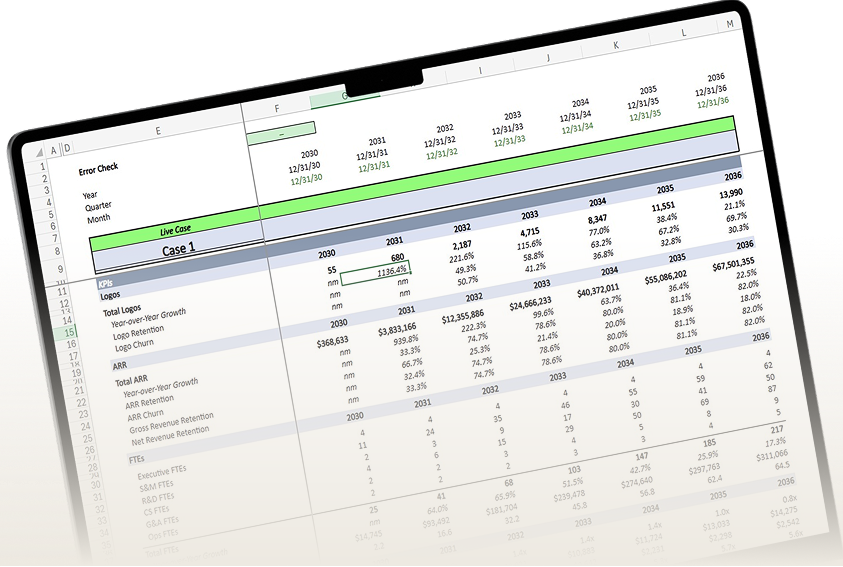
Budgeting software is a workspace. It gives your finance lead a structured place to build formulas, connect data sources, and produce reports faster than a spreadsheet allows.
What it doesn't do is decide what the model should assume, resolve disagreement about how NRR gets calculated, or stand in front of the board when a scenario question comes up cold. Someone still has to own that layer, whether the tool costs $50 a month or $2,000.
| Dimension | Budgeting software | Outsourced budgeting service |
|---|---|---|
| Who builds the model | Your team, using the platform | The service, typically CFO-led |
| Who owns the assumptions | Your finance lead or founder | The senior advisor, in partnership with you |
| Who answers board questions | Whoever presents the deck | The advisor who built and owns the model |
| Monthly cost structure | License fee, scales with seats/modules | Fixed monthly retainer |
| One-time costs | Implementation, data integration, training | Model-build project fee |
| What happens when an assumption changes | Your team re-models it | The advisor updates it as part of the cadence |
The gap in that last row is the one founders underweight. A tool doesn't flag a bad assumption. A person does.
What it actually costs at $5-100M ARR
Sticker price is the wrong comparison point. The real number includes implementation, renewal creep, and the labor hours your team spends running the model, whether or not that labor shows up on an invoice.
| Option | Typical cost | Notes |
|---|---|---|
| Fiscallion (fractional CFO-led model build plus reporting) | From $9,000 one-time build, from $3,500/month ongoing | Fixed-fee, scoped in writing; first board pack ships in roughly 6-10 weeks |
| Pry (early-stage budgeting tool) | $50/month flat | Recommended for companies up to $75,000 in monthly expenses and 30 employees or contractors |
| Cube | Median $22,098/year across 58 tracked purchases; band $12,794-$34,200 | Add $5,000-$10,000 one-time implementation; renewals reported up 10-50% |
| Mosaic | Median $24,000/year across 57 purchases; range $14,184-$32,123 | Average buyer negotiated savings of roughly 19% off list |
| Fractional CFO (market rate) | $8,000-$16,000/month fixed engagements, or $250-$500/hour | Broader scope than a modeling service; covers ongoing strategic leadership |
| Full-time CFO | $200,000-$400,000 total comp, sometimes past $500,000 at growth stage, plus equity | Most companies below roughly $10M ARR don't hire one |
Two things stand out. First, mid-market platforms like Cube and Mosaic often land at or above a managed FP&A engagement's ongoing cost once implementation is included, while still requiring your team to run the model. Second, software renewal increases are a real and recurring cost that a fixed-fee service contract doesn't carry.
The cheapest line item is rarely the cheapest decision once you count the hours someone spends becoming the model's de facto owner.
The tiering in that post is the same one behind the cost table above: recording-layer work is cheap to rent, and senior ownership of the planning layer is what actually drives the number.
Time to first decision-grade output
This is where the comparison gets uncomfortable for software vendors. Purchasing a platform is not the same as having a usable forecast.
FP&A implementation timelines run roughly 2-6 weeks for spreadsheet-native platforms and 3-6+ months for web-based platforms, according to vendor-reported data. Startups sometimes get a usable build in days to four weeks; multi-entity enterprises can take 4-6+ months.
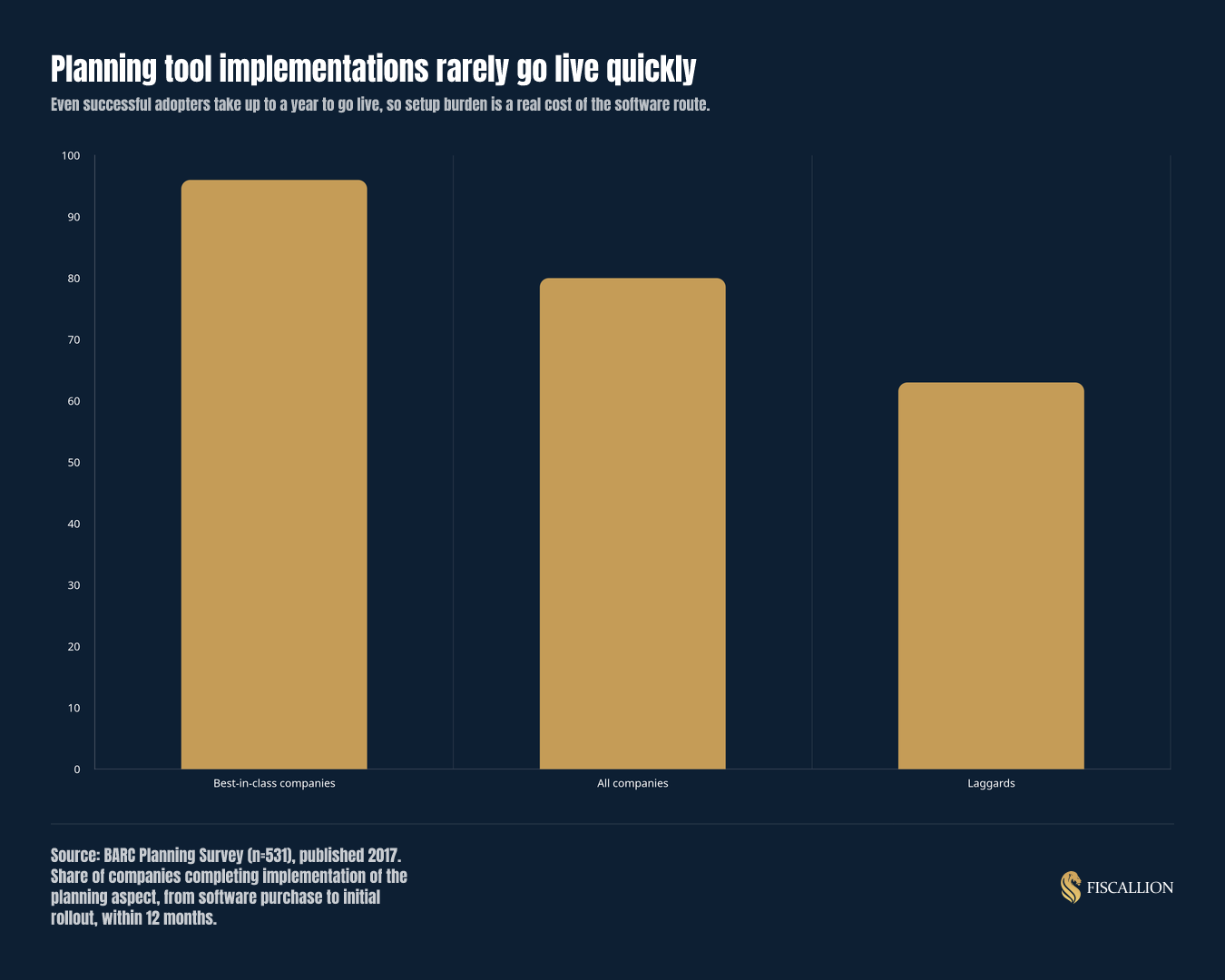
Independent survey data backs up the slower end of that range. In a BARC survey of 531 companies published in 2017, only 80% of organizations completed implementation of the planning aspect of their software, from purchase to initial rollout, within twelve months. Even among best-in-class companies, 96% finished within a year, against 63% of laggards.
The chart below shows that gap.
Compare that to a managed model build. Fiscallion's model-build engagement is delivered over 6-10 weeks, with the first board pack in the new format typically shipping in the second board cycle, roughly 6-10 weeks in.
If a custom integration is required for any of the three critical data sources (GL, HRIS/payroll, or an actuals source), vendor guidance suggests adding roughly three months and $30,000 to a software implementation. That's a vendor-reported figure, but it matches the directional pattern in the independent BARC data: integration work is where software timelines slip.
Compare the two routes before you commit budget
Before choosing a platform or a provider, it's worth putting your current setup in front of someone who has built the model both ways. A 20-minute conversation on your last board deck will surface the two or three fixes you need regardless of which route you pick.
Bring your last board deck and compare software administration with managed annual planning. Every Fiscallion engagement runs directly with Aleksandar Stojanovic at the CFO layer, not a junior analyst reviewing your numbers after the fact.
When budgeting software is the right choice
"Software is the correct call in specific, identifiable situations. It's worth naming them honestly rather than treating every software purchase as a mistake."
— Aleksandar Stojanovic, CEO & Founder at Fiscallion- Your finance lead wants to own the tool directly and has the bandwidth to build and maintain the model themselves
- Revenue is simple and largely flat-subscription, without heavy usage-based components, multi-entity structure, or frequent pricing changes
- You have internal capacity to maintain the model through the monthly close and reforecast cycle, not just at setup
- Cost sensitivity is real at the early stage, and a $50-a-month tool like Pry genuinely fits a company with modest monthly expenses
There's also a sequencing argument worth respecting: your first model should usually be a spreadsheet. Platforms earn their price when planning becomes a team sport, meaning multiple people touch the model and the coordination cost of a shared workspace outweighs its license fee. Buying a mid-market platform before that point often means paying for capacity you don't yet need.
When an outsourced budgeting service beats the tool
The signals here map closely to the pain points founders describe when they reach out for help. None of them are solved by better software.
- Nobody currently owns the layer between closed books and decisions. Reports exist, but no one is accountable for what they imply.
- The board asks a scenario question and the honest answer is "give us two weeks." That delay is an ownership problem, not a tooling gap.
- NRR gets computed three different ways depending on who's presenting, which erodes board confidence in every other number in the deck.
- You're heading into a fundraise or diligence process and need a model that survives investor scrutiny, not just internal reporting.
- Revenue has usage-based or multi-entity complexity that a template-driven tool wasn't built to model cleanly.
- Founder decision fatigue from being the default owner of every finance judgment call, on top of running the company.
There's supporting evidence for the deeper problem here. The 2026 AFP FP&A Benchmarking Survey of 332 practitioners found only 38% use structured scenario planning, and just 47% report consistent planning variables across their organization, even though budgets nominally align at the top 63% of the time. Buying a tool doesn't close that gap. Someone has to own the definitions before the tool has anything reliable to run.
How the two models work with your existing stack and bookkeeper
Neither route requires you to rip out your existing accounting setup. The question is who sits on top of it.
An outsourced budgeting service typically layers onto your current bookkeeper or accounting team rather than replacing them. Your bookkeeper continues daily transaction processing, accounts payable and receivable, and routine reconciliation. The senior advisor owns GAAP judgment, revenue recognition calls, close ownership at the reporting layer, and forward-looking work: the model, the forecast, and the board pack. Tax stays with a specialist either way.
Budgeting software sits on the same stack in a different way. It pulls data from your GL, HRIS, and billing system, but someone on your team still has to reconcile what the tool shows against what your books actually say. Scope clarity, meaning exactly who is responsible for which numbers, is the variable that determines whether either setup actually works.
The handover matters here too. A well-run model build should end with documentation your team can run day to day, not a permanent dependency on the person who built it.
"Dashboards and software can automate the recording layer, but the judgment behind runway decisions, pricing trade-offs, and board framing needs a named, accountable senior person reviewing the model before it reaches the board."
— Aleksandar Stojanovic, CEO & Founder at FiscallionCommon mistakes and the replacement move
- Buying a $24,000 platform before anyone owns the model. Replacement move: assign an owner first, even if that owner is a spreadsheet for now. The tool doesn't fix an ownership gap.
- Comparing license price against $0 in-house labor. Replacement move: count the fully-loaded time your team spends maintaining the model, not just the invoice.
- Treating a tool rollout as the fix for a definitions problem. Replacement move: resolve how NRR, CAC payback, and burn multiple are calculated before automating the reporting of numbers nobody agrees on.
- Paying full-time CFO-level cost for part-time-strategy workload. Replacement move: match the engagement model, fractional, service-based, or full-time, to the actual weekly demand on strategic judgment, not to what feels safest.
Route decision scorecard
Answer these honestly. The pattern points to the route that fits your current stage, not a universal answer.
| Question | If yes | If no |
|---|---|---|
| Does someone today own your metric definitions (NRR, CAC payback, burn multiple)? | Software may be enough | Ownership gap; a service closes it |
| Can your model answer a "churn plus 2 points" scenario within an hour? | Your current setup is working | Scenario planning gap; see AFP data above |
| Does your board pack ship at least 7 days ahead of the meeting? | Cadence is under control | Cadence problem, likely an ownership problem |
| Is your revenue simple, flat-subscription, single-entity? | Software fits well | Complexity favors a managed build |
| Do you have internal bandwidth to maintain the model monthly? | Software fits well | You'll be paying for a tool nobody has time to run |
| Are you heading into a fundraise or board-level scrutiny in the next two quarters? | A managed model reduces diligence risk | Lower urgency, either route can work |
| Has your NRR or CAC payback been calculated differently by two people in the last quarter? | Definitions problem; a service resolves it | Definitions are stable |
Frequently asked questions
When should a SaaS company switch from budgeting software to an outsourced planning service?
Switch when the trigger points stack up rather than waiting for a single dramatic event. The clearest signals are a fundraise or diligence process on the horizon, a board that keeps asking scenario questions your current setup can't answer quickly, metrics chaos (NRR or CAC payback computed differently by different people), and revenue complexity like usage-based pricing or multiple entities that a template tool wasn't built to model well. The AFP 2026 survey found only 38% of practitioners use structured scenario planning, which is the practical symptom: if your team can't turn an assumption change into an updated forecast within hours, the software isn't the constraint. Ownership is.
How do budgeting software costs compare to outsourcing SaaS annual planning?
At the earliest stage, software wins on price. A tool like Pry runs $50 a month flat for companies with modest monthly expenses. But mid-market platforms scale quickly: Cube's median contract runs $22,098 a year across tracked purchases, plus $5,000-$10,000 in one-time implementation, and Mosaic's median lands at $24,000 a year. Both report renewal increases in the 10-50% range. A managed engagement like Fiscallion's runs from $9,000 for the initial model build and from $3,500 a month ongoing, as a fixed fee scoped in writing, with no renewal surprise built into the structure. At the mid-market tier, the software and service price points converge, but the service also supplies the owner. That's the part a license fee doesn't include.
Can an outsourced budgeting service work alongside my existing bookkeeper or accounting team?
Yes, and it typically should. A layered structure is the standard pattern, not an exception: your bookkeeper or internal accounting person continues daily transaction processing, while the senior advisor owns GAAP judgment, revenue recognition, close-level reporting decisions, and the forward-looking model and forecast. Tax work generally stays with a specialist regardless of which route you choose. The variable that determines whether this works well is scope clarity, meaning both sides know exactly which numbers they're responsible for.
What does the onboarding process look like for outsourced SaaS budgeting versus setting up budgeting software?
For an outsourced service, the sequence typically runs: a scoping call, a review of your current books, then onboarding into the model build. If your books need historical clean-up or a cash-to-accrual conversion first, that's scoped as a separate project, commonly taking 60-90 days, before the model build starts. The first board-ready pack usually ships one to two board cycles after clean-up is complete, or in roughly 6-10 weeks if your books are already clean. For software, the sequence is integration, data modeling, workflow setup, and parallel runs to validate the output against your existing process. Spreadsheet-native platforms can be usable in 2-6 weeks; web-based platforms commonly take 3-6 months or more, and if any of your three critical integrations (GL, HRIS, or actuals source) needs a custom build, add roughly three months and $30,000 to that timeline.
The decision, restated
Software administers a planning process someone already has to own. A service supplies that owner, along with the model, the cadence, and the person who stands behind the numbers in the room. Neither is wrong in isolation, but the mismatch, buying a tool when what you actually need is judgment, is the mistake that shows up in board meetings, not in the invoice.
If you're weighing the two routes right now, bring your last board deck to a conversation and find out which gap you're actually solving for.